Showing posts with label Protestant. Show all posts

Monday, January 28, 2013

Book Review: Five English Reformers


JC Ryle was the first Bishop of Liverpool, and a leading evangelical churchman in his day. Throughout his writings there are warnings of the rise of ritualism in the Church of England and an appeal to return to the great martyr-reformers who died at the hands of Queen Mary for the truths of the gospel. This little book, Five English Reformers, collated and published by The Banner of Truth Trust turns the spotlight on the person, profile and legacy of John Hooper, Rowland Taylor, Hugh Latimer, John Bradford and Nicholas Ridley.

The opening chapter presents a paper entitled 'Why Were Our Reformers Burned?' In what may be an early assault on postmodernism (so early, in fact that a hundred and some years ago it wasn't even imagined), Ryle declares that 'It is fashionable in some quarters to deny that there is any such thing as certainly about religious truth... Yet three hundred years ago, there were men who were certain they had found out truth, and were content to die for their opinions.' He goes on to present the broad facts of the persecution arising under Bloody Mary when she assumed the throne on her brother Edward VI's death: 'She began at once to pull down her brother's work in every possible way, and to restore Popery in its worst and most offensive forms.'

The facts are shocking - in the years 1555 - 1558 there were 288 martyrs in England, including an archbishop, four bishops, 21 clergy, 55 women and 4 children. Most died by fire at the stake. Horrifying. Of these, Ryle suggests that, 'Never, I believe, since Christ left the world, did Christian men ever meet a cruel death with such glorious faith, and hope, and patience, as these Marian martyrs.' Indeed, one 'went to death as if he was walking to his wedding.'

Why were they killed? Ryle is adamant that it was the refusal of one doctrine: 'the real presence of the body and blood of Christ in the consecrated elements of bread and wine in the Lord's Supper.'

In each of the remaining chapters, one of the reformers is in view, with an in-depth look at their person, ministry, martyrdom, and writings. There are some interesting insights into the time of the reformers, one instance of which relates the ignorance of the clergy in the diocese of Gloucester in 1551: 'Out of 311 clergy in his diocese, 168 were unable to repeat the Ten Commandments, 31 of the 168 could not state in what part of the Scripture they were to be found; 40 could not tell where the Lord's Prayer was written; and 31 of the 40 were ignorant who was the author of the Lord's Prayer!'

There was a very relevant reflection which has been borne out even more in these days of the internet and the celebrity pastor. Ryle is discussing the scarcity of Rowland Taylor's remains - his sermons and letters were not compiled or published or famous beyond his congregation: 'The causes of this absence of information are easily explained. For one thing, the good man lived, and laboured, and died, in a small country town, fifty miles from London. Such a position is fatal to a world-wide celebrity. It is the dwellers of large cities, and the occupiers of metropolitan pulpits, whose doings are chronicled by admirers, and whose lives are carefully handed down to posterity.' You'd wonder what Ryle would make of podcasting and real celebrity pastors these days...

Yet despite Taylor's insignificance on the world stage, his ministry was powerful in his parish: 'The whole town seemed rather a university of the learned, than a town of cloth-making or labouring people; and what most is to be commended, they were for the most part followers of God's Word in their living.' What a testimony!

On examining Bishop Hugh Latimer's ministry, Ryle speaks of the power of his sermons. While they (extant sermons) may seem quaint, very familiar and rambling, Ryle declares that his contemporaries would be poor judges of sermons: 'A modern sermon is too often a dull, tame, pointless religious essay, full of measured, round sentences, Johnsonian English, bald platitudes, timid statements, and elaborately concocted milk and water. It is a leaden sword, without either point or edge: a heavy weapon, and little likely to do much execution.'

On the contrary, when Latimer was reminded he was preaching in the hearing of the King, Latimer would remind himself: 'remember also thou art about to speak before the King of Kings, and Lord of lords. Take heed that thou dost not displease Him.'

This was a good book to read to gain a general impression and introduction to the reformers in question, and also to be reminded of important reformation principles. The only problem is that it is a collection of papers and addresses delivered on separate occasions in magazines and/or meetings. As such, there is a lot of repetition, both on the individuals concerned - the opening chapter is like a summary of the stories of the later chapters), and also regarding the dangers of aggressive Romanism. If Banner were to re-publish this volume, it could profit from some editing to streamline the material.

Those wishing to learn a bit more about the leading reformers in England, those who compiled the Articles and Homilies at the centre of Anglicanism, will find this a useful book, and a prompt to commit to keeping the gospel flame burning brightly. Five English Reformers(Kindle)

Tuesday, August 28, 2012

Book Review: John Charles Ryle 1816-1900


JC Ryle has gone down in history as the first Protestant (Anglican) Bishop of Liverpool, a leading evangelical churchman, and a prolific writer of books and tracts. It's probably no surprise that his books feature on my shelves, both his commentaries and his devotional, doctrinal works, but I couldn't have told you that much about him. That malady has now been corrected through this little biographical book by Marcus Loane, the former Archbishop of Sydney.

Even before you get to the stuff about JC Ryle, this book is worth getting and reading. Loane begins by presenting an introduction to Evangelical belief and continuity focusing on the fact that evangelical faith is not novel or new, neither during the Evangelical Awakenings nor the Reformation, but rather: 'Our faith... can be traced back through all the ages of its primitive origin in the revelation of the Gospel of the Lord Christ himself.' (p. 12) Alongside this continuity, Loane demonstrates the 'fact that our faith draws its strength from recognised scholarship: it is nothing if not reasonable in its approach to the New Testament.' (p. 14) The third element of Evangelical faith is that 'our faith proves its worth in personal devotion: it is nothing if not spiritual in its response to the New Testament' - a devotion which bears fruit in self-giving and service. These are the qualities which are seen in the life of JC Ryle, which the rest of the biography displays.

Having been educated at Eton and Oxford, where he was cricket captain, and where he learnt important lessons in leadership, Ryle was converted at the age of 21, on hearing Ephesians 2:8-9 being read aloud in his parish church. He was wonderfully converted, yet it was not universally welcomed: 'But the great change in his life was hardly welcome at home. It led to an awkwardness and a sense of estrangement in his own family; it drove a wedge between him and old friends.' (p. 35)

He's not the first, nor even the last to experience such frustration and disappointment, and yet his story is an encouragement for the rest of us. 'In calm retrospect he came to see how God was fitting him for after work in a way he did not know.' (p. 36) Isn't that often the case - our difficult experiences are paving the way for what will later come.

In Ryle's case, it was his father's sudden bankruptcy, going from wealthy banker, silk trader and MP to being left with nothing, virtually overnight, that directed Ryle towards his place in the world, not in the family business, but in the Father's business: 'But there can be no doubt that God used this calamity to turn his heart towards his true life work, for the thought of ordination had not even crossed his mind as long as his hope for a political career had been practicable.' (p. 38)

Being ordained in 1841 at the age of 25, he became Curate of Fawley with responsibility for the Chapel of Ease at Exbury. In a remarkable ministry, he was in every home in the parish every month - something the recent Church of Ireland Gazette letter-writers would be most impressed with! However, such a course of action may have been his downfall, and within two years he had moved to Winchester as incumbent because 'his own health broke down at the end of two years.' (p. 40) Just six months later, he was on the move again, to a better living, that of Helmingham in Suffolk.

It was here that disaster struck for poor Ryle, being quickly widowed twice, with five children between the ages of two and fourteen. Yet even then, 'his faith did not falter; it taught him to echo the words of the Psalmist: "As for God, His way is perfect."' (p. 48).

His next parish was that of Stradbroke, and it was here that he came to national prominence, as a preacher and tract writer. Seeking to promote and maintain the true religion of the 39 Articles in the face of the rise of the Tractarians (the Oxford Movement / Anglo-Catholics), he wrote several more books including Knots Untied, and Old Paths.

Having been appointed as Dean of Salisbury, he never took up his place, instead being appointed as the first bishop of the new diocese of Liverpool by the Prime Minister of the time, Disraeli.

Having mentioned his books, perhaps the most famous of them all were his series of Devotional Thoughts on the Gospels - a useful running commentary on the scriptures, three of which were written in his incumbency in Helmingham (and the fourth in Stradbroke). If I'm to write, perhaps it'll be during my time here?

All in all, this was a good little book to read. It provided an account of a faithful minister's struggles and triumphs, and encourages other ministers to remain faithful and to give all they have in the cause of the gospel, for the glory of Jesus.

Friday, December 17, 2010

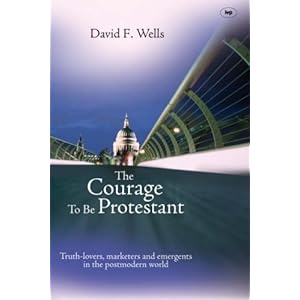
Book Review: The Courage to be Protestant


It's certainly an arresting, and perhaps especially in Northern Ireland, a controversial title. However, let's be clear from the start, it's not remotely sectarian or political, and nothing at all to do with how we view ourselves or others in Northern Ireland.

What the book by David Wells has to do with is the issue of the assumptions, motivations and methods of the church in seeking to reach the world with the good news about Jesus Christ. As Wells has observed the protestant churches, he sees three main groups:

1. Classical evangelicals - people like John Stott and others, who are united on the key Protestant doctrines such as the authority of the Bible and penal substitution, and who agree to differ on secondary issues which are considered less important (e.g. baptism). Wells argues that as the importance of doctrine has been shrunk, so too does our understanding of the church, which led to a second group appearing:

2. Marketers - churches like Willow Creek, where the church has been reconfigured around the sales pitch, where the form modifies the content in order to win the 'sale' and keep the customer happy. This may have worked for an affluent American boomer generation, but now, Wells argues, the next generations are dissatisfied with such commercial Christianity.

3. Emergents are into deconstruction, doubting of truth completely, where the loss of truth is offset by adventurous worship and trying to recover a lost sense of mystery.

His analysis of the church is, I think, perceptive, but what is perhaps even more helpful, is how he critiques the wider culture. The church has sought to be driven by the culture rather than critiquing it (in both marketing and emerging forms), so Wells seeks to redress the balance and examine the postmodern mind and culture.

The heart of the postmodern rebellion is unveiled: 'It turned away from meaning that is fixed and universal and turned toward meaning that is private and subjective.' All external forms of authority are rejected, so that pomo's are only looking to the self for values (not virtues!) and truth.

This was a particularly thought-provoking statement on secularisation: 'What the secularisation of life does it to demand that all belief in a God or the saved be kept private and not appear in the public square.' This leads to two worlds developing - the public and the private, with different behaviours, values and norms. For the church, a retreat into the privatised leads to relating to the immanent God as therapeutic and near, but ignores God's transcendence and authority over all.

The conclusions towards which he draws leads to a wake-up call to the churches to consider again their relation to the culture they are seeking to reach. The question of authority and truth is a key one to be sure on - 'Images we may want, entertainment we may desire, but it is the proclamation of Christ crucified and risen that is the church's truth to tell.'

This is a valuable book for those in church leadership - both pastors, elders and committee members, as well as the thoughtful church member seeking to understand culture better. It's not overly technical, and fairly easy to follow the argument right through. The Courage to be Protestant will help to impress the reader with the urgency of standing in the line of historical Protestantism on the solas of the Reformation as we proclaim the truth to a watching world.

Monday, October 25, 2010

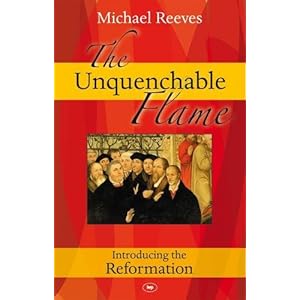
Book Review: The Unquenchable Flame


For most people, Protestants especially, the Reformation is a bit of a confused blur. Fragments of information are held, but without knowing how they fit together. So perhaps you know something about Martin Luther, Archbishop Cranmer and the Pope, but how does it all fit together? What was it all about, at the end of the day, particularly when some are claiming that the Reformation is over (or shouldn't have happened under the new perspective on Paul)?

Michael Reeves has written a fairly short, snappy, and suitable introduction to the Reformation, and is perhaps one of the best books I've read this year. From a short, dramatic prologue, your appetite is whetted, and the book propels you into the turbulent times of the 16th century.

As well as introducing you to the key personalities (Luther, Calvin, Zwingli, Tyndale, Cranmer, the Puritans and a few others), and what they did and said, Reeves presents the issues and doctrines at stake in a clear and helpful way. Alongside the important doctrines, there are some nice witty touches. For example, 'Allowing Luther such freedom with a Bible was a move Rome would soon profoundly regret, but for now, Luther became a teacher of the Bible at the brand new university of Wittenberg.'

Reeves is careful and considered in his writing, though, recognising some of the problems associated with the Reformers while appreciating their stand for true doctrine. His analysis of the Puritans is particularly penetrating, seeing their 'attempt to enforce strict Christian behaviour on a nation' as one of the reasons the Commonwealth under Cromwell ultimately failed.

All in all, this book is an excellent introduction to the history of the Reformation period. Lots of ground is covered with good explanation, but in a clear and accessible way. Both highly recommended and heartwarming!

Thursday, July 16, 2009

The Ballybeen Bonfire

I have a confession to make. This year was the first time I had ever been to an Eleventh Night bonfire. In fact, when I wrote about the bonfires on Sunday, I wasn't expecting to go to one this year either.

But on Sunday evening we got talking about it after church, and thought that if the weather cleared up after the thunder and lightning during church, then we would take a look later. Behold it did, and so Mark and myself headed over to Ballybeen for the stroke of midnight.

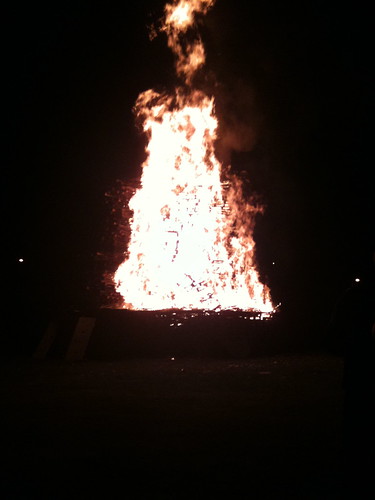
Eleventh Night Bonfire

Perhaps in my head bonfires were over-imagined, but I had thought there would have been music of some sort, perhaps a lambeg drum or flute band, or even just one fluter (flautist, if you prefer, although that word suggests more a James Galway type performer than someone playing the Sash on a flute). But there was no music. Just a huge crowd - perhaps several thousand, and most of them with carry-outs of drink. The Methodist minister in Ballybeen / Dundonald thought he was the only one not drinking, but there were two others of us at least!

We saw quite a few of the young people from the 'Been who come along to our Drop-in and youth club, so it was good to see them again now that we're in the summer break, and to hear what they're doing.

As I've already said, the one thing that struck me (other than the heat of the bonfire once it got lit, pushing most of the crowd backwards to cooler vantage points), was the vast number of people who were present to take part in the community ritual celebrating their heritage. For some, it was an excuse to get blocked, probably as quickly as possible, with the more drink the better. But many were there out of some sense of loyalty to Protestantism. They were celebrating Protestantism, and yet how many of them really know what Protestantism is?

I suspect for quite a number of them, to be a Protestant is to hate Catholics and go to parades. Oh, and vote unionist, if you vote at all. How far the community has moved from the traditions and origins of Protestantism, that of being a witness for the truth of the gospel, that is, of being a reformed Christian.

A connected challenge, then, is how can we impact on this community? Thousands of people in one place, coming together to celebrate (albeit missing the point) Protestantism. How do we reach them with the gospel? How do we reach the young men of Ballybeen and Dundonald whose main interest might well be drinking?

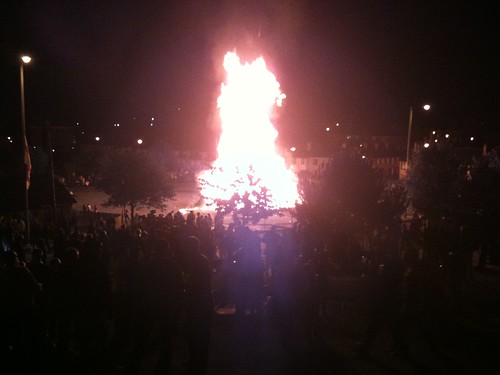
Ballybeen Bonfire

That photo doesn't really do the scene justice, as it was taken in my iPhone, but even here you can see some of the huge crowd. What can we do? We cannot do nothing!

Sunday, July 12, 2009

When is the Twelfth not the Twelfth?

When it's the Thirteenth!

With the Twelfth of July on a Sunday this year, the Orange parades have been deferred until the next day. It led to some confusion about the lighting of the Eleventh Night bonfires - Saturday or Sunday night? I've never been to a bonfire, and yet for many, it's an essential part of the culture. The closest we ever got was sitting watching the Thornhill bonfire from a distance on the other side of the A1 dual carriageway.

But why bonfires? In some ways, those lighting the bonfires are celebrating the mobile phone of the Williamite era. Nowadays we're used to twenty-four hour news channels, mobile phone coverage and even Twitter to know what's going on in the world. But back in 1690, as William took to the battlefield on the green grassy slopes of the Boyne, how would the folks at home know who had won? Twitter is restricted to 140 characters, but the bonfire communicated one word: victory!

The word could spread quickly, from one hilltop to the next, with beacons blazing in the night sky. Ancient communications being continued, only now it's from one housing estate to another! That's why the commemoration of the Battle of the Boyne is (normally) held on the Twelfth. You see, the Battle of the Boyne was fought on the 1st July 1690 under the Julian calendar. In 1750, when Britain adopted the Gregorian calendar, ten days were added to bring Britain in line with Europe, which makes the 1st July Old Style into 11th July New Style. The bonfires on the evening of the 11th are as if the word is just reaching the towns and villages, and then the celebrations and processions are held on the next day, the Twelfth, unless it's on a Sunday.

Monday, June 22, 2009

Licentiate, Not Licentious


Last night I journeyed far and wide to Stewartstown in County Tyrone for a service in 1st Stewartstown Presbyterian Church. One of my good friends, Stewart Glendinning, was being Licensed as a Probationer for the Ministry in the Presbyterian Church, and it was interesting to see how Presbyterian services are conducted.

Following the welcome, opening hymn and prayers, the Bible reading and offertory, and another hymn, a Commission of the Presbytery of Tyrone was constituted, which would conduct the formal business of licensing Stewart. In many ways the whole enterprise was similar to the ordination service - the Rule of Faith , that is, the standards and beliefs of the church, is put to the candidate, who assents; then a series of prescribed questions on the specifics of belief, and finally subscription to the Westminster Confession of Faith. Anglican ordinations are similar, in that we subscribe our assent to the Thirty-Nine Articles of Religion, although that happens before the service, rather than during.

Following the act of licensing and prayer, Stewart became a Probationer for the ministry of word and sacrament, without any laying on of hands, but with the right hand of fellowship. He's now legit to work as the assistant minister in Sinclair Seaman's Church in the Belfast docks.

The minister of Brigh, Albany and 1st Stewartstown, David Irvine, preached a great sermon from 1 Corinthians 4, highlighting that those engaged in the ministry are servants of Christ (under-rowers, not the usual word for servant diakonos), minsters are stewards of the mysteries of God (entrusted with the work of preaching the gospel), and ministers are to love as fathers and mothers the people in their charge.

All in all, a great service, and hopefully a big encouragement for Stewart too. The evening gave me a chance to meet up with some friends from the Mid-Ulster Battalion Boys' Brigade camps who I haven't seen in a couple of years as I haven't gone camping with them for that length of time!

The two words in the title may sound quite similar, but are very, very different! Stewart is now a Licentiate, but is definitely not licentious!

*The photo wasn't taken last night, but on a bowling trip several years ago!

Sunday, November 23, 2008

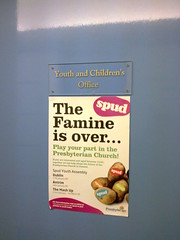
The Famine Is Over - Contextual Mission?

While Northern Ireland might be seen as a sectarian place, it appears that Glasgow is up there too. The media have been full of reports on sectarian songs at both Parkhead and Ibrox, the home grounds of Celtic and Rangers Football Clubs. One such has been the Famine Song, which reminds Celtic fans that 'The Famine is over, why don't you go home?' In fact, it has risen to such an extent that Sir David Healy received death threats from dissident republicans for his entirely innocent comments after having scored his first goal in several games against San Marino, when he said, “I am pleased to score, the famine, the drought, whatever people would call it is over, and am so pleased to be on the scoreboard.”

Into this context, the Presbyterian Church in Ireland Youth have launched an event called SPUD. It's a new Youth Assembly for the Church, and looks to be very good. Sadly, though, it appears their marketing might be in slightly poor taste. Yes, you've guessed it: 'The famine is over' is their tagline...


Oops.

Wednesday, January 16, 2008

Preparation and Protestants

It never really stops in college. It's the night before the first of the interview in the Curacy appointments process, and I've been sitting researching an essay, for the most part. The essay is for Anglicanism, and I'm looking at the Preamble and Declaration of 1870. It was the Church of Ireland preparing for disestablishment (that is, freedom from state control, and being seen as a wing of the civil service), and defining itself.

Stating clearly what it was, and was not. An interesting document, and one of the few places in the Church of Ireland's formularies (maybe even the formularies of the entire Anglican Communion) where the Church is question is defined as 'a reformed and Protestant Church.' Elsewhere, the phrasing would be 'catholic and reformed' but here, they went full kilter for the declaration that the Church of Ireland was protestant.

While the declaration talks about a lot more, I think I'm going to focus in on the self-identity of the Church, looking at the background to this statement, and also what relevance it has for the Church of Ireland of today.

Prayers, as always, greatly appreciated for the interviews tomorrow, Friday and Monday. Oh, and by the way, my darling has summarised our last few months in great style at her blog in a post entitled 'The road less travelled.'

Wednesday, March 21, 2007

Cranmer Remembered

Behold, on this day 451 years ago, Archbishop Thomas Cranmer was martyred by Queen Mary for his reformed position. Cranmer was the man behind the Book of Common Prayer of 1549, and also the 1552 revision, and was Archbishop of Canterbury under Henry VIII, Edward VII and Mary.

Precious in the sight of the LORD is the death of his saints. (Psalm 116:15)