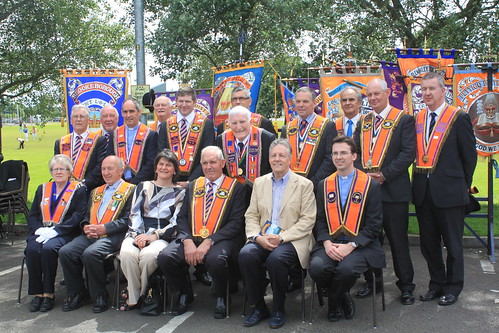
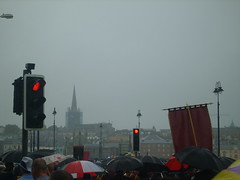
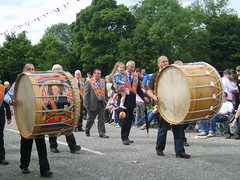
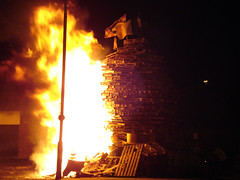
Showing posts with label parades. Show all posts

Tuesday, July 29, 2014

Sermon: Romans 1: 1-17 I am not ashamed of the gospel


I wonder if you've ever been ashamed. Maybe it was a long time ago when you thought you were a big boy, and your mum took your hand to cross the street - in front of your friends. Perhaps it was an embarrassing situation where you've made yourself to look like an eejit. You'd rather the ground swallow you up. Like the time you asked the lady when her baby was due and then to discover she wasn't actually pregnant... I think one of the times I was most ashamed was the night many years ago we took the youth group to Dundonald Ice Bowl, and I managed to split my trousers while ten pin bowling. If you've been very fortunate to have never been ashamed of yourself, then maybe you can identify by thinking of the situations others get themselves in!

In our second reading today, we hear about being ashamed, or rather, about not being ashamed. The apostle Paul is writing to the church in Rome before he comes to visit. He has been wanting to visit for a long time, to make it to the capital of the entire Roman Empire, but he hasn't made it so far. And why is it he wants to get to Rome? Is it for a decently priced city break? Does he want to do the touristy sites - the Coliseum, the Vatican? Well, no, of course not, the Vatican doesn't exist.

He is eager to get to Rome because he wants to preach the gospel in Rome. Just as he has been preaching everywhere else, so now he longs to go to Rome to preach the gospel in that great city. But once he says that, he then says what might seem as a bit of a strange thing to say: 'For I am not ashamed of the gospel.'

Why does Paul say this? Or, to put it more accurately, why does he feel he has to say this? It must be because some people were ashamed of the gospel. Perhaps the Christians in Rome were under pressure from their friends and workmates - you don't really believe all that about Jesus, do you? You don't really think there's only one God rather than all the hundreds of Roman gods and goddesses? Is it not very intolerant of you to claim that there is only one way to God?

There is always a danger of drifting. To pay more attention to the opinions of the world around us than God's opinion will always lead us away from God, to be ashamed of God and his gospel. I wonder if you have felt that pressure as well? It's easier to be ashamed of God and turn away.

For Paul, there may also have been the temptation to tone down his message. Perhaps people were saying to him - do you really have to be so dedicated and committed? Maybe you wouldn't land in prison as often if you just moderated your message.

But Paul declares that 'I am not ashamed of the gospel.' In doing so, he challenges the Roman Christians, and us as well gathered here today, to echo his words. I wonder can you say with him, 'I am not ashamed of the gospel'? To help you do that, let's look at why Paul says it - what the gospel is, and what the gospel does.

So what is the gospel? So that the Romans are left in no doubt, Paul outlines the gospel in the very first verses of the letter. The whole letter is a fuller statement of the full extent of the gospel, but even in the very first verse, Paul gets to the gospel of God. This isn't just a fairy story; it isn't something made up to make us feel good for now. It's not, as Marx claimed, the opiate of the people, designed to keep the poor happy until they die. The gospel is God's gospel - his good news given to us.

This good news didn't just appear in the first century either. The gospel was promised beforehand by God - through his prophets in the Holy Scriptures. The Old Testament was laying the foundation for what would come later, just as you have to lay your foundation before you build a house.

The gospel is all about a person. Paul writes, 'concerning his Son, who was descended from David according to the flesh and was declared to be the Son of God in power according to the Spirit of holiness by his resurrection from the dead, Jesus Christ our Lord.' The gospel is the good news about Jesus, the God-man who was the Son of David (the King), and the Son of God. He lived, he died on the cross, and he was raised to new life. This is the good news, that Jesus has defeated death, and now lives. If Jesus was not raised from the dead, then there is no news, no good news. This is the gospel - Jesus died and lives.

So why does Paul hold fast to this gospel? Why is he not ashamed of it? He tells us the reason in verse 16. Here's what the gospel does. 'For I am not ashamed of the gospel, for it is the power of God for salvation to everyone who believes, to the Jew first and also to the Greek.'

This message about Jesus is the power of God for salvation to everyone who believes. You see, without Jesus, we are in danger. We are lost. We need to be rescued. We are dead men walking. We stand under judgement by a holy God, who cannot abide our sin. And yet so often we don't realise. We drift along, in danger unawares.

Now if you’re out on a boat on Lough Erne and you get into difficulties, then you need a rescuer. You need someone to come and get you out of danger and bring you back to safety. And that’s what Jesus has done. He came into this world, he took on our flesh, he took up our sin, and he gave his life so that we might live. The King of heaven left his high throne to be the rescuer.

The rescue has been accomplished. The victory has already been won. And all you have to do is to trust in the Lord Jesus - to believe the good news proclamation. As Paul goes on to say: ‘for it is the power of God for salvation to everyone who believes.’ Everyone, anyone, all who will come will be saved. Those like us and those we like; those we don’t like so much - all can come and be saved.

It’s not about bringing a big list of reasons why you should be good enough for God to save. To trust in ourselves is to say that Jesus isn’t enough; that we can do it by ourselves. But there is only salvation in Jesus. Without the gospel, we are lost, both now and for eternity. In the gospel, we find God’s righteousness revealed, accessible only by faith.

About five hundred years ago, a German monk struggled to be good enough to please God. He could never be satisfied that he had done enough. The demands of God’s law weighed down heavily upon him, with no relief. He even grew to hate the God he tried to serve. But then he began to study Romans, and in 1:17 found the key to his own changed life, and began the Protestant Reformation.

‘The righteous shall live by faith.’ Martin Luther came to discover that it’s not about what we bring to the table. The good news of the gospel declares the finished work of Christ and asks us - do you believe this? It is by faith that we trust the promise, and by faith that we receive eternal life. This is why Paul is not ashamed of the gospel. It is God’s gospel from start to finish. It’s all about Jesus, what he has done for us. And it is the power of God for salvation for anyone who will believe.

Perhaps today as you hear of the gospel, you realise that you’ve never really believed the message. You’ve heard it many times before, but never received it for yourself. You can trust in Christ for the first time, just where you’re sitting. Take hold of the promises. Look to Christ, and discover that he did it all for you. Believe on him today.

But maybe you’ve been a Christian for a long time. You’ve been around a few corners and you know how life works. It’s far easier to keep your faith private. No one else need know. No one could even guess! Paul challenges you today - are you ashamed of the gospel?

As we are reminded of the glories of Christ, the marvellous good news of what he has done, the amazing promise that anyone who believes will be saved, may our hearts be strangely warmed like Wesley on reading Luther’s introduction to Romans. Be bold in your faith and your proclamation. Count all else as loss compared to knowing Christ. Live in such a way that proclaims to everyone you meet: ‘I am not ashamed of the gospel.’ And may we all, on that last day, be joined with the great crowd from every nation, all who have received the good news and trusted the Lord Jesus, for his glory. Amen.

This sermon was preached at the RBP service for Brookeborough Victoria RBP 487 in Brookeborough Methodist Church on Sunday 27th July 2014.

Monday, July 22, 2013

The Orange Order: Faith Proclaimed or Feet Parading?

The other day, I was in a national shop in a local town. The assistants are always polite, always friendly, mostly chatty. Picking up and scanning the copy of The Irish News I was buying, the lady quickly made a few assumptions and asked me who would win on Sunday. I had to confess that I didn't know what she was talking about. It turns out it was the GAA Football Ulster Final yesterday between Donegal and Monaghan, which was won by Monaghan 0-13 to 0-7, although I couldn't have told you that without looking.

The assumptions were plain and obvious - buy the Irish News, be a Roman Catholic / Nationalist / Republican, and chat about Gaelic Football. It's precisely because those assumptions are in place (similarly, probably with those on the 'other side' who buy the Newsletter) that I wanted to share a couple of articles from The Irish News last week. Many who need to read them would never ever pick up a copy of The Irish News - but perhaps they'll read them here.


They are both by William Scholes, the faith and religion editor, and were published on Thursday 18th and Friday 19th July. First up, 'Faith proclaimed becoming lost to order's feet proclaiming.'


In it, he explores the 'juggernauts of religion, culture and politics' colliding for the Orange Order. Reflecting on the scenes from the Woodvale Road after they were banned from returning along the Crumlin Road past Ardoyne shops, he says, 'Sorting out where it stands on faith would seem to be central to that.' As he declares, 'Something has clearly gone badly wrong for the Orange Order, certainly in Belfast, if feet parading has become more important than faith proclaimed.'

While recognising that Belfast is a case apart, and in other places, such as Fermanagh, the Twelfth is an entirely different kind of a day, it all comes down to identity:

It seems to be a question of identity. If the Christian's identity lies "in Christ", then while flags, parades and other expressions of culture can remain vitally important, they are no all-consuming.

My thought is on how the actions of attacking the police can be a witness to the love of Christ and his concern for the lost.


The second article came a day later, entitled 'Orange Order needs to have critical friends.'


Scholes focuses on the debate in the recalled Stormont Assembly on Tuesday on the parades issue.

There was going to be a showdown. And after a weekend of violence, intemperate words and the usual blame game, this wouldn't just be any old showdown.
It would be Achilles stepping out of his tent on the Plain of Scamander and confronting Hector at the gates of Troy. It would be King Henry V at Agincourt on Saint Crispin's Day.
But in the end, it was more like Noggin the Nog. Or was it Mike the Knight?
Tuesday's debate at the recalled assembly was the build up to the let-down, at least for anyone expecting a full-on blood on the carpet battle..
For anyone who clings to the belief that politics is the answer to our problems, there were glimmers of hope to be discerned.

The end point and conclusion of his opinion piece should provide a plan for the future:

It is highly tempting for the silent majority of the Protestant community - as if it were a homogeneous bloc in the first place - to allow its apathy towards the Orange Order in Belfast to turn into disavowal.
But that would be a mistake. If Orange ears are apparently shut to nationalists, then it is for other Proetstants to help them see another way.
Some might prefer the order to stop paying lip service to a Christianity its actions at Woodvale contradict but as long as being "Christ-centred" is part of its DNA, Church leaders in particular will have a duty to be involved.

Two important articles, albeit almost entirely hidden away from the eyes who most need to see them, because they're appearing in the Irish News. We give thanks for the peaceful parade / protest on Saturday, but the order needs to find a new way forward, sharing the gospel of Jesus Christ with the whole community as a matter of first priority.

Note: Both articles are used with the permission of the author, William Scholes.

Tuesday, July 16, 2013

Orange Parades: History Repeating Itself?

The scenes in Belfast over the Twelfth have been shocking. Members of the Orange Order, bands, and hangers-on attacking the PSNI with a variety of weapons and ammunition, due to the blocking of a parade. After the positive coverage of Northern Ireland during the G8 (only a month ago), the normal headlines have returned, with footage beamed across the world of people waving union flags attacking Her Majesty's police service.


Orange leaders have been describing the blocking of parades as the latest installment in a 'culture war', citing the removal of the union flag from Belfast City Hall as another field of engagement. In actual fact, though, problems with parades are not a new thing. Even further back than the Lower Ormeau or the Garvaghy Road / Drumcree disputes, the student of Irish history discovers that things were even worse about 160 years ago. So bad, in fact, that party processions, both unionist and nationalist, were banned for over seventeen years. The incident that brought the ban? The battle of Dolly's Brae.

© Copyright Kevin O'Kane and licensed for reuse under this Creative Commons Licence

It was the Twelfth of July 1849. The Orangemen of Rathfriland had marched to Lord Roden's Park - what is now Tollymore Forest Park, at Bryansford. Appeals had been made for the Orangemen to return by the new road, that is, the one known as the Horse Shoe Bend on the A50. The Orangemen, though, had gone that way the year before and 'been humiliated over the next year by songs mocking their cowardice.' [1)

Waiting for them at Dolly's Brae were 'masses of armed Ribbonmen... crowded to prevent them.' [2] Between the Ribbonmen and the Orangemen were troops and police, to keep the peace and ensure the march passed through. Everything almost worked out. 'When they were twenty yards of so beyond the danger zone, someone threw a squib and all hell broke loose.' [3] Firing began on both sides, the police moved to scatter the Ribbonmen from the hill, and in the turmoil, many were killed. 'At least thirty Ribbonmen were killed and Orange stragglers burned some Catholic houses and attacked one of the owners.' [4]

The following year, 'Sir William Meredith, the Chief Secretary for Ireland, brought in a bill outlawing Party Processions.' [5] Parades were completely banned, with the order going 'into decline.' [6] Ten years later, 'following a serious riot at Derrymacash, near Lurgan, County Armagh, a Party Emblems Act was passed. The displaying of party flags, banners or emblems from buildings (or other public places) was prohibited; so, too, was the ceremonial discharge of cannon or firearms. Even the playing of traditional party tunes in public was outlawed. Orange leaders denounced both Acts as tyrannical, unconstitutional and an infringement of British liberties, yet they insisted that all brethren should obey them.' [7]

It seems like an early prototype of the current Parades Commission, and even more of a war on Orange culture than we are currently experiencing. The danger, though, in such times of 'persecution' is that a new hero will emerge, who will stand up and be counted. With the union flag dispute, it appeared to be Jamie Bryson and Willie Frazer. With the parades dispute now, who can tell? In the 1860s, the Orange hero was William Johnston of Ballykilbeg in County Down.


'As the events of 12 July 1867 illustrate, the Orange Order remained capable of putting large crowds on the streets, when its cause demanded it. That day, William Johnston of Ballykilbeg, who was opposed to legal curbs on Orange marches, led 100 Orange lodges, with 40,000 people as participants or spectators, in procession from Newtownards to Bangor.' [8] Johnston and a few others were prosecuted, but 'so intent was Johnston on making his mark that he refused to pay the bail money that would have secured his release. When he emerged from Downpatrick jail a month later, thousands of supporters had gathered at the gates, singing Orange songs as loyalist bands played their party tunes.' [9] Such was the groundswell of support for Johnston that he was soon after elected to Westminster and successfully brought about the repeal of the Party Processions Act in 1872.


Reading the accounts of the events of the 1860s, there are some striking resonances with today. An embattled and embittered Orange order under siege. Violence surrounding some parades, even while the vast majority pass off peacefully. Government legislation seeking to pursue peace but making the situation potentially worse. Heroes and martyrs waiting in the wings to rise to prominence. An uneasy political situation.

Rathfriland District still remember Dolly's Brae - the name of that road emblazoned on their District Bannerette like a military battle honour. The rest of us need to remember it as well, and all that followed, to seek a peaceful resolution before it's too late and history repeats itself.


Notes:
[1) Ruth Dudley-Edwards, The Faithful Tribe, p. 250.
[2] Mervyn Jess, The Orange Order, p. 34.
[3] Kevin Haddick-Flynn, Orangeism: The Making of a Tradition, p. 277.
[4] Dudley Edwards, p. 251.
[5] Haddick-Flynn, p. 279.
[6] Haddick-Flynn, p. 280.
[7] Haddick-Flynn, p. 281.
[8] Chris Ryder & Vincent Kearney, Drumcree, p. 12.
[9] Jess, p. 36.

Tuesday, July 09, 2013

Sermon: 2 Timothy 3:10 - 4:8 Bible and Crown


It’s hard to believe that it’s almost a year since the Olympic Games in London. It was great to see the British athletes win 29 gold, 17 silver and 19 bronze medals. They were brilliant at the cycling, the rowing and the long distance track races. However, when it came to one particular event, the British men’s team did it all wrong, and were disqualified. The women didn’t even make it to the Olympics. Now, at the risk of turning into A Question of Sport, which event was it?

The relay race. The 4x100 metres. The final changeover was disastrous, it didn’t happen correctly, and despite finishing second in their heat, the men were disqualified. Many a cold, wet afternoon during PE being taught how it was meant to be done, as the baton is passed to the next runner. It’s so important for the baton to be passed, for the next person to take over and have a chance at a medal.

The apostle Paul is writing his young friend Timothy, giving him instructions as he passes the baton on. Paul has been giving his life to the work of the gospel, travelling around the known world telling people about Jesus, planting churches, and declaring the good news. But now he is in prison. Execution is not too far away. Paul’s race is almost over: ‘I have fought the good fight, I have finished the race.’ (4:7). It’s up to Timothy now to take up the baton and run his race, to continue on Paul’s work of teaching.

Yet as Timothy looks to the future, as he sees what lies ahead, it seems that the relay race isn’t being run on the nice new athletics track in the Olympic stadium. What lies before him is more like an army assault course, with obstacles and dangers to face. Paul even spells them out for him. He reminds him of the persecutions & sufferings in Antioch, Iconium and Lystra, These were places where Paul had been driven out of town, opposed, and stoned (that is, attacked with stones, not drugged).

More than that, it’s not just Paul who will face problems and difficulties for being a Christian: ‘Indeed, all who desire to live a godly life in Christ Jesus will be persecuted, while evil people and impostors will go on from bad to worse, deceiving and being deceived.’ (3:12). Now you might think that it’s silly to mention this at all, especially if you’re thinking about becoming a Christian, but we have to present the whole truth. The Lord Jesus warns us to count the cost before we decide to follow him.
So the future looks bleak. Is it all just doom and gloom? Why would anyone want to be a Christian faced with such opposition and problems? Wouldn’t it be easier to just continue on in your sinful life and live the way you want?

Paul gives Timothy a glimpse of reality - what his life will look like as he follows Jesus. But it’s not all negative. Rather, he also gives two great big encouragements, as he looks to the future in faith. Two things that we are given by God as we love and serve him.

The first comes at the end of chapter three. Paul has said that evil people and impostors will go from bad to worse. That may be the direction they’re going, ‘But as for you...’ Timothy, don’t follow the crowd. Don’t go the way of the world. As for you, continue in what you have learned... What is it he has learned? What is it that he has firmly believed? It’s the ‘holy Scriptures, which are able to make you wise for salvation through faith in Christ Jesus.’

The Bible is able to make us wise- to give us the information we need in order to find salvation- salvation through faith in Jesus Christ. Despite there being 66 different books from around 40 different authors written over a period of a couple of thousand years, there is one uniting subject. From Genesis to Revelation, the Bible is all about Jesus, sharing the good news, showing us his glory.

Now how can this be so, if there are all those different authors? Behind them, and through them, Paul tells us, there is one author: ‘All Scripture is God-breathed’ (3:16) Just as my words are coming out of my mouth as I breathe, so the Scriptures are God-breathed. Scripture says what God is saying. When we read the Bible, it’s not just ancient words on a page, but God speaking to us now.

I suspect that I’m a typical man, [and perhaps wives you’ll recognise this trait in your husbands too]. I get a new piece of equipment, some new technology, and straight away, I want to turn it on and get stuck in. I’ll footer about with it, trying to make it work. It’s only when I get stuck that I’ll go back to the box to find the instruction manual. We think: I can sort this out myself. We don’t need any help. Until we realise we do.

Life can be like that. We have some freedom and off we go, making our own mistakes, trying to sort things out ourselves. We live the way we want to, and then wonder why we end up getting things so very wrong. We need the instruction manual. We need to hear from the Maker, who knows how life is meant to work. Paul tells us: ‘All Scripture is God-breathed and is useful for teaching, rebuking, correcting and training in righteousness, so that the man of God may be thoroughly equipped for every good work..’ (3:16-17)

Perhaps today you’re wandering, you’re lost. You recognise yourself among the evil people and impostors going from bad to worse, deceiving and being deceived. The remedy is to be rescued. To turn from error and self-deception, to the living God who has spoken. To become wise in the way of salvation, through faith in Christ Jesus. To learn about the saviour and to trust in him. To be taught & corrected from his word so that we can love and serve him.

In the world of Twitter. Lady Gaga has over 38 million followers, Justin Bieber 41m - all eager to hear from their heroes (even if it’s just what they ate for breakfast!). Yet we have the words of the living God in our homes, often in a box, out of the way on a shelf, gathering dust. One of the banners you’ll see at the Twelfth shows the secret of England’s greatness as a Bible is presented by Queen Victoria to foreign princes. Will you take up your Bible and read and learn, and hear God’s voice to you? It is in this way that we hear and are saved, as we trust in the Lord.
The first thing we’re given is the Bible, the scriptures. This is what Timothy is to give himself to learn and teach and proclaim, in and through the dark days that lay ahead of him. At the end of our passage, Paul tells us about the second thing we’re given, which encourages us to keep going as we love and serve the Lord Jesus. Here’s what he says: ‘For I am already being poured out like a drink offering, and the time has come for my departure. I have fought the good fight, I have finished the race, I have kept the faith. Now there is in store for me the crown of righteousness, which the Lord, the righteous judge, will award to me on that day - and not only to me but also to all who have longed for his appearing.’ (4:6-8).

You see, as Paul comes towards the end of his life, as he completes his race, he looks towards the finish line, towards the podium. The reward isn’t a gold medal and a wee posy of flowers. Instead, what awaits is the crown of righteousness. This crown of righteousness is the sign of being accepted by God, of being in the right with God. It is awarded by the Lord, the righteous judge, who judges with absolute fairness and justice. Remember where Paul is: He’s on remand, sitting in prison, awaiting the death sentence, which the unjust judge, Nero, will pass on him. His earthly life will cease, condemned as a prisoner; but Nero’s judgement doesn’t concern him. Rather, he is looking forward to the only opinion that finally matters - the Lord, the righteous judge, who will award that crown of righteousness.

Now you might be thinking to yourself that of course Paul deserves such a crown - he’s in the Bible, after all, he wrote books of the Bible, he was so very good. You could not be further from the truth. Paul doesn’t deserve this crown of righteousness. Earlier we spoke of salvation through faith in Christ Jesus. That is, salvation from our sins - Paul needed rescue, just as we do too. Our rescue is in Jesus Christ, who died on the cross, in the great exchange taking away our sins, and giving us his perfect righteousness. It’s by faith that we receive God’s grace. Indeed, as Paul says, ‘I have kept the faith.’

Paul can face the future with confidence. His heavenly reward is certain. His crown is laid up ready for him. Friends, today, your future can also be certain. You see, Paul wasn’t boasting, as if to say, well I’m all right, I’ve got a crown waiting for me. He goes on to say that it is ‘not only to me but also to all who have longed his appearing.’

Jesus is returning, the righteous judge, who died to save us. We too can be sure of receiving the crown of righteousness as we hear God’s word of grace and respond in faith. Jesus has died to win your salvation. Will you hear and heed him today? Will you trust in the Lord for your salvation? Will you welcome him on that great Day when he appears as judge? The Bible, God’s breathed out word, points us to the crown, God’s gracious gift, offered freely.

This sermon was preached at the Lower Iveagh West Orange Parade Service in Magheralin Parish Church on 7th July 2013.

Sunday, March 24, 2013

Sermon: Luke 19: 28-44 The Royal Visit


Can I let you into a sermon secret? There sometimes comes a moment when the you realise the path you’re pursuing comes to a dead end. The sermon you had hoped for doesn’t quite materialise. But in its place comes something much more useful.

I was almost going to focus this morning on the donkey. Here’s how my thinking went. Yes, it’s Palm Sunday; Jesus on a donkey; we’ll have a wee think about the donkey, and how Jesus used such a humble animal for his purposes; and how Jesus can use each one of us. A fine sermon, I’m sure you would agree, but it’s not one that you’ll hear today.

You see, as I studied the passage, it turned into the curious case of the colt. There’s no doubt that the colt, the donkey is featured. It is Palm Sunday, after all. But focusing on the donkey would be a bit like watching a movie to catch a glimpse of an extra who appears in one scene, crossing the street behind the main character. It might be fun, but it kind of misses the main point.

The question that helped me on (what I hope is) the right path was this: Why does Luke report on things in this way, with these words? You’ll probably know that there are four gospels - Matthew, Mark, Luke, John; each of which tell the story of Jesus’ life, death and resurrection; but all with their own focus and method.

Last weekend when Ireland suffered a horrendous defeat to those rugby giants Italy, the BBC declared that Paddy Jackson had been Ireland’s best player, while the RTE commentators were of the opinion that the Ulsterman had been the poorest player on the team. They’re reporting on the same match; they’re speaking about the same thing, but each with their own perspective. It’s the same with the gospels - often they share the same story, but with their own take on it.

So while Matthew ties the donkey’s use to fulfilling the prophecy of Zechariah 9:9, Luke doesn’t. So what is Luke’s focus? Why does he give us Jesus’ instructions about going and getting the donkey, including what to say when challenged, and then immediately reporting that it all happened, and that they used the reply to the challenge. I don’t think he’s making the point that the colt is needed, so much as he’s flagging up who it is that needs it.

‘The Lord needs it.’ (31, 34) Twice in quick succession these words are repeated - Luke’s main point is about the identity of the one who needs the donkey: ‘The Lord.’ We’ll see how he develops this as the passage unfolds. But for now, it’s enough to see that Jesus describes himself as ‘The Lord’ - a title denoting authority, power, and honour.

That honour is seen when the colt is brought to Jesus and cloaks are spread on it for him to sit on. More than that, others spread their cloaks on the road. Remember the story of Sir Francis Drake spreading his cloak over a puddle so that Queen Elizabeth (the first) didn’t have to step in it? This is kind of what’s going on here. It’s like a red carpet for the VIP of the day.

That same honour is heard as the disciples begin to ‘praise God joyfully with a loud voice for all the deeds of power that they had seen.’ (37) The disciples have been following Jesus; they’ve travelled with him on the way up to Jerusalem; they’ve witnessed the miracles, and now, as they come within sight of Jerusalem itself, they burst out in praise. But look at what they say. If they’re praising God, wouldn’t you expect them to say something to God? What do they say?

‘Blessed is the king who comes in the name of the Lord!’ Their words are directed to the coming King. They’re praising God by praising the King in their midst - Jesus. They’re using words from Psalm 118 as they recognise that Jesus is God’s promised king, coming in power, the one to bring peace.

Now these days we’re used to hearing of restrictions placed on some processions by the Parades Commission. It looks as if the Pharisees are the earliest members of the Parades Commission as they seek to impose restrictions here: ‘Some of the Pharisees in the crowd said to him, “Teacher, order your disciples to stop.”’ They don’t like the tone of the praise; they don’t accept that Jesus is God’s King.

Yet how does Jesus answer them? ‘I tell you, if these were silent, the stones would shout out.’ (40) They may not accept the King, but creation itself recognises it’s Creator King. If the disciples were to stop singing, the stones themselves would shout out for joy!

It’s a joyful occasion; it’s a big day; one to be remembered, as the disciples sing for joy. Yet in the midst of all the joy and loud shouting, the camera focuses in on Jesus himself. Sometimes in a wedding video, you’ll catch a glimpse of the bride or groom (or maybe their parents) with a wee tear in their eye - weeping for joy.

As Jesus weeps here, in the middle of the joy, we’re told that it’s not happy tears - but a full-on expression of sorrow and sadness: Jesus weeps for the city, weeps for the lost, because of the fate Jerusalem faces - total destruction in just about forty years from then. They rejected peace when it was available; they will instead receive the effects of war.

And why was this so? ‘because you did not recognise the time of your visitation from God.’ Jesus here declares that he is the Lord, the king coming in the name of the Lord, that he is God, on a royal visit to Jerusalem. He comes in peace on the donkey; yet even now he knows that he will not be received in peace. They did not recognise him as God.

Last year for the Jubilee there was a special TV interview with Prince Charles. He spoke of the times in the 1950s and early 1960s when the Royal Family were holidaying in Balmoral and would take a boat over to Northern Ireland for tea with family friends. The Queen was here, travelling about, but if you’d met her on the road you wouldn’t have known it was her. Jesus, the King, has arrived - how will he be received on this royal visit?

Through the nights of this week, we’ll follow the rest of the story; we’ll watch what happens when Jesus enters Jerusalem; the various responses to the king. I invite you to join with us.

Today, the key question is this: what is your response to Jesus? By your words and actions as they expose your heart attitude, will you reject him like the Pharisees, wanting it all to be hushed up? Jesus comes as King, offering peace. God comes to visit - will he be refused entry?

Or will you be like the disciples, who celebrate that God has come to them; that Jesus is here to reign over the new kingdom, bringing peace, as the whole creation cries out in praise?

This sermon was preached in Aghavea Parish Church on Palm Sunday, 24th March 2013.

Friday, July 13, 2012

The Twelfth in Enniskillen: PIcture Special

Yesterday was my first time watching the Twelfth parade in the county of Fermanagh, and the important Williamite garrison town of Enniskillen. Throughout the siege of Derry (Londonderry), it was the island town of Enniskillen that prevented James II from pressing the advantage and forcing the Maiden City to surrender. The Williamite troops of Enniskillen went on raiding parties, engaging in guerilla warfare against the Jacobite forces; which meant that James had to divide his men.

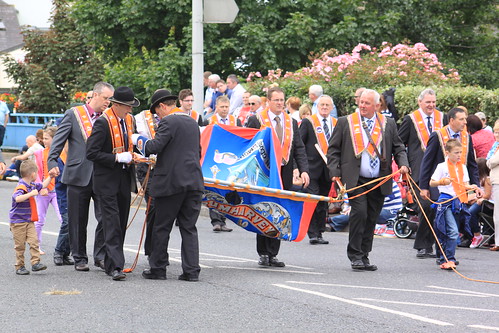
The route of yesterday's parade was largely contained on the island of Enniskillen itself (Kathleen's Island), with the assembly and demonstration fields both car parks - at the Legion and the Castle. A large crowd of supporters watched as the lodges, bands, and even a pair of Lambeg drums made their way to the Castle car park for a Highland Scottish dancing demonstration before the service and speeches. Rev Stanley Gamble, newly appointed Rector of Killinchy, Kilmood and Tullynakill, and Grand Chaplain of the Orange Order, preached, assisted by County Chaplains Rev William Johnston and Rev Roderic West.

Surprisingly for Fermanagh, the sun came out, to the extent that I'm nursing a bit of sunburn on my face this morning!

Here are a few pictures from the day:
King Billy leads the procession.
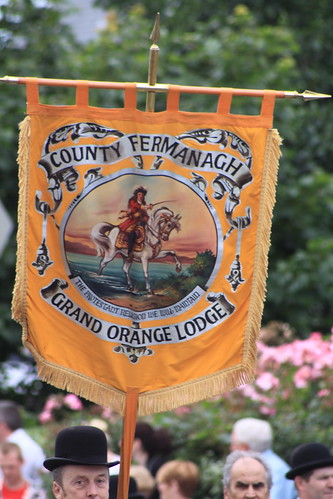
County Fermanagh Grand Lodge
The County Standard.
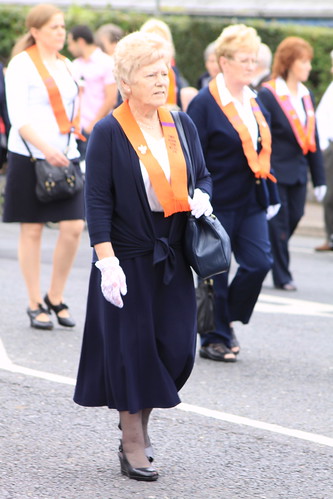
Orange Women
Orange sisters on parade.
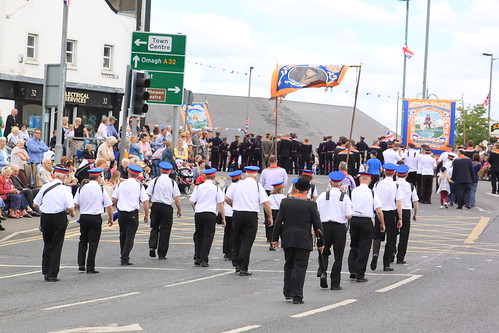
Parades
Banners in the breeze.
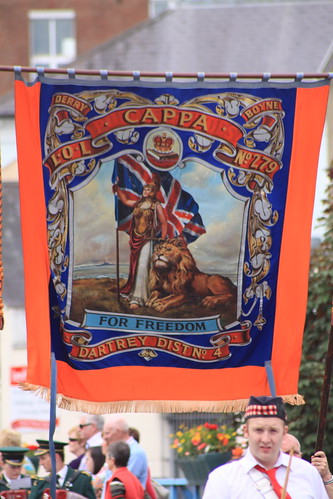
Cappa LOL 279
Britannia from Cappa, Monaghan.
Broken Banner
Emergency repairs on a broken banner.
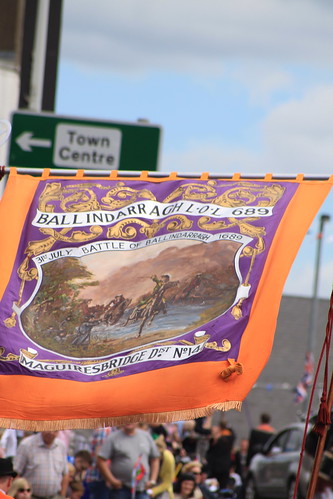
Ballindarragh LOL 689
Local history in the Battle of Ballindarragh.
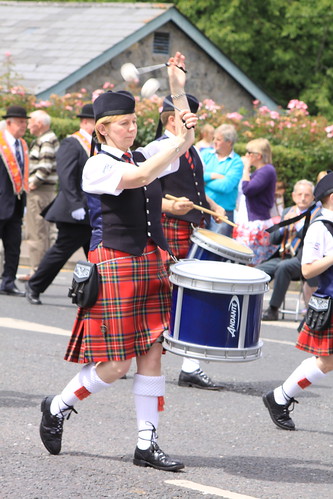
Tenor Drum
Tenor Drum in action.
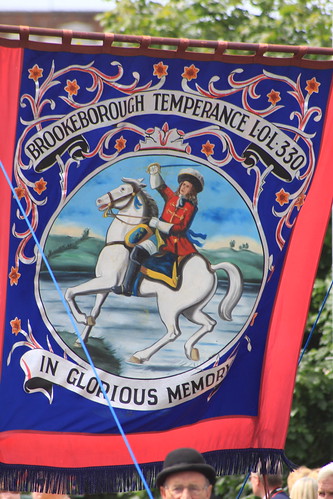
Brookeborough Temperance LOL 330
One of many portraits of King Billy.
Brookeborough Flute Band
Brookeborough Drums.
Pipe Band and Lodge
Pipe Bands were the order of the day.
Lambeg Drums
The Lambeg Drums.
The Queen Travelled in Style
The Queen revisits Enniskillen!
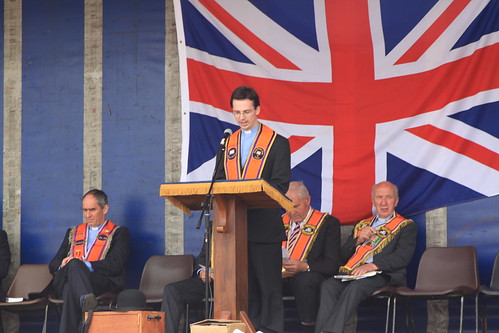
Platform Party
The Platform Party, with special guests First Minister Peter Robinson and Minister Arlene Foster.
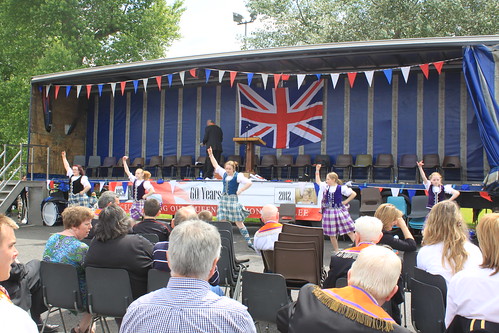
Scottish Dancing
Scottish dancing.
Stanley Gamble
Platform Proceedings.

For these and more photos from the Twelfth in Enniskillen, check out my Flickr set.

Monday, July 12, 2010

The Twelfth of Never

Today is the Twelfth of July, a public holiday in Northern Ireland, and the day when Orange parades are held to celebrate a Dutch World Cup victory the Battle of the Boyne. But why the Twelfth, when the actual battle was on the 1st July?

You see, the Battle of the Boyne was fought on the 1st July 1690 under the Julian calendar. In 1750, when Britain adopted the Gregorian calendar, ten days were added to bring Britain in line with Europe, which makes the 1st July Old Style into 11th July New Style. The bonfires on the evening of the 11th are as if the word is just reaching the towns and villages, and then the celebrations and processions are held on the next day, the Twelfth, unless it's on a Sunday.

The only thing that happened on 12th July (OS) was the Battle of Aughrim in 1691, the truly decisive battle of the Williamite Wars in Ireland. King Billy was long gone, though, safely in London governing his kingdoms. But then the actual anniversary of Aughrim would be the 22nd July according to our calendars.

So the glorious Twelfth is here. But how many Orangemen will realise that it's all down to Pope Gregory that they're marching on the Twelfth?

Saturday, August 29, 2009

Black Saturday

It's the last major parade of the summer marching season today- Black Saturday or the Last Saturday in August. Sir Knights from Royal Black Preceptories from across Northern Ireland and the border counties of the Republic will gather to parade at six county demonstrations. County Antrim are parading in Lisburn, County Londonderry are in Castlerock, Armagh and East Tyrone will gather in Killylea, West Tyrone are in Castlederg, County Down are going to the small village of Crossgar in the Lecale District, and Belfast Blackmen are on their way to Ballymena. (County Fermanagh hold their RBP parade on the same day as Derry Day to commemorate the Battle of Newtownbutler won by the Enniskillen men at roughly the same time as the boom was broken by the Mountjoy on Lough Foyle to lift the siege of Derry.)

A couple of weeks back we heard the Apprentice Boys leaving from Tullycarnet, and this morning at 7.30 there was the sound of drums as the East Belfast RBP set off from the Old Dundonald Road. An early start as they move to Ballymacarrett Orange Hall then off to the trains for Ballymena (passing the Short Strand on the way).

I'll not be at the parades today as we have lots of stuff to be getting on with, but no doubt someone will have photos on Flickr later on.

Sunday, August 16, 2009

Green Sashes


Green Sash
Originally uploaded by Garibaldi McFlurry.

Yesterday I went on a day trip to Londonderry for a dander around the walls and some photography in the Maiden City. Along the way, I noticed a parade was about to start in the town of Dungiven, and decided I would stop and watch it.

It being the 15th August, Assumption Day (or Lady Day) for Roman Catholics, when they think that Mary was ascended into heaven, there was a parade by the Ancient Order of Hibernians (AOH) in advance of the main parade in Carnlough.

This was the first time I had ever encountered the AOH, and from what I could see, it was a sort of Catholic version of the Orange Order. There were 6 members, a bannerette and an accordian band, so not huge numbers involved in Dungiven anyway. The parade began in the grounds of the Chapel, and passed down the main street through the town to the waiting bus.

So what are they all about? According to the fount of all knowledge, Wikipedia, they are an Irish-Catholic fraternal society formed to protect Catholic churches and help Irish immigrants in America.

From what it looked like in Dungiven, it appears that, like the Orange lodges, the AOH is struggling to recruit new and younger members. But maybe it was different in Carmlough. It did seem strange to see what looked like the Orange order, only with green sashes!

Saturday, August 08, 2009

Derry Day

I woke this morning to the sound of drums. Over in Tullycarnet, the Apprentice Boys and their band were marching in the local area before boarding a bus to travel to the City of Londonderry to celebrate the lifting of the Siege of Derry in 1689. Two hours on a bus for a wee walk, and then two hours home!

Today is also the anniversary of Internment, which was announced by the bonfires last night. As we drove through the Westlink, the smell of smoke was evident from the west of the city, reminders of past days.

For both communities, it seems, the past dictates how things should be conducted now. For the Protestant community, the siege mentality may never have lifted, with leaders being branded a Lundy if there is a hint of a sell-out or surrender. Indeed, in recent times we have seen the DUP, the party most likely to call others a Lundy now being branded Lundies themselves by Jim Allister's Traditional Unionist Voice.

For Northern Ireland, it appears that neither side can 'break faith' with their forefathers, as they contantly recall the struggles of their ancestors. Will this condemn us to further conflict in the future?

Thursday, July 16, 2009

The Ballybeen Bonfire

I have a confession to make. This year was the first time I had ever been to an Eleventh Night bonfire. In fact, when I wrote about the bonfires on Sunday, I wasn't expecting to go to one this year either.

But on Sunday evening we got talking about it after church, and thought that if the weather cleared up after the thunder and lightning during church, then we would take a look later. Behold it did, and so Mark and myself headed over to Ballybeen for the stroke of midnight.

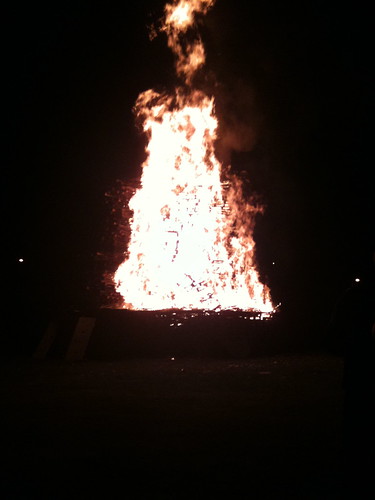
Eleventh Night Bonfire

Perhaps in my head bonfires were over-imagined, but I had thought there would have been music of some sort, perhaps a lambeg drum or flute band, or even just one fluter (flautist, if you prefer, although that word suggests more a James Galway type performer than someone playing the Sash on a flute). But there was no music. Just a huge crowd - perhaps several thousand, and most of them with carry-outs of drink. The Methodist minister in Ballybeen / Dundonald thought he was the only one not drinking, but there were two others of us at least!

We saw quite a few of the young people from the 'Been who come along to our Drop-in and youth club, so it was good to see them again now that we're in the summer break, and to hear what they're doing.

As I've already said, the one thing that struck me (other than the heat of the bonfire once it got lit, pushing most of the crowd backwards to cooler vantage points), was the vast number of people who were present to take part in the community ritual celebrating their heritage. For some, it was an excuse to get blocked, probably as quickly as possible, with the more drink the better. But many were there out of some sense of loyalty to Protestantism. They were celebrating Protestantism, and yet how many of them really know what Protestantism is?

I suspect for quite a number of them, to be a Protestant is to hate Catholics and go to parades. Oh, and vote unionist, if you vote at all. How far the community has moved from the traditions and origins of Protestantism, that of being a witness for the truth of the gospel, that is, of being a reformed Christian.

A connected challenge, then, is how can we impact on this community? Thousands of people in one place, coming together to celebrate (albeit missing the point) Protestantism. How do we reach them with the gospel? How do we reach the young men of Ballybeen and Dundonald whose main interest might well be drinking?

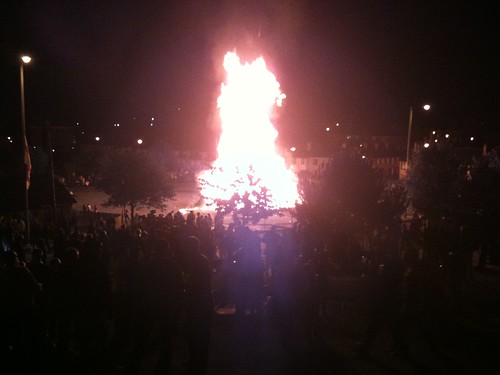
Ballybeen Bonfire

That photo doesn't really do the scene justice, as it was taken in my iPhone, but even here you can see some of the huge crowd. What can we do? We cannot do nothing!

Tuesday, July 14, 2009

Scarva 09

With the Twelfth being on the 13th, the Thirteenth was moved to the 14th. The Thirteenth is the annual parade of the Royal Black Preceptories from Counties Armagh and Down, and accompanied by the Sham Fight.

One of the highlights of the Thirteenth is the quality of the bands. One of the best on parade today was Killeen City of Armagh Pipe Band:


Pure class!

I took about 850 photos today, which will be carefully selected and uploaded to Flickr over the coming days (as well as the remainder of the Belfast Twelfth pictures). You can check out the Thirteenth set or my main Flickr page.

Aerial View


Aerial View
Originally uploaded by Garibaldi McFlurry.

Photos from the Twelfth parade in Banbridge are now online at my Flickr page. Have a look at them. I've still got about 250 images from the Belfast parade to sort through and upload.

With the Twelfth being on the 13th, the 13th is shifted to the 14th - the County Armagh Royal Black Preceptory parade in Scarva. Expect some more updates and pictures from it in due course.

Monday, July 13, 2009

The Belfast Twelfth

I'm currently standing on the Dublin Road in Belfast, watching the Twelfth parade on the 13th. An hour of the parade has gone by but now there's a long delay. Not quite sure why. We're up to the middle of District 6 Ballymacarrett.

The Twelfth in the city is a lot different to a country Twelfth such as I'm more used to. So far it has all been flute bands, apart from two accordian bands. No pipes, no silver or brass bands. A couple of lambeg drums were out before the parade started on Royal Avenue, outside City Hall and then at Bedford Street. But being here means I get to see different people, including some parishioners, and a new set of banners to take photos of.

Weather has been great, sunny and warm although there's a bit of a breeze which makes it hard to photograph the banners as they wave.

After this I'm off to Banbridge to get my fill of pipe bands and lambeg drums on the return parade

Sunday, July 12, 2009

When is the Twelfth not the Twelfth?

When it's the Thirteenth!

With the Twelfth of July on a Sunday this year, the Orange parades have been deferred until the next day. It led to some confusion about the lighting of the Eleventh Night bonfires - Saturday or Sunday night? I've never been to a bonfire, and yet for many, it's an essential part of the culture. The closest we ever got was sitting watching the Thornhill bonfire from a distance on the other side of the A1 dual carriageway.

But why bonfires? In some ways, those lighting the bonfires are celebrating the mobile phone of the Williamite era. Nowadays we're used to twenty-four hour news channels, mobile phone coverage and even Twitter to know what's going on in the world. But back in 1690, as William took to the battlefield on the green grassy slopes of the Boyne, how would the folks at home know who had won? Twitter is restricted to 140 characters, but the bonfire communicated one word: victory!

The word could spread quickly, from one hilltop to the next, with beacons blazing in the night sky. Ancient communications being continued, only now it's from one housing estate to another! That's why the commemoration of the Battle of the Boyne is (normally) held on the Twelfth. You see, the Battle of the Boyne was fought on the 1st July 1690 under the Julian calendar. In 1750, when Britain adopted the Gregorian calendar, ten days were added to bring Britain in line with Europe, which makes the 1st July Old Style into 11th July New Style. The bonfires on the evening of the 11th are as if the word is just reaching the towns and villages, and then the celebrations and processions are held on the next day, the Twelfth, unless it's on a Sunday.

Saturday, January 10, 2009

Gaza Protest in Belfast


Red is the Colour
Originally uploaded by Gary McMurray.

Today I was down in Belfast city centre, with my camera. Today I was going to start taking photos again as I haven't touched my camera in almost a month. As it would turn out, I arrived as a Trade Union march was gathering, so I was able to get lots of photos!

The march was to protest for peace in the Gaza strip, and to call on Israel to begin a ceasefire. Maybe about 2000 people took part, as the parade wound its way from St Anne's Cathedral to City Hall. I didn't stick around for the speeches, but the BBC is reporting that people from the 'four main churches' as well as trade union representatives and politicians spoke.

You can see lots more photos at my Flickr - the majority of participants were probably from the nationalist / republican community. Whilst there were lots of banners from Sinn Fein and SDLP Youth, there were no visible signs of unionism, apart from trade unionism.

I did spot Nelson McCausland standing watching, taking photos on his mobile phone, but that probably doesn't count as an endorsement of the parade by him.

The photo used in this post is of the Socialist Youth. I wouldn't agree with their politics, yet they seemed very passionate in their shouting and protesting. Plus, the colour is very vivid.

Saturday, August 30, 2008

Black Saturday in Dromore


Last of the Mohicans
Originally uploaded by Gary McMurray.

Today was the annual Black Saturday parade, hosted in Dromore for the first time in thirteen years. 120 Royal Black Preceptories from across County Down and from further afield were on parade, accompanied by 100 or so bands. I took a quick race home to see the first parade, and have still loads of photos to upload to Flickr. I'm working through them in reverse order so that eventually, you'll be able to see the pictures in order of the parade.

This is one of my favourite photos of the day. Looks like he is the Last of the Mohicans, from RBP 307 in Newtownards District.

Saturday, August 11, 2007

Umbrellas at Derry Day


Umbrellas
Originally uploaded by Gary McMurray.

I think this photo best sums up Derry Day for me. The parade's on, the crowds are out to watch, but more than anything else, the umbrellas are up!

As I'm going to miss Black Saturday in a couple of weeks time, I decided to give mum and my auntie the option of going to either the Black parade in Lisnaskea or the Apprentice Boys of Derry 'Relief of Derry' parade in Londonderry. They chose the north-west, and so we went.

Well, it never stopped raining the whole day, and I was absolutely soaked. Right through to the boxers (which is probably too much information!), so that the car seat is still wet now, after several hours of me being in the house.

Lots more photos of the day are available by clicking on this photo - it will take you through to my Flickr site. So, in conclusion, Derry has been relieved!

Thursday, July 12, 2007

The Twelfth


Magherabeg drums
Originally uploaded by Gary McMurray.

As you have probably noticed, today is the Twelfth of July. It's a public holiday in Northern Ireland, and is marked by Orange parades across the country.

The South-West Conference of the Orange Order had their demonstration in Laurencetown and Lenaderg, at the place where King Billy forded the Bann at Huntly. This morning it was wet, wet, wet as the brethren assembled on the Huntly Road, and the rain persisted during the outward parade. Rain, as well as meaning there were umbrellas aplenty. But it also means that the lambeg drums couldn't be brought out.

During the service and speeches, the weather cleared, and the sun came out! All this meant that the parade on the way back was much better, and the lambeg drums could be heard! The photo illustrating this posting is of the drums with my brother's lodge, Magherabeg True Blues LOL 838.

In total, I took 550 or so photos, and am working through sorting and renaming them. So far I only have a few of Magherabeg online at Flickr, but more will come after the weekend... Tomorrow morning I'm heading off to Scotland for the Wilkinson-Kee wedding!

Wednesday, July 11, 2007

A 'Green' Bonfire?


12th Night Bonfire, North Belfast
Originally uploaded by Howard..

Once again it's the Eleventh night, when across Ulster, bonfires will be lit. You can't help wondering, though, if it's all eco-friendly, so soon after the Live Earth event. What ways can we celebrate Orange culture while being green? (Maybe our new power-sharing Assembly and its DUP ministers can tell us how to mix orange with green?)