Showing posts with label death. Show all posts

Sunday, November 04, 2018

Sermon: 1 Thessalonians 4: 13-18 Good Grief


When I was growing up, my heart was set on becoming a journalist. So all my work experience was in local newspapers. My subjects for A-Level and my university were all geared towards journalism. And then, in the summer before I started university, God ambushed me with the call to ministry.

For the three years of my course, I was fighting against God’s call. And I had my reasons all stacked up. I didn’t think I would be able to preach (maybe you think that too!); I didn’t really like hospitals and medical stuff; and I definitely wouldn’t be able to be do funerals. As you can see, God won out in the end, and here I am. And when I was ordained as Curate, I had a few weeks to work with the rector before he headed off on holidays. We’d be able to do any funerals together. Well, there were none. And then the morning he was heading off on holiday, probably just as he was getting onto the plane, the local undertaker rang to say that I was about to do my first funeral.

When it comes to death and dying and what happens next, there are lots of questions. Questions that you might think, but have never said out loud. And as time goes on, and you encounter loss - whether sudden or expected - the questions are still there, and never really answered.

It seems that the Thessalonian Christians had questions too. You see, so far, we’ve heard all about the things that they knew. Last week, we saw that they knew how to live to please God, by loving one another. But there were some things they weren’t quite sure about. And it’s understandable. Paul and the team had only been in Thessalonica a short time. He had shared as much as he could, but he wasn’t able to tell them everything. That’s why he prays that he’ll be able to get back to see them. It’s why he sent Timothy to see them.

And now Timothy has returned to Paul, bringing the good news of their continuing faith, but also bringing news of their uncertainty about death. It seems that some of the Christians in Thessalonica had died in the short time since Paul’s visit. And that leads to the question - what happens to them when they die? Will they miss out on the excitement of the return of Jesus? Are they gone forever or will we see them again?

Those are the questions that Paul is answering as he writes this section of the letter. And in verse 13, we see his purpose in writing these verses: ‘Brothers, we do not want you to be ignorant about those who fall asleep, or to grieve like the rest of men, who have no hope.’

Paul’s purpose is to provide information, so that they won’t be ignorant (without knowledge); but more than that, he wants to provide inspiration. We don’t want you to be ignorant, so we’ll tell you what the story really is. And we don’t want you to grieve like other people, who have no hope.

He is’t saying that Christians shouldn’t grieve. He’s saying that we shouldn’t grieve like other people, who don’t have the hope that we do. We mourn and grieve - but we don’t do it in the same way as other people. The answer is to have ‘good grief’ or hope-filled grief.

Rather than speculating about what may or may not happen, Paul grounds everything that he says in objective fact. He points to what has already happened to the Lord Jesus: ‘We believe that Jesus died and rose again.’ (14) That shouldn’t come as a surprise to you - we say that every week in the creed, whichever creed we use. It’s the basis of our Holy Communion service, as we reflect on all that Jesus did - he died on the cross, and he rose again to new life.

This is what we believe as Christians. But it also leads us to believe something else: ‘and so we believe that God will bring with Jesus those who have fallen asleep in him.’ (14)

Because Jesus died and rose again, it means that God will bring with Jesus those who have fallen asleep in him. Did you notice how Paul describes these believers? They have ‘fallen asleep’ - verse 13 and here in verse 14. To die as a Christian is like falling asleep - with the understanding that the one sleeping will waken again. And they have ‘fallen asleep in him.’ They are in Christ - united to him, with him - which is why God will bring with Jesus those who have fallen asleep in him. When the believer dies, their soul is immediately with the Lord in what we call heaven; their body is laid in the ground, sleeping, awaiting the resurrection to new life.

To be in Jesus is to be with Jesus - to go where he goes and to stay where he stays. It’s a bit like getting onto a bus. Where the driver takes the bus, you go too. Where he goes, you go. And the hope that we have is that Jesus is going to return.

Now, sometimes, we use that word hope in a wishful thinking, not sure if this really will happen kind of way. I hope it’s a nice day tomorrow. I hope my team win. I hope I get a space at the hospital car park. But the hope that we have - the hope of Jesus’ return to this earth - this isn’t like those wishful thinking, maybe possibly kind of hopes. No, this hope of Jesus’ return is absolutely certain. It’s sure enough to build your life upon. It means that you don’t have to grieve like people who have no hope.

And in verse 15, we see what our hope is. ‘According to the Lord’s own word, we tell you that we who are still alive, who are left till the coming of the Lord, will certainly not precede those who have fallen asleep.’ Those who have died, trusting in Christ, aren’t going to miss out; they’re not going to be second class citizens; they’re not going to be at the back of the queue. And we, who are left, who are alive when Jesus returns - we aren’t going to precede them.

So what will it be like? Verse 16 shows the events of that day: ‘For the Lord himself will come down from heaven, with a loud command, with the voice of the archangel and with the trumpet call of God.’ When Jesus returns, we’re not going to miss it - he will be accompanied by these sounds - a loud command, an archangel’s voice, and the trumpet of God. All announcing his return. All heralding his coming.

And what will happen when Jesus returns? ‘and the dead in Christ will rise first.’ (16). When Jesus returns, those who have died in Christ will rise from their graves. Do you remember when Jesus raises Lazarus from the grave in John 11, and he calls to him, ‘Lazarus, come out’? A famous preacher said that he used the name of Lazarus, otherwise everyone in the tomb would have arisen. But that’s what will happen on the last day, when Jesus returns.

Then, the next bit in verse 17. ‘After that, we who are still alive and are left will be caught up together with them in the clouds to meet the Lord in the air. And so we will be with the Lord for ever.’

All believers, whether they have died or whether they are living, will meet the Lord. And it’s not just a passing glance, or a brief encounter - we will be with the Lord for ever. Maybe over the halfterm holiday, you’ve gone to visit family. You’ve spent a day or two with them, but the time comes when you have to return home again. School or work is back tomorrow. Or maybe over the summer holiday you spent the whole two months with family, and it was great, but even then, the time comes to leave them. When that day comes, when we see the Lord, we will be with him for ever. There’ll never come a time when we have to depart. We’ll never again be absent from him.

This is good grief; or hope-filled grief. When a loved one dies, of course we miss them; of course we mourn for them. But as Christians, we have this cure and certain hope - we will see them again, and we will be with them again - because we will be with the Lord Jesus. For ever.

This is the Christian hope, rooted in the death and resurrection of Jesus - that we too will share in his resurrection, his victory over death. We will be with him.

And the application of this morning’s passage is straightforward. Sometimes, it can be hard to know what to do with a passage; what God is calling us to do in response to his word. This morning, though, it’s easy to know what to do. Paul tells us in verse 18. In light of all that we’ve heard, here’s how to do it: ‘Therefore encourage each other with these words.’

There is encouragement in these words, in this passage of Scripture. And so we can remind each other about the hope that we have in Jesus.

The grieving process can be different for everybody; some seem can mourn for a long time, others for a shorter time. But in the message of Jesus, we have the words to share, the hope to bring, the encouragement that we need to have hope-filled grief. And it’s this hope that means that I could deal with the medical stuff, and lead funeral services, and even try to preach. And it’s this hope that we can hold on to in difficult days, when we lose a loved one, or when we face our own death - as we’ll say later on in the Communion prayer:

Christ has died;
Christ is risen;
Christ will come again.

This sermon was preached in St Matthew's Church, Richhill on Sunday morning 4th November 2018.

Sunday, November 08, 2015

Sermon: John 11: 1-44 Resurrection and Life


On this Remembrance Sunday, we honour those who served and gave their lives for the cause of peace and freedom. It is estimated that 17 million people lost their lives in WW1, and around 60 million died through WW2. Yet we also remember those who have died since, through war and terrorism. The sheer scale of loss is unimaginable, yet behind those numbers lie the human stories - sons, husbands, fathers, daughters, wives, mothers, sisters and brothers.

Each death brings the pain of loss, the weight of sorrow, the sense of hopelessness in the face of death. And sometimes, death can even bring out some questions about God. Does he really love us - and if he does, why did he let this happen? Does he not care? Why did he not do something to prevent it?

Those are the questions that were spoken around the village of Bethany in our Bible reading. Does God love? Does God care? Is God powerless to help? The chapter opens with an ill man. Lazarus is ill, near death, and so his sisters send an urgent message to Jesus. ‘Lord, he whom you love is ill.’ They remind Jesus that he loves Lazarus, and urge him to come. We’re told in verse 5 that Jesus loves the family, but his love leads him to do something very strange. Look at it with me. ‘Now Jesus loved Martha and her sister and Lazarus. So, when he heard that Lazarus was ill, he stayed two days longer in the place where he was.’

It’s because Jesus loves that he waits where he is. It doesn’t sound like the loving thing to do. Imagine the sisters, frantically watching Lazarus get sicker and still no sign of Jesus. Where is he? Why has he not come? Does he not love us? Jesus loves them, and he allows them to go through the grief, the sorrow, the heartbrokenness, the sadness - because through their pain, they will see God’s glory all the more. Does Jesus love us? Yes - even though we might not think it.

But does he really care? Jesus had waited two days, then travelled to Bethany, and by the time he arrives, Lazarus has been dead four days. His funeral has finished, and the days of mourning are in full swing. And did you notice that both Martha and Mary said the very same thing to Jesus when he arrived? Verse 21 and 32. ‘Lord, if you had been here, my brother would not have died.’ You could have helped, but you dillydallied. Don’t you care?

In verse 33, we see the care and compassion of Jesus up close and personal. When he sees Mary weeping, and the crowd weeping, then he is deeply moved in his spirit and greatly troubled. So much so that we get the shortest verse in the whole Bible - John 11:35 ‘Jesus wept.’

Even though Jesus knows what he’s about to do, he cares for those in need. He is troubled by the things that trouble us. Some of the people watching recognise that care: ‘See how he loved him.’ Yet other people bring up the last of our questions - he might love us and he might care for us, but is he powerless to help?

Verse 37: ‘But some of them said, ‘Could not he who opened the eyes of the blind man also have kept this man from dying?’ Throughout the autumn we’ve been working through John’s Gospel, seeing the amazing things Jesus did, watching as he met with people and brought about change. He made water out of wine; made the lame walk; healed the official’s son by his word 25 miles away; and even made a blind man see (as we’ll see in two week’s time). Was Jesus powerless to help in this instance?

It’s the same question the two sisters asked. Don’t you care, can’t you help? Lord, if you had been here, my brother would not have died. Do you see what they’re saying? Before Lazarus died, you could have helped him, but you’re too late now.

He might have been able to stop Lazarus from dying, but is Jesus powerless against death itself? Can he give us sympathy but that’s about it? Is he all right to tackle some things, but others are too much even for him?

We’ve looked at how Jesus answered Mary, with compassion, his tears flowing with hers. But it’s with Martha that Jesus shows that he is the answer to the power of death. You see, Martha went a wee bit farther than Mary. She says the same, but then she goes on to say: ‘But even now I know that whatever you ask from God, God will give you.’ Along with the accusation comes a little bit of faith, a mustard seed.

Jesus tells her that her brother will rise again. So she jumps on the Jewish hope of resurrection on the last day. She looks ahead to the end of time, to an event away in the future. It’s what the Jews believed, and it’s what we have affirmed as well - that on the last day there will be the resurrection of the body, the judgement, and eternal life.

But look at what Jesus says. She sees resurrection away in the future. Jesus says: ‘I am the resurrection and the life. Whoever believes in me, though he die, yet shall he live, and everyone who lives and believes in me shall never die.’

Jesus is saying that he gives life, new life, resurrection life in the here and now. To receive Jesus is to receive life, and to have to promise of life eternal. Everyone thought that Jesus was powerless to help, but Jesus says that he has overcome the power of death, and he spells out what it means for all who believe in him. Even though he dies, yet shall he live. Death will come, but it does not have the final say; it is not the last word. Jesus brings resurrection, being raised in a new and perfect body, because he himself would rise from death.

But it’s one thing to say it. It’s another thing to demonstrate it. When Jesus gets to the tomb in verse 38, he tells them to roll the stone away. Practical Martha steps in - ‘Lord, by this time there will be an odour, for he has been dead four days.’ But look at how Jesus replies. It’s all about faith: ‘Did I not tell you that if you believed you would see the glory of God?’

The stone is rolled away. Jesus shouts with a loud voice ‘Lazarus, come out’, and (to make absolutely clear) John tells us ‘The man who had died came out, his hands and feet bound with linen strips, and his face wrapped with a cloth.’ This was a dead man walking. Jesus has the power over death because he is the resurrection and the life.

When we’re faced with death, it brings all sorts of questions. Does God love me? Does God care? Is God powerless to help? The answer to each comes in the Lord Jesus, because he has demonstrated his love, his care and his power by surrendering to death, the death of the cross, dying for our sins, to bring us to God; and by rising from death, the firstfruits of resurrection life, to never die again.

Lazarus came out of the tomb that day, but Lazarus would one day die. Indeed, the chief priests plotted to kill Lazarus (12:10) because of his witness to Jesus’ power. But Jesus will never die. As he says in Rev 1:19 ‘Fear not, I am the first and the last, and the living one. I died, and behold I am alive forevermore, and I have the keys of Death and Hades.’ Jesus loves you. Jesus cares for you. And Jesus has power over death. Will you trust with your death, as well as your life? Jesus says: ‘I am the resurrection and the life. Whoever believes in me, though he die, yet shall he live, and everyone who lives and believes in me shall never die. Do you believe this?’

This sermon was preached on Remembrance Sunday 8th November 2015 in Aghavea Parish Church.

Sunday, June 28, 2015

Sermon: 1 Thessalonians 4: 13-18 Walking Worthy in Hope


Back when I first felt that God was calling me to ordained ministry, there were a few big objections I raised straight away. For a start, I wanted to be a journalist, working in a newspaper, and was holding out for my big break. Well, as you can see, God overruled on that one, and made it clear that I should be ordained. But one of the other reasons I had, the one which stands out the clearest was this - I don’t want to be a minister, it would mean I would have to do funerals. Fast forward a few years to my first week as a Curate in Dundonald. The rector had just about sat down on the plane to head off on his holidays, when my phone rang. My first funeral would be a solo affair.

There’s something about death and bereavement that affects us. When it’s someone close to us, there’s the pain of separation. The absence of the person from the chair or the kitchen table. Perhaps the regret of things said, or unsaid. For everyone else around, there can be a feeling of helplessness - we want to help, we want to comfort, but what can we say? Everything sounds so meaningless, so empty. How do we cope? Is there something we can say?

God’s word deals with every part of our life. And in our reading this morning, God speaks to us about those who have ‘fallen asleep’. Now he’s not talking about the people who doze during the sermon. He’s speaking about Christians who have died. And the problem he’s facing is this: have the dead missed out on eternal life?

To grasp the problem, we need to remember the timeline. Paul had visited Thessalonica. He had shared the gospel for three weeks, then moved on. Throughout the letter he reminds them of things he has already told them. And he has said that Jesus is coming back to take us to be with him. In the time that Paul has moved on to Berea, Athens and Corinth, some of the believers had died. The church was doubly sad. Not only had their brothers and sisters died. That was bad enough. But to think that that might miss out on Christ’s return and all that lies after? That was even worse. So what’s the answer?

Paul’s answer is hope-filled grieving. Look at how verse 13 opens up. ‘But we do not want you to be uninformed, brothers and sisters, about those who are asleep, that you may not grieve as others do who have no hope.’ Notice that Paul doesn’t say ‘that you may not grieve’ full stop. He’s not saying that Christians shouldn’t grieve. It’s right and proper that we mourn the loss of loved ones (both in our family and in our church family). It’s only natural that we feel sad and miss them. But Christians will grieve in a different way to other people. ‘That you may not grieve as others do who have no hope.’

Perhaps you’ve been at funerals where there is no hope. They can be a wonderful celebration of a full life of achievements and personality, but it’s all there is. End of story. Nothing beyond. Nothing to look forward to. Christians should grieve - but not like that. Our grieving is to be hope-filled.

Now when you hear that hope-filled or (as we would tend to say) hopeful, you might think of lots of situations where it’s just wishful thinking. On Friday night, we were hopeful that there would be nice weather to show off Fermanagh to our visitor. It certainly didn’t seem likely. It was just wishful thinking. Is Paul saying that we’re to ignore reality and hope for the best, however improbable?

Paul says that hope-filled grieving is possible, because it is based on Jesus’ work and his word. First up, Jesus’ work. Do you see how the ‘for’ connects verse 13-14. ‘For since we believe that Jesus died and rose again, even so, through Jesus, God will bring with him those who have fallen asleep.’ We’ve already declared that we believe it in the creed. Jesus died, Jesus was buried, Jesus was raised on the third day. If that’s what happened to Jesus, then it will happen to those who are his. If God has the power to raise Jesus from the dead, he can do it for everyone else as well. Where Jesus goes, we go too.

On Saturday, we’ll get on a bus. Wherever the driver takes us, we’ll end up. Now, hopefully that will be Glenarm Castle, for Summer Madness, but it’s up to the driver. We’re connected to him. We’re with him. Where he goes, we go too. Jesus’ work gives us hope-filled grieving.

But Jesus’ word also gives us hope-filled grieving. We see this in verses 15-16. The word from the Lord says that we aren’t at an advantage over the dead. We aren’t going to be front of the queue and them straggling along behind, like in some of those zombie movies. There’s an order, a plan, a promise of what is coming. At the moment of the Lord’s return, there’ll be a cry of command, the voice of an archangel, and the sound of the trumpet of God. The three things announce his return. At that moment, ‘the dead in Christ will rise first.’

The dead in Christ - those who are in him (in the same way the Thess are described 1:1) - are raised first. They’ll not miss out. They’ll not be lagging behind for the joyful reunion of verse 17. ‘Then we who are alive, who are left, will be caught up together with them in the clouds to meet the Lord in the air, and so we will always be with the Lord.’

The Lord is coming down, and the dead in Christ and we who are alive are going up, and we meet together. What a great promise this is. To be with the Lord forever. Without end. Whenever you go to visit relatives, there comes a time when you have to leave. Even if you went to stay with a granny for the whole summer, there comes the day when you have to go home, and go back to school. But this promise is forever. Always with the Lord and his people. All his people, those who at the moment are dead or alive.

This is how we can have hope-filled grieving. It’s based on Jesus’ work, his own dying and being raised. And it’s based on Jesus’ word, his promise that all his people will be with him forever. Paul could have ended right there. It’s all we really need to know. But the last verse is the application. Here’s the take away, here’s the action, what we need to do based on what we’ve heard today. Here’s how we can comfort in times of grief. Here’s why I found that I was able to do funerals. Verse 18: ‘Therefore’ - because of all that I’ve said: ‘Therefore encourage one another with these words.’

When we’re in the valley of the shadow of death, the darkness can overwhelm. But with these words, we can encourage. A simple reminder of the hope that is ours. A pointer forward to the joyful reunion. The sharing of the promise that we will be with the Lord forever.

But this encouragement isn’t just for those who are mourning today (whether the loss was recent or a long time ago). There’s encouragement for each one of us as we face our own mortality. If the Lord doesn’t return in our lifetime, then we too can be assured that we will be raised to be with him. This promise is for you, if you’re in Christ, if you’re trusting in him. If you’re not, then why not come today, believe in him, and receive this great promise of hope.

Hope-filled grieving, based on Jesus’ work and word, brings us encouragement. May this be a word of grace and comfort, not just for us who are here, but for anyone we come in contact with.

This sermon was preached in Aghavea Parish Church on Sunday 28th June 2015.

Monday, April 23, 2012

Book Review: Conduct Gospel-Centered Funerals


One of the most difficult things a minister can be involved with is a funeral. Yet at the same time, a funeral can be a very rewarding part of ministry. One of the challenges for the minister in preparing a funeral is in being faithful throughout the service, to proclaim the gospel.

In this little book by Brian Croft and Phil Newton, the gospel is front and centre (or should that be center?), as the subtitle puts it: 'Applying the gospel at the unique challenges of death.' The book is divided into four main sections - plan, prepare, preach, perform. For the younger minster this is a really helpful book, as it discusses both the practical aspects as well as the pastoral elements of funerals and bereavement. While there are some parts which are very American in terms of culture and context (such as the graveyard service with chairs etc), the reader can use discernment and wisdom to apply or reject the cultural bits, depending on their own situation.

The main thrust of the book is the most helpful, with the reminder that the gospel should be front and centre in every part of our pastoral and preaching ministry, not just on Sundays or not just in evangelism. There are useful tips and advice on how to explain and include the gospel in every step of the process, not just in the funeral sermon. The fact that the two authors are experienced pastors is also reassuring - they have been there and done that.

As a little bonus, there are helpful appendices, which give some sample sermons, eulogies, appropriate music, and orders of service. While it's a great little book, there were several times where it appeared that there was a lot of overlap and repetition - partly due to the separate efforts of the two authors, and partly even within the authors' sections.

All in all, it'll be very useful for student ministers and newly ordained ministers who are seeking to develop their gospel-centred ministry in the realm of funerals. Conduct Gospel-Centered Funerals is part of the 'Ministering the Master's Way' series of books for pastors, and can be bought at Amazon.

Sunday, March 25, 2012

Sermon: John 11: 1-6, 17-53 Resurrection and Life


The only sure things in this life are death and taxes. Taxes have been in the news this week, with the budget being announced, but in this morning’s reading, we’re confronted with death. The death of Lazarus, the friend of Jesus. Are we powerless in the face of our great enemy?

At the start of the reading, Mary and Martha (Lazarus’ sisters) send Jesus a message saying that Lazarus is ill. But rather than dashing off straight away to get to his bedside, Jesus stays where he is for another two days. It’s strange behaviour, isn’t it? You’d imagine Jesus would drop everything and go, yet he doesn’t. He says that God’s glory will be seen through what happens - yet because he loves the family, he stays away. (That’s not quite how the NRSV text puts it - it tries to explain away Jesus’ odd behaviour by the ‘though’, but it’s actually a ‘so’).

When Jesus does arrive, Lazarus has been dead for four days. Both Martha and Mary greet Jesus with the same words: ‘Lord, if you had been here, my brother would not have died.’ (21, 32). There’s a a terrible accusation here - that Jesus doesn’t really care when we suffer; that he is powerless to help. As if that’s not enough, the crowd of mourners heap up the accusations: ‘Could not he who opened the eyes of the blind man have kept this man from dying?’ (37).

Yet Martha goes further than her sister. Here’s what she says: ‘Lord, if you had been here, my brother would not have died. But even now I know that God will give you whatever you ask of him.’ (21-22). There’s a hint of faith here. Yet even with that, she misunderstands when Jesus says that her brother will rise again.

You see, she looks forward to what God will do on the last day, when everyone who has lived will be resurrected to the judgement. She knows this will happen, but do you see what she’s really saying? Jesus could have done something in the past, to prevent Lazarus from dying; God will do something in the future to raise him in the general resurrection; but right now, Jesus is powerless.

Death is the great enemy. It wins every time, its success rate is 100%. So what can Jesus do in the face of death? He might have been able to do something to stop Lazarus dying, but now he is powerless. It was reported this week that the Bolton football player, Fabrice Muamba, was effectively dead for 78 minutes after he collapsed during last Saturday’s FA Cup game against Spurs. Lazarus has been dead for four days. Even according to the widely held belief of the day, the spirit of the deceased hovered around for three days but then departed. Lazarus is definitely dead.

We see this as Jesus commands the stone to be rolled away, and Martha steps in to stop him - ‘Lord, already there is a stench, because he has been dead for four days.’ Is Jesus only for this life? Is he powerless in the face of death? Let’s think about Jesus reply to Martha, in those well-known words:

‘I am the resurrection and the life. Those who believe in me, even though they die, will live, and everyone who lives and believes in me will never die.’

Jesus declares who he is, and what that means for us. All the way through John’s Gospel, Jesus uses these ‘I am’ sayings - I am the good shepherd; I am the way, the truth, the life. That phrase ‘I am’ is the Old Testament name of God, so as Jesus uses it, he’s declaring that he is God, and here’s a part of what that means.

So as he says ‘I am the resurrection and the life’ he’s saying that he is the one who triumphs over death - that he is the one who is life, and who gives life. Now remember that this is before the cross and the first Easter, but these words point us forward to what he will do as he goes through death and is raised to life and lives forever more. It wasn’t clear for Martha at this point in the way it is for us because we live after Easter, we know what is going to happen.

But how does that affect us? ‘Those who believe in me, even though they die, will live, and everyone who lives and believes in me will never die.’ As we believe in Jesus, we’re united to him - he gives us his life, so that, even though we pass through death, it is not the end, we will live with him. Death for the Christian is just the movement into the greater presence of God. We will not perish - in fact, we’ll have this resurrection life both now and in eternity.

As Jesus moves to the grave, he is deeply moved. He weeps, knowing the pain and hurt we have experienced as we suffer loss. Jesus knows what we’re going through as we stand at the graveside of a dear relative or friend. He orders for the stone to be rolled away, despite the objection, by saying: ‘Did I not tell you that if you believed, you would see the glory of God?’

Jesus is the resurrection and the life. He gives life to those who trust in him, and as a demonstration of his power, as a sign of hwo he is, Jesus calls out: ‘Lazarus, come out!’ ‘The dead man came out.’ Jesus gives life to the dead.

Yet Lazarus would one day die again - his was a restoration to physical life (in fact, in chapter 12, the chief priests plot to murder Lazarus because his being alive was a witness of who Jesus was). The life Jesus offers us will never come to an end. This is the comfort we have as we recall loved ones who have gone before; and as we face our own death.

Jesus has power over death, to give life. Yet not everyone was pleased by the raising of Lazarus. At the end of the reading, the chief priests and Pharisees are furious. They are fearful for their position and power; they determine to get rid of Jesus once and for all. The collision course is set, as we prepare to begin the journey of Holy Week next Sunday, and trace the last week of Jesus’ life.

Isn’t there a great irony that Jesus gives life, but they plot his death. As it turns out, Caiaphas speaks better than he knows, speaking unwitting prophecy: he thinks that if they get rid of Jesus, then the city of Jerusalem will be spared; actually, their plan will mean that Jesus will die for the nation, to gather into one the dispersed children of God.

As the chief priests plot his death, Jesus is the resurrection and the life. We’re told that many believed in Jesus, because they had seen the miracle he performed - they knew, just like us, that dead men don’t rise. Jesus gives life, not just to Lazarus, but to everyone who believes in him.

As we meet around his table, recalling his death for us and his resurrection, we rejoice in the new life that we receive from him. As Jesus says to Martha: ‘I am the resurrection and the life. Those who believe in me, even though they die, will live, and everyone who lives and believes in me will never die. Do you believe this?’

This sermon was preached on Passion Sunday 25th March 2012 in Aghavea Parish Church.

Tuesday, February 28, 2012

Book Review: Dead Interesting


A couple of weeks ago, a parcel landed through our letterbox, having journeyed the whole way from Dublin (via our old address!). Inside, I discovered a book that was fairly quickly read and immensely enjoyed.

Dead Interesting is a compilation of stories from the graveyards of Dublin, written by one of the tour guides at Glasnevin Cemetery, Shane MacThomáis, and is a fascinating dander through not just the graveyards, but also the full sweep of modern Irish history. Each chapter is short, just a couple of pages, with at least one illustration (one of which is a picture I had taken). This book is guaranteed to make you laugh, cry, and learn, in equal measure.

Where else would you be guided through the graves of famous and infamous Irish men; the resting places of Jews and Hugenots; the cholera pits and mass graves; and be informed about graverobbers and funeral rites? There are many memorable and quirky stories contained within, of which these are just a small sample: the boxer's mother who bared her breasts in public; the two brothers buried side by side, one a British soldier and one an Irish rebel; fighters from both sides of the Spanish Civil War; and perhaps the most strange of all, the Belfast member of the Ulster Volunteer Force (UVF) buried in the Republican Plot at Glasnevin.

There was just one tiny error in the book, as the author deals with the story of Margorie McCall, with the claim that her burial place was the Shankill graveyard in Belfast. It's actually the Shankill graveyard in Lurgan, from which she emerged to live again for a while, frightening her family as she landed on the doorstep fresh from her grave. But it's an easy mistake to make, given that most people would think of Belfast as being the Shankill in question.

All in all, this is a great little book, and one I thoroughly enjoyed reading. I'm very grateful to Shane for sending me a copy of it on its publication, and wish him every success for the book. Copies are available from the publishers.

Thursday, February 09, 2012

Granny Jean

Life has been a bit of a blur these last few weeks, and what has happened still hasn't really sunk in. On Monday 30th January 2012, after one week in hospital, my Granny Jane McMurray, passed from this world into the joy of her Master.

Jane Hunter, known as Jean to just about everyone, was born at 'The Pole', Macadam's Crossroads in Drummiller, Dromore in April 1927 to John and Sarah Jane Hunter, one of five children - Bella, Billy, Rebecca and Ronnie. Granny worked as a stitcher, mostly in Belfast, but also in Dromore, most recently at Warners, from which she retired in 1987.

Jane met Francis McMurray of Dromore, and they were presently married:


At first, granny and granda continued to live at The Pole with the Hunters, before moving into Maypole Park, and eventually Churchview. Jackie and Yvonne were born, yet in the days after granny died, I discovered that there was unmentioned sorrow and pain in granny's life. Three other daughters were born and died within their first year of life - something I had never known about or ever heard mentioned until we were preparing the information for the tribute.

Granny had endured a lot, also having lost her right eye (with several explanations of what had happened so I'm not quite sure). Yet despite these sorrows, as well as the death of granda McMurray in 1988, granny continued to be lively, full of fun, kind, generous, dedicated, committed, and altogether lovely.

I will never forget the day when we were playing outside on our bikes and granny decided she would have a go on mine. Off she set for a quick lap of Churchview, to the bemusement and delight of Neil and me (and possibly Paul and Mark) - granny on a bike at about the age of 70!

There are so many memories that flood back, as stories were shared and moments recollected that had long been forgotten. When we were wee, the four grandchildren all went to their house for Sunday lunch after Sunday School and church, and what we had for lunch, every Sunday without fail, was 'stewed bugs and onions' - or mince and onions as you might know it. Granny's kitchen was a virtual playground with the stools imagined to be buses or cars or whatever and the table a mysterious tunnel. But the best thing about granny's kitchen was her home baking. A family friend always loved Aunt Jean's Jelly Rings, while there were pavlovas and my personal favourite, the wee pancakes fresh off the griddle.

Granny was baptised, confirmed, married and buried in Dromore Cathedral, and she gave herself in the parish in so many ways. Not so long ago, she received a certificate recognising her fifty years of membership of the Mothers' Union; she also helped at the Clayton Hall Communions, went to Bible study, helped at the Autumn Fair and other catering occasions, and played some bowls. As the Rector, Stephen Lowry said, granny was at church as often as the clergy, morning and evening for so many years.

Sunday afternoons for many years saw my wee car travel the highways and byways of the country, joined by mum and dad sometimes, but every time by granny, as we explored all around us, enjoying conversation and the views. At that time, granny was delighted to hear that I'd been accepted for training at college, with the constant question - will I ever see you ordained?

Granny made it to see me ordained,

and married.

With full determination, she even made it to our new house in Brookeborough, all those miles, to attend my Institution in Aghavea.

Granny's death, so sudden and unexpected, has been very sad. I've lost my last grandparent, and we'll no longer have granny around to call in and see or to phone up. The house will soon be cleared and returned to the Housing Executive for someone else to move in. Things will never be the same again.

Yet it's not all sad. Mixed with the tears of the last fortnight there have been laughs, and beneath all, a sure and certain confidence that we know where granny is now. No longer is she weakened by her Parkinsons and associated ailments; no more does she bear those sorrows and pains; never again will she be sorely tried by temptation.

Granny is with the Lord Jesus, in his safe keeping, already enjoying the bliss of Paradise as she waits for the resurrection and is given her new, perfect body. We know she is there, not because she was good (she wasn't) or perfect (she wasn't) or holy (she wasn't). We know she is there because she acknowledged her sin and trusted in the Saviour. From that moment on, she lived for the Lord Jesus, and not for herself, witnessing in words and ways to the saving power of Jesus.

I can still remember the nights we stayed over in granny's. Neil and me in a single bed (it wouldn't happen now - there wouldn't be room!) with the plastic bottle filled with hot water to warm the bed (a health and safety nightmare!). Granny would go to bed, but before she got in, would kneel and pray for a long time.

It's hard to say goodbye. Seeing granny in her last days in the hospital with wires and tubes and oxygen was difficult to watch as she laboured for breath. It looked as if death was winning. Death claimed another victory. But it's not the end of the story. Jesus lives, and granny lives with him, and one day she will receive her new body. No more sorrow. No more pain. No more tears. Life forever. This was granny's hope, and is ours too. We shall meet again and shall never again be separated.

Sunday, November 13, 2011

Sermon: 1 Corinthians 15: 12-26, 50-58

I believe in the resurrection of the body, and the life everlasting. As we gather on Remembrance Sunday, it’s useful for us to remind ourselves what it is Christians believe about death and the future. Is there life after death? What is it like? Is it all clouds and harps and white robes?

There are some people who try to say that this life is all there is - that there’s nothing after death. There were even some in the church in Corinth who were saying the same thing. They were claiming that there is no resurrection of the dead (12). The apostle Paul, writing to the church, says that it’s nonsense - as he unpacks their logic.

No resurrection means that not even Jesus has been raised. If Jesus has not been raised, if he is still in the tomb at Jerusalem, then ‘our proclamation has been in vain and your faith has been in vain.’ Paul says, in effect, that if Jesus is not alive, then our meeting together as a church is pointless. A dead Jesus means there’s nothing to believe in, no forgiveness of sins, and no hope. So if we continue to cling to our faith despite the facts, then we are to be pitied. We might as well just pack up and go home. That is, if Jesus is still dead.

Verse 21 is the great statement of fact: ‘But in fact Christ has been raised from the dead, the first fruits of those who have died.’ Jesus is indeed alive - and that changes everything. Nothing will be the same. It’s a bit like the one red sock in the washing machine full of white shirts - the resurrection affects and changes everything it comes into contact with.

In verse 21 Jesus is described as the first fruits. First fruits was a Jewish harvest festival, where the very first bunch of grapes or sheaf of wheat was brought as an offering to thank God - in anticipation of the rest of the harvest. First fruits signifies all that will follow. And here Jesus is the first fruits - he rises from the dead first, guaranteeing that others will also live.

Verse 22 shows us who will live with Christ. Let’s look at it together: ‘For as all die in Adam, so all will be made alive in Christ.’ In that verse, it’s as if there are two teams, two captains. (I never liked having teams picked at school for football as I was too small and was always picked near the end!). By nature, we are all automatically in Adam’s team. We’re born into his family, and share his problem - we sin (and are sinful), and so will die. That’s because right back in the garden of Eden, Adam disobeyed God and ‘death came through a human being.’ As Romans reminds us, the wages of sin are death. So that’s Adam’s team. The future is bleak.

But the good news is that, while all in Adam will die, ‘so all will be made alive in Christ’ - in Christ, all live. Now those ‘alls’ aren’t the same - it’s not that all everyone will die and all everyone will live - it’s all those who are in Christ, who are on Christ’s team, who are united to Christ, will live. As verse 23 makes clear, ‘those who belong to Christ.’

The question for us to consider is this: whose team are you on? Which of the two heads are you connected to? We’re all naturally in Adam, but are you also in Christ? Are you trusting in Jesus for your future, connected to him? We have this sure hope that those who die trusting in Jesus will be raised to live with him.

Now as we think of this, there might be an objection forming in your mind. Surely, you’re thinking, if Jesus has defeated death by rising to new life, then surely we shouldn’t die at all. If Jesus is alive, then why do we die? Why do we have to keep hearing of friends who have died? But Paul says it’s all a matter of timing. Jesus’ resurrection, the first fruits, is a bit like D-Day in World War Two. The decisive victory has been won, but the war continues until the enemy is fully defeated. After D-Day, the battle continued to rage until VE Day, but it was clear who was going to win.

It’s the same with Jesus’ resurrection. Death has been defeated by Jesus, and yet it still has some hold over us - until Jesus returns: ‘But each in his own order: Christ the first fruits, then at his coming those who belong to Christ.’ When Jesus returns, death will be destroyed, because it has already been defeated in Jesus’ resurrection.

It’s why we look forward to the return of Jesus so much - death will be fully and finally defeated; new life will be given to us; there will be no more pain or sorrow or sickness or sadness. But what will it be like? What is heaven like?

Paul says that it involves change - ‘we will not all die, but we will all be changed... for the trumpet will sound, and the dead will be raised imperishable, and we will be changed.’ Our bodies will put on imperishability and immortality - we will still have bodies in the new creation, not just souls or ghosts. In another place, we’re told that we will be like Jesus - you remember his resurrection body, he could eat fish and bread with the disciples, Thomas could touch his wounds, so it’s not a ghostly existence we’re destined for.

It’s at that very moment that we will then celebrate the victory in our own experience: ‘then the saying that is written will be fulfilled: Death has been swallowed up in victory.’ Death will have been devoured, no more to impact us, no more to make us sad. It’s as if we can taunt death as we sing: ‘Where, o death, is your victory? Where, o death, is your sting?’

Right now, it looks as if death is winning. Each day the death columns in the newspapers is full. Every family, indeed every person in church has probably had to deal with death at some point. But Jesus has gained the upper hand - it’s as if death overreached itself in trying to hold Jesus, the author of life. It’s as if death is a bee which has stung Jesus - leading to the demise of the bee itself.

This is the Christian hope - life after death; everlasting life in the new creation that God is preparing for us - but we can’t be sure of being there by our own merits, our own achievements. The only thing we have to contribute is our sinfulness. And as we’ve seen, sin brings death. ‘But thanks be to God, who gives us the victory through our Lord Jesus Christ.’

Jesus has won the victory, but graciously allows us to share in that victory - he did it for us. It’s a bit like a football fan rejoicing because Man City won the FA Cup this year, even though they weren’t on the pitch, they didn’t take part - the team has done it for everyone who is connected to the team.

Jesus has died for our sins, been raised for our justification, has defeated death, and lives forevermore. He offers each one of us this hope, these blessings, if we will but come and join his team. Our lives can be changed, our futures transformed, our hope made sure and certain. Which team are you on today? Adam’s or Jesus’?

This sermon was preached on Remembrance Sunday, 13th November 2011 in Aghavea Parish Church.

Thursday, July 28, 2011

John Stott


The Christian blogosphere has exploded with tweets, Facebook messages and blog posts celebrating the legacy of the undoubted leader of British evangelicalism for the last fifty years. John Stott died yesterday at the age of 90, surrounded by family and friends as they listened to Handel's Messiah and 2 Timothy being read.

I only heard him preach once, just over five years ago, when he came to Belfast. Despite being frail, it was still incredible to hear his faithful teaching and passionate engagement with the text of Scripture and the congregation gathered before him. Nevertheless his legacy far exceeds his parish ministry in his one and only parish, All Souls Langham Place, through the Langham Partnership, his international speaking tours, and perhaps best known of all, his prolific writing ministry.

For many years I've appreciated his books, particularly his work on The Bible Speaks Today commentary series, as well as Basic Christianity and The Cross of Christ. In the past, I've reviewed some of his works, including The Cross of Christ and The Last Word, and have read something from his pen in each of the last five years, as well as the first volume of his weighty biography.

While there is a sadness at having lost such a godly gentleman, it is, as Mark Meynell commented, bitter-sweet, because of the unshakeable hope of the gospel. Truly 'Uncle John' was trusting in the Lord Jesus for salvation, and we can confidently say that he is at home with the Lord, in the joy of his Master.

Monday, June 20, 2011

Touring the Underworld

It seems that any time you're talking about death, the old question always arises: burial or cremation? From there, the discussion will lead on to talking about the crematorium, what it's like, what really happens, and stories you've heard from a friend of a friend.

I'm sure you've heard some of them: that you can't be sure whose ashes you're getting; or that they take the bodies out of the coffins and resell the coffins; or that a pacemaker/bottle of whiskey/something random will explode in the crem.
As a minister, I've often led services up at Roselawn Crematorium in Belfast, and the staff had always been offering a tour to show me what it's really like. Recently I was able to take them up on the offer, and Pat, one of the attendants, showed me around.

Immediately, you can forget the preconceptions mentioned above. It's a very professional, dignified service Roselawn provide, and it was fascinating to see how it all works behind the scenes.

Normally, at the end of the service, the coffin is lowered from the chapel to the lower level. From there, it's transferred onto a trolley, and brought to one of the four (what's the word? ovens? incinerators? cremators?) ovens. Checks are made that the person's name matches the card taken from the register in the office, then the coffin is 'charged' or placed into the oven. The person's name card is then attached to the front of the oven. This means that you're very sure to receive your loved one's remains.

Roselawn has four ovens, which are fired up in preparation for the half-hourly interval committals, with the process taking about two hours. There's some heat involved, reaching temperatures of around 1000° Centigrade at its hottest, although the ovens are all monitored individually with their own computer system and screen for temperature/smoke/etc.

When the cremation has been completed, the remains are removed from the oven and placed in the container (whether a box or urn), to be either collected by the family or undertaker, or scattered by the staff in the gardens of remembrance. Again, the name is checked from the same card, so that you can be sure you're receiving the right remains.

There's really no mystery, and certainly no dodgy dealings in the underworld. It was very interesting to see what happens after the committal, and I'm very grateful to Pat and Eddie for showing me around. There is also the possibility of families or members of the public being shown the workings of the Crematorium, just contact the office to arrange it.

Photo by HeideKlein_OrangenKopf from Flickr.

Monday, January 17, 2011

The Baby Swap

The current storyline in Eastenders has generated a lot of controversy. Following the birth of two baby boys around Christmas, and the sudden cot death of her baby, Ronnie Branning swapped her dead baby for the son of Alfie and Kat Moon. The consequences have been compelling viewing - the sense of terrible grief and regret on the part of Kat towards her 'dead' baby; the ongoing effect on Ronnie; and the rising tension of the inevitable realisation of what has happened.

There have been lots of negative comments on how grieving parents are portrayed, with the suggestion that anyone in that position would seek to swap children and put others into the place of grief. It must be remembered, though, that Eastenders isn't real life - it's a long-running TV soap opera, which needs ongoing shocking stories to draw in and keep viewers.

However, I've been reminded of the original baby swap story, as found in 1 Kings 3. Two prostitutes, each with a child, have been caught up in a real life drama. One of the children has died in the night, and the grieving mother swaps her dead child for the live one. The mother of the live child realises what has happened, and brings her case to the King, Solomon.

Earlier in the chapter, we see how the young ruler asks God for wisdom to rule wisely, and here in his judgement we see that wisdom in action:

And the king said, "Bring me a sword." So a sword was brought before the king. And the king said, "Divide the living child in two, and give half to the one and half to the other." Then the woman whose son was alive said to the king, because her heart yearned for her son, "Oh, my lord, give her the living child, and by no means put him to death." But the other said, "He shall be neither mine nor yours; divide him." Then the king answered and said, "Give the living child to the first woman, and by no means put him to death; she is his mother." And all Israel heard of the judgment that the king had rendered, and they stood in awe of the king, because they perceived that the wisdom of God was in him to do justice. (1 Kings 3:24-28)

At this stage we don't know how things will turn out in Eastenders. Perhaps the writers and director of the show need the wisdom of Solomon to deal with such a controversial subject. It's probably good that it is being raised in the public domain, yet the sudden death of one so young can leave more questions than answers.

Monday, November 01, 2010

Sermon: John 8:31-47 The Truth About the Father of Lies

Freedom! It’s the cry that stirs millions of hearts, has inspired stories, movies, revolutions and resistance the world over. Whether it’s William Wallace, stirring the Scottish troops before attacking the evil English in Braveheart; or the delight of the USA - the land of the free and the home of the brave.

Everyone wants to be free; free to do what they want when they want - perhaps especially it’s what the teenagers are seeking as they push boundaries at home (ironically, in seeking to be free and different, they all end up looking exactly the same!).

For a people who have been enslaved for centuries, freedom is a big deal. Just think of the joy of the people of Israel as they left Egypt at Passover; or more recently, those newly independent states in Eastern Europe after the fall of communism. Freedom is something to celebrate. How sad, then, if some people don’t even realise that they are in slavery.

To groan under the oppression of slavery is one thing, but to not even know that you’re a slave is quite astonishing. Yet that’s exactly the state of the people speaking with Jesus in our reading from John 8 tonight. Jesus is speaking with Jews in Jerusalem, during one of the feasts of the Jews, the feast of Booths (when everyone made themselves booths/shelters to remember the time of wandering in the wilderness).

Jesus says to these Jews, who have believed in him (to some extent): ‘If you abide in my word, you are truly my disciples, and you will know the truth, and the truth will set you free.’ Jesus’ word is truth, and the truth sets people free. Yet on hearing of this release, they immediately protest that they have never been enslaved to anyone! To their mind, they are free as a bird!

But look at what Jesus says to them in reply: ‘everyone who commits sin is a slave to sin.’ Completely unbeknown to us, as we sin, we become enslaved to sin itself. Sin continues and multiplies, and comes to rule over us, leading us to more sin, further sin, deeper sin. So even though these Jews never realised they were in slavery, Jesus is saying that they are definitely slaves, needing to be freed.

It’s not just the Jews who didn’t realise they were in slavery. Perhaps you yourself are also in unseen chains, presenting your body as slaves to impurity and to lawlessness (Rom 6:16,19). You don’t realise your position. Yet Jesus offers freedom, even tonight.

As Jesus goes on to debate with these Jews (who are getting more irate by the minute), he links this slavery to sin with the idea of sonship. Do you see the contrast in verse 38 (which is the first hint of it): ‘I speak of what I have seen with my Father, and you do what you have heard from your father.’ Jesus’ Father is not their father - and each act according to who their father is.

This is shocking stuff! These were religious Jews, people who attended synagogue, who had travelled to Jerusalem for this special occasion, this feast, yet Jesus is exploding the idea that his Father is their father. Just stop for a moment and think about it. If you were to ask people on the street if God was their father, most people are likely to think that he is, no matter what their connection to God is. Even more so in a church connection. But Jesus is asking them (and us) to be sure of who our father really is.

These Jews are convinced that they are Abraham’s children. We see this in verse 33 - ‘We are offspring of Abraham’, and again in verse 39 ‘Abraham is our father.’ They’re identifying themselves with Abraham, the father of the people of promise. While this is true in a biological sense (they could trace their family tree back to Abraham) yet Jesus insists that they’re not really true children of Abraham, because they aren’t doing what Abraham did.

Abraham heard God’s word and obeyed it. You remember in Genesis 12 where God tells Abraham to leave his father’s house and homeland, and go to a land God will give him. What happens? Abraham goes. Abraham receives the promise of offspring, numerous descendants like the stars or the sand, and (despite a wee wobble when Ishmael is produced through Sarah’s intervention...) Abraham believes God and obeys.

Yet here, Jesus is revealing God to them, speaking the very words of God, and they want to kill him! They’re not doing what Abraham did.

Similarly, in verse 41, they claim to have one Father - even God. They claim that God is their Father, but again, Jesus says that simply isn’t true, because Jesus has come from the Father, so if they were of God, they would love Jesus, they would welcome him and his words. But again, they’re rejecting Jesus.

We sometimes see this today, don’t we? People who think that God is their Father, and yet they reject Jesus. They think they don’t need him, don’t need to hear his teaching. But if they are truly of God, then they will receive Jesus and his words.

So Jesus has exposed the false beliefs of these Jews, that Abraham is their father, and behind that, that God is their Father. Yet Jesus is still pushing the idea that someone is their father. Look at the start of verse 41. ‘You are doing the works your father did.’ Your father. And who is their father? Who is the one who has enslaved them, ruling over them, leading and guiding them?

‘You are of your father the devil, and your will is to do your father’s desires.’ (44) Do you get what Jesus is saying to these religious Jews? And not only to them, but to everyone who isn’t a Christian, no matter how decent or nice or good they may appear. Your father is the devil.

Jesus goes on to sketch out just who their father is in a bit more detail. It’s for this reason that we’re thinking about it tonight, on this night in the year when people willingly are open to the influence of evil, when kids are encouraged to dress up and think about evil spirits.

Just who is the devil, our enemy? What are his desires that Jesus speaks of? ‘He was a murderer from the beginning’. Satan, the devil, appears to have been one of the angels of God. But he set himself up in opposition to God, wanting the praise of heaven for himself. And so the war has raged from that day to this, the devil opposing God, seeking to destroy and defile God’s good creation.

If God is the giver of life and all good things, then the devil seeks to do the opposite - to kill and murder and destroy. He led Adam and Eve astray, in effect murdering them, killing them through their slavery to sin. He continues to destroy lives, families, nations.

Similarly, just as God is just and true and right and good, the devil ‘has nothing to do with the truth, because there is no truth in him. When he lies, he speaks out of his own character, for he is a liar and the father of lies.’ Just think of some of the lies the devil tells people - there’s no such thing as God; there’s no such thing as the devil; hell is just a thing to joke about; there’s no judgement and no consequences; sin is a good thing; just seek your own pleasure; you’ll never be found out.

The light of Christ shines in the darkness and points out exactly what the devil is like. His lies lead people astray, they enslave people to serve sin and himself.

In contrast, Jesus, the Son of God, is the one who came from God and was sent by the Father (v42), who tells the truth (v46), who reveals what God is like (v40), and who sets people free (v36). He did this ultimately in his cross and resurrection, when the powers of evil did their worst, killing the Son, but God the Father raised him from death, setting him high over all as King.

It’s one of the great contrasts running through John’s Gospel - between light and darkness, between those who believe and those who don’t; between those who receive Jesus and those who reject Jesus; between freedom and slavery; between life and death; between those who serve God, and those who serve the devil.

The question is - which are we? Which are you? Or as the passage tonight asks - who is your father? Are you linked up to the devil, serving him, following his example of murder and lying? Or are you a child of God through adoption?

The good news is that Jesus, the Son of God, through his death and resurrection, offers us adoption into the family of God - being removed (as it were) from the abusive parent, our father the devil; being adopted by God the heavenly Father, so that we can call him our Father. We receive eternal life as we believe in Jesus.

We can be confident of our future in the family of God. Yet we’re aware that Satan still prowls around (as Peter puts it) like a roaring lion seeking someone to devour. Peter urges us to resist him - Jesus has defeated Satan through the cross, and will finally defeat him when he returns on the last day. We know how it ends already - it’s as if we have seen the score before watching the highlights on TV.

In Jesus, we have the victory. We are truly free - now from the penalty of sin and the power of sin, and when Jesus returns, from the presence of sin. Free indeed!

This sermon was preached in St Elizabeth's Church, Dundonald on Sunday evening 31st October 2010.

Monday, November 23, 2009

Not Forgotten

When you're young, you think you're indestructible. Nothing can happen, and death is many decades away. Life is for living, and there's plenty of it going spare. You can never imagine one of your friends dying 'too soon'.

That's why the death of a young person is so unexpected, so shocking. For everyone in the community, yes, but particularly for the family and friends of the deceased. And while the wider community can forget so quickly, with the litany of people dying, and other news stories coming and going, those who were close to the person can never forget.

Time seems to move so quickly, and yet it can also stand still, with memories returning of former days. Happy memories, things to smile about, yet with tears never far away.

It's hard to believe, but it's one year today since PSNI Constable James Magee died, alongside Constables Kenneth Irvine, Declan Greene, and Kevin Gorman, in a terrible accident in their police 4x4 vehicle on their way to help colleagues in Rostrevor.

As I wrote last year, James was my best friend at Primary School. We were always playing together, and I spent many happy times up at Bishopsmount, the former family home in Dromore. It was always fun taking my bike up there, as there was a path right around the bungalow for us to do cycle races. There were the goats and other animals to look at but not get too close to. There were the vintage cars in the garage to get excited about. He had the most amazing and massive model railway set which was always out in one of the garages. There were the ham and cheese sandwiches and the weak diluting orange juice. There was the times we played football and got stuck in the whirly-line, then James' mum would come out and scrub down the concrete saying that she had to get the pitch all clean for the footballers. There was the big stove in the kitchen to get warmed at when we had got cold outside. There was the stony lane between the house and Church Street under the old railway tunnel which echoed as you shouted out. There were the silly jokes that made us laugh all day. There was the time when David Riddell put his hand on the electric fence having been told it was turned on.

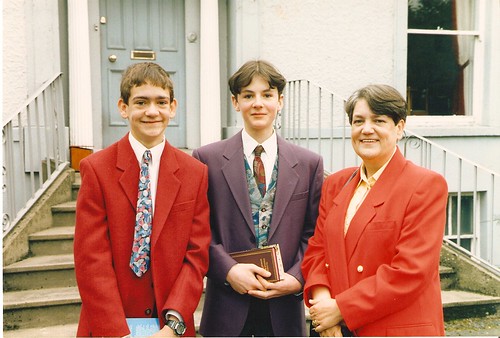
Despite going to different secondary schools, we stayed in touch, still going to Sunday School together, and then being Confirmed on April 9th 1995.

Confirmation 1995

It's hard to believe that James has been dead for a year now, and yet one thing is certain - he has not been forgotten.

Friday, February 20, 2009

Bondage to Decay

Have you noticed that things don't last too long. The oranges in the fruit bowl look delicious, but soon turn too soft and mouldy. The yoghurt and milk has turned, with the accompanying foul smell. The bread develops the colourful blue mould. Perishables go off, and have to be thrown out, if not used quickly enough. We're all too familiar with the Best Before Date and the Use By dates on food items. Ever wonder why this is? Why are things good for a little while, then all decays?

We might realise that it's all because of our sin. Originally, things were perfect, and were made to last. But that all changed. We thought that we could do a better job of running things.

Yet it might surprise you to learn that it was God who brought about the processes of decay and rotting. We read this in the letter to the Romans:

For the creation waits with eager longing for the revealing of the sons of God. For the creation was subjected to futility, not willingly, but because of him who subjected it, in hope that the creation itself will be set free from its bondage to decay and obtain the freedom of the glory of the children of God. For we know that the whole creation has been groaning together in the pains of childbirth until now. (Romans 8:19-22)

When we see things rotting and spoiling, it is to remind us of our sinfulness, and to point us to a better reality, an everlasting kingdom which is to come. Just as the creation groans - rocks, hills, trees, flowers, cows, milk, oranges - waiting for the restoration and renewal of all things in the new heavens and the new earth, so we are to look forward with the anticipation of hope. A good lesson to bear in mind when clearing the fridge and taking the rubbish out to the bin.

Tuesday, November 25, 2008

Tragedy


We're all still in shock after the sudden death in tragic circumstances of Constables James Magee, Kenny Irvine, Kevin Gorman and Declan Greene between Warrenpoint and Rostrevor early on Sunday morning. I simply couldn't believe the news when I heard it.

James was my best friend in Primary School. We grew up together, both in School, Church and Sunday School. He didn't live very far away, and we spent lots of time playing together. Despite going to different secondary schools, we stayed in touch, and were Confirmed on the same day.

In recent times we haven't seen much of each other, apart from singing in the Cathedral Choir. When he got the job in the Police Service of Northern Ireland, he was delighted - he was made for the job. It was his calling. One night last summer I was down in Kilkeel to see a band parade, and bumped into James. He was on duty, and was telling me how much he loved his job. A great policeman. Cut down in his prime.

And tomorrow, we will gather in the Cathedral for his funeral service. Much too soon for one with great promise. Please pray for Bawn and Freda, and Sarah and Rachel as they come to terms with this tragedy. And pray for the Greene, Gorman and Irvine families too.