Sermons, book reviews and randomness from the Reverend Garibaldi McFlurry.
Showing posts with label creation. Show all posts
Sunday, September 08, 2019
Sermon: Genesis 2: 4-25 Beginnings - Provision
I see trees of green, red roses too,
I see them bloom for me and you,
and I think to myself, what a wonderful world.
And if you were here last week, you’re thinking to yourself, ‘The Rector has picked up last week’s sermon. Are we going to hear it all over again?’ You’ll be relieved to hear that it’s not the same sermon again. But perhaps as I read Genesis 2, you were thinking that it seems awfully similar to Genesis 1. After all, it’s another telling of the creation story. So what’s going on?
Think for a moment of watching football on TV. When a goal is scored, they don’t just show it from one angle - they show it from one side, then the other, then from behind the goal, and from overhead. You get a bigger picture when you see it from different angles. And that’s part of what’s going on here. But also, while it looks as if it’s the same old story again, this is a new departure - the story is going somewhere.
You can tell that by the start of verse 4. ‘This is the account of the heavens and the earth when they were created.’ The way that line starts is the way the writer of Genesis divides up his material. You see, we’re so used to chapters in the Bible - so it seemed strange that last week we read a chapter and a bit. But Genesis is divided up by the places where it says ‘This is the account of...’ (or ‘These are the generations of...’ in the ESV). There are eleven of these, each time indicating a new part of the story, the next stage of God’s unfolding plan. (e.g. 5:1, 6:9 etc)
And what do we find in this account of the heavens and the earth? We find that the subject is God. It’s all about what the LORD God did and is doing in his world. God is active, working, creating, fulfilling his plans and purposes for his creation. He’s putting the patterns in place in God’s big design. And he is providing all that we need.
But that’s maybe to get ahead of ourselves. Because as we begin the chapter, people aren’t around yet. We get an idea of the timeframe in verse 4-6. The shrubs and plants of the field haven’t sprung up yet. They’re ready, they’re full of potential, but they haven’t grown up yet because: ‘for the LORD God had not sent rain on the earth and there was no man to work the ground, but streams came up from the earth and watered the whole surface of the ground.’ (5-6) Maybe that sounds like paradise - no rain and no men. But of course, there are no women either! Not yet!
That’s all about to change, though, as God makes man. ‘the LORD God formed the man from the dust of the ground and breathed into his nostrils the breath of life, and the man became a living being.’ (7)
Can you remember what we saw last week? How did God create everything else? How did light come about? God spoke, and it was so. He said something, and it happened. His words were powerful. But here, God gets his hands dirty. He formed the man from the dust of the ground. He scoops up some mud, like a child playing with plasticine or playdough, and forms the man.
And that’s not all - he also breathes into his nostrils. This isn’t the Sistine Chapel image by Michaelangelo (as seen on the opening of The South Bank Show), you know the one, the finger of God touching the finger of Adam and zapping him into life. No, God gives the kiss of life, breathing life into his creation, this first man.
And God is the God who provides. He provides a home for the man, in the Garden of Eden. When you hear Eden, you think of paradise - and so this is God’s Ideal Home Exhibition and the Chelsea Flower Show all in one. All kinds of trees are there - ‘trees that were pleasing to the eye and good for food.’ And right in the centre of the garden are two special trees - the tree of life and the tree of the knowledge of good and evil.
The paradise God provides is also supplied with water - a river flowing from Eden, dividing into four headwaters (slightly tricky to pronounce); and there is even gold, and resin and onyx all provided.
God provides a home, and water, and work. You see, the man isn’t in paradise just to lie back and take it easy. He’s there ‘to work it and take care of it’ (15). The man’s task is to work the ground, to extend the kingdom of Eden into all the world, and to take care of it - to guard it and keep it. So work isn’t something that only started after the fall (even though it can sometimes feel that way) - work is part of God’s plan. [Next week we’ll be thinking about the idea of vocation in work and ministry]
God has provided a home, and water, and work, and food. In Eden, though, there aren’t any juicy steaks or chicken dinners. The food is hanging on the trees: ‘You are free to eat from any tree in the garden; but you must not eat from the tree of the knowledge of good and evil, for when you eat of it you will surely die.’ God provides the fruit as food - and God also provides a warning, a barrier. There’s an abundance, but there’s one tree he can’t eat from. Just one restriction in a garden full of trees. This is God’s only commandment - will Adam obey or not?
We’ve seen how God has provided so much - a home, water, work, food, his good command - and you could think to yourself, what a wonderful world, what a perfect paradise. And you’d be right. The echoing chorus of last week - And God saw that it was good - could come again. But suddenly, right in the middle of Eden, there is something that is not good. Verse 18: ‘The LORD God said, “It is not good for the man to be alone. I will make a helper suitable for him.”’
Remember that we’ve been made in God’s image - for love and community as well as for God’s plan and purpose - and so it’s not good for this man to be alone. He needs a helper, someone to share in his work and his world. And so the search is on. God brings all the beasts of the field and the birds of the air to the man. The man names them, exercising authority over them. Can you imagine what that was like? After he has named them all, aardvark to zebra and everything in between, he has come to the end, but ‘for Adam no suitable helper was found.’
So again, God takes the initiative, and performs surgery. He causes Adam to fall into a deep sleep, takes a rib, and makes a woman from the rib. Matthew Henry, writing in the 1700s, said this: ‘Women were created from the rib of man to be beside him, not from his head to top him, nor from his feet to be trampled by him, but from under his arm to be protected by him, near to his heart to be loved by him.’
And then comes the moment of meeting, when the man and the woman are introduced. And for the first time in the Bible, the man speaks:
‘This is now bone of my bones
and flesh of my flesh;
she shall be called woman
for she was taken out of man.’
It’s the original love poem, for the very first love story. And do you see how man and woman are so intimately connected? Bone of my bones, flesh of my flesh. And our English words with the common part of ‘man’ in both - man and woman reflect the Hebrew words ‘ish’ and ‘ishah’. Equal but different; the complementary nature of male and female. And that’s reflected in God’s plan for marriage, as we see in the next verse:
‘For this reason a man will leave his father and mother and be united to his wife, and they will become one flesh.’ (24)
God’s pattern for marriage is one man and one woman living faithfully together for life in a public covenant. The two become one. And in our New Testament reading we see that Jesus, when asked about marriage and divorce, refers back to this verse as the foundation for the Bible’s teaching on sex and marriage. Marriage is God’s idea, his plan. And so the man and his wife were naked, but felt no shame.
In Genesis 2, we’re still marvelling at the wonderful world God has made; we get a glimpse of God’s perfect paradise; and in a sense, we wish we were there. We know that paradise has been lost, but God is still the same God, who is a generous and gracious provider. And here we see the ways in which God provides - a home, and water, and work, and food, and companionship, and marriage.
When you realise just how much God has given to us, it should move us to praise and thanksgiving - to say thank you to God for the many, many ways in which he has provided.
So let’s do that; let’s pause and take a moment, quietly, to thank God for his provision. Let’s pray.
This sermon was preached in St Matthew's Church, Richhill on Sunday morning 8th September 2019.
Sunday, September 01, 2019
Sermon: Genesis 1:1 - 2:3 Beginnings: Creation
I see trees of green, red roses too,
I see them bloom for me and you,
and I think to myself, what a wonderful world.
I’m sure you know that song by Louis Armstrong. He sings about all sorts of things - skies of blue, clouds of white, colours of the rainbow, the faces of people, friends shaking hands, babies crying. And his end point is: ‘Yes I think to myself, what a wonderful world.’
What is it for you that makes you think of how wonderful our world is? Perhaps it’s the way your garden grows up; or a beautiful landscape or spectacular mountain range; or some of David Attenborough’s wildlife programmes. Whatever it might be, your wonder is inspired and you’re amazed, and perhaps it even leads you to ask the question - where did this wonderful world come from?
As you’re probably aware, many people think that this wonderful world came about by pure random chance. Some sort of chemical reaction, a big bang of some kind, and it just so happened to produce everything that we see in this wonderful world. We started with a song - so here’s another, the theme song to The Big Bang Theory:
Our whole universe was in a hot, dense state
Then nearly fourteen billion years ago expansion started, wait
The earth began to cool, the autotrophs began to drool
Neanderthals developed tools
We built a wall (we built the pyramids)
Math, science, history, unraveling the mysteries
That all started with the big bang! Hey!
The book of Genesis tells us how the world came about - not by random chance, but by the direction of the God who made everything. So who is the God we are introduced to in this opening chapter of the Bible?
He is the eternal God. Look at verse 1: ‘In the beginning God created the heavens and the earth.’ The word ‘Genesis’ means beginnings - we hear of the beginning of the heavens and the earth, but God already existed. God was already here before the beginning. He is the eternal being - the creator of time itself, but himself without beginning or end - the Alpha and the Omega.
The eternal God is also the God who speaks. You can’t miss it in this chapter. Verses 3, 6, 9, 11, 14, 20, 24, 26, 29 contain either ‘And God said’ or ‘Then God said.’ God is a speaking God. He didn’t just speak creation into being, he has also revealed it to us. Back in the day, day one of creation, there was no Facebook or Twitter; no one was live-blogging creation as it happened; making snap judgements on what had happened. People hadn’t even been formed yet. We wouldn’t and couldn’t know about how God created if he hadn’t told us. And so he revealed it to Moses, who wrote it down for us.
Genesis is not necessarily a ‘how to’ - even though the order and sequence of creation is being corroborated by the work of scientists. God is showing us the ‘why’. God speaks, and tells us what we need to know about himself, and ourselves and our place in his creation.
The eternal, speaking God is also the God of power. We see this because when God speaks, things happen. Have you ever had the frustration of saying something and nothing happens - telling the kids to get ready for bed; or asking for a cup of tea - you might as well be talking to the wall! But not so with God. Look at verse 3. ‘And God said, “Let there be light,” and there was light.’ He just says it, and it happens. Do you see that pattern running through the chapter? ‘And God said... And it was so.’ (7, 9, 11, 15, 24) God is powerful, his words have power.
And what is it he says - this eternal, powerful, speaking God? His words show that he is the God of order. In verse 2 we see that the earth was ‘formless and empty’ (tohu wabohu). As the days of creation unfold, we watch as God forms the world (days 1-3) and fills the world (days 4-6).
There is separation as God forms the world - separating the light from the darkness (day 1), separating the waters under and above the sky (day 2), and separating the day land and the water (day 3). And then he repeats the pattern, as he fills the world - light and darkness match up to the lights in the expanse of the sky, the sun and moon [which aren’t even named, as some of the Israelites’ neighbours worshipped the sun and moon - Genesis reminds us that God made the sun, the moon, and v16 ‘he also made the stars’ - we worship the creator, not the creation]; the waters and sky of day 2 are filled by the fish and the birds of day 5; and the dry land is filled by animals and people (last of all) on day 6. God is the God of order.
The eternal, powerful, speaking, orderly God is also good. And the things he makes are good. Did you notice the constant chorus, the repeated refrain: ‘And God saw that it was good.’ The good God works goodness, and when he makes humans, the climax of all his work, we see God’s verdict on everything in verse 31: ‘God saw all that he had made, and it was very good.’
The God who made everything is the eternal, powerful, speaking, orderly, good God. And this is our God: Father, Son and Holy Spirit. Right at the very beginning we see God the Father, who creates and speaks; we see the Spirit of God hovering over the waters; and we see the Son, the Word of God, by whom all things were made. There is one God, in three persons - the Trinity. And we see that again in verse 26: ‘Then God said, “Let us make man in our image, in our likeness.”’ If not the Trinity, then who would God be speaking to or about when he says ‘Let us...’
This is the God who made everything: the eternal, powerful, speaking, orderly, good God who made the first humans in his own image and likeness. It is only as we see and know the God who made us that we can see who we are.
In Genesis 1:27 we find the only rational foundation for human rights. The secular world argues strongly for human rights, but underneath they have little basis for equality and rights; and that’s why many reckon that the unborn, the elderly and the sick should be conveniently dealt with. But here we see that every human, male and female, is made in the image of God and is precious.
We also see our purpose in verse 26: ‘Let them rule over the fish of the sea and the birds of the air, over the livestock, over all the earth, and over all the creatures that move along the ground.’ And it’s found in the blessing God gives in verse 28: ‘Be fruitful and increase in number; fill the earth and subdue it. Rule...’
We have been made according to God’s plan and purpose, shaping the world and us by his power and goodness to be like him and image him to the world - in love and community, dependent on our maker who gives us our place as stewards over the creation, and gives us food and everything we need for life in this world. We are called to care for creation, under God’s rule and care.
The good God made everything good. And we continue to get glimpses of what a wonderful world we live in. But alongside the trees of green and red roses too, our world is also full of pain and sadness and sickness. In a few week’s time we’ll see how that came about, but this morning we acknowledge that God’s good world has been marred and broken by sin; just as God’s image in us has been marred and broken by sin. We have turned our backs on God; we have exploited and abused his good gifts to us.
But one man did walk on the earth, perfectly displaying what it is to be the image of God. God himself became one of us. The Word became flesh and dwelt among us.
The Lord Jesus calls us back to relationship with him; calls us to turn to him by faith; to receive his blessings (won for us by his perfect life and spotless, sinless death); and to enter into his rest. God made the heavens and the earth and everything in six days, and on the seventh day he rested. It wasn’t that God was tired after all his work and needed to take it easy for a day or so. No, it was a day of enjoying all he had made, a day of blessing.
On the seventh day, the pattern is broken. Six days of work, one day of rest. And that’s what we find in the Ten Commandments also. But notice also that the pattern of numbering the days is broken. In verse 5, 8, 13, 19, 23 and 31 we have a pattern: ‘And there was evening, and there was morning, the ...th day.’ But for the seventh day, you don’t get the same. The pattern is broken. And that’s an indication that God is continually resting from his work of creation - an unending Sabbath rest, which he is inviting us to share in.
Our weekly rest day (now the first day of the week, the Lord’s Day), when we rest from our labours, is a sign and symbol pointing forward to the perfect rest of heaven. Jesus invites us to share in his rest - a rest from labours, a rest from trying to earn our way, a rest from religious striving, and to instead receive his blessing and his rest:
‘Come to me, all you who are weary and burdened, and I will give you rest.’ (Matthew 11:28).
This is our God: the eternal, powerful, speaking, orderly good God who is Father, Son and Holy Spirit. We are made in his image, made for his purpose, and made for relationship with him. Will you come to him, and find your true identity in him today?
This sermon was preached in St Matthew's Church, Richhill on Sunday morning 1st September 2019.
Friday, September 13, 2013
Sermon Audio: Psalm 19
On Sunday evening in the Brooke Hall I was preaching from Psalm 19. There we find a chorus of voices joining to declare God's glory in the heavens and the scriptures. Will our hearts be in tune with the universe so that we desire God's glory?
Labels:
Bible,
creation,
Psalms,
sermon audio
Tuesday, September 10, 2013
Sermon: Psalm 19: 1-14 Declaring God's Glory
“You’re not even listening!!!” You’ve zoned out, you’re miles away, and those are the first words you hear. Disaster (or so I’ve heard...), as you try to think back to what might have been said; the important instructions about the washing machine or what’s needed from the shops.
I like to go people watching sometimes. You’ve a spare half hour, and so you walk along the street, or you sit on a bench or in a coffee shop, and watch the people going by. You hear snatches of conversation; you catch stories being shared, but often times there are so many voices, such a cacophony of noise, that it’s good to get some peace and quiet.
Voices. Speech. With 24 hour news, TV stations and radio stations broadcasting all through the day and the night, there is always someone speaking. At least you’ll get peace when you’re in bed, unless your spouse is a sleeptalker. Voices are all around us, but David points us to another voice with a unique message. But you don’t need your ears - rather it’s a bit like the BBC programme: ‘See Hear’. All we need to do is look up.
‘The heavens declare the glory of God, and the sky above proclaims his handiwork.’ (1) The skies above us are speaking, their voice goes out to the whole word, pouring out speech and revealing knowledge. Just look at the first four verses and see all the ‘speaking’ words. Declare, proclaim, speech, words, voice...
As David looks up, perhaps as he was watching the sheep, he hears the declaration of God’s glory. The sky, the sun, the moon and stars all proclaim that God made them. They cry out to anyone who will listen. But when was the last time you tuned in? Just think of the spectacular sunset you saw (not this evening anyway) - it was telling you about God’s glory. But not just the sunset - the way the sun ‘runs’ across the sky is a witness; it’s as if it is a bridegroom running to meet his bride; a champion running for the finish line.
The heavens are speaking; they are telling all who will listen of the power and glory of the God who made them and put them in place. Are you listening?
So we’re getting through the Psalm, you know where David is going with it, but then, it seems that he has gone off in a completely different direction. When you’re buying a secondhand car, you have to watch out for a cut and shut. That’s where you had two cars - one damaged at the front, the other at the back, so the two cars are cut up, the good bits put together and made to look like a normal car. Is that what’s happened here? There’s a psalm about the skies, another about the law, so slam them together and don’t pass any remarks?
Now if you thought that was strange enough, what about the bit that David says next? You’ve made it over the gap, and then he says ‘The law of the Lord is perfect, reviving the soul.’ When you hear of law, what do you think of? You might have in mind pictures of courts and judges and prisons. Hardly something that gives life and reviving?
The law of the Lord, though, isn’t just law, it’s the whole of the first five books of the Bible. It’s the teaching of the Lord, the teaching about the Lord. You see, this isn’t a big leap at all - from creation’s voice to the Bible’s voice. The law of the Lord also speaks of God’s glory, as it reveals God to us, in relationship - Lord, rather than God. That’s why David can say that the perfect, sure, right, sure law revives the soul, makes the simple wise, rejoices the heart and enlightens the eyes.
Even the commandments and rules and law of the Lord is precious. It’s more to be desired than gold; and sweeter than honey. Is this what we think of the Bibles in our homes? Precious and sweet? Or something that sits on a shelf?
We don’t just read the Bible to become Bible quiz geeks. Every year at our Boys Brigade Camp there was a Bible quiz on the Sunday night. There was always great competition to see which team would win. But much more important than a Mid-Ulster battalion medal, the Bible reveals God himself. The Bible speaks, telling us of God’s glory, laying out the warnings and rewards.
On Friday night I was in Belfast at the Northern Ireland football match. The chants start off quiet, one or two voices, but before long, most of the ground are singing along. In fact, it’s a good job the match was on Friday night rather than last night. There’s something powerful when different voices join together - in a choir or as we say the responses together, or when a crowd gets behind their team. The voice of the heavens joins with the voice of the Bible to declare and proclaim the glory of God in creation and in scripture. But to these is joined a third voice. David himself, the author of the Psalm, now joins in, seeking to align himself with the way the world is.
In verse 12, he recognises that the whole universe is ablaze with the glory of God, but he is out of step. ‘Who can discern his errors?’ Faced with the glory of God in creation and in scripture, we’re confronted with our sinfulness. Some choose to put their fingers in their ears and refuse to listen. It’s the point Paul makes in Romans 1:18-20, as we suppress the plain truth about God, seen in creation, but turn away from him. It’s the tactic we all try, but it’s unsuccessful. We are without excuse.
Rather, the Bible calls us to turn, to re-align ourselves with God, to repent as we confess our sins. It’s what David says: ‘Declare me innocent from hidden faults.’ It’s when we do this that we find ourselves in tune with the universe. The heavens declare God’s glory. The law of the Lord declares God’s glory. And now we see that David desires God’s glory. Having turned from sin, his desire is to please the Lord. The last verse isn’t just a nice wee prayer before a sermon. It’s a prayer for every moment of every day, that we will live for the glory of God.
Just as the heavens speak of God’s glory, so our prayer is that the words of our mouths will also point to God’s glory. Just as the law of the Lord performs heart surgery on us, reviving the soul and rejoicing the heart, so our prayer is that the meditation of our heart will tend to the glory of God. It’s as we admit that often our words and our thoughts aren’t in tune with God’s glory that we can be mindful of the need to change. David asks, prays, in this verse, as he sums up the whole psalm, that God’s glory will be his supreme purpose. Will you make this your prayer tonight?
This sermon was preached in the Brooke Memorial Hall, Brookeborough on Sunday 8th September 2013.
Labels:
Bible,
Bible study,
creation,
Psalms,
sermons
Tuesday, March 19, 2013
Sermon Audio: Psalm 139

Last Wednesday I was preaching from Psalm 139 in our 'Cries From The Heart' Lent Midweek sermon series. Here's how it sounded.
Labels:
creation,
God,
Psalms,
sermon audio
Friday, December 14, 2012
Book Review: Genesis in Space and Time
Day Five in the Genesis book tour.
This was the first book I've ever read by Francis Schaeffer, and I must confess, it took me a little while to get into his writing style. Some of the other books I've reviewed this week were more readable, but having got used to Schaeffer, there were lots of helpful insights in Genesis in Space and Time.
With a perhaps more philosophical approach, Frank Schaeffer underlines the importance of Genesis:
I wish to point out the tremendous value Genesis 1-11 has for modern man. In some ways these chapters are the most important ones in the Bible, for they put man in his cosmic setting and show him his peculiar uniqueness. They explain man's wonder and yet his flaw. Without a proper understanding of these chapters we have no answer to the problems of metaphysics, morals or epistemology, and furthermore, the work of Christ becomes one more upper-story 'religious' answer.
The book charts the 'flow of biblical history' through the opening chapters, with a good reflection on the wonder of creation (and of the 'time' before time - my term, not his). As he explores the revelation of God as Trinity in the creation, as well as the power of God, creating by divine fiat, the spirit soars. On the creation of man, he is perhaps at his finest:
A man is of great value not for some less basic reason but because of his origin. Thus the flow of history has tremendous implications for every aspect of our lives. I stand in the flow of history. I know my origin. My lineage is longer than the Queen of England's. It does not start at the Battle of Hastings. It does not start with the beginning of good families, wherever or whenever they lived. As I look at myself in the flow of space-time reality, I see my origin in Adam and in God's creating man in his own image.
Schaeffer doesn't confine himself to Genesis only, but makes connections with the rest of the scriptures, tracing the lines from the fall through to the cross and beyond. Despite my initial uncertainty, I'm definitely glad I made it through the book and benefited from Schaeffer's contribution. While some of the other books might only be of interest to the person specifically studying Genesis, this would be a great book for any student of our culture; people wondering why the world is the way it is, and what can be done about it; and all those wanting to grow in apologetics reasoning and engagement.
Labels:
apologetics,
Bible study,
books,
creation,
Genesis,
reading
Thursday, December 13, 2012
Book Review: God's Pattern for Creation
Day Four in Genesis week on the blog. This time, the book under review is God's Pattern for Creation: A Covenantal Reading of Genesis 1 by W Robert Godfrey. This was a little shorter than some of the other books, but then it does only deal with the first chapter of Genesis. However, it was still a useful addition to the reading I had undertaken, helping to shape the important first sermon in the series by focusing on the order and plan of creation, through the lens of the covenant.
It's essential to start well, as the author points out: 'Beginnings are important, and if we want to understand the teaching of the Bible as a whole, it is vital to understand what it teaches about creation.' Noting the challenges to the authority of Genesis in revealing the work of creation, he declares that: 'In some ways such controversy is a good sign for the people of God. It means that people are studying Genesis 1 with great interest and care.'
The structure of the book is very simple, and follows Godfrey's reading of Genesis 1: the first three days; the last four days; and then the message of the chapter. He demonstrates his interest and care as he carefully examines the text of Genesis and draws out the meaning of the words, and how they fit together. He notes the patterns of words - not just the seven days, but also the threefold use of 'create', as well as the seven 'and it was so' uses, and the ten 'let there be' and 'make'. There are useful figures and diagrams, setting out the chiasms found in the text, again highlighting the structure carefully written by Moses as led and inspired by the Holy Spirit.
The issue of the seventh day - the Sabbath - takes up a lot of space, as he discusses the options of what the rest day means for God and for us, and its connection to the 'rest' to which Hebrews points us forward. His conclusion is interesting:
All of our considerations of the Bible's teaching on days and time should lead us to the conclusion that the days and week of Genesis 1 are presented to us as a real week of twenty-four-hour days. These days and week, however, do not describe God's actions in themselves but present God's creative purpose in a way that is a model for us. The purpose and message of Genesis 1 is that God created the world for humankind - a world in which man could be the image of God in his working and his resting.
While there may come a stage when you've read so many different points of view that you become totally confuddled, this book didn't add to the confuddling. While it's short, it's a great help in getting to the original language of the text (without a Hebrew character appearing in the book), and would be useful for anyone wanting to think further about the order and purpose of the days of creation. The summary at the end, presenting ten theses on creation, is spot on in providing the takeaway message.
Labels:
Bible study,
books,
creation,
Genesis,
reading
Tuesday, December 11, 2012
Book Review: Seven Days That Divide The World
It's Day Two of my Genesis book reviews, and perhaps appropriately, it's a book that deals with the creation days themselves. This wasn't strictly part of my sermon series prep, but further background reading by an author I respect on a related topic. John Lennox is emerging as one of the leading Christian apologists in the realm of science and evolution, so it was interesting to read his take on the creation.
It might be a recurring observation by all the writers this week, but Genesis is not an easy subject: 'The biblical announcement of the fact of creation was as timelessly clear as it was magnificently appropriate. However... when it comes to the timing and means of creation... people over the centuries have found the book of Genesis less easy to understand.'
Lennox declares that 'the topic is clearly a potential minefield.' Yet he continues to argue that there is hope of a harmony of the Bible and science both properly interpreted. After all, belief in creative intelligence was the starting point for modern science, which therefore doesn't disprove God's existence. Indeed, Lennox examines the trouble surrounding Galileo, that famous test case of religion against science. Rather, 'The conflict was far more between two 'scientific' world pictures than between science and religion.'
Continuing to discuss bible interpretation, Lennox points to a number of examples where the 'literal' sense of the words used can be inadequate and even misleading - 'since there can be different levels of literality.' So, with the discovery that the earth revolves around the sun: 'Even though our interpretation relies on scientific knowledge, it does not compromise the authority of Scripture.' Therefore: 'The Galileo incident teaches us that we should be humble enough to distinguish between what the Bible says and our interpretations of it.'
With this foundation in place, Lennox examines the text of Genesis 1 to discover what it actually says. He explains that there are a variety of meanings for the word 'day' in the Hebrew, whether the period of sunlight; a twenty-four hour period; or an age. He also considers the possibility of the six creation days being solid days, but spaced throughout a longer period of time (ie not just in the one week).
Moving on, the problems of the origin of humans and death are raised. Were Adam and Eve just a pair of humanoids that God decided to begin with, or were they a special creation? Did evolution play a part in their rise? Did death exist before the fall? Lennox' answer seems to push for an ancient world, with an attitude of humility as the 'best fit' for the evidence of Scripture and science.
His fifth and final chapter appears to be the strongest, as he turns from science to focus instead on the message of Genesis 1, displaying the truth it reveals of God to the reader. In a series of simple points, Lennox again and again points to the God who is, the creator, the one who formed us, and calls us to relationship with him.
There are also a number of interesting appendices, providing a background to Genesis, an examination of the Cosmic Temple view, thoughts on the beginning of time, a brief discussion of the suggestion that there are two accounts of creation, and an analysis of theistic evolution and the God of the gaps.
All in all, it's a book that will raise the salient points in the discussion and provide much food for thought. I'm not sure that I agree with all his conclusions, but at least I've been provoked to think more carefully about my position, and am now better informed about the issues. Any book by Lennox also equips the reader for apologetics, which is also a bonus!
Labels:
apologetics,
books,
creation,
evolution,
Genesis,
postmodernism,
reading
Monday, September 17, 2012
Sermon: Genesis 2:4-25 The God Who Provides
Have you ever watched a football game in the stadium? Your team scores a goal - it's very exciting, but from your seat, you might not have been able to see how it happened. Sometimes it's better to watch the game on TV, because the cameras can show lots of different angles - you get the same event, from different viewing points.
It was the same with the Olympics. You might have been watching the judo or the hockey, or maybe even the track events. The TV cameras gave you lots of views of the same event. You knew what was happening better than just having the one angle.
When you open up your Bible and begin to read, you might wonder why we have what looks like two creation stories. In Genesis 1, we have the six days of creation laid out. So we know what happened. But then you continue reading into chapter two, and discover another bit about creation. What's going on?
Well, just like our TV cameras, we're being given the same event, from a different angle. There's a different point being made, but the same thing is being described. In Genesis 1, we discover the God who made everything. We noticed the pattern in the chapter: 'And God said... it was so... it was good.'
When we move into chapter two, we have another view, a different camera angle. This time, the focus is on the people God made, as we discover the God who provides.
We're told that God had made the heavens and the earth. There are no shrubs or plants (5) for two reasons: 1. there was no rain (now, wouldn't that be a lovely thing, if we had no rain. I know a few farmers who would be glad of no more rain for a while!) - the earth was watered by streams coming up. and 2. there was no man to work the ground.
God makes man.
Have you ever heard the little rhyme:
What are little boys made of?
Slugs and snails
And puppy-dog tails
That's what little boys are made of.
What are little girls made of?
Sugar and spice
And all things nice
That's what little girls are made of.
Or so they say! It's just a wee saying, but here we're told that God made Adam (whose name means from the ground) from the dust of the ground. It's been worked out that if we were to figure out all the chemical elements in the human body - oxygen, hydrogen, potassium, calcium and so on, we would have a market value of about $5.
But we're much more valuable than that. You see, God forms the man, and breathes his life into him. God places him in the garden at Eden, where we find him richly provided for:
There are trees, pleasing to the eye and good for food - his hunger is provided for. There is water in the river (with all those hard to pronounce rivers) - his thirst is provided for. There is work in the garden - his labour is provided for.
It's then that we hear a loud siren ringing. It's as if an alarm has sounded. Suddenly, we discover that something is not good. You remember all the way through Genesis 1 there was the pattern: 'And God said... it was so... it was good.' Now there is something that is not good.
God says that it is not good for the man to be alone. He needs a helper suitable for him - a partner in his life and work.
God brings a parade of all the animals to Adam; Adam names them; controls them; and we're going to think about some of those animals now.
Challenge 1: Give each child some plasticine (or play dough), and ask them to quickly make an animal [When I used this talk, we got some snakes and a worm, but also a hedgehog, a pig, a dog, and lots more imaginative creatures!]
Challenge 2: Work from A to Z with the children (and adults) shouting out animals (or creatures) for each letter [We came stuck at U - until someone shouted unicorn!!!]
We've thought about lots of different animals. Yet when Adam had considered all the animals, none of them was a suitable helper for him. What was it Adam needed? Eve!
And so the woman is formed out of the man - not from his head to rule over him, nor from his foot to be trodden by him, but from his rib to be protected by his arm, close to his heart, and side by side.
God brings Adam and Eve together - the same, but different, to be joined together in the work God has for them to do.
So what does this passage teach us? We see that God provides - the garden, work, food, partnership, family. We have been made according to God's plan and purpose for a role and task. Let's find it, and do it, for his glory. Amen.
This sermon was preached at the Family Service in Aghavea Parish Church on Sunday 16th September 2012.
Labels:
creation,
Family Service,
Genesis,
sermons
Wednesday, September 05, 2012
Sermon Audio: Genesis 1:1 - 2:3
On Sunday morning we began a new series in Genesis, as we discovered the God who made everything - the eternal, speaking, powerful, orderly, good God who made us in his image.
Labels:
creation,
Genesis,
sermon audio
Sunday, September 02, 2012
Sermon: Genesis 1:1 - 2:3 The God who made everything
Every so often, I get some strangers calling to the Rectory. More often than not, they’ve travelled a long way - from America, or Australia. As soon as I hear the accent, I know what they’re looking for: old church records of baptisms, marriages and deaths. They’ve returned to the homeland, they’re trying to trace their great, great grandparents. At the root of their search, though, is the big question: who am I? Where did I come from? What is my background?
Over the course of the autumn, these are the questions we’re asking as well. But we’re not just going back two or three generations. Rather, we’re going right back to the start, to our first parents, as we trace the opening chapters of the book Genesis. One preacher describes this whole section as the seedbed of the Bible. It’s here that we’ll discover who we are; why the world is this way; and see how our salvation story begins.
Now as we begin to think about where we came from, how the world began, we realise that there are lots of different ideas floating around. In the time of the ancient Israelites, the surrounding nations believed that there were lots of gods who were a bit bored one day and decided to make humans; others believed that one of the gods had a battle with a great sea monster, out of which he made the earth. We’ll see that Genesis stands in opposition to those pagan stories.
Today, there are also competing stories of the beginning. New Atheists like Richard Dawkins attributes the Big Bang and all of us existing as pure random chance. Macro evolution - where all forms of animal life developed from the same simple root - is declared to be how we got to where we are.
Genesis will not allow us to bow down to randomness - rather, in this first chapter, we find the good God who made everything. You might find it useful to have your Bible open, as you follow along. So who is the God we are introduced to in this opening chapter of the Bible?
He is the God of eternity. Look at the opening words: ‘In the beginning, God created the heavens and the earth.’ Genesis means ‘beginnings’ - we hear of the beginning of the heavens and the earth, but God already existed ‘in the beginning God’. It’s not that God was somehow made first - God always existed. He is the eternal being. (You might remember that we saw a hint of this in Ephesians 1:4 ‘just as he chose us in Christ before the foundation of the world’). God is eternal, the creator of time itself, without beginning or end, the Alpha and the Omega (the A and the Z, in our language).
This eternal God is also the God who speaks. It’s one of the things you can’t miss in this chapter! Each part of the creating comes about by the words: ‘Then God said... And God said...’ God is not silent - you see, he doesn’t just speak creation into being, he has also revealed it to us. Back in the day (day one, that is), there was no Facebook or Twitter; no one was live-blogging creation as it happened. People hadn’t been formed yet. We wouldn’t and couldn’t know about God creating if he hadn’t told us. He revealed it to Moses, who wrote it down for us.
Now Genesis is not necessarily a ‘how to’ - even though the order and sequence of creation is being corroborated by the work of scientists - God reveals to us the ‘why’. God speaks, and tells us what we need to know about himself, and about our place in his creation.
The eternal, speaking God is also the God of power. We see this because when God speaks, things happen. Have you ever had the frustration of saying something and nothing happens - whether it’s asking your kids to make their beds, or your husband to make you a cup of tea - you might as well talk to the wall! Not so with God - look again at verse three. ‘Then God said, “Let there be light”; and there was light.’ Do you see the pattern right through? ‘And God said... And it was so.’ God is powerful, what he says is done.
And what is it he says, this eternal, powerful, speaking God? His words show that he is the God of order. Verse two says that the earth was a formless void - shapeless and empty. As the creation days unfold, we watch as God forms the world (days 1-3) and fills it (days 4-6), each day following the pattern: light (1) - sun and moon (4) [which aren’t even named as some of their neighbours worshipped the sun and moon - Genesis reminds us that God made the sun, moon and stars - we worship the Creator, not the creation]; waters and sky (2) - birds and fish (5); dry land (3) - animals and finally people (6).
We’ve had quite a few babies born over the summer. The families would have been busy making preparations, making sure the nursery was ready, the cot and pram and all the rest - we see that God forms and fills the earth, making it ready for us to live in.
This eternal, powerful, speaking, orderly God is also good. With each step, we’re told ‘And God saw that it was good’ - the good God works goodness, and with the creation of people, the climax of all his work, God declares that it was very good.
The final thing to notice about the God who made everything is that this is our God - Father, Son and Holy Spirit, the God who does not change. In the opening verses we find mention of God, of the Spirit of God hovering over the waters, and God speaking (God’s word - whom John reveals to be the Lord Jesus, God’s Son, by whom everything was made). We also see it in verse 26, when God says ‘Let us make humankind in our image, according to our likeness.’ Why the plural, if it is not the Trinity declaring together, speaking collectively as one?
This is the God who made everything, the God who made the first humans, in his own image and likeness. It is only as we see and know the God who made us that we can answer that question: who am I? You see, we were made according to God’s plan and purpose, shaping the world and us by his power and his goodness, to be like him - in love and community, dependent on our maker who gives us our place as stewards over the creation, and gives us food and everything we need for life in his world.
Even though this world has been marred and spoiled by our sin, even though we’ve turned our back on him, and exploited and abused his good gifts to us, one man did walk on the earth who perfectly displayed what it was to be the image of God, the one who was the Word made flesh, who dwelt among us.
The Lord Jesus calls us back to relationship with him, calls us to turn to him by faith, and receive his blessings (won for us by his death on the cross), and to enter into his rest - the weekly rest a sign and symbol pointing forward to the perfect rest of heaven, as he issues his invitation to us: ‘Come to me, all you who are weary and burdened, and I will give you rest.’ (Matt 11:28)
This is our God, the eternal, powerful, speaking, orderly, good God, Father, Son and Holy Spirit, who invites us to find our identity connected to him. Will you come to his table?
This sermon was preached in Aghavea Parish Church on Sunday 2nd September 2012.
Monday, May 07, 2012
Sermon: Psalm 8 What is man?
One of the things that we’ve quickly noticed since moving to Fermanagh is the quality of the stars at night. In Belfast, you might have seen a few stars, but with all the light pollution, it was hard to make out many. It would have been difficult to be amazed by the universe. But here, well, the view is wonderful! On a clear night you can see stars, and stars, and stars - more than I could have imagined!
Have you ever stopped to think about the greatness of the universe, and compared it to us, here on planet earth? There’s a famous picture taken by the space shuttle Voyager 1, taken four billion miles away, in which the earth appears as a ‘blue dot’. Someone referred to earth as ‘a mote of dust in a sunbeam.’
When you are confronted with all this, what do you make of it? How do you respond to the wonder of all that exists? Do you praise the big bang which brought all this into being by chance? Are you amazed by the randomness of it all? As King David surveys the skies, it moves him to praise - in the right direction:
‘O LORD, our Lord, how majestic is your name in all the earth!’ David looks at the earth, and sees the glory of God. David looks at the skies, and sees the glory of God. It’s what Paul later affirms in Romans 1: ‘For his invisible attributes, namely, his eternal power and divine nature, have been clearly perceived, ever since the creation of the world, in the things that have been made.’
God delights in the praise of his children - David says that he has established strength out of the mouths of babies and infants. Remember the scene as Jesus enters Jerusalem, and the children are crying out? Their praise silences the opposition, stills the enemy.
As David considers the heavens, he’s led to wonder. Here’s how he puts it: ‘When I look at your heavens, the work of your fingers, the moon and the stars, which you have set in place, what is man that you are mindful of him, and the son of man that you care for him?’
If we’re just a speck of dust floating in a sunbeam, and yet God cares for us, how amazing and wonderful is that? Why have you done this God? Why would you care for us?
Imagine someone who has served the community for years and years - a lollipop lady, or someone who fosters children. They quietly go about their business, and yet one day a letter from the Queen arrives, inviting them to receive an honour - an MBE or OBE. If you’ve ever seen someone like that interviewed on TV or in the local newspaper, they’ll be so humble, they never expected it. Who am I to receive this, they might ask.
David is saying who are we - what is man? But more than that, it’s not just a once in a lifetime honour - it’s ongoing care and love. If God is overseeing and ruling over the whole universe, then why would he be concerned with little old me? But he is!
And not just concerned with us, but given us a place of honour: ‘Yet you have made him a little lower than the heavenly beings and crowned him with glory and honour. You have given him dominion over the works of your hands; you have put all things under his feet...’
Isn’t this what happened at creation? God makes Adam and Eve and gives them the place of authority over the world, to rule it under God. We still have this role of oversight over creation - for better or worse, as things are going.
God gave Adam and Eve a share in his glory and honour. They were to rule over the creation, but as we all know, it went badly wrong. Rather than ruling under God, Adam and Eve tried to rebel against God’s rule, and set themselves up as supreme. Their place in the Garden was lost, the fall affected everything - weeds and thistles, hard labour, and pain in childbirth. One writer even goes so far to say that when birds or creatures fly or run away from us now they know that we’re in quarrel with their maker!
The good news is that God sent a second Adam to the fight, the new man, who would overturn the curse, and bring in the new heavens and the new earth. It’s the point that the writer to the Hebrews makes as he quotes these verses. He points to the son of man (a favoured title of the Lord Jesus), who was made for a little while lower than the angels, now crowned with glory and honour, with everything in subjection under his feet.
How amazing that the eternal son of God should give up his place in heaven for the sake of you and me, and take a step down. There’s a TV programme that’s on Channel 4 - undercover boss. The head of a company turns up in one of his branches as a new employee, and sees what it’s like to work at the bottom of the pile - experiencing the dirty jobs rather than the nice, pleasant office work. That’s a bit like what the Lord Jesus undertook - he went from the very top, down below the angels, to become man, to do that job that only he could - to die for our sins and our salvation.
As a result, he has been crowned with glory and honour, as he was raised from the dead and ascended to reign in heaven, at the right hand of his Father. But the writer to the Hebrews points out that the last wee bit hasn’t been completed yet:
‘At present, we do not yet see everything in subjection to him. But we see him who for a little while was made lower than the angels, namely Jesus, crowned with glory and honour because of the suffering of death, so that by the grace of God he might taste death for everyone.’ (Heb 2:8-9)
If we can paraphrase David, what are we, that you would give your Son for us? How worthy is the Lord Jesus to be praised and honoured, who gave up so much for us! As we look at the night sky, we may be moved and humbled by the array of stars, shining in their places. but even that is as nothing compared to the glory of the Lord Jesus, who stepped down for us, and died on the cross for you and for me.
Will you receive his love? Will you honour him? Count Nicolaus von Zinzendorf was converted as he gazed at a painting of the Lord Jesus, the scars of the cross visible, and the saying: ‘‘All this I did for thee, What hast thou done for Me?’ Jesus reigns, and one day soon everything will be under his feet. Will you come today, and praise him, and give your life to him?
This sermon was preached in the Brooke Memorial Hall, Brookeborough on Sunday 6th May 2012.
Tuesday, January 03, 2012
The Battle Within
There's a battle raging within me. I'm under attack. Despite coming a little later than usual, the post-Christmas cold has struck with a vengeance. I'm just thankful that it didn't happen before yesterday, when all the Christmas services and all the New Year services have been completed!
The battle is raging. My body is under attack from germs and bugs, trying to gain the upper hand. Right now, it seems as if they're winning. Tiny, microscopic organisms bringing down something so much bigger than them.
But it's not all one-sided. My body is fighting back. It is marshalling its own armies, fighting against the invaders, defending my body and boosting the immune system. The multiple hot drinks and tablets and soothers are helping the task by sending reinforcements. In a day or two, the battle will have been won, the aliens defeated and I'll be getting back to normal.

The human body is amazing - fearfully and wonderfully made, to quote a former King of Israel. It just gets on with the task of fighting infection, seeking to stay healthy, defeating the things that just shouldn't be there.
It reminds me of another battle that rages within, but one which isn't always as successful. Sin ravages and rampages within, seeming to have a free rein (and reign), but am I always as quick to fight against it as my body is to fight infection? The remedy is the gospel, the medicine supplied by the indwelling of the Holy Spirit, as we seek to fight back against sin, the world and the devil. Victory may be a longer time coming, but it is sure and certain one day - that same day that suffering and sickness and sadness will be no more.
The defeat of this sin-sickness will come courtesy of the red cross, where the blood of my Saviour was shed for me, and the unhealthy, miserable sinner will be made right and whole and healed. O Lord, give me grace for the battle, to stand in your victory, to battle against all that is sinful in me.
The battle is raging. My body is under attack from germs and bugs, trying to gain the upper hand. Right now, it seems as if they're winning. Tiny, microscopic organisms bringing down something so much bigger than them.
But it's not all one-sided. My body is fighting back. It is marshalling its own armies, fighting against the invaders, defending my body and boosting the immune system. The multiple hot drinks and tablets and soothers are helping the task by sending reinforcements. In a day or two, the battle will have been won, the aliens defeated and I'll be getting back to normal.

The human body is amazing - fearfully and wonderfully made, to quote a former King of Israel. It just gets on with the task of fighting infection, seeking to stay healthy, defeating the things that just shouldn't be there.
It reminds me of another battle that rages within, but one which isn't always as successful. Sin ravages and rampages within, seeming to have a free rein (and reign), but am I always as quick to fight against it as my body is to fight infection? The remedy is the gospel, the medicine supplied by the indwelling of the Holy Spirit, as we seek to fight back against sin, the world and the devil. Victory may be a longer time coming, but it is sure and certain one day - that same day that suffering and sickness and sadness will be no more.
The defeat of this sin-sickness will come courtesy of the red cross, where the blood of my Saviour was shed for me, and the unhealthy, miserable sinner will be made right and whole and healed. O Lord, give me grace for the battle, to stand in your victory, to battle against all that is sinful in me.
Monday, October 04, 2010
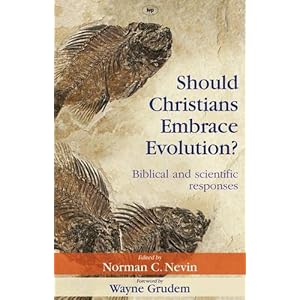
Book Review: Should Christians Embrace Evolution?

My reading seems to have a bit of a pattern to it. Throughout the year I'll mix it up, some fiction, some theology, some history, some whatever. Yet for the past few years it seems that the summer months are when I read a book or two on the matters of evolution, science and creation. Already this summer I've read Bill Bryson's A Short History About Nearly Everything, and so my second book on the topic approached the subject from a different starting point.
Norman C Nevin edited and compiled the volume 'Should Christians Embrace Evolution: Biblical and Scientific Responses', which is an interesting read, and very useful when approaching these controversial topics from a theological position. The subtitle basically gives the breakdown of the chapters, although there seem to be seven from a theological perspective, and three or four from a scientific background.
The theological chapters were very good, coming from various experts in their fields. Various vital issues are at stake - including the language of Genesis, the nature of Adam and Eve, the fall and death, the grand scheme of creation, redemption and eschatology, and the nature and character of God. There were some gems of quotes, including the following:
'There is much more to embracing evolution than suggesting different ways of interpreting the creation passages of Scripture.'
'The role Adam plays in Paul's theology makes Adam's historical reality integral to the basic storyline of Paul's gospel.'
'Adam fell downwards, not upwards' (on the impossibility of death as bringing improvement, as required by Darwinian evolution)
When attention is turned to the scientific issues, there are some helpful aspects drawn out, with a useful reminder that science is the basic reporting of inquiry and experiments, whereas the whole package of Darwinian evolution is a philosophical approach using the basic observations in a particular way for a particular agenda. The same evidence can lead to other conclusions which are currently out of vogue in the scientific realm.
'Far from being an engine for beneficial change, mutations are a downhill slope.'
'It follows that, even in principle, some quite different explanation is required to account for the origin of life.'
'The origin of such a system presents a paradox of the "which came first: the chicken or the egg?" variety. The DNA information is needed to build the protein machinery, but only the specific protein machinery can read the instructions! This set-up proclaims design about as loudly as any evidence could.'
It's a very helpful book, with lots of reasons to commend it. However, there were also a few things that have to be flagged up which might take away from the book.
First of all, it appears that (as may commonly happen), this book was written and compiled in response to another book. In a good number of the chapters specifically written for this volume (rather than having been used in this volume from prior sources), there are repeated references and refutations of the work of Denis Alexander in his book Creation or Evolution: Do We Have To Choose? Given its context, this volume may be best read in conjunction with Alexander's - to fully appreciate the points that this book is seeking to make and correct in Alexander's approach.
Secondly, I personally find it a struggle sometimes to read these compilations. It's good to have the various experts writing on their particular subject, but I find it difficult to read, because you're just getting used to one writer's style when his chapter has finished and you're into the next author's new style.
Thirdly, and perhaps more important than my reading preferences, is that while the scientific material was good, there just wasn't enough of it. The section seems to be very brief, with a lot more that could be said and discussed. Perhaps some extra weight could be good in the science chapters, to balance the greater number and weight of the theological chapters?
Another minor quibble I had with one chapter was the assertion that 'the final number of the saved may well vastly exceed the number of the lost by an incalculably long way.' (p.69 - Greg Haslam). This is in the chapter on eschatology, with the assertion that the restoration of creation, the new heavens and the new earth will be even better than what was originally lost at the fall. Yes, indeed, but I'm not sure you can make the assertion that more will be saved than lost - how could you account for the narrow road and the broad road to destruction in this reckoning?
All in all, I think this is a good book on the theme of creation and evolution in terms of the origin of life. The theological chapters are very good, and if the science was boosted, it would be even better. Definitely one for the church bookstall, and for those who wish to further think about creation and evolution in a Biblically faithful way.
Saturday, June 05, 2010
Giving God the Glory

This morning I caught about one minute of BBC 1's food programme, Saturday Kitchen. A great moment to see though, as celebrity chef James Martin was demonstrating how to cook a particular kind of fish (I didn't catch which it was - possibly Turbot or another flat fish). James made mention of the clever markings of the fish - black on one side and white on the other so that it can be disguised / camouflaged and escape predators. The celebrity guest, Lenora Crichlow, said that it was a genius fish, to which James replied that God was the genius for creating it like that.
Truly giving God the glory for the wonders of his creation! Well done James.
Labels:
creation,
food and drink,
TV
Monday, January 04, 2010
In The Beginning...
Isn't technology wonderful? This year I'm using the ESV One Year Bible which will guide me through the complete Bible in the year 2010. It's organised by the ESV Bible publishers, and the day's readings pop into my RSS reader (Google Reader) every morning at 8.30am.
On Friday, we got stuck in with day one's readings - Genesis 1-2, Matthew 1-2:12, Psalm 1 and Proverbs 1:1-6. Every day there'll be a section of the Old Testament, the New Testament and the Psalms and Proverbs. When I can, I'll try to blog something about the readings, either on the day or shortly after.
Genesis 1 is all about beginnings. With the words that John later picks up, 'In the beginning', Genesis takes us back to the start of every created thing. But while everything was being created, God was already there, the Creator by whom and through whom everything else was formed.
Three things strike me from the account of creation:
1. God's Word has power - God speaks, and things happen. Let there be light, he says, and there is light - three days before the sun is formed! At each stage, God speaks, and the creation is established and completed.
2. God creates in his image - humans are created in God's image, 'in our image, after our likeness', and given the task of being fruitful, multiplying, filling and subduing the earth, and having dominion. We are the pinnacle of creation, the final part, the only creatures made in the Creator's image, so we cannot think less of ourselves. But at the same time, we are still just creatures, we are not the centre of creation, so we should not think too much of ourselves.
3. God's creation is good - at the end of each day, God reviews his work, checks it, and declares that it is good. Having created humans, God's review declares that everything is very good.
A perfect paradise. So far from what we experience now, yet we look forward to when God will re-create, when the new heavens and the new earth are unveiled. Better than Eden.
On Friday, we got stuck in with day one's readings - Genesis 1-2, Matthew 1-2:12, Psalm 1 and Proverbs 1:1-6. Every day there'll be a section of the Old Testament, the New Testament and the Psalms and Proverbs. When I can, I'll try to blog something about the readings, either on the day or shortly after.
Genesis 1 is all about beginnings. With the words that John later picks up, 'In the beginning', Genesis takes us back to the start of every created thing. But while everything was being created, God was already there, the Creator by whom and through whom everything else was formed.
Three things strike me from the account of creation:
1. God's Word has power - God speaks, and things happen. Let there be light, he says, and there is light - three days before the sun is formed! At each stage, God speaks, and the creation is established and completed.
2. God creates in his image - humans are created in God's image, 'in our image, after our likeness', and given the task of being fruitful, multiplying, filling and subduing the earth, and having dominion. We are the pinnacle of creation, the final part, the only creatures made in the Creator's image, so we cannot think less of ourselves. But at the same time, we are still just creatures, we are not the centre of creation, so we should not think too much of ourselves.
3. God's creation is good - at the end of each day, God reviews his work, checks it, and declares that it is good. Having created humans, God's review declares that everything is very good.
A perfect paradise. So far from what we experience now, yet we look forward to when God will re-create, when the new heavens and the new earth are unveiled. Better than Eden.
Labels:
creation,
Environment,
Genesis
Wednesday, December 16, 2009
Mixed Up on Methane?
I haven't been following the Copenhagen Climate Talks very closely. I'm not entirely sure that we can change the climate to such an extent as some are suggesting. But today when I was driving, I heard a suggestion on the news. Seemingly, climate protesters and Eco-warriors want us to eat less meat, to cut down on our cow consumption. The methane produced by a cow or sheep is much worse than the CO2 produced by cars.
That strikes me as a slightly odd suggestion. Surely if we reduce eating as much meat, then more animals will survive, thus producing even more methane than if they were being eaten?
So do your bit to stop global warming and have a burger and steak - from a local farm, obviously to reduce transport costs and gasses!
That strikes me as a slightly odd suggestion. Surely if we reduce eating as much meat, then more animals will survive, thus producing even more methane than if they were being eaten?
So do your bit to stop global warming and have a burger and steak - from a local farm, obviously to reduce transport costs and gasses!
Labels:
creation,
Environment,
news
Wednesday, July 29, 2009
Book Review: God's Undertaker

Fundamentalist Atheists are on the rise. As militant as any army, they march on society, seeking to denounce and refute anything that stands in their way, or even attempts to criticise their views. Science and religion are in a battle, and with Richard Dawkins leading the challenge, it appears that science will win very shortly.
However, there are those who can stand against the rhetoric and science of Darwinism as purported by Dawkins et al. John Lennox is one such writer who has presented an exceptional discussion of the issues at the heart of Darwin's theory of natural selection as explaining everything, even the origin of species and life itself. As Lennox progresses through his chapters, he exposes the faulty reasoning, poor logic and shaky science of Darwin's theory, and presents major evidence for an Intelligent Designer of the universe.
With impeccable logic, such that I wish had been recommended the book and read it during the Cosmology classes at Trinity, Lennox makes his first major point - that the war between science and religion is actual a phony. There is no war here - rather, the war is between naturalism and theism - between those who claim that the whole material world came about by itself, and those who claim that there was an outside input. In this war, science is just a tool to weigh the proofs of each claim.
In a very helpful analogy, Lennox directs the reader to consider Aunt Matilda's cake. A beautiful cake, which scientists are analysing, and which they discover contains so many calories, and the chemicals which make up the ingredients etc. All well and good - science is telling us what science can tell us - the what, and maybe even the how. But science can never tell us why. The scientists won't be able to say why the cake was made in the first place, despite being very thorough in their own specialist fields. 'The grin on Aunt Matilda's face shows she knows the answer, for she made the cake, and she made it for a purpose.' (p. 41)
As he turns to the science of the universe, Lennox provides some amazing statistics, as he discusses the fine-tuning of the universe. This is made up of a series of constants, all of which must be within very small limits for there to be a chance of life existing on earth. These include the distance of the earth from the sun (too close and we'd boil, too far and we'd freeze); surface gravity to ensure an atmosphere; the speed of the earth's rotation. Other examples are provided for the entire universe, such as the nuclear ground state energy to produce carbon, the ratio of the nuclear strong force to the electromagnetic force to ensure stars are formed, and the level of entropy in the universe, which is 10 to the power 123 (10 multiplied by itself 123 times).
Further, Lennox very helpfully breaks down just what is meant by evolution, showing that micro-evolution (within species) occurs all the time, whereas macro-evolution (to form new species) has not been proven at all, much less can it be used to explain the origin of life at the start. As he points out, there is an edge to evolution - limits beyond which it cannot function, no matter how loud Dawkins shouts. this is demonstrated by the faulty fossil record - there are no 'missing links' proving species turn into other species; and through lengthy discussions of genetics and information theory. At parts, these were heavy going, with detailed science, mathematics and genetics. However, there was a light at the end, and through good humour and simple explanations for idiots like me, we got through it!
While risking a Dawkins Certificate of Lunacy for questioning evolution, Lennox emerges to point out that the Emperor of Atheism has no clothes in denying a Creator God who is more complex than the universe.
I really enjoyed this book, even though it was tough reading at times. If you're struggling to keep up with or counter the arguments of Richard Dawkins in the God Delusion, then this is a great book to read and remember. We may not be called to present the finer points of the details of the argument, but the book certainly increases confidence in Intelligent Design, and reveals the glory of God as seen in his creation.
Friday, February 20, 2009
Bondage to Decay
Have you noticed that things don't last too long. The oranges in the fruit bowl look delicious, but soon turn too soft and mouldy. The yoghurt and milk has turned, with the accompanying foul smell. The bread develops the colourful blue mould. Perishables go off, and have to be thrown out, if not used quickly enough. We're all too familiar with the Best Before Date and the Use By dates on food items. Ever wonder why this is? Why are things good for a little while, then all decays?
We might realise that it's all because of our sin. Originally, things were perfect, and were made to last. But that all changed. We thought that we could do a better job of running things.
Yet it might surprise you to learn that it was God who brought about the processes of decay and rotting. We read this in the letter to the Romans:
For the creation waits with eager longing for the revealing of the sons of God. For the creation was subjected to futility, not willingly, but because of him who subjected it, in hope that the creation itself will be set free from its bondage to decay and obtain the freedom of the glory of the children of God. For we know that the whole creation has been groaning together in the pains of childbirth until now. (Romans 8:19-22)
When we see things rotting and spoiling, it is to remind us of our sinfulness, and to point us to a better reality, an everlasting kingdom which is to come. Just as the creation groans - rocks, hills, trees, flowers, cows, milk, oranges - waiting for the restoration and renewal of all things in the new heavens and the new earth, so we are to look forward with the anticipation of hope. A good lesson to bear in mind when clearing the fridge and taking the rubbish out to the bin.
We might realise that it's all because of our sin. Originally, things were perfect, and were made to last. But that all changed. We thought that we could do a better job of running things.
Yet it might surprise you to learn that it was God who brought about the processes of decay and rotting. We read this in the letter to the Romans:
For the creation waits with eager longing for the revealing of the sons of God. For the creation was subjected to futility, not willingly, but because of him who subjected it, in hope that the creation itself will be set free from its bondage to decay and obtain the freedom of the glory of the children of God. For we know that the whole creation has been groaning together in the pains of childbirth until now. (Romans 8:19-22)
When we see things rotting and spoiling, it is to remind us of our sinfulness, and to point us to a better reality, an everlasting kingdom which is to come. Just as the creation groans - rocks, hills, trees, flowers, cows, milk, oranges - waiting for the restoration and renewal of all things in the new heavens and the new earth, so we are to look forward with the anticipation of hope. A good lesson to bear in mind when clearing the fridge and taking the rubbish out to the bin.
Friday, February 01, 2008
How Great Thou Art
So here it is, a new version of the slideshow I used in the Spirituality class the other day. These are all my own photographs, and the music is 'How Great Thou Art'.
Subscribe to:
Posts (Atom)