Sermons, book reviews and randomness from the Reverend Garibaldi McFlurry.
Sunday, February 28, 2016
Sermon: Luke 18: 15-30 Entering the Kingdom
This morning we’ve got a quick quiz for you. They’re all multiple choice. What important event happened in England in 1066? 1. The Romans left England. 2. The building of the Offa Dyke. 3. The Norman invasion or 4. The Battle of Bannockburn? (3 Norman invasion). True or False: The Union Flag comprises of four crosses, one for each part of the United Kingdom? (False). Who appoints life peers in the House of Lords? 1. The monarch. 2. The Prime Minister. 3. The Speaker of the House of Commons. 4. The chief whip. (1 The monarch).
Now what’s the point of those questions? Well, they are the sort of questions you’re asked in the ‘Life in the UK’ test to gain British citizenship. If someone comes from another country and wants to become British, they have to pass the test (pass mark 75%). There’s a practice test online, so with some fear I took it, but thankfully I passed, so I don’t have to give up my citizenship! To enter the kingdom, to become a citizen, you have to prove yourself and pass the test.
The question running through our Bible reading today is that very question. What do I need to do to enter God’s kingdom? How can I gain entry? Is there a test? A pass mark? How do I get into the kingdom?
On Friday there was a General Election in the Republic of Ireland. I wasn’t watching the campaign too closely, but sometimes you see the photos of politicians kissing babies. They make a good, positive image as they go around trying to get votes. Well here, ‘they were bringing even infants’ to Jesus ‘that he might touch them.’ Jesus was in town, and parents were bringing their babies to Jesus.
Or at least, they were trying to. The disciples were acting like Jesus’ bouncers, bodyguards, keeping the babies away. Rebuking the parents. Maybe they were worried that Jesus was too busy to spend time with babies. Maybe they were afraid they’d be sick over him. For whatever reason, they were stopping them.
But look at what Jesus says: ‘Let the children come to me, and do not hinder them, for to such belongs the kingdom of God. Truly, I say to you, whoever does not receive the kingdom of God like a child shall not enter it.’
Jesus wants the children to come to him. It is ‘to such’ the kingdom belongs. Did you hear what Jesus says about coming into the kingdom? ‘Whoever does not receive the kingdom of God like a child shall not enter it.’ He’s not saying that if you don’t enter as a child, then there’s no hope for you to come in in later life. You enter ‘like a child’.
Childlike faith is to receive it entirely as a gift, not able to earn it, just taking hold of what you’re given. Just like those infants being brought to Jesus so that he could touch them - they hadn’t earned it; they hadn’t done anything; they just received it as a gift. To enter the kingdom, you need to be childlike.
Yet straight away, this ruler asks Jesus this question. Was he not listening? ‘Good Teacher, what must I do to inherit eternal life?’ Look at what Jesus says in reply: ‘Why do you call me good? No one is good except God alone.’ Do you hear the force of those words? No one is good except God alone. Even the best of us is, at heart, bad. No one is good. No one is good enough. We can’t reach that level of goodness. Now, immediately, that should set off the alarm bells. No one can ‘do’ what is needed to inherit eternal life.
But the man asked the question, so Jesus gives the answer. Here it is. Here’s what you need to do to make it to heaven by your own effort. Verse 20, Jesus lists some of the ten commandments. No adultery, no murder, no stealing, no false witness, honour your parents. You can see him checking them off - no adultery, never done that, tick. No murder, haven’t done that, tick. On and on and on. The man claims to have a perfect passmark. ‘All these I have kept from my youth.’
And perhaps you have also checked them all off. Maybe you’re thinking to yourself that it’s no big deal. Five out of ten isn’t bad. halfway there. But if you know the ten commandments, then you’ll realise that he has checked off commandments 7, 6, 8, 9, and 5. They’re from the ‘neighbour’ bit of the commandments. What’s missing? The commandments to do with God (and coveting). So look at what Jesus says. He doesn’t directly quote the commandments, but he gets to the root of the man’s worship:
‘One thing you still lack. Sell all that you have and distribute to the poor, and you will have treasure in heaven; and come, follow me.’ He just needed to do this, but it was too much for him. Luke tells us ‘But when he heard these things, he became very sad, for he was extremely rich.’ Five out of ten wasn’t enough. To ‘do’ to get eternal life, the passmark is perfection - to perfectly love God all the time with everything, and perfectly love our neighbour. No one is good except God alone. We just can’t do it. We can’t work for it or earn it. Nothing we can do will be good enough. Even our best days aren’t good enough. There’s a wee saying that helps us here - nearly never cleared the sheugh. If you’re jumping over a ditch, you want to get right over it - nearly make it, and you’ll find yourself in sheughwater. Attempt to live the perfect life, even if you nearly make it, you’ll still have failed.
Now just in case we missed what was happening, Jesus makes it even clearer. ‘How difficult it is for those who have wealth to enter the kingdom of God! For it is easier for a camel to go through the eye of a needle than for a rich person to enter the kingdom of God.’ (24-25) Can a camel go through the eye of a needle? Of course not! I can hardly put a thread through the eye of a needle, let alone a camel! And that’s the point. It’s impossible. Those who heard it get it: ‘Then who can be saved?’ (26)
How can anyone enter the kingdom? How can anyone be saved? ‘What is impossible with men is possible with God.’ From our point of view, it’s like putting the camel through the eye of the needle. Impossible. We can’t do it. We can’t make it. But it’s possible for God. In fact, Jesus has already told us how God makes it possible - enter with childlike faith, not working or earning, but simply receiving what Jesus has done for us.
None of us are good enough, but Jesus was. He lived the perfect life. He died the perfect death. And it’s by trusting in his life, death and resurrection, we can come into the kingdom. Humanly impossible, but God makes it possible as he extends the offer to all, to come in under his terms, by his grace.
The ruler has walked away. The cost was too much for him. But Peter can’t resist pointing out his own obedience - ‘See, we have left our homes and followed you.’ Remember what we’ve done. It is possible that God does call us to give up things in order to follow him. But Jesus reminds us that he is worthy, and worth it. Look at how he ends the passage. When we give up, we find that we receive far more back. ‘Truly I say to you, there is no one who has left house or wife or brothers or parents or children, for the sake of the kingdom of God, who will not receive many times more in this time, and in the age to come eternal life.’
As we take up our cross, as we deny ourselves, as we give up good things, God gives us even more. Houses and family relationships. Just think of our one church, how many houses and brothers and sisters we are; and how many more across the world. Jesus doesn’t call everyone to sell all and give to the poor, but he might. but out of his abundance, he more than repays in this life, and even more abundantly in the age to come with eternal life.
How do we obtain that life? How do we enter the kingdom? Not by tests, passmarks or performance. No one is good except God alone. But God in his goodness provides a way; he makes what is impossible for us, possible through Jesus. A free gift to be received like a child.
This sermon was preached in Aghavea Parish Church on Sunday 28th February 2016.
Labels:
Jesus,
Luke,
sermons,
Thy Kingdom Come
Wednesday, February 24, 2016
Sermon: Job 4-27 With Friends Like These... - Job's Comforters
What do you say to someone who is suffering? That’s the question which the book of Job asks us tonight. When you meet with someone who is going through a hard time, what do you say?
Tonight we’re thinking about the contribution of Job’s three friends, Eliphaz, Bildad and Zophar. They say that a friend in need is a friend indeed, but I wonder is that what Job thought of these three. At the start, they were friends in need and indeed. They came together, they sat with Job, and they kept quiet. True friends. It’s only when they open their mouths that they start causing problems.
In our readings, we heard a little bit from each one of them, but it might be useful to remember how the book of Job is structured. Chapters 1&2 give us the split screen of heaven and earth - in heaven, God and Satan’s conversation about Job, and Satan’s permission to test Job’s faith, by unleashing disaster after disaster - taking away his wealth; his children; and his health. On earth, we see how Job responds, with faith and confidence in God. Chapter 3, which we looked at last week brought Job’s lament, the cry of suffering, and it’s that which prompts the three friends to intervene, to begin speaking. And the pattern continues - Job speaks, then one of the friends, then Job, then the next friend, round and round until chapter 31, Job’s final defence.
So what we’re looking at tonight is just a bit of what they say. But even that little bit is quite shocking. They get worse, the more they go on. Can you imagine sitting down with someone at a wake and telling them to their face that they’re only getting what they deserve? That they have no right to complain, and should just suck it up?
Yet that’s what they do. In terms of pastoral sensitivity; in terms of decency, it’s ridiculous. You want to squirm in your seat. You can’t believe that they’re coming out with it. That’s shocking of itself. But as I read what they said, there was a bigger shock. I found myself agreeing with quite a lot of what they said. They talk about universal sin, about the need for repentance, and God’s great mercy for the one who turns to him. Those are all things that we sign up to and agree with and preach.
So what’s going on? How can we grasp what’s happening? And how can we discover the truth from what’s being said?
I think it’s helpful to remember a couple of things before we dive in to look at chapters 4-5. The first is that God’s word is true, but not everything in the Bible expresses truth. What we have here in these speeches are the opinions of the three men. They’re recorded in the Bible, but they may not be true, in the way the words of Jesus are absolutely and perfectly true. God’s verdict of these speeches is found in chapter 42: ‘My anger burns against you and your two friends, for you have not spoken of my what is right, as my servant Job has.’
The second thing to remember is that Job is blameless. God has affirmed it several times. Now that doesn’t mean that Job has never sinned, but it does mean that this suffering is not linked to his sin. He maintains it throughout, but his friends don’t believe him. They reckon there must be some serious secret sin for him to suffer in such a way.
With that introduction, let’s look at Eliphaz’ first speech. With truth and untruth mixed together, let’s see how not to speak to the sufferer. First of all, he accuses Job of hypocrisy and inconsistency (1-6). Job had been a counsellor and advisor to other people (3) but now that bad times have come to his own door, he has changed his tune. Now he’s impatient and dismayed. Yet he should have confidence and hope, because of his integrity and his fear of the Lord.
Eliphaz’ worldview is summed up in verse 8. You reap what you sow. (7-11). So, Job, if you’re suffering, it must be your own fault. If you’re reaping trouble, then you must have sowed it. After all, ‘who that was innocent ever perished? Or where were the upright cut off?’
He then turns super-spiritual with his night vision asking that question: ‘Can mortal man be in the right before God? Can a man be pure before his Maker?’ In other words, we’re all sinners, so we deserve to suffer. That observation carries him through to 5:7 - ‘man is born to trouble as the sparks fly upward.’
So what does Job need to do? ‘As for me, I would seek God, and to God would I commit my cause.’ See this as a warning, as discipline, as an opportunity to repent, so turn now while you still can. Then you’ll know God’s blessings. The end of chapter 5 sums it up: ‘Behold, this we have searched out; it is true. Hear, and know it for your good.’
Do you see what I was saying? It sounds right. There’s much that we would agree with. In other contexts it would be right, except, here it’s not. He’s too quick to take a general principle, the observation you reap what you sow, and turn it into a universal principle. Eliphaz wants to see life as black and white, as clear cut, when it’s a lot more grey, a lot more messy. Job is not suffering for his sin.
When it’s Bildad’s turn to speak, he majors on history and ancient wisdom. He affirms God’s justice, but then applies it insensitively by saying that maybe his grown up children got what they deserved. He then looks to the learning of the past, the lessons of long experience, which show that reeds wither without water, and that’s what happens to people who forget God. That must be what has happened to Job, he’s like a suddenly snapped spider’s web. He just needs to return to trust in the just God - ‘Behold, God will not reject a blameless man, nor take the hand of evildoers.’ (8:20).
Zophar goes even further. He says that Job deserved even worse! (11:6) Job needs to realise that he can’t know himself deeply, that God really knows what he is really like, and that therefore he needs to repent. And so the cycles go on. Job maintaining his innocence, his friends calling him a liar, calling him to repent, and so on.
Well, with friends like these, who needs enemies? It’s no wonder that Job calls them miserable comforters (16:2). So what can we learn from them? How can we speak to those who are suffering?
We need to learn to speak the truth (the whole truth, and nothing but the truth), but to do it, as Paul says in Ephesians, in love. Speak the truth in love. Ask, is this helpful and upbuilding and for their benefit? Ot am I using truth like a hammer or machine gun?
We need to acknowledge that we can’t know everything perfectly. The friends have their particular worldview, and everything must fit into how they see things. But as we hear (rightly) of God’s majesty and power, we need to be aware that we aren’t God; that we can’t know everything perfectly. As someone said, the best thing the friends did was to keep quiet!
We need to also see God at work in our world - not as the God of karma who waits for you to do something good or bad and then to pay it back to you; but the God of mercy and grace, who intervenes in our world, who takes the initiative to rescue sinners. Job’s comforters couldn’t have got their heads around the cross - an innocent man suffering in the place of sinners. The answer to Eliphaz’ question: ‘who that was innocent ever perished?’ Jesus.
As RC Sproul said, ‘why do bad things happen to good people? That only happened once, and he volunteered for it.’
We who are aware of our own sin, who recognise that we do indeed deserve the wages of sin - death - in the face of Jesus Christ and his death for us; how can we pontificate about what other people deserve? In the face of grace, we bow down and worship. Let’s be slow to speak; slow to judge; and swift to offer the grace we have received to others as well. Let’s pray.
This sermon was preached in the Out of the Storm series at the Lent Midweek service in Aghavea Parish Church on Wednesday 24th February 2016.
Labels:
Jesus,
Job,
Lent,
Out of the Storm,
sermons
Wednesday, February 17, 2016
Sermon: Job 3: 1-26 The Cry of Suffering: Job's Complaint
What do you do when someone is suffering? Maybe they’ve received bad news, and they’re in distress - how do you deal with the situation? Many of us, I suspect want to help, want to provide some comfort, but we just don’t know what to do. We’re afraid of getting involved, because we don’t know what to say, or how to say it, so we back off. Or maybe we get offside fairly quickly, not wanting to have to deal with someone else’s grief.
What if the person begins to speak, and a flood of words comes out - some shocking things, things we’re not prepared for, things we don’t expect to hear. As we come to Job 3, this might be where we find ourselves tonight. Listening in, not knowing quite what to do with Job’s thoughts and feelings and words, caught adrift.
Or what if the struggling person is you? Is it ok to feel like this? Is there a place for doubt, darkness and dismay in the Christian life?
What I propose we do is something we’re commanded to do in Romans 12:15. ‘Rejoice with those who rejoice, weep with those who weep.’ We probably enjoy a party better, yet we’re called to weep alongside those who weep.
Just in case you missed last week - Job was a prosperous man, but in a series of disasters, his livestock were all killed or captured; his children killed; and he’s been covered from head to toe in loathsome sores. Unknown to Job, God had held him up as a model believer, and with God’s permission, Satan has stripped away all he has to prove his faith.
Some commentators have referred to chapter 3 as Job’s Gethsemane. It’s the place where Job is tested, and on the surface, it appears that he is found wanting - complaint and despair rather than humble submission. There are three main features of Job’s lament - his birth day, his desire for death, and his complaint against God.
As we look at these briefly, remember that these are the outpourings of a week of anguish. He has sat silently on the ash heap scraping his sores with thoughts rushing through his mind, the anguish and helplessness building all the time. It’s similar to how we find the prophet Elijah after his great victory over the prophets of Baal, and in response to Jezebel’s death threat, he runs away and prays ‘It is enough; now, O LORD, take away my life, for I am no better than my fathers,’ (1 Kings 19:4).
First, Job laments his birthday. Not in the way some of us lament yet another birthday coming around with increasing age, but the fact that he had a birthday at all. Notice the great raft of curses he lines up against the day of his birth - verses 2 to 9 - let the day perish, let it be darkness, let gloom claim it, darkness seize it, let it be barren, darkness. Why does he wish these terrible things against the day of his birth? Because he wishes he had never been born in the first place. Despite a long and prosperous life with happy times and a happy home, when compared with the previous week of misery, he wishes he had never lived it all.
Despite the longest day of sunlight, the darkness of the night brings despair and dread. Everything fades into black, and all Job can see now is the trouble he faces and feels in his loss and suffering. The gloom of death would be preferable to the pain he now experiences, or so he imagines.
Second, we find Job’s desire for death. From the ash heap, Job thinks that the grave would be a preferable position - longing for death more than for hidden treasures (21). Why is it that death seems such an attractive relocation, so that he would rejoice exceedingly and be glad when he finds the grave (22)? For Job, it appears to be a place of rest (13) and sleep, free from the pains and burdens he currently bears.
Death is also the great leveller. Look at verse 19: ‘The small and the great are there, and the slave is free from his master.’ It’s what one writer refers to as the ‘democracy of death’ - kings, princes, prisoners, slaves, all are there together in freedom and peace. Perhaps this was attractive to one who had been the greatest man in the east (1:3) but had lost everything in a series of cruel blows.
That longing for death is something we see in the movement for euthanasia or assisted suicide. Still the debate rages among our politicians. You sometimes hear of people heading to Switzerland to end their life with medical assistance. Notice, though, that Job never contemplates taking his own life. Suicide is not an option for him. Yet even as Job laments and lays his complaint out, there is a recognition that God is present in his circumstances.
Verse 20: ‘Why is light given to him who is in misery.’ Or again in verse 23: ‘Why is light given to a man whose way is hidden, whom God has hedged in?’ Even as Job complains, he’s aware that God is present, that he has been given light and life in the midst of suffering. That remark about being hedged in by God seems to accuse God of being restrictive, almost besieging Job. Yet look back to 1:10 - there Satan accuses God of hedging Job in, being a protection and guard for him. One commentator wrote that the hedge of protection has become for Job a prison wall. Is Job listening to the voice of demons, tormented by the half-truths being twisted to maximum effect?
Job continues in his complaint against God, with sighing and groanings instead of bread and water, signs of his anguish. Indeed, it appears that this is what he had feared all along - verse 25 - that even in the good days, there was a dread of it all being taken away.
Verse 26 is the final summation of his current complaint - where his life is declared to be the exact opposite of how he imagines the grave: ‘I am not at ease (cf v18), nor am I quiet (cf v13); I have no rest (cf v17), but trouble comes (cf v10).’
So what do you say to Job? How do we deal with his words here in chapter three, as the flood of despair is unleashed after the week of silence? Do you want to run up to him and say ‘don’t worry Job, all’s well - we know how it turns out?’ Our advice to keep praying and keep trusting seems almost trite in the face of what he has said. From our privileged position in watching Job we have two advantages - we know how it will end up, and we also know about the discussion in heaven, but Job knows neither part. He is in the middle of it all, saying what he sees.
Two things to immediately remember. First, Job speaks of ‘a man whose way is hidden’ (v23). This could either mean hidden from God, or hidden from himself. Hidden from God, because God doesn’t seem to care any more, God seems to be absent, distant, unconcerned. Yet if it is hidden from himself - if his way is hidden and unknown, then here is the very essence of the believer’s walk: We walk by faith, and not by sight - we don’t know what is around the corner - otherwise it would be sight, and not faith. It is only through the hiddenness, through the afflictions, that our faith is tested and proved. The very fact that we have light and life is the proof that God has not finished with us, that we continue by faith.
But the second, even tonight, is to remember God’s verdict of Job. God speaks of ‘my servant Job’ in the first chapter (1:8, 2:3), and again in chapter 42 when he tells the friends ‘For you have not spoken of me what is right, as my servant Job has.’ (42:8). Job’s outpouring is not counted as sin, and Job’s salvation is not in doubt - even the secure saints may have the dark night of the soul, while being firmly held in the hand of the Lord.
So how do we respond to Job? Next week we will explore the words and help of his so-called friends, Job’s comforters, but what about you? What would you say to Job after his outburst? Perhaps our wisest response in the immediate aftermath is, as Romans says, ‘weep with those who weep.’ Even God’s answer is 35 chapters away yet. And pray for those we know who may be going through such an anguish.
Job asks why - why is light given, why is death not given, why. As we look back from this side of Calvary, we see in Job’s question the words of another, who cried ‘My God, my God, why...?’ The cry of suffering, of God-forsakenness, is shouted in the darkness of the cross. The Lord Jesus has plumbed the depths of our sorrows. He has endured the full weight of trouble, the restlessness of sin, to rescue us and save us.
Because of the abandoned one, we are never alone, as he stands with us as we suffer. As one modern song puts it: ‘I’m forgiven because you were forsaken, I’m accepted, you were condemned... Amazing love, how can it be, that you my king should die for me!’
This sermon was preached in the Out of the Storm series of Lent Midweek services in Aghavea Parish Church on Wednesday 17th February 2016.
Labels:
Jesus,
Job,
Lent,
Out of the Storm,
sermons
Sunday, February 14, 2016
Sermon: Luke 17: 20-37 The Coming Kingdom - The Return of the King
Whenever we pray the Lord’s prayer, there are many things that we pray for. Deliverance from evil; forgiveness as we forgive; daily bread. But before we get to those things which we need every day, we pray for some other things. We ask that God’s name would be hallowed (made holy, honoured by all). We ask that God’s will would be done on earth the way it is done in heaven. But there’s one more thing we ask. ‘Thy kingdom come’ or ‘Your Kingdom come.’
We pray that God’s kingdom would be known on earth the way it is in heaven. That everyone would submit to God’s rule. That God would be king over all. And you might think to yourself, well, when’s this going to happen? In a world of religious terror, and rising secularism, when will God’s kingdom come?
In our reading today, the Pharisees ask the very same question. When will the kingdom of God come? It’s as if they’ve got their diaries out, ready to write in the day when it will come. They’re looking to the future, wondering when it will eventually come, but Jesus says that it is already here. ‘The kingdom of God is not coming with signs to be observed, nor will they say, ‘Look, here it is!’ or ‘There!’ for behold, the kingdom of God is in the midst of you.’
The kingdom of God isn’t like an advancing army, and you’ll see the cloud of dust rising from their feet. You’ll not hear the sound of helicopters or warplanes or tanks. It’s too late for that. It’s too late to look ahead, because ‘the kingdom of God is in the midst of you.’ It’s already here! The kingdom of God is here, because the King is here. As Jesus stands before them, the kingdom is here, but they couldn’t see it; they wouldn’t accept it; they didn’t like the look of it.
The kingdom is already here, because the king is drawing people to himself in repentance and faith. We skipped over chapter 15 (lost sheep, coin, son) because we’ve looked at them before, but Jesus told those parables because the Pharisees were grumbling about the tax collectors and sinners drawing near to Jesus. Jesus is saying that the kingdom of God is here. And it is also here and now in Aghavea, as men and women, boys and girls turn to Christ the king. The kingdom of God is already here, and is growing.
But as Jesus turns from the Pharisees to the disciples, he gives us a paradox. Something that sounds confusing, but as we look at what Jesus says, it will hopefully make sense. Jesus says to the disciples that the kingdom is already here, but that it is still to come. [This is the eschatological tension so beloved by theologians]. He explains it by pointing to three different coming days; days in the future. Days which set out the way the world is as we wait for his return.
The first ‘coming day’ he talks about is in verse 22. ‘The days are coming when you will desire to see one of the days of the Son of Man, and you will not see it.’ These coming days are the ones we’re living in. They’re the kind of day when your heart is heavy; when you’re worn down by opposition or hardship or suffering or shame, and you long to see Jesus face to face.
They’re the days that remind you that you live in a fallen world; a world which hates you the way it hates Jesus because it hates Jesus. Your desire is to see Jesus’ return, but Jesus says ‘you will not see it.’ Not last Tuesday, when the tears were tripping you. Not yesterday when you longed for heaven. You’re so desperate to see Jesus that you might even fall for the people who claim that they (and they only) have him. He’s here, in our wee meeting. Or he’s in this particular spiritual experience. Or that he has already returned somewhere else in the world. When I was writing this sermon, I had a vague memory of some Australian who claimed that he was Jesus, so I googled it, only to find that in the past 3 years there’ve been two Australians, both convinced that they are Jesus - Brian Marshall and AJ Miller.
Jesus says, ‘do not go out or follow them.’ Why? Well, because when Jesus does return, you’ll know about it. You’ll not miss it. ‘For as the lightning flashes and lights up the sky from one side to the other, so will the Son of Man be in his day.’ In these coming difficult days - the days we’re now living in - we’re to wait for the return of the king. We’ll not miss it, so don’t be taken in by impostors or fakes.
The next coming day Jesus talks about is in verse 25. It was coming then, but happened fairly soon after he spoke about it. ‘But first he must suffer many things and be rejected by this generation.’ Jesus looks ahead to the cross, looming on the horizon as he makes his way to Jerusalem. Once again we see that this wasn’t a tragic mistake, an unfortunate series of events. Jesus knew what was in front of him, in this coming day, Good Friday. It’s only through that day that the final coming day could come. The final day, ‘the day when the Son of Man is revealed.’ (30). The day when God’s kingdom comes fully and finally - and suddenly, unexpectedly.
To help us see what that day will be like, Jesus points us to two other days recorded in the Old Testament when something sudden happened, well, suddenly. ‘Just as it was in the days of Noah, so it will be in the days of the Son of Man.’ (26) ‘Likewise, just as it was in the days of Lot...’ (28) The things people were doing weren’t wrong; in fact they were decent, good, normal things - eating and drinking and marrying and being given in marriage... buying and selling, planting and building. Good things, but not the best thing. The only thing that could save.
It’s when Noah entered the ark that the flood came ‘and destroyed them all’ - all the eating and drinking and marrying ordinary decent people. It’s when Lot leaves the city that the fire and sulphur rained down from heaven and destroyed them all. Salvation was available, but they didn’t get round to it. Salvation was possible, but only a few took hold of it (8 in the ark, 4 in Lot’s family).
Are you planning for the future only in this life, while missing out on the real future? As you get on with your eating and drinking and marrying and going to weddings and buying and selling and planting and building, caught up in everything that’s happening, are you missing the fact that this could be the day of the Son of Man, the day of God’s coming kingdom, the day of salvation or judgement?
This coming day is certain and fixed. We don’t know when it will be. But when it happens, it will reveal Jesus, and will reveal our hearts. Jesus is speaking to disciples: ‘On that day, let the one who is on the housetop, with his goods in his house, not come down to take them away, and likewise let the one who is in the field not turn back.’ When Jesus comes, don’t worry about anything else. To turn back is to show that you weren’t ready; you weren’t really caring for Christ. That’s the example we heard in our first reading, which Jesus summarises in verse 32: ‘Remember Lot’s wife.’ She escaped Sodom, but looked back; her heart was still in the city, and she became a pillar of salt. To seek to save your life, to try to hide away will bring loss; to lose your life will be to keep it.
The coming day will be sudden; the coming day will reveal our hearts; and the coming day will bring separation. Only those who are ready will be with Jesus. And Jesus gives the picture of two in one bed, husband and wife. One taken, the other left. Two women working side by side, grinding corn into flour. One taken, the other left. It’s not enough to be close to a Christian; you have to be a Christian; to have that assurance, to be ready for that day.
The kingdom of God is here; it is in our midst. But it is still coming - Jesus has endured the cross, so that in these coming days we can look forward to that certain coming day. It will be unmissable - like lightning flashing across the sky. It will be sudden - like Noah’s flood or Lot’s fire and sulphur. It will bring separation as it reveals our hearts. But like Noah’s ark and Lot’s mini-exodus, God will bring his people through safely. You can’t write it in your diary - Tuesday week, the day of the Son of Man, be ready. But every day, remind yourself, maybe today. Maybe today will be the return of the king. Kingdom come, fully, finally, forever.
This sermon was preached in Aghavea Parish Church on Sunday 14th February 2016.
Labels:
Jesus,
Luke,
rapture,
sermons,
Thy Kingdom Come
Wednesday, February 10, 2016
Ash Wednesday Sermon: Job 1-2 On the Ash-Heap
Why do bad things happen to good people? When you open your newspaper or turn on the TV, you’re quickly confronted with bad news. And it makes you wonder. Why do bad things happen to good people?
Sometimes we can be very clinical, very philosophical, very detached from the question. It becomes a theoretical plaything, to return to and argue about back and forward. For some it can be a compelling reason to remain an unbeliever - as they point to suffering and say, surely God is either not powerful or not good.
But as we sit with Job, we’ll come to see that there are no easy and quick answers. You see, Job isn’t a casual observer, able to recline on his armchair and consider the plight of others. No, Job is no armchair theologian, rather he is, if you like, he is a wheelchair theologian. Job wrestles with these questions (and his so-called friends) from on top of an ash pit, having been personally afflicted.
The first verses of the book of Job provide us with a fine introduction to the man. What was it struck you about him as the verses were read earlier? Was it his big family (seven sons and three daughters)? Was it his thousands of livestock (sheep camels, oxen, donkeys)? His servants? Maybe it was the declaration in verse 3 that he was ‘the greatest of all the people of the east’. Yet I want to suggest that the most important thing we’re told about Job is found in verse one: ‘that man was blameless and upright, one who feared God and turned away from evil.’
It’s not saying that Job never sinned. He’s not blameless by being perfect. Rather, he is blameless and upright because he ‘feared God and turned away from evil.’ He is one who fears and therefore trusts God, and turns from evil. Those two words, blameless and upright describe his standing before God - blameless; and his dealings with other people - upright. Job is someone you would want on the church eldership, or to serve on the Select Vestry. A model Christian, a pillar of the community.
Yet in just one day, his world is turned upside down. It’s like a personal 9/11, a day he will never forget, as the devastating blows continue to rain down on him, with the out-of-breath arrivals of four of his servants. One of the events would be tragic, but together, Job has his disaster day. First the oxen and donkeys are taken by the Sabeans. Then the fire of God (thunder?) consumes the sheep. Then the Chaldeans capture the camels. Then the word arrives of the simultaneous death of all ten of his children. What a haunting refrain echoes in his ear: ‘And I alone have escaped to tell you.’ Left with just these four servants, and his wife. Total devastation.
How would you react? Would you do what Job does next? Verse 20: ‘Then Job arose and tore his robe and shaved his head and fell on the ground and worshipped.’ His first response is not to curse God, but to worship God. His security was not in his possessions, but rather in his God.
This is brought out in his words, in verse 21: ‘Naked I came from my mother’s womb, and naked shall I return. The LORD gave, and the LORD has taken away; blessed be the name of the LORD.’ Notice that this isn’t a Stoic kind of que sera sera, whatever will be will be kind of attitude. He’s not saying, well, whatever happens we can deal with it, that’s luck or fate or chance.
No, what Job expresses is a firm, unwavering faith in the face of terrible events. He recognises the Lord’s sovereignty, both in giving, and in taking, and will bless the Lord either way. Remember what Paul says in Philippians 4 - I have learned in whatever situation I am to be content. Plenty or hungry; abundance or need - ‘I can do all things through him who strengthens me.’
Now as if all that wasn’t bad enough, another day comes soon after, in chapter 2, and Job’s body is covered by loathsome sores. Can you imagine the pain, the misery? It’s so bad that his only comfort is to scrape himself with a piece of broken pottery, while sitting in the ashes.
It’s too much for his wife to bear. Her solution is simple: ‘Curse God and die.’ But look at how Job responds: ‘You speak as one of the foolish women would speak. Shall we receive good from God, and shall we not receive evil?’
You might be wondering how Job could be going through such a painful period. Why did all this bad stuff happen to him? In popular thinking, there’s the idea of some kind of cosmic karma. What you give is what you get. So do good things and good things will happen to you. Or do bad things and watch out.
But even inside the church we can see this kind of thing - if you pay in, or attend every meeting, or be nice to people, then good things will happen to you. And if something bad happens, then God mustn’t like you - or you must have done something really bad. In later weeks we’ll see this come up in the book as Job’s comforters (poorly named, I know) try to use this kind of prosperity theology against Job. There truly is nothing new under the sun.
So did Job do something bad? Was he a secret sinner which led to his sudden suffering? Is there a simple correlation between goodness and prosperity, between badness and bad health?
It would be so easy if there was. But it’s not like that. We see Christians who go through immense suffering, or who are cut down at a young age, while the wicked go from strength to strength. We see believers struggle to eke out a living on sparse crops while sinners waste more food than they eat.
Behind the scenes, unknown by Job, there is another series of events occurring. We see this in both chapters. It’s as if the TV programme cuts from the earthly scene to the heavenly throne room, then back to earth. One commentator suggests its like stage left and stage right in a theatre play. We see the whole thing, but Job is unaware of what has occurred. Our behind-the-scenes all-access pass helps us to understand more than Job can know, and helps us to see at least a little better how this could happen, and why we sometimes are faced with suffering.
Verse 6 presents us with the heavenly throne room. The sons of God (angels) are present, and Satan is there too. Satan literally means the accuser, and seems to be the DPP of heaven - the Director of Public Prosecutions. His job is to investigate if God’s people are as they should be, accusing them of wrongdoing.
God brings the conversation round to Job, and Satan reacts in fine form. Of course Job worships God - after all, look how he is profiting from his faith. If God is protecting him and giving him so much, then Job would be a fool not to side with God. But Satan’s opinion is that if his wealth was gone, then Job will curse God. It’s a challenging question, isn’t it? Why do we worship God? Are we only in it for what we get out of it? How would your motives stack up? This is the question that runs through the entire book: what sort of believer is Job? Is he genuine, or phoney?
God lays the challenge, and allows Satan to take away all that Job has, but without afflicting Job himself. And so Satan goes off and arranges the day of devastation. Job doesn’t know why it has happened, and yet he passes the challenge - Satan said in verse 12 ‘Touch all that he has, and he will curse you to your face’ but verse 22 affirms that ‘In all this Job did not sin or charge God with wrong.’ That would be 1-0 to God, then.
Then the second challenge follows swiftly. ‘Skin for skin! All that a man has he will give for his own life. But stretch out your hand and touch his bone and his flesh, and he will curse you to your face.’ Even with his wife’s provocation, ‘In all this Job did not sin with his lips.’ 2-0 to God.
So even though Job doesn’t know what’s happening in the heavenlies, what can we learn from it? There are three important things to notice here, and to carry through the entire book.
1. Satan has real influence. Satan is indeed the accuser of the brethren, and is heard by the LORD. But let’s be clear:
2. God is absolutely sovereign. Satan and God are not two equally powerful agents who are in constant battle, getting the better of each other as things move back and forward between them. No, God is sovereign - the LORD reigns, and Satan answers to him. It is the LORD who first mentions Job and brings him into view. It is the LORD who invites Satan to consider him. And it is the LORD who sets the limits of Satan’s activity - verse 12 ‘Behold, all that he has is in your hand. Only against him do not stretch out your hand.’ Luther called Satan, ‘God’s Satan’ - like a dog on a leash. Yet God in his sovereignty gives a terrible permission. This might just be the most scandalous aspect of Job. God sometimes gives terrible permissions.
3. Job really is blameless. We’ve already noticed this earlier, but it’s essential to mention it again. The LORD affirms the verdict of verse 1 as he talks to Satan: ‘Have you considered my servant Job, that there is none like him on the earth, a blameless and upright man, who fears God and turns away from evil?’ Job is blameless, has no unforgiven sin to be punished for, yet these things happen to him. Sometimes in the Bible we do see people suffering for their sin, perhaps even instantaneously - the Israelites grumbling in the desert being bitten by snakes; or Ananias and Sapphira dropping dead after lying to the apostles about the proceeds of the sale of property. But not all suffering is as the result of sin.
Satan has influence, Job really is blameless, and God is truly sovereign. Job doesn’t know why this has happened, yet he remains faithful to the LORD, continues to trust in him. As we begin in Job, let me challenge you to take some time over the next few weeks and read through the book. You’ll find the text challenging, perhaps surprising. But for us to journey with Job, we have to sit with him, listening to his pain, and sharing in his faith.
Perhaps you’re suffering right now. Job is a companion, a fellow sufferer, who points us to faith in the LORD. Job is described as ‘my servant Job’, yet that is no guarantee of immunity from suffering. Isn’t that what we see in the cross? The servant of the Lord, his own dear Son, losing everything, suffering and dying - yet through his suffering we receive healing; through his dying we receive life; through his forsakenness we receive hope and welcome.
This sermon was preached as part of the 'Out of the Storm' series in the book of Job on Ash Wednesday 10th February 2016 at the Lent Midweek service in Aghavea Parish Church.
Labels:
Job,
Lent,
Out of the Storm,
sermons
Sunday, February 07, 2016
Sermon: Luke 17: 1-19 Increase our Faith
I wonder if you’ve got a drawer or a cupboard like the one we have in ours. In it, you’ll find all sorts of random bits and pieces. A key for a lock you don’t even have now. Some string. A few batteries which might not have any power in them. Phone chargers and cables. The comedian Michael McIntyre talks about it as a ‘man drawer’. You never know when you might need it, so you put it there, along with all the other potentially useful but slightly random items.
At first glimpse, it looks like our chapter this morning is Luke’s man drawer as he writes his gospel. Random bits and pieces about sin, forgiveness, faith, duty and so on, so he throws them all in here. Maybe useful some time, but not entirely sure what to do with them. That’s what I was thinking, until I remembered Luke’s express purpose, as he says at the start of his gospel. He is writing ‘an orderly account.’ So how do they fit together?
The key moment seems to be the request of the disciples in verse 5. Maybe as you come to church today, it’s the cry of your heart as well. You’re following Jesus, but you feel that it’s not always easy. You feel like you need his help. You feel like you need more. Do you see what they say? ‘Increase our faith!’ We have faith, but give us more, help us to trust you more. This morning, as we work through the passage, remember that request: Increase our faith! What prompts it? How does Jesus respond? And what might it look like?
So what prompts it? What is it that makes the apostles say to Jesus ‘Increase our faith’? It’s something that Jesus says about sin. Or rather, two things, almost equal and opposite, about sin.
Verse 1: ‘Temptations to sin are sure to come, but woe to the one through whom they come.’ Don’t be the cause of someone else’s sin. Don’t be the one to lead someone else astray. Here’s how serious it is - Jesus says it would be better to have a millstone hung round your neck and be thrown into the sea.
You see, we’re not Christians in isolation. We’re part of the body, we’re responsible for one another - we are our brother’s keeper. Now that might be hard enough, but the next thing Jesus says is even harder. Verse 3: ‘Pay attention to yourselves! If your brother sins, rebuke him, and if he repents, forgive him, and if he sins against you seven times in the day, and turns to you seven times, saying, ‘I repent”, you must forgive him.’
Don’t be the cause of other people’s sin; and don’t hold their sin against them. Forgive when they repent. Forgive every time they repent. Now when he says seven times that doesn’t mean you count, and the eighth time you don’t have to forgive. Jesus is saying as many times as they repent, forgive them. Are you ready to forgive?
No wonder the apostles say ‘Increase our faith!’ This isn’t easy. That’s what they’re saying - Lord, if you want us to do this, then we need your help. Increase our faith. Give us more faith to be able to do these hard things.
But look at how Jesus replies. ‘If you had faith like a grain of mustard seed, you could say to this mulberry tree, ‘Be uprooted and planted in the sea’, and it would obey you.’ The mulberry tree was seen as the hardest of trees to move. It was thought that the root would remain in the ground for 600 years, it was so firmly rooted. So how much faith would it take to do the seemingly impossible? Buckets of faith? Oceans of faith? No, faith like a grain of mustard seed. A teeny tiny seed, you would hardly see.
It’s not that you need loads and loads of faith. You just need to have faith in God. As one writer has said: ‘If there is real faith, then effects follow. It is not so much great faith in God that is required as faith in a great God.’ (cf Leon Morris).
Having even a small amount of faith in God is enough to see miracles happen. It’s only a mustard seed of faith that’s needed to be born again, enough to be guaranteed the hope of eternal life. To stop trusting in yourself, and to start trusting in Jesus, that’s enough to see amazing things happen.
But when we do trust, and we do see amazing things happen; as our faith grows, and we see God working in our lives, we can’t take the credit for it. That’s what Jesus goes on to say in this story of the servant.
Verse 7: ‘Will any one of you who has a servant ploughing or keeping sheep say to him when he has come in from the field, ‘Come at once and recline at table’? Does the master become the waiter for the servant? The obvious answer in the culture is no! The servant serves, makes sure the master is fed and watered before he sees to himself. But if the servant does what is required, then he doesn’t need thanked. He’s just done his job. He has obeyed his orders.
Jesus says that we are God’s servants; that we are under his command; that ‘We are unworthy servants; we have only done what was our duty.’ We may see amazing things as we step out in faith. We may see lives changed, but at the end of the day, we’re only doing what God told us to do. We don’t deserve to be part of his plans. It’s all by grace that he chooses to use any of us.
The disciples wanted Jesus to increase their faith. He was calling them to hard things - not leading other people to sin, and forgiving other people’s sins. But Jesus says you don’t need big faith, just small faith in a big God is enough. And then Luke tells us about something that happened on the way. Something that shows us how much faith is needed.
Jesus is entering a village when ten lepers stand at a distance and shout at him. Leprosy in those days was a life sentence. You were unclean, cut off from normal family life, living with other lepers on the edge of society. They see Jesus and shout at him: ‘Jesus, Master, have mercy on us.’
Jesus tells them to ‘go and show yourselves to the priests.’ The priests had a public health role as well; they were the people who could certify healing from leprosy. And as the ten set off, they were cleansed. The rest continue, but only one turned back, praising God with a loud voice; falling at Jesus’ feet, giving him thanks. And he was a Samaritan!
Ten were cleansed, but only one said thank you. Ten were healed of leprosy, but only one heard the closing words of Jesus. As you look at them, you might find them familiar. These are the same words Jesus spoke to the sinful woman in Simon the Pharisee’s house (Luke 7:50) and the woman with the discharge of blood (Luke 8:48). They’re words which show that even a little faith, faith as small as a mustard seed, is saving faith.
Jesus says: ‘Rise and go your way; your faith has made you well.’ The footnote says that this also means ‘Your faith has saved you.’ As you come to the Lord’s table today, you don’t need to have gallons of faith. But you do need to have faith. Even a mustard seed is enough to be assured of sins forgiven, to have heaven as your home, and to see God use you in the here and now to do his purposes, to do the impossible, as he changes us and makes us more like Jesus. As you cry out to him ‘Increase our faith’, hear his word that your faith has saved you, even if it’s as small as a mustard seed.
This sermon was preached in Aghavea Parish Church on Sunday 7th February 2016.
Labels:
discipleship,
faith,
Jesus,
Luke,
sermons,
Thy Kingdom Come
Sunday, January 31, 2016
Sermon: Luke 16: 19-31 The Rich Man and Lazarus
When we meet together, Sunday by Sunday, we work our way through books of the Bible, passage by passage. There are some good reasons why we do it this way - it helps us get the big idea of the book, and to see how the story develops, or what the writer wants to teach us. It means that the preacher isn’t sitting around waiting for inspiration on what particular text to preach from - which can take up a lot of sermon prep time for one-off special services. But it also means that we don’t get to skip the hard, or difficult, or uncomfortable bits of the Bible. We have to deal with it as we come to it.
And let me tell you, having started back into Luke’s gospel, chapter 16 was on the horizon, fitting the bill of hard, difficult and uncomfortable. Last week we had the parable of the dishonest manager - hard enough to get your head around. But today’s passage is even harder. We get to see what hell is like. Every so often you see one of those ‘I died and went to heaven and now I’m back and here’s my story’ type of TV programmes or books. Here, we’re told what hell is like.
Now even as I say that, you might be tempted to switch off, to go to your happy place, and sit it out. But this isn’t a scare tactic invented by hellfire and damnation preachers. These are the words of Jesus. They follow on from last week, with his warning to the Pharisees who loved money that you cannot serve two masters.
Jesus tells a story of two men, with two different life situations, and two different destinies. One man has everything now, and the other has nothing. There’s the rich man in his palace, and the poor man sitting begging at his gate. The rich man was wealthy, and also thought of himself as religious. He dressed in all the latest designer fashions, and had a feast every day. As he was chauffeured in and out through his gates, he always saw Lazarus sitting begging, but never did anything to help.
Lazarus, on the other hand, had a miserable existence. Covered with sores, hunger made worse by the smells of the tasty food on the rich man’s table. His only company were the dogs who came and licked his sores. Two entirely different lives, but verse 22 tells us that both lives came to an end. Lazarus died, and the rich man also died. And as the two funerals happen, there’s a complete reversal of their condition. Lazarus is carried by the angels to Abraham’s side, but the rich man is in Hades.
Hades is the realm of the dead, in Greek thinking, and here we see that it is a place of torment for those who have rejected God. What makes it even worse for the man is that he can see afar off the poor beggar, who’s sitting beside Abraham in comfort and rest.
The rich man cries out to Abraham, asking that he send Lazarus with even a drop of cooling water for his tongue. Ironic, isn’t it, that the one who had everything he ever needed, and ignored the needs of one who lived right in front of his gates is now the one who is in desperate need himself!
The rich man had always been the one who called the shots, whether in business or family, and even now, he seeks to control the lives of others, trying to boss Lazarus around. But Abraham says it is futile - the judgement is just, and the punishment is final - there are no transfers from heaven to hell, or hell to heaven after death. It’s a bit like the ‘transfer window’ in football these days - any players moving from one club to the next have to be signed and sealed by 11pm tomorrow - and once the deadline comes, then they have to stay where they are. But as well as there being no transfers, the judgement is just: the man has already received his good things, he had ‘heaven on earth’ and squandered it.
Abraham says that ‘you in your lifetime received your good things, and Lazarus in like manner bad things; but now he is comforted here and you are in anguish.’ It would be easy for some to read that as an isolated statement and conclude that rich people go to hell, and poor people go to heaven. But it’s not as simple as that. We have to read this in its context. This story is told against the Pharisees, who were both religious and rich. They loved money, not God.
The rich man was clearly religious - he knew Abraham, and even called him Father. He knows the truth, but didn’t live it out. But more than that, when he asks Abraham to send Lazarus to warn his five brothers about the wrath to come, Abraham refuses, because his brothers have all they need to avoid ending up in Hades. “They have Moses and the Prophets.” That is to say, they have the Old Testament Scriptures. By shutting off this as a possible excuse for ending up in hell, Abraham exposes the folly of the rich man himself, condemning him also for failing to listen to Moses and the Prophets.
The rich man is not in Hades / hell because he is rich. It is because he selfishly used his riches for himself while ignoring the needs of those around him - prime example being poor Lazarus, who sat at his gate.
In the same way, Lazarus does not end up in paradise simply because he is poor. It is because he trusted in God, even through his terrible circumstances. Did you notice that while the rich man isn’t named, Lazarus is - what’s the significance of that? Well, Lazarus means ‘God has helped.’ Despite his poverty, God has helped him, and Lazarus responds in faith.
As the rich man makes clear in his last plea, hell is a place that can be avoided, through repentance, by turning away from the habitual life of sin and greed, and turning towards God. But he seeks it for his brothers through a supernatural sign, rather than through them reading God’s word and repenting. He wants Abraham to send Lazarus to them to call them to repent. Look at what Abraham says in reply - ‘If they do not hear Moses and the Prophets, neither will they be convinced if someone should rise from the dead.
Not long after this, a man called Lazarus would rise from the dead, in John 11. Did the Pharisees believe then? No, they sought to kill Jesus and Lazarus. A Christmas Carol might be a good story, with Ebenezer Scrooge changed by the appearance of the ghost of Jacob Marley and the ghosts of Christmas past, present and future. But signs aren’t enough to make anyone believe. It’s hearing God’s word and responding in faith, like Lazarus.
This isn’t an easy passage of scripture to read, or listen to, or preach from. But Jesus gives us a clear warning of what lies ahead. Heaven or hell. Selfish loving of money, your good things now, the closest you’ll get to heaven and a lost eternity? Or patient endurance, trusting in God for salvation, and eternity in God’s paradise?
Let this be your only experience of hell, from the lips of Jesus, in this solemn warning. Jesus endured the shame, the punishment, the pain of hell so that you wouldn’t have to. His mercy is great. His promise is true. His salvation is real, for all who will trust in him. O may we know that we are safe in the arms of Jesus, eternally safe. May that be your assurance today as you trust in Christ. Let’s pray.
This sermon was preached in Aghavea Parish Church on Sunday 31st January 2016.
Labels:
hell,
Jesus,
Luke,
sermons,
Thy Kingdom Come
Sunday, January 24, 2016
Sermon: Luke 16: 1-18 The Faithful Servant
I’m sure you’ve heard the story of the three little pigs. There they are, innocently building their houses of hay, sticks and bricks, when suddenly, the big bad wolf comes along huffing and puffing. When we hear how the wolf is described, we’re automatically on the side of the three little pigs. We don’t want the big bad anything to win.
You even see the same thing happening in the way you tell your friends of things that have happened you. “So there I was, driving along sensibly, when suddenly this idiot tried to overtake...” Your friend is going to take your side, rather than that of the idiot driver. We do it all the time. We read a story in the newspaper, and we’re taking sides, pre-judging, deciding if the person really was guilty or not.
So as Jesus begins to tell the story of this dishonest manager, we think we know how it’s going to go. The manager has been wasting his master’s money, then he’s caught on, and he cheats his master out of even more on his last day at work. It’s the easiest of clear cut stories - don’t be like this man! Or at least, that’s how we think it’s going to go.
It’s enough of a shock to find the master commending the dishonest manager in verse 8. It’s even more of a shock to find Jesus commending his example for us to follow! But before you jump ahead to thinking out ways you can cheat your employer tomorrow at work, we need to see what Jesus is recommending in this unexpected example.
Look again at verse 8. There we see why the master commended the dishonest manager - ‘for his shrewdness.’ How was he shrewd? Well look at what he says in v3-4. He’s losing his job; he’s not strong enough to dig and is too proud to beg. ‘I have decided what to do, so that when I am removed from management, people may receive me into their houses.’ He’s making friends, setting up favours to be recalled, ‘so that... people may receive me into their houses.’
While he still has control of his master’s accounts, he gives everyone a little bit of debt relief - 50 measures or 20 measures off their bill. The customers will be grateful, and will remember his kindness, and eventually pay him back. Even though the master is losing out, he commends his manager’s shrewdness. What a cunning, well thought out plan he had! He might not like it, but he can’t help being impressed.
And this is the unexpected example Jesus gives us. Look at verse 8: ‘For the sons of this world are more shrewd in dealing with their own generation than the sons of light. And I tell you, make friends for yourselves by means of unrighteous wealth, so that when it fails they may receive you into the eternal dwellings.’
Isn’t this the very point of the story? The dishonest manager used wealth to make friends, who would receive him into their houses. But we’re not just making friends for this life. Jesus is saying to use your money, use the resources you have to make friends who will welcome you into eternal dwellings. In other words, use your money to make sure that others will be with you in heaven.
So how do you do that? You know very well that you can’t buy your way into heaven. Nor can you pay for someone else to make it into heaven. But you can use your money to help people make it into heaven. As we saw a couple of weeks ago - provide hospitality so that you can share the gospel with a friend or neighbour. It doesn’t have to be fancy, even just a cup of tea and a biscuit. Or you could buy a Christian book or a Bible to give to a friend who is searching or struggling. Or you could invest in church and mission projects to help people hear the good news of Jesus for the very first time.
Many years ago there was a week of mission in a church. And a wee lady called Evelyn, who didn’t have very much money at all, wanted to buy two wee boys a book each from the bookstall. The books were picked, and read, and over the course of time, both boys became Christians. Evelyn invested a little of what she had, and within that week, I became a Christian. There are lots of ways you can make friends for eternity in the way you use your wealth.
That leads us to the principle Jesus teaches in verse 11. ‘One who is faithful in a very little is also faithful in much, and one who is dishonest in a very little is also dishonest in much.’ While that’s a principle in all sorts of ways and walks of life - just think of how it applies in work - you give a new worker something small to do, and that gives some indication of what they’ll be like in bigger jobs - Jesus is specifically looking at how we use our money.
Look at the questions in v11-12, the two big ifs. How we use our money is the being faithful in small matters. If you’re not faithful with unrighteous wealth, ‘who will entrust to you the true riches?’ (The things of God). ‘And if you have not been faithful with that which is another’s, who will give you that which is your own?’
Faithfulness in very little leads to faithfulness in much. And Jesus is calling us to be faithful to God in the use of our money. You see, you can’t serve two masters. You can’t ride two horses at the same time. Jesus says the great impossible: ‘You cannot serve God and money.’ You will either use God as a way to worship money; or you will use your money as a way to worship God. (I’ll say that again).
Luke tells us that some who were listening ridiculed Jesus when he said this. They were the Pharisees, the religious people. Luke tells us why - ‘who were lovers of money.’ On the outside they looked religious, respectable. But their hearts weren’t on fire for God. They were only interested in money. ‘You are those who justify yourselves before men, but God knows your hearts. For what is exalted among men is an abomination in the sight of God.’
God sees through our pretence of respectability. God sees past the outward veneer of religious goodness we try so hard to keep polished. God sees and knows our hearts. He knows the motives and desires of our hearts, even when they’re hidden from everyone else. He knows what we’re worshipping when we sing the hymns and say the creed - whether God, or money, or something else.
And perhaps today as we hear that, we have a moment of realisation. God really does know us. God knows that we have not been faithful, either in small things or in big. Each of us has been faithless in some way.
But the good news of Jesus is that he was fully faithful, all of the time. In small things and in big, he was faithful. He was tempted as we are, yet without sin. Each and every time, he made the right choice, he said the right thing, he fully obeyed. It’s through his use of all that he had - his very life - that we can be welcomed into the eternal dwelling.
He calls us to repent, to turn again, to start again to be faithful in our use of our money - sorry, God’s money. To use the gifts God gives us to worship him and serve others (rather than using God to worship money). In Luke 16 we find an unexpected example - the dishonest manager, and Jesus urges us to be like him, to be shrewd as we make friends by means of unrighteous wealth, so that when it fails they may receive you into the eternal dwellings. How will you invest in God’s coming kingdom? How many people will you meet in the new Jerusalem who give thanks to God because you invested money in gospel work and witness, and helped them come to know and love God for themselves?
This sermon was preached in Aghavea Parish Church on Sunday 24th January 2016.
Labels:
Jesus,
Luke,
money,
sermons,
Thy Kingdom Come
Sunday, January 17, 2016
Sermon: Luke 14: 25-35 Count the Cost
This morning I want to start by finding out a little bit about you, everyone in church this morning. I’ve got a little quickfire quiz, to see what you like or don’t like. It’s very simple - I’ll give you two options, if you like the first, stand up, and if the second, sit down. Here we go:
1 Ice cream or custard?
2 Going by boat or going by plane?
3 Mashed spuds or chips?
4 Chocolate or crisps?
5 Liverpool or Manchester United?
We all know each other a little bit better now - some of the questions might have been hard to decide. Some might have been really easy to decide. You like one, and don’t like the other. You know which one you would put in first place.
Today in our Bible reading, that’s what Jesus wants us to do as well - to put something or someone in first place. Now I don’t know about you, but when ... read the passage, were you shocked by what you heard? Jesus says something that is really hard to understand. Look at verse 26. ‘If anyone comes to me and does not hate his father and mother, his wife and children, his brothers and sisters - yes, even his own life - he cannot be my disciple.’
Jesus wants us to hate people? Hate the people who are closest to us? Mum and dad, brothers and sisters, husband or wife and kids? Really? Hate? That’s such a strong word. Maybe you’ve heard that shouted at you - I hate you! Or maybe you’ve shouted it yourself...
Is this really what Jesus said? He wants us to hate people? Jesus, who shows us God’s love? Jesus, who loves us? To quote those well known philosophers, Will I Am and the Black Eye Peas - where is the love?
But Luke helps us to understand what Jesus means. Verse 25 sets the scene for what Jesus says. ‘Large crowds were travelling with Jesus, and turning to them he said...’ There’s a big crowd following Jesus. It looks great. Lots of people wanting to be with him. But Jesus says what they need to do to follow him.
You see, Jesus is on the way to Jerusalem. He’s going up to die on the cross. He knows this already. From chapter 9 he has set his face to go to Jerusalem, and now we’re in ch 14. He knows what is in front of him, so he wants the crowd to know as well. He doesn’t want to have thousands of half-interested people going along for the craic. He wants followers, disciples, people who are committed 100%.
Think back to the quiz we did at the start. You had two options, and you had to pick which one you liked the best. Maybe you liked both, but had to choose one. The Jews had a way of speaking that to make a choice, you hated the one you didn’t choose. It’s a way of showing what is Number One in your life. Jesus isn’t saying hate people, especially your family. He’s saying ‘put me at number one - be committed to following me.’
This isn’t always easy. Following Jesus never is. Because Jesus goes on to say what else you have to do as you follow him. ‘And anyone who does not carry his cross and follow me cannot be my disciple.’ Now Jesus isn’t saying that we should get two bits of wood and make a cross and carry it around with us. What he means is to follow him, to give up our own wants, and to follow him.
He’s telling the crowd who are half-interested and wanting to see a miracle that it’s difficult. He says that they need to count the cost, to weigh it up, to make a careful decision before they commit. Are they really ready to follow him, with all it means? Are we ready to follow Jesus and keep on following Jesus? Jesus gives us two pictures of what it means to follow him.
The first, is a man building a tower. I’m going to build a tower right now. The biggest tower of Jenga bricks you’ve ever seen. It’ll be so big that I might even live in it. Maybe I could get my picture in the Impartial Reporter as the minister building a tower inside the church to live in it. So let’s get started. That’s the first bit of wall done... oh. I’ve run out of bricks. I can’t afford to finish it. What would happen when people saw it in the paper and heard what happened? They would laugh at me! They’d think I was silly.
Jesus says to be sure that when you start to follow him that you’ll keep going, that you’ll be able to do it. Otherwise it’ll be like that tower that was started, and everyone laughs at him.
The second picture is a king. Have we a king? He wants to go to war with another king. Have we a second king? King 1 has ten thousand; He has to decide if that’s enough to go against King 2’s twenty thousand. Are you willing to keep going even when things are against you? Even when you’re outnumbered?
Jesus says to count the cost. To make sure you’re ready and able and willing to follow him. It’s not easy, but it is worth it. You see, Jesus had already counted the cost to him. Remember where he is, and where he is going. He is on the way to the cross. He has counted the cost, and decided that it is worth it to die on the cross in order to save us, to bring us to heaven, to have us with him for all eternity.
Because Jesus gave up his all for us, it’s easy for us to give up things to put him in Number One, to follow him. He helps us as we follow. He wants us to follow him. But we need to count the cost, to decide if we’re ready to follow.
I’ve brought with me something from our table. What’s inside? Salt. Now I know it’s bad for you, but sometimes you need a wee bit of salt to add flavour to potatoes or whatever you’re eating. But it’s only good if it’s actually salt. If I put this on my dinner today and it’s just what stones painted white, it wouldn’t be very nice. I wouldn’t be able to eat my dinner. I’d have to throw the ‘salt’ away. Jesus calls us to be the salt of the earth, to add flavour. But if we turn back, if we realise the cost is too much, if we stop following him, then the salt will lose its saltiness. It’ll just be white stones.
Jesus wants us to follow him, to put him number one. It’s worth it, because he is worth it. He counted the cost and came to save us. He calls us to count the cost, and follow him. Let’s pray.
This sermon was preached at the Church Family Service in Aghavea Parish Church on Sunday 17th January 2016.
Labels:
discipleship,
Family Service,
Jesus,
Luke,
sermons,
Thy Kingdom Come
Thursday, January 14, 2016
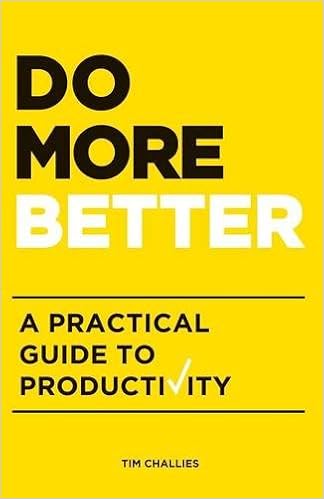
Book Review: Do More Better
Tim Challies makes a big claim at the start of this little book. When I read it, I was dubious, but here it is: 'I believe this book can improve your life. This is a bold claim, I know, but the book would not be worth my time writing, or your time reading, if I did not believe it. I wrote this because I want you to do more better and because I believe you can.'
I must confess that I'm not really into the 'productivity' mindset. Having read Matt Perman's book 'What's Best Next' last summer, it slightly scared me to find such highly motivated, always on, never resting enthusiasm. Perhaps it was a difference of personality, but 'What's Best Next' wasn't best for me. So when I heard that Tim Challies had written and released a productivity book, I approached it with trepidation. Having availed of the offer of a free PDF review copy for bloggers, and having read the opening claim, I almost switched the Kindle off. But I kept going, and I'm glad I did. I even think it might have made a difference in my life and work in the week since I've read it, and it has the potential to do even more even better in the future. If it can do that with someone once described as 'so laidback he's horizontal' then Do More Better could help you as well.
Tim Challies lays out the foundations for the book by describing how it came about. Having invested lots of time and energy into productivity, because he loves 'to make the best use of my time and energy', he is 'constantly fine-tuning the ideas, tools, and systems that help [him] to remain that way.' The book is a sharing of what he has discovered, by opening up his life to demonstrate how his system works. But before he gets to the system, he first covers the essential foundation of productivity - knowing your purpose. This first chapter unfolds the vision of purpose - why God made us (to bring glory to God), and how we bring glory to God (by doing good works). Good works are defined as 'deeds done for the glory of God and the benefit of other people.'
It's a good place to start, but as I read it, I wondered was this a book only for Christians? Especially since he states: 'But when God saved you, he gave you a heart that longs to do good for others.' Now, later on he does explain the Gospel, and outlines how you can be saved, but in this initial chapter, it did appear to be limited in its approach. It wasn't the only issue I encountered in the chapter. Several times there were statements that seemed quite simplistic, or un-nuanced. The first was 'Good works, then, are any and all of those deeds you do for the benefit of others.' The second was like it: 'There is no task in life that cannot be done for God's glory' - to which I typed in my kindle 'really?' Setting aside my doubts and having made it through the chapter, the foundational purpose is found to be: 'to glorify God by doing good to others.'
Chapter two asks how we can do this in our everyday life, recognising that it isn't always easy. The 'lifelong struggle to be and to remain productive' is because of three main reasons - laziness, busyness and the 'mean combination of thorns and thistles.' Through this chapter, he considers the sluggard of Proverbs, the equal and opposite problem of busyness which does lots but doesn't achieve anything that counts; and the thorns and thistles of the Genesis 3 curse - 'the punishment was not work itself, but the difficulty that would not accompany work.' This was a helpful diagnostic chapter, and one which helped the reader to locate their own unique approach to life and work, and what might need done about it!
From chapter three onwards, Challies becomes more practical and more hands-on. There's even some homework, as the reader is called to Define your Responsibilities. The audit helps to summarise the various areas of responsibility, such as home, work, church, hobbies, projects, and to tease out the main tasks of each. Chapter four builds on this, by inviting you to State your mission as you allocate your scarce resource of time and make difficult decisions. The pursuit of productivity is refined by the helpful saying: 'Your primary pursuit in productivity is not doing more things, but doing more good.' He advises that the way to do this is the slow 'yes' and the quick 'no' to things that do or don't fit the mission statement of your life.
Chapter five begins to introduce what some would have expected from the opening chapter - Choose your Tools Having journeyed with him thus far, it makes sense to only begin to talk tools and procedures at this stage. His focus is on software tools, but it's about finding what works. His system boils down to this: 'Effective productivity depends upon three tools and the relationship between them: task management tool; scheduling tool; and information tool.' The chapter then outlines the programs and apps he uses, along with alternatives for each, depending on personal preference.
His shortlist is: task management tool - Todoist; scheduling tool - Google Calendar; and information tool - Evernote. The guiding principle for what goes where is 'a home for everything, and like goes with like.' The rest of the book follows an outline of what each bit of the system does, and how to set up and begin to use each of the three tools. But the key to effective productivity is to use them together, in connection with each other. His tip to doing this is to daily plan, and then execute - to review, decide and plan, and then actually get on and do the work. Tim outlines the way he does this, through a daily review, and a weekly review.
All in all, it was an interesting book to read, and as I was reading it, I was thinking to myself that it was too complicated to put into practice. But then I thought I would give it a go. It would beat my current system of trying to remember the things I had to do (and forgetting some). I already use Evernote, and had dabbled with Google Calendar. So I decided to be more intentional with my Evernoting, switch to using the Google calendar on my phone (which links in to Facebook and the church website diary anyway), and download Todoist. Just to see. And now I haven't looked back.
My to-do list and reminders are contained in Todoist, and my productivity graph is rising each day as things get done. My calendar is always with me, and is working better than my Moleskine diary (I never thought I'd say that!). And the information I need is stored in Evernote (and Dropbox). I'm still working on email inbox zero, but I'm getting there. So perhaps the book has made a difference in my worklife. My system is working, and I'm feeling on top of what needs to be done. For that, and for the free PDF review copy of Do More Better, thank you Tim Challies!
Labels:
books,
productivity,
reading,
work
Sunday, January 10, 2016
Sermon: Luke 14: 1-24 Come Dine With Jesus
I wonder if you’ve ever seen the TV programme ‘Come Dine With Me.’ The format is simple. Contestants take it in turns to host a dinner party, with the other participants secretly scoring their efforts. The person with the most points wins a cash prize of £1000. It seems that the producers work hard to put together the most bizarre combination of guests to make memorable TV moments, with a few confrontations and shocks along the way.
Our reading today is a bit like an episode of Come Dine With Me. We’re told in the very first verse that Jesus has gone to eat in the house of a ruler of the Pharisees, and he’s being watched carefully. As the dinner party unfolds, we’re given glimpses of what life in Jesus’ kingdom is like, in the four episodes Luke tells us about:
Scene 1. In the house, there’s a man with dropsy, abnormal swelling. Jesus asks the Pharisees and experts in the law (those who are very religious) ‘Is it lawful to heal on the Sabbath or not?’ When the assembled men don’t answer, Jesus heals the man and sends him away.
The Pharisees considered healing to be a work, something that shouldn’t be done on the Sabbath. And yet, as Jesus explains, it’s a work of mercy: “Which of you, having a son or an ox that has fallen into a well on a Sabbath day, will not immediately pull him out?” (5)
It would be unthinkable to shout down the well to your child to keep paddling until the next day, when you would be able to work to pull them out. No, you would get them out straight away, Sabbath or not. In the same way, this healing, doing good, isn’t something that should wait.
The atmosphere is also tense after the first confrontation. But then in scene 2, as the guests choose their seats and make sure they’re in the places of honour, right up beside the host, Jesus tells them a parable:
Imagine that you’re at a big function. You want to be seen to be there, noticed by everyone, so you plonk yourself down at the top table. You’ve got the best seat in the house, it’ll be a night you’ll never forget. The only thing is that someone more important than you has been invited. You’re sitting in the Lord Mayor’s seat; you’re in the place where the Queen should be sitting; you’re where the bride and groom have been placed. What will happen? Everyone will notice you all right, as you’re escorted from the best seat to the lowliest. You’ll be humiliated.
Instead, Jesus says to put yourself in the lowest place - the host may then come and promote you to a better seat. You’ll be honoured. Then Jesus gives the principle: ‘For everyone who exalts himself will be humbled, and he who humbles himself will be exalted.’ (11)
Have you ever seen it? Someone puts on a display of self-importance; they brag about their skills; they look down on others and are full of themselves - but in exalting themselves they are soon humbled. The story goes that some celebrity or other was in an airport, wanting special treatment as they were checking in - maybe an upgrade to first class. The assistant wasn’t playing ball, and the celebrity started up with ‘Don’t you know who I am?’ Quickly, and calmly, the assistant lifted the microphone and broadcast to the whole airport the following: ‘There’s a gentleman at desk 12 who doesn’t know who he is. If someone does know, could they please help him?’
It’s funny to see in others - it can be painful when it happens to us. But remember that this is a parable - an earthly story with a heavenly meaning. Who is Jesus addressing? - the Pharisees and teachers of the law - they were exalting themselves in the religious way; they thought they deserved the top seats, but Jesus says they will be brought low.
As we move on to scene 3, Jesus turns from the guests to the host, and exposes the motives of his heart. You see, in throwing his grand dinner party, he has invited the great and the good. It’s the place to be, with the celebrities of the day. Why? Well, because they will have dinner parties and you’ll be invited back. You’ll be repaid, it’ll all be pleasant. An endless round of fuzzy fellowship with good food and nice people.
But when you give a feast, invite the poor, the crippled, the lame, the blind, and you will be blessed, because they cannot repay you. For you will be repaid at the resurrection of the just.” Do we only help those who will in turn help us? Do we dare to only use the gifts God has given us for us and our friends? People we like and people like us?
Jesus challenges us to use them to share with those in need; those who really do need them. Or will we continue with our comfortable round of entertainment? It might be costly, and yet there is ample repayment - on that day, at the resurrection of the just / righteous; when those who belong to Jesus will rise to life with him; righteous because of Jesus, not because of their own goodness.
Now you might have noticed that up to this point, Jesus has been doing all the talking. The Pharisees had nothing to say when Jesus asked them about healing; they have ventured no opinion on the things that Jesus have been challenging them with. It’s almost as if there’s an awkward silence (ever experienced one of those?!) when suddenly one of the guests seizes on what Jesus has just said: ‘Blessed is everyone who will eat bread in the kingdom of God!’
One of the promises of the Old Testament, one of the pictures of the completed kingdom is of the feast, the banquet. And the man rightly declares that those who will be there and eat in the kingdom will be blessed. But in scene 4, Jesus tells a parable about the kingdom, about who it is that will be present. It’s another shocker:
The invitations have been sent, the replies received, and when everything is ready, then the servant is sent to tell the guests to ‘Come, for everything is now ready.’ Just at that moment, the invited guests start to drop out. The excuses start, and what poor excuses they are: ‘I have just bought a field, and I must go out and see it... I have just bought five yoke of oxen, and I am going to examine them... I have married a wife, and therefore I cannot come.’ Feeble excuses - would you buy a field without seeing it? Would you buy a car without test driving it? Would you suddenly get married in a flash?
Those who were invited refuse to come. They back out at the last moment. Now what will happen? The feast is ready, the food has to be eaten. The servant is sent out: ‘Go out quickly to the streets and lanes of the city, and bring in the poor and crippled and blind and lame.’ and then again ‘Go out to the highways and hedges and compel people to come in, that my house may be filled.’
Those who were expected and invited refuse; the most unlikeliest of people are welcomed in. The great and the good, those who exalt themselves and think they are worthy are excluded; those who are no-hopers and down and outs; those who are humble are welcomed in and exalted.
It’s a picture of Jesus’ ministry - the Jews, those who had been invited through the promises of the Old Testament, refuse to come in, they refuse to listen to Jesus; they exclude themselves. In their place, we who were on the outside are brought in; we’re given a place at the table, a share in the heavenly banquet, as we hear the good news and respond to it.
And yet there’s a danger that we, respectable upright church-going people, might presume on our place and think ourselves worthy, and exalt ourselves. Well, obviously God will welcome me - heaven would be a worse place without me and my wonderful goodness there. But by such an attitude, we’re refusing the invitation; we’re shutting ourselves outside; missing out on the joy of the heavenly feast.
No. the heavenly banquet is for the poor, crippled, lame and blind; for the sinner who recognises their unworthiness, and comes humbly to the Lord Jesus, pleading their sinfulness and trusting in the saving blood of the Lord Jesus, who welcomes us in.
We’ve been looking at an episode of ‘Come Dine With Jesus’. This dinner party was memorable for all sorts of reasons. Yet through it, the invitation is extended to us - we too can ‘Come Dine With Jesus’ in his heavenly home for eternity. Will you come? Will you be drawn in?
This sermon was preached in Aghavea Parish Church on Sunday 10th January 2016.
Labels:
Luke,
sermons,
Thy Kingdom Come
Sunday, January 03, 2016
Sermon: Matthew 2: 1-12 Wise Worship
Most years, coming up to Christmas, the newspapers sneak in a story about the science of Santa. They figure out the figures of one jolly red man and his sleigh travelling around the world in one night, delivering presents to every home. The Telegraph estimates that he would have to travel 212 million miles, at a speed of 6 million mph. But this morning I want to think about another epic gift-giving journey of Christmas.
Because that’s what we immediately think of when we think about the wise men from our Bible reading. These mysterious wise men from the east travelled a huge distance to arrive in Jerusalem. If you imagine them stopped at a border control or an immigration checkpoint and asked ‘What is the purpose of your visit?’ then our first answer is probably to give some gifts.
That’s what I thought too - them bringing the gold, Frankenstein and a mirror; sorry, the gold, frankincense and myrrh. It seems so obvious, because it’s probably the first thing you think of when you think of the wise men. And yet, the giving of gifts wasn’t their primary purpose; it wasn’t what they set out to do.
Sometimes we can read the Bible and think we know what it says. It’s only when we take a closer look that we see what it actually says.
So why did the wise men set out on that long journey? Why did they not just stay at home with a tin of Quality Street and watch the repeats on the telly? Verse 2 tells us in their own words: ‘Where is he who has been born king of the Jews? For we saw his star when it rose and have come to worship him.’
They’re asking for ‘he who has been born king of the Jews.’ They know there has been a royal birth, a new king born. They saw his star as they watched the heavens by night. These stargazers saw his star rise, and climbed on their camels to come... to come and give him gifts? No - we have come to worship him.
The primary purpose of the wise men was to worship. They didn’t come to Jesus to be nosy. They didn’t travel to catch up on the gossip. They weren’t interested in anyone or anything else - they came to worship him. Summoned by a star, they went to worship.
Now think of where they were, and what they had just said. Perhaps you can remember the reaction when Prince George was born, the boy who would one day be king. The news channels went into overdrive; press photographers camped outside the hospital to get the best picture. Most people were very excited.
You’d think that the people of Jerusalem, that the Jews would be excited by the news that these outsiders had come to worship their new king. But that wasn’t what they experienced. Herod the king was troubled (3), and all Jerusalem with him. Rather than being good news, they treated this announcement as bad news. In fact, Herod didn’t even seem to be aware of it until the wise men arrived.
So he calls in the chief priests and asks them where the Christ was to be born. They know the answer straight away. They know the scriptures say Bethlehem. But they aren’t interested in going along with the wise men. The king of the Jews, the ruler to shepherd Israel has been born, but they’re too busy, washing their hair, or straightening the books on the shelves or playing tiddliwinks to go and see the Christ for themselves.
The religious people know the scriptures, but they don’t want to obey them. They know the answer, but they don’t want to apply it to themselves. And there’s a danger that we could do the same. In our preaching and in our Bible reading are we gathering information, or undergoing transformation? Perhaps you’ll take up the challenge to read through the Bible this year. Don’t just become a Bible mastermind, storing up knowledge - pray that your reading will move you to worship.
King Herod seems to be different. Having heard where the Christ was to be born, he sends the wise men off to find the child, and then to come back and let him know, ‘that I too may come and worship him.’ His lips express a desire to worship, but his heart holds a desire to destroy Jesus.
You see, Jesus was a rival to Herod’s power and position. When the wise men ask ‘where is he who has been born king of the Jews’ you can hear Herod saying that there’s only one king of the Jews, and there are no vacancies to be filled. If Jesus is indeed the king of the Jews, then Herod is out of a job.
But that’s the same for every one of us. The wise men recognise that the true king has been born - which means that everyone else is out of a job. We all like to set ourselves as king or queen of our life. We want to rule our own lives, make our own decisions, and do what pleases us. To do so, we’ve de-throned God from his rightful place. That’s at the heart of sin - to say no to God, to deny God his place as king.
The wise men recognise that the Christ has been born. The true king. The one who has every right to rule. The one to whom everyone else should bow. Herod is threatened. Herod is troubled. And Herod plots to kill Jesus. He doesn’t say that, of course. It’s like the Vicar of Dibley episode where they put on the nativity play and Herod tries to make out that the soldiers misheard his instruction to kiss the babies, not kill them.
Perhaps our declarations of worship are only from the lips out. Could it be that our words don’t match our hearts? That we claim to want to worship, but actually we’re still rebelling against King Jesus? May God in his grace show us and have mercy on us.
The religious knew, but didn’t care. Herod knew, but continued to plot against the rightful king. It’s only the wise men who show us what it is to worship the king. They set out from Jerusalem, rejoicing exceedingly with great joy as it led them to Bethlehem, to the house where Jesus was staying.
Look at what they do when they enter the house (11): ‘They saw the child with Mary his mother, and they fell down and worshipped him. Then, opening their treasures, they offered him gifts, gold and frankincense and myrrh.’
They don’t open their treasures straight away. They fell down and worshipped him. The place of worship is bowing before the rightful king. Before giving him anything, they give themselves. To be in his presence is greater than the presents they gave. When was the last time you bowed before Jesus? When did you surrender all to him?
This morning as we come to the table, we remember this king who gave his life for rebels like you and me. He died the death we deserve to bring us pardon. Perhaps you’ve never truly worshipped. Come today, and as you kneel, bow before your king. Surrender to him, because he is worthy of your worship, your praise, and your adoration.
This sermon was preached in Aghavea Parish Church on Sunday 3rd January 2016. Telegraph article referenced is here (accessed 02/01/16)
Subscribe to:
Posts (Atom)