Sermons, book reviews and randomness from the Reverend Garibaldi McFlurry.
Showing posts with label apologetics. Show all posts
Tuesday, October 16, 2018
Cafe Church Sermon: Romans 8: 18-39 How can I believe that God is good?
When you look at the world, you might be tempted to ask - what’s going on? You only have to watch the news, or read a newspaper, to see plenty of bad things happening. War and terrorism. Crime. Intimidation. Poverty and hunger. Suffering. Earthquakes, hurricanes, tsunamis.
Or maybe we don’t have to turn on the news, or go outside. We see bad things happening in our families, to our friends, or even in our own lives. And when we see bad things happen, it leads us to ask the question - why?
Why do bad things happen? Or rather, why does a God who is meant to be good allow bad things to happen? The question leads us to question what we know about God - the God who is good, and sovereign, and powerful, and love. If something had has happened, then there must be some breakdown in God’s character: Does God not care? Is God not powerful to stop them from happening? Or is God simply not good?
As we start to tackle that question, we need to work out what we actually mean by ‘good’. When we say that something is good, what do we mean? Is it just whatever feels good for us, something we like? Or is there an ultimate standard? There must be an ultimate standard, an objective good, beyond our feelings and desires and wants.
So imagine, two children being given sweeties. If one gets more than the other, then there’ll be cries of ‘That’s not fair!’ From we’re no age, we appeal to fairness, we know there is such a thing as right and wrong, good and evil.
Those notions and right and wrong, good and evil, they’re not just evolutionary concepts, passed along the line in order to ensure the continuation of the species. Right and wrong, good and evil, are external to us - they’re objective, a shadow of the divine image we were created with - an echo of the goodness of God.
Yet, when we hear that phrase - the goodness of God - you may well question it. And so the table talk discussion took you to the question behind the question. How can I believe that God is good when... you fill in the blank. You know the particular question you’ve been asking. It might be global, thinking about suffering and natural disasters and a world that seems out of control. Or it might be personal, in the face of illness, suffering or death. But it’s the question you keep asking. How can I believe that God is good?
We get an answer to both the global problem and the personal problem in the reading from Romans 8. In Romans, Paul sets out the gospel that he is preaching, so that the church in Rome will welcome him and support his efforts to move on to Spain to preach there too. And chapter 8 is all about the hope that we have in the Lord Jesus.
He talks about how ‘creation waits in eager expectation for the sons of God to be revealed.’ How it is currently subjected to frustration, in bondage to decay. All that happened because Adam and Eve questioned the goodness of God, right back in the Garden of Eden.
God had provided everything they needed - an abundance of food, perfect relationships, enjoying God’s company - they were in Paradise. There was just one rule - they were not to eat of the fruit of the tree in the middle of the garden - the tree of the knowledge of good and evil.
The serpent (who we’re later told is Satan), comes along and starts asking questions. Why did God say no? Was he holding something back from them? Or, to put it another way, was God not good? He also doubts the goodness of God’s word - and says, you will surely not die.
Adam and Eve doubted God’s goodness, they believed the lie, so they took and ate. And immediately they realised their mistake. The world was different. They blamed each other; they were banished from the garden; and life and work became more difficult - thorns and thistles and death became an everyday experience.
This paradise lost world is our world. The creation is in bondage because of us. Verse 22 talks of the creation groaning as in the pains of childbirth. The world is waiting for the coming of the Lord Jesus, and everything being made right.
But Paul goes on to say that, as well as the creation groaning, we ourselves, who have the firstfruits of the Spirit (Christians), we also groan inwardly as we wait eagerly for our adoption as sons, the redemption of our bodies. There’s a frustration that we feel too, as we wait for the coming of the Lord, for our new resurrection bodies, when there will be no more sadness or suffering or sickness or sin.
Knowing that we have this hope, this glorious future, it almost makes the waiting and the suffering worse. And yet Paul gives a comparison back in verse 18. Imagine those old baking scales where you have the two pans. In one, all our present sufferings. And you imagine, that’s very weighty. They’re hard to bear, they weigh us down. Yet, says Paul, in the other pan is the glory that will be revealed in us. It doesn’t even compare - it far outweighs the suffering.
Knowing that we have this hope is great. But how do we get through each day? How do we react when something bad happens to us? What do we need to know? We have the Spirit, who helps us in our weakness, by praying for us when we don’t know what to pray.
But we can also know something else. Verse 28: ‘And we know that in all things God works for the good of those who love him, who have been called according to his purpose. For those God foreknew he also predestined to be conformed to the likeness of his Son, that he might be the firstborn among many brothers. And those he predestined, he also called; those he called, he also justified; those he justified, he also glorified.’ (28-30).
These verses tell us that no matter how things may appear; no matter what might be going on in your life; God is at work. It’s not that in some things God is working; no, in all things God works... And what is he working? ‘God works for the good of those who love him.’
In all things, whether we think that they are good or bad, God is at work. And he’s working for our good. Now, maybe you think to yourself, but that doesn’t really help. Because for my good should mean that everything runs smoothly, there’s never any pain or hardship or frustration, rather, that I’m always happy. Those are the only good things that I want.
But do you see what God defines as our ultimate good? The thing that God purposes for us is: ‘to be conformed to the likeness of his Son.’ In everything, in all things, God is at work to make us more like Jesus. This is the good that he is working towards. And he will use everything that happens - even the wrong things others do to us; even the everyday events of life; even the catastrophic, to make us more like Jesus.
With this perspective, the question changes from why is this happening to me? to what is God doing through this?Sometimes we may only see it in retrospect, looking back on a particular period or experience. Sometimes we may never know why. But we can be sure that God is still in control, and working out his purposes for our ultimate good.
Just think of the man in prison, for allegedly assaulting his boss’ wife. It’s the low point amidst much unhappiness. Attacked by his brothers. Sold as a slave. Far from home and family. Yet he continues to trust in his God. Eventually, he gets the most amazing promotion - from the prison to the palace; from prisoner to Prime Minister. Joseph is used to guide Egypt through the seven years of plenty and the seven years of famine.
His brothers come calling, wanting grain. And years later, after his father dies, the brothers are fearful of what Joseph will do now. How does he respond? ‘As for you, you meant evil against me, but God meant it for good, to bring it about that many people should be kept alive.’ (Gen 50:20). God was working for good, even in Joseph’s experience of evil.
And that’s what we see in the events of Good Friday. Three crosses stand outside the city wall. The man on the middle cross - he had done nothing wrong. Rather, he had gone around doing good - healing the sick, driving out demons, even raising the dead. But now he hangs on the cross, his back lacerated from the flogging, his head pierced with the crown of thorns, struggling to breathe, in agony.
He saved others - let him save himself, the crowd mocks. Yet this good man - the only good man who ever lived - he dies, a cruel death on a Roman cross. The mocking continued - where is your God? Yet in the pain and the agony, the darkness and the desolation, God was working his purpose for good. In the very darkest day, Jesus died - to save you.
God did not spare him, so that you could be saved. No one will be able to bring a charge against you, because he has borne your sins. And no one will be able to separate you from the love of Christ - nothing that happens makes him love you any less.
How can I believe that God is good? When we look at the cross, and hear of God’s purpose, and the hope that we have in Jesus, how could we not believe that God is good?
This talk was presented at the Cafe Church event in St Matthew's Church, Richhill on Sunday evening 14th October 2018.
Labels:
apologetics,
cafe church,
Romans,
sermons
Monday, December 29, 2014
Book Review: Magnificent Obsession
From the publication of his book The Dawkins Letters, in which he answered the chapters in Richard Dawkins' The God Delusion, Dundee Free Church minister David Robertson has emerged as one of the leading Christian apologists in the UK and further afield. With speaking engagements all over the country and beyond, Robertson has honed his apologetics, presenting the truth of Christianity in a clear and engaging manner. This is also the case in his most recent book, Magnificent Obsession: Why Jesus is Great.
Tackling one of the most common objections, 'I would believe if I had the evidence', Robertson admits that it isn't an unreasonable request. 'What is unreasonable... is when the statement is made with the assumption that there is either no or insufficient evidence.' Thus, 'This book is written to challenge that assumption.' He acknowledges that, while some people thought that the rise of the New Atheists was a bad thing, they have actually revived an interest in Christianity and opened it up to outsiders asking questions. He explores the idea that everyone has a faith position of some kind, even the atheists. For him, 'I am a Christian because of Jesus Christ.'
The book follows a familiar format, drawing on the same letter style as The Dawkins Letters. However in this book, the recipient isn't an actual person, rather an amalgam of various atheists and agnostics known to him through correspondence, speaking engagements, pastoral work and personal contact. The letters follow a logical sequence, building on the previous, as well as the anticipated response from the reader. The themes of the letters are: Man, Miracles, Messenger, Murdered, Marvellous, Meaning, Mission, Modern, Maranatha, Magnificent.
Throughout, there is a clear and concise presentation of the evidence about Jesus, answering objections and putting the New Atheist on the back foot with some questions and challenges for their faith position. There are plenty of ideas to use in conversations, and threads to pursue and think about further.
On the evidence for Jesus, Robertson contends that 'in our postmodern, touchly-feely world, Jesus is whoever we want him to be.' The reason people don't want to know about Jesus is simple: 'The only reason that people will not accept the overwhelming evidence for the existence of Jesus is that they just really do not want him to exist.'
On the virgin birth, 'If true, it is part of the evidence that there is a God, who does 'intervene' in the world and who does call us to follow him.'
His section on the cross is pure gold, answering the objection of its horror, its need, and its purpose. Similarly, the resurrection is shown to be the heart of the faith, historically attested, and reliable to believe.
He doesn't shrink back from the hard things - even the doctrine of the Trinity, which is the centre of the faith, and vital to understanding God as he has revealed himself.
I couldn't recommend this highly enough. It's a great book which clearly presents the Christian faith in a logical and coherent way, answering the objections many Christians are likely to face from their friends. It would be useful for Christians to read to gain help for those conversations, but also to give to their non-Christian friends to read and discuss together. Magnificent Obsession is available from Amazon.
Labels:
apologetics,
books,
Christianity,
reading
Tuesday, December 16, 2014
Book Review: Naked God
Is there a God? And if there is, then what difference will that make to my life?
That's the question Martin Ayers examines and answers in this slightly strangely titled book 'Naked God'. It's been out for about four years now, and I heard rave reviews whenever it launched, but it was only recently that I got an opportunity to read it. I'd have to go along with the rave reviews - this is an excellent book to put in the hands of anyone wondering about whether God exists. It probably wouldn't be the initial contact with Christian things, but as an ongoing thought-provoker and guide for discussion and investigation, it is excellent!
Ayers begins the book with a quick survey of the way the world has changed and is changing, in all sorts of ways - technology, sex and many more. He asks the question: 'So how do you react to the change that is all around us?' He goes on to look at how religion seems to be changing, leading him to observe: 'When it comes to the God Question, people keep changing their minds.'
The title of the book is inspired by the television chef Jamie Oliver. You see, the Naked Chef wasn't nude, he was 'stripping the food to its bare essentials.' The aim of the book is to do the same thing with God - to expose the truth about God. This leads to the basic premise of the first part of the book: 'The first task of this book is to show why the God Question really matters... If things are fine without God, then why bother looking for him?'
The chapters in the first section then look at the Naked Truth about why we're here; freedom and knowledge; right and wrong; and they consist of the best analysis of the ultimate end of our secular, pluralist society I've read in a long time. Along the way there are some perceptive comments, including his assertion that 'Atheism is a position of faith or belief just like any religion.'
Chapter two focuses on the belief that the universe is a closed system, only consisting of matter, only fueled by blind, purposeless evolution. But even as many ask the question why are we here? 'naturalism tells us that we shouldn't even ask the question.' You see, if naturalism is right, then it doesn't make sense to live as if there is any purpose or meaning. But, as he concludes, 'the Naked Truth is that if God does not exist, there is no real meaning or purpose for our lives.'
Chapter three builds on this foundation as it explores the ideas of freedom and knowledge. From across the world, he presents examples of people fighting for freedom, and espousing human rights. But, 'naturalism tells us that we people are not really separate, independently existing 'things' after all.' Further, we're really just a product of our genes and environment, and shouldn't be praised for right choices or blamed for wrong actions. He goes even further as he discusses knowledge. The logical conclusion of naturalism is that by thinking about it, we can't trust what we're thinking - because if our brains evolved for survival, then there is no guarantee it tells us what is true. Again, 'what we're doing here is seeing where naturalism actually takes us. It's not pleasant, because it takes us inexorably to conclusions we don't like. But it's only fair to think of the world consistently like this.'
Chapter four looks at morality, and where our sense of right and wrong comes from. He doesn't doubt that there can be moral naturalists. 'But the problem isn't that naturalists have moral values. It's the naturalists have no basis for these moral values.' Therefore, 'without God, there are no universal human rights.' Again, naturalism fails.
Chapter five brings the conclusion of his exploration of naturalism, with a devastating verdict. Naturalism will lead to despair (nihilism) or denial (unwilling to accept that we have no purpose or meaning or morality). He then asks, 'what if there is a God?' 'There is another option. We can investigate whether or not God actually exists.' In all the areas already examined, God would make a real difference, and provide the basis for each of them.
In preparation for the second section, chapter 6 introduces Jesus. 'I primarily want to consider who Jesus was, and whether that changes our mind about God.' Recognising the problem some have with him because of popular misconceptions, Ayers proposes to go back to the evidence, as found in the New Testament Gospels.
Before presenting the positive evidence, he first clears the ground by dealing with two common objections: 1. Isn't Jesus just one of many valid options? But relativism 'doesn't evaluate the reasons for believing something.' He points out that there is a big difference between the opinions and preferences of football supporters and the objective fact of who won the FA Cup last year. 'If God is real, the whole world could deny that fact, and yet it would still be true.' The second objection is: Isn't Jesus just a made up legend? Here he shows how the Gospels are reliable eye witness testimony.
In the rest of the section, he looks at the life of Jesus in a warm, conversational, friendly and engaging way. The topics he covers include 'Isn't Jesus just a good moral teacher?' - the identity of Jesus; Who is Jesus? - his character; Didn't Jesus just die tragically young? - the crucifixion and resurrection. There's also a helpful chapter on the aftermath of Jesus' life, and the objections that could still creep up, such as the socially regressive teaching on sex that the church holds to; the disgraceful record of Jesus' followers, such as the crusades; and the fear of losing freedom by surrendering to Jesus. Each response comes with grace and a challenge to try it out by focusing on Jesus and taking it from there.
Part three concludes the book by pressing home the conclusions by looking to the future. The author deals with judgement, assurance, becoming a Christian, and the alternatives of heaven and hell. There's a clear progression through the book as the false alternatives are closed down, leaving the logical certainty of Christianity based on Christ.
Naked God is a really good book, and one I enjoyed reading. It can sometimes appear slightly wordy, and could maybe benefit from a little editing to become shorter and snappier. There are plenty of cultural references, so the author must like the movies, with illustrations from Good Will Hunting, One Hour Photo and Brassed Off (among others). The pitch is probably aimed towards university students and young professional graduates, but most people seeking to engage with our secular culture will find something to stimulate thought and discussion. It would be a great book to read on Christmas Day, when everyone else is sleeping off the turkey dinner. Naked God is available from all good Christian bookshops and for the Kindle.
Labels:
apologetics,
books,
Christianity,
reading
Wednesday, July 09, 2014
Book Review: Jesus and the Logic of History
Have you ever had a book sitting on your shelf for ages and ages? You think you know what it's going to say, and so you leave it to descend in your reading priorities. And then you eventually get around to reading it and wonder why you left it so long? That's been my experience with this book - Jesus and the Logic of History by Paul Barnett.
The big idea behind the book is that we can get to know that the gospel accounts are accurate through the incidental details recorded in the New Testament letters. Just think for a moment. Within the letters, which were written before the gospels, there are details about the person and character and life of Jesus which were already part of the eyewitness testimony. The fact that they are already written down before we get to the gospel accounts must mean that the gospels themselves are authentic and accurate records of the life of Jesus. That's the summary of the book. To discover a bit more, read on!
Barnett introduces his book with the reminder that 'Christianity is a historical religion in at least two senses' - that it is a part of world history, but also because 'Jesus was a real man.' That means that 'the origins of Christianity are not mythical in character.' Yet many scholars are attempting to redefine Jesus historically, casting him in some other light, such as a sage, or prophet, or cynic, or whatever. 'There are as many Jesus as there are people who write about him' - each of them seeing their own type of hero in him. Contrasting with this, 'It is the argument of this book that the 'logic' of history demands a Jesus who is definable and about whom a practical consensus can be reached. By this logic it is argued that the Christ of the early church's faith and proclamation must have borne a close relationship to Jesus the historical figure.'
There is a good discussion of the historical approach to events and facts and the changes in society. This helps us to think through the sources used, and presents a challenge to the 'Jesus Questers' who only use fragments of gospels, rather than the fullsome source material present from the earliest days of the Christian movement. This even more so when they tend to rely heavily on discredited late sources such as the Gospel of Thomas.
From this base, he moves on to examine the references to Jesus in secular histories, again adding testimony to the fact that Jesus must have been (at least) a remarkable man who caused such an amazing influence on so many so quickly. This impact is developed in the third chapter, looking at Jesus in the proclamation and tradition. Given that Paul's letters to Corinth and Thessalonians come soon after his first visit to the cities when churches were planted, the details of Jesus' life found within are illuminating. The churches already know about Jesus, the references are merely mentioned in passing, illustrating doctrine and life. This is then expanded to the other apostolic writings of Peter and John, each of whom make mention of the life of Jesus throughout.
Placing Jesus in his historical context is the task of chapter four. Here, the relationship of Jesus to the other major figures found in Luke 3 is considered - John the Baptist, Herod Antipas, Pilate, Annas and Caiaphas. Each of them are known from extra-biblical sources, so there can be no doubt of their existence.
Jesus in the gospels furthers the idea that any reconstruction of Jesus must contend with the details given by the very earliest churches - in continuation from his ministry. Yet most reconstructions refuse to deal with the 'deity dimension' - a belief which is highly noticeable in the earliest churches. These churches already existed before the conversion of Paul - which can be seen in what he writes to the Galatians (because he was persecuting those self-same churches) and the tradition of Jesus' resurrection which had been handed on to him and which he reminds the Corinthians he had passed on to them (1 Cor 15).
The remaining chapters are at pains to show that the gospels and Acts are reliable testimony and not something mythic or made up. His arguments are convincing, because the logic of the history is so clear. Contained within is a discussion of the process of producing the gospels - from witnesses to publication. Each gospel is seen to come from an author who was either an apostle themselves or else was connected to the apostles - Matthew himself; Mark through Peter; Luke through eye witnesses and associated with Paul; John himself. These weren't late documents produced several hundred years later (as claimed by the Da Vinci Code et al) but within the lifetime of the apostles.
This really is an excellent book. It takes a different angle and approach to the New Testament text, but is logical and encouraging. By looking at the letters in a fresh way, the history contained within is unearthed, confirming the reliability of the gospels, and all because Jesus, the Son of God really did live, die and rise. This will be a great book for anyone seeking to engage in defence and confirmation of the gospel through apologetics, or those seeking greater confirmation of the historical roots of the Christian faith. I'm just sorry it took so long to read it!
Jesus and the Logic of History is available from Amazon.
Labels:
apologetics,
books,
Christianity,
history,
Jesus,
reading,
theology
Friday, July 19, 2013
Book Review: Lies! Lies! Lies!
Michael Green is a well respected preacher, author and evangelist, with lots of experience in apologetics. This book came highly recommended to me several years ago when it was published, but I've only just got around to reading it. Despite the delay, it was well worth a read.
In Lies, Lies, Lies
The first chapter serves as an introduction to Jesus, explaining what a gospel is, and how we find out about Jesus in them. He helpfully shows that each of the gospel writers declare unambiguously that Jesus is divine - a very early belief - as well as in the three ways that Jesus claims divinity: he forgives sins, accepts worship and has the right to judge. Each of these are powers reserved for God, but claimed by Jesus. As Green comments, these are 'totally crazy claims - unless they were true.'
In the rest of the book, Green tackles some of the common statements being bandied around: 'Scholars are discovering a very different Jesus'; 'Jesus had a fling with Mary Magdalene'; 'Jesus? He's just a myth'; 'The New Testament manuscripts are unreliable'; 'The New Testament story is incredible'; 'Jesus never really went to the cross'; 'Jesus did not rise from the dead - his tomb has been found'; 'Jesus did not rise from the dead - there's no evidence'; 'Nobody thought Jesus divine until the fourth century'; and 'The "New" Testament is evil'.
Quite a lot of the focus is on Dan Brown's The Da Vinci Code, and all the nonsense claims that are perpetuated in that work of fiction. However, he also discusses the claims of Islam about Jesus; as well as the tomb of Jesus' family which was supposedly found in Jerusalem. There are lots of pages which deal with the Gnostic 'gospels' which demonstrates the unreliability of them. Each of the chapters is carefully researched with the appropriate material explained.
The interested skeptic will find lots to consider here, as will the ordinary Christian seeking to help their friends to discover the real Jesus amongst the many alternative protrayals. It will also be a useful addition for a pastor's library when dealing with those issues in sermons, apologetics series, or with enquirers. Lies Lies Lies is available from Amazon
Labels:
apologetics,
books,
Christianity,
faith,
God,
history,
Jesus,
reading
Wednesday, January 23, 2013
Book Review: The Explicit Gospel
I'd heard good things about The Explicit Gospel
Through the two main sections of the book, he examines the gospel story in its two dimensions and viewpoints: the individual (what he calls the Gospel on the Ground) and the universe (what he calls the Gospel in the Air). Each traces the grand scheme of God's purposes from creation through to new creation by the pathways of: God - Man - Christ - Response; and Creation - Fall - Reconciliation - Consummation.
There's much to commend his approach, forged from the tension (or even supposed opposition) of the two perspectives. The shorter closing section of the book discusses some of the problems that can arise when one or other approach is exclusively used, either only ever focusing on the individual salvation or only making the world a better place through acts of justice.
The whole book is also an attack against what he refers to as 'Christian moralistic therapeutic deism', which is simply being the best you you can be by your own efforts. This is a million miles from the gospel, which is carefully spelled out. As the title suggests: 'The gospel had merely been assumed, not taught or proclaimed as central. It hadn't been explicit.' Chandler corrects that fault in the church in this book.
There are many reasons to commend the book. I appreciated and enjoyed his use of Scripture as he discussed each step in turn. Along the way there are sustained expositions of God's glory (Romans 11:33-36), our hardness of hearing and heart (Isaiah 6 - the whole of it, not just the 'nice' call of Isaiah. In fact, in quite a few places he helpfully takes our 'nice' notions of verses to task and calls us to look at the context, rather than just plucking a verse into obscurity.), the frustrated creation (Romans 8) and the fall and the meaninglessness of everything (Ecclesiastes).
As well as his thorough Bible expositions, Chandler is also thorough as he teaches, including discussions on all sorts of issues and subjects I wouldn't have expected along the way including evolution and creation etc. His thoroughness also extends to his illustrations, with a vast array of word-pictures to help explain the point.
I only had two minor questions. The first was whether he was clear on his audience - at times it seemed as if it was aimed at non-Christians or baby Christians, but the other bits seemed to be addressed solely to pastors or experienced Christians. The second question was: what happened to the witch mentioned in the introduction?!
All in all, this is a good book, and one that you'll want to read more than once to take in the glories of God as displayed in the Gospel of his beloved Son, Jesus Christ. The book resounds with gems like this:
'Romans 8:1 tells us that there is no condemnation for us, not because of all the great stuff we've done but because Christ has set us free from the law of sin and death. My sin in the past: forgiven. My current struggles: covered. My future failures: paid in full all by the marvelous, infinite, matchless grace found in the atoning work of the cross of Jesus Christ.'
Amen and Amen! The Explicit Gospel
Labels:
apologetics,
books,
Christianity,
God,
Gospel,
Jesus,
reading
Friday, December 14, 2012
Book Review: Genesis in Space and Time
Day Five in the Genesis book tour.
This was the first book I've ever read by Francis Schaeffer, and I must confess, it took me a little while to get into his writing style. Some of the other books I've reviewed this week were more readable, but having got used to Schaeffer, there were lots of helpful insights in Genesis in Space and Time.
With a perhaps more philosophical approach, Frank Schaeffer underlines the importance of Genesis:
I wish to point out the tremendous value Genesis 1-11 has for modern man. In some ways these chapters are the most important ones in the Bible, for they put man in his cosmic setting and show him his peculiar uniqueness. They explain man's wonder and yet his flaw. Without a proper understanding of these chapters we have no answer to the problems of metaphysics, morals or epistemology, and furthermore, the work of Christ becomes one more upper-story 'religious' answer.
The book charts the 'flow of biblical history' through the opening chapters, with a good reflection on the wonder of creation (and of the 'time' before time - my term, not his). As he explores the revelation of God as Trinity in the creation, as well as the power of God, creating by divine fiat, the spirit soars. On the creation of man, he is perhaps at his finest:
A man is of great value not for some less basic reason but because of his origin. Thus the flow of history has tremendous implications for every aspect of our lives. I stand in the flow of history. I know my origin. My lineage is longer than the Queen of England's. It does not start at the Battle of Hastings. It does not start with the beginning of good families, wherever or whenever they lived. As I look at myself in the flow of space-time reality, I see my origin in Adam and in God's creating man in his own image.
Schaeffer doesn't confine himself to Genesis only, but makes connections with the rest of the scriptures, tracing the lines from the fall through to the cross and beyond. Despite my initial uncertainty, I'm definitely glad I made it through the book and benefited from Schaeffer's contribution. While some of the other books might only be of interest to the person specifically studying Genesis, this would be a great book for any student of our culture; people wondering why the world is the way it is, and what can be done about it; and all those wanting to grow in apologetics reasoning and engagement.
Labels:
apologetics,
Bible study,
books,
creation,
Genesis,
reading
Tuesday, December 11, 2012
Book Review: Seven Days That Divide The World
It's Day Two of my Genesis book reviews, and perhaps appropriately, it's a book that deals with the creation days themselves. This wasn't strictly part of my sermon series prep, but further background reading by an author I respect on a related topic. John Lennox is emerging as one of the leading Christian apologists in the realm of science and evolution, so it was interesting to read his take on the creation.
It might be a recurring observation by all the writers this week, but Genesis is not an easy subject: 'The biblical announcement of the fact of creation was as timelessly clear as it was magnificently appropriate. However... when it comes to the timing and means of creation... people over the centuries have found the book of Genesis less easy to understand.'
Lennox declares that 'the topic is clearly a potential minefield.' Yet he continues to argue that there is hope of a harmony of the Bible and science both properly interpreted. After all, belief in creative intelligence was the starting point for modern science, which therefore doesn't disprove God's existence. Indeed, Lennox examines the trouble surrounding Galileo, that famous test case of religion against science. Rather, 'The conflict was far more between two 'scientific' world pictures than between science and religion.'
Continuing to discuss bible interpretation, Lennox points to a number of examples where the 'literal' sense of the words used can be inadequate and even misleading - 'since there can be different levels of literality.' So, with the discovery that the earth revolves around the sun: 'Even though our interpretation relies on scientific knowledge, it does not compromise the authority of Scripture.' Therefore: 'The Galileo incident teaches us that we should be humble enough to distinguish between what the Bible says and our interpretations of it.'
With this foundation in place, Lennox examines the text of Genesis 1 to discover what it actually says. He explains that there are a variety of meanings for the word 'day' in the Hebrew, whether the period of sunlight; a twenty-four hour period; or an age. He also considers the possibility of the six creation days being solid days, but spaced throughout a longer period of time (ie not just in the one week).
Moving on, the problems of the origin of humans and death are raised. Were Adam and Eve just a pair of humanoids that God decided to begin with, or were they a special creation? Did evolution play a part in their rise? Did death exist before the fall? Lennox' answer seems to push for an ancient world, with an attitude of humility as the 'best fit' for the evidence of Scripture and science.
His fifth and final chapter appears to be the strongest, as he turns from science to focus instead on the message of Genesis 1, displaying the truth it reveals of God to the reader. In a series of simple points, Lennox again and again points to the God who is, the creator, the one who formed us, and calls us to relationship with him.
There are also a number of interesting appendices, providing a background to Genesis, an examination of the Cosmic Temple view, thoughts on the beginning of time, a brief discussion of the suggestion that there are two accounts of creation, and an analysis of theistic evolution and the God of the gaps.
All in all, it's a book that will raise the salient points in the discussion and provide much food for thought. I'm not sure that I agree with all his conclusions, but at least I've been provoked to think more carefully about my position, and am now better informed about the issues. Any book by Lennox also equips the reader for apologetics, which is also a bonus!
Labels:
apologetics,
books,
creation,
evolution,
Genesis,
postmodernism,
reading
Tuesday, September 18, 2012
Biblical Marriage
On Sunday morning I was preaching from Genesis 2, on the way in which God provides in his wonderful creation. Now in every sermon situation, there is always more material than can be fitted in to the allotted time. There might be some really interesting asides and pieces of information and gems that just don't fit into the sermon as preached. And if that's the case on a regular sermon, then how much more in Genesis 2. By focusing on the God who provides, it wasn't possible to unpack everything the passage says about men and women, and marriage.
Now, if you've been around the internet on blogs or Twitter or Facebook, you might have seen a campaign picture that looks a little something like this:
The point being made is that there are lots of different permutations and combinations of marriage in the Bible, and therefore Christians are wrong / bigots / dumb to insist on one man and one woman in a mutually exclusive public union until death.
The fact is that although we're told about Abraham's dealings with a concubine or David's many wives or Solomon's 700 wives and 300 concubines, those pieces of information are presented as that - information, not recommendation. Those accounts are descriptive, telling us how it was; but they are not proscriptive, telling us how we should do it. You only have to follow the story to see the mess they get into by going their own way.
Abraham (Abram) and Sarah (Sarai) have received the promise of a son from God, but they don't believe it will happen, so Sarai takes matters into her own hands, giving her servant Hagar to Abraham. Ishmael is born, but he is not the child of promise.
David falls into adultery by a slippery slope of 1. not going to war to lead his people in battle; 2. spying Bathsheba bathing naked on her roof; 3. committing adultery with her in his head; 4. committing adultery with her in his bed; 5. murdering her husband to cover up the affair.
Solomon's many foreign wives lead him astray from the worship of the Lord by their idolatry, sowing the seeds of Israel and Judah's fatal split, and eventually Jerusalem's ruin.
We're told of these various permutations of relationships and the ways in which some of the Bible's leading characters messed things up, not out of approval, but as a warning.
In order for us to understand what marriage is, we must go back to the Creator's original plan, as revealed in Genesis 2:
'But for Adam there was not found a helper fit for him. So the LORD God caused a deep sleep to fall upon the man, and while he slept took one of his ribs and closed up its place with flesh. And the rib that the LORD God had taken from the man he made into a woman and brought her to the man. Then the man said,
"This at last is bone of my bones
and flesh of my flesh;
she shall be called Woman,
because she was taken out of Man."
Therefore a man shall leave his father and his mother and hold fast to his wife, and they shall become one flesh. And the man and his wife were both naked and were not ashamed.' (Genesis 2:20-25)
God is the first matchmaker, bringing together man and woman, Adam and Eve, in the first marriage. In the mathematics of it, one plus one equals one. One man and one woman, publicly joined together become one flesh.
We know this is the key text on marriage because it is the foundation for everything else the Bible teaches about marriage:
This is the passage Jesus turns to when he addresses human sexuality, marriage and divorce: 'Have you not read that he who created them from the beginning made them male and female...' (Matthew 19:4) In this passage Jesus continues by pointing out that divorce was only permitted later, by Moses, because of the hardness of the hearts of the people. The Creator's intention is that marriage is lifelong: 'What therefore God has joined together, let not man separate.' (Matt 19:6)
This is also the passage that Paul turns to in Ephesians 5 as he advises wives to obey their husbands, and husbands to love their wives - because Genesis 2 is the pattern of human marriage, which itself is a picture and patterned on the relationship between Jesus and his church. The eternal unity of Christ and his church is displayed in God's pattern for marriage, a coming together and unity of husband and wife.
When we call for biblical marriage, this is what we're looking to - God's design for marriage, according to his purpose and plan, instituted before the Fall. We acknowledge that we don't always get it right, but we know that the pattern points to the Lord Jesus who loved his bride so much that he gave his life for her - for us - so that, despite our sin, we might spend eternity with him at the marriage supper of the Lamb.
Now, if you've been around the internet on blogs or Twitter or Facebook, you might have seen a campaign picture that looks a little something like this:
The point being made is that there are lots of different permutations and combinations of marriage in the Bible, and therefore Christians are wrong / bigots / dumb to insist on one man and one woman in a mutually exclusive public union until death.
The fact is that although we're told about Abraham's dealings with a concubine or David's many wives or Solomon's 700 wives and 300 concubines, those pieces of information are presented as that - information, not recommendation. Those accounts are descriptive, telling us how it was; but they are not proscriptive, telling us how we should do it. You only have to follow the story to see the mess they get into by going their own way.
Abraham (Abram) and Sarah (Sarai) have received the promise of a son from God, but they don't believe it will happen, so Sarai takes matters into her own hands, giving her servant Hagar to Abraham. Ishmael is born, but he is not the child of promise.
David falls into adultery by a slippery slope of 1. not going to war to lead his people in battle; 2. spying Bathsheba bathing naked on her roof; 3. committing adultery with her in his head; 4. committing adultery with her in his bed; 5. murdering her husband to cover up the affair.
Solomon's many foreign wives lead him astray from the worship of the Lord by their idolatry, sowing the seeds of Israel and Judah's fatal split, and eventually Jerusalem's ruin.
We're told of these various permutations of relationships and the ways in which some of the Bible's leading characters messed things up, not out of approval, but as a warning.
In order for us to understand what marriage is, we must go back to the Creator's original plan, as revealed in Genesis 2:
'But for Adam there was not found a helper fit for him. So the LORD God caused a deep sleep to fall upon the man, and while he slept took one of his ribs and closed up its place with flesh. And the rib that the LORD God had taken from the man he made into a woman and brought her to the man. Then the man said,
"This at last is bone of my bones
and flesh of my flesh;
she shall be called Woman,
because she was taken out of Man."
Therefore a man shall leave his father and his mother and hold fast to his wife, and they shall become one flesh. And the man and his wife were both naked and were not ashamed.' (Genesis 2:20-25)
God is the first matchmaker, bringing together man and woman, Adam and Eve, in the first marriage. In the mathematics of it, one plus one equals one. One man and one woman, publicly joined together become one flesh.
We know this is the key text on marriage because it is the foundation for everything else the Bible teaches about marriage:
This is the passage Jesus turns to when he addresses human sexuality, marriage and divorce: 'Have you not read that he who created them from the beginning made them male and female...' (Matthew 19:4) In this passage Jesus continues by pointing out that divorce was only permitted later, by Moses, because of the hardness of the hearts of the people. The Creator's intention is that marriage is lifelong: 'What therefore God has joined together, let not man separate.' (Matt 19:6)
This is also the passage that Paul turns to in Ephesians 5 as he advises wives to obey their husbands, and husbands to love their wives - because Genesis 2 is the pattern of human marriage, which itself is a picture and patterned on the relationship between Jesus and his church. The eternal unity of Christ and his church is displayed in God's pattern for marriage, a coming together and unity of husband and wife.
When we call for biblical marriage, this is what we're looking to - God's design for marriage, according to his purpose and plan, instituted before the Fall. We acknowledge that we don't always get it right, but we know that the pattern points to the Lord Jesus who loved his bride so much that he gave his life for her - for us - so that, despite our sin, we might spend eternity with him at the marriage supper of the Lamb.
Labels:
apologetics,
Bible,
Bible study,
culture,
Genesis,
marriage,
sex
Thursday, June 21, 2012
Book Review: Orthodoxy

You don't have to be on Facebook or Twitter for long to spot one of the many social networking trends, whether it's posed photos; inspirational quotes with picture included; soppy sentiments (I plead guilty for yesterday's reminder of our engagement anniversary); games; or quotations from books. One of the authors who always gets a mention is the English writer, GK Chesterton, most notably from his book Orthodoxy.
Having found it for free on the Amazon Kindle store, it was downloaded and read, although not necessarily completely understood. Chesterton sets out in Orthodoxy to 'attempt an explanation, not of whether the Christian faith can be believed, but of how he personally has come to believe it.' (p. 1) To some extent, it is autobiographical, yet at the same time, he is writing in opposition to some other key thinkers in his day, against their philosophies and theories. In a certain sense, it's like listening to someone on the phone, only really hearing one side of the conversation, and not grasping all that is going on. The intellectual challenges and issues are those of his own day and experience, the debate raging in the letters pages of the London Times and such other papers, against George Bernard Shaw and other controversialists.
Chesterton's wit is very obvious, with his turns of phrase and his self-deprecating humour. Early on he declares: 'For if this book is a joke it is a joke against me. I am the man who with the utmost daring discovered what had been discovered before.' (p. 6) He tells how his experience of life has confirmed each of the main doctrines of Christianity, having worked from philosophical premises, so that what he would expect is exactly how things actually are: 'Instinct after instinct was answered by doctrine after doctrine.' (p. 75)
He has little time for revisionists or innovators in theology: 'Certain new theologians dispute original sin, which is the only part of Christian theology which can really be proved.' (p. 10) Similarly, he declares: 'And though St John the Evangelist saw many strange monsters in his vision, he saw no creature so wild as one of his own commentators.' (p. 13) There are great appeals to tradition, such as this one: 'Tradition means giving votes to the most obscure of all classes, our ancestors. It is the democracy of the dead.' (p. 43)
As I've said, there were some parts I found difficult to grasp, partly because he was answering the accusations and challenges of others (in the most forthright of terms), and partly because he seemed to be using words I knew, but not in a way I could understand. one such is in his contrast between mysticism and reason; sanity and insanity.
The memorable phrases seem to roll off his pen: 'In so far as I am Man I am the chief of creatures. In so far as I am a man I am the chief of sinners.' (p. 90) 'We have said we must be fond of this world, even in order to change it. We now add that we must be fond of another world (real or imaginary) in order to have something to change it to.' (p. 102) 'In the upper world hell once rebelled against heaven. But in this world heaven is rebelling against hell.' (p. 107)
I'm not sure what my final opinion on Orthodoxy (the book!) really is. The special moments shine out like gems or stars, but there was a lot of other stuff to wade through to find them. While Chesterton was answering the questions his society (or particularly, some of the fashionable intellectuals) were asking, the questions have now changed, even if the answer remains the same. If you are wanting a challenge, then plunge in - the rewards are within - but the cost of finding them may just be too great. Having said that, the Kindle edition is free, so it'll not harm your pocket!
Labels:
apologetics,
books,
Christianity,
Kindle,
reading
Friday, April 20, 2012
Book Review: Gunning For God

In the ongoing battle between the New Atheists and the Christians, John Lennox has been in the front line of defence on the Christian side. His recent book, Gunning For God, is a powerful appeal to the New Atheists to examine again their position, and to examine the evidence for the Christian position.
As the book opens, Lennox surveys the current position, where atheism is on the march, both vocal and widespread, from the strangely worded atheist bendy buses to the newspaper columns and blogs. Having debated with several of the New Atheists, where he seeks to present 'a credible, rational alternative to the fare which the New Atheists offer,' the book presents a full development of those ideas, as he explains the rationale of Christianity.
In order to engage the debate, he first discusses the position of the so-called New Atheists, arguing that their position is nothing new. Rather, the new element is in 'their tone and their emphasis' - being more aggressive. He also wonders if they are truly atheist, or more specifically anti-theist. In rounding off the opening salvo, he points out the discomfort of some agnostics with Dawkins' approach, such as the famous statement by John Humphrys in his book 'In God We Doubt'.
As he seeks to answer the question 'Are God and Faith enemies of reason and science?' Lennox points out that the God of the Bible is certainly not opposed to reason - sadly he makes a tiny error which has been exploded beyond proportion by some other online reviews. He asserts that the command to 'love the Lord your God... with all your mind' is the 'first of the Biblical Ten Commandments', when it is actually part of the Lord Jesus' summary of the Law. It's a good point, but the impact has been lessened by the glaring mistake.
The rest of the chapter is a good discussion of the ways in which faith and science are compatible. As one such example, he points out that it was a theist who first proposed the Big Bang Theory, which was at first rejected because it seemed to fly in the face of the accepted wisdom of an eternal universe. Indeed, 'It is rather ironical that in the sixteenth century some people resisted advance in science because it seemed to threaten belief in God; whereas in the twentieth century scientific models of a beginning were resisted because they might increase the plausability of belief in God.'
Lennox tackles the notion of a 'God of the Gaps' as espoused by Stephen Hawking, where God can only be the explanation for the small and shrinking number of things we still don't understand. It's a useful refutation, which leads into the discussion of what 'faith' is - thus displaying that the New Atheists' position is as much a faith position as the Christian position. Contra the New Atheists, Christian faith is not believing in spite of evidence, but believing based on sound evidence, just as much as the New Atheists.
In the remaining chapters, Lennox considers whether religion is poisonous, or atheism is poisonous; discusses morality in a number of guises - whether we can be good without God, and the morality of the God of the Bible in the Old Testament. From there, he considers the atonement, miracles, and finally the resurrection of Jesus. In these chapters, the exposure of the atheist position is expertly argued, and the Chrsitian position is humbly and carefully (and rationally) explained. There is much for the atheist to consider, and the Christian will be helped in dealing with the objections and problems presented by the New Atheists.
All in all, it's a great book which deserves a careful reading, whether in paperback or Kindle format.
Labels:
apologetics,
books,
Christianity,
reading
Wednesday, April 18, 2012
Book Review: Christianity and Liberalism

For a long time, I'd been told that I had to read J Gresham Machen's 'Christianity and Liberalism.' The book was written in 1946, yet no matter who talked about it, the consensus was that it could have been written this week. So when I recently got a Kindle, and discovered that the book was just 77 pence, I downloaded it and got stuck in. And I have to say, it does seem to be very relevant to the situation we find ourselves in these days.
Machen's thesis is simple: that Christianity and Liberalism are two different, distinct, separate religious systems, despite using similar words and phrases. Through the six chapters of the book, Machen develops this theme, as he considers the importance of and distinct approaches and beliefs about doctrine, the relationship between God and man, the Bible, Christ, salvation, and the church.
In each of the chapters, Machen demonstrates the difference between orthodox Christianity and Liberalism, which clarifies the opposing worldviews and beliefs and hermeneutics battling for the mind and future of the church:
'Christianity is battling against a totally diverse type of religious belief, which is only the more destructive of the Christian faith because it makes use of traditional Christian terminology.' (Loc 17-18)
'In trying to remove from Christianity everything that could possibly be objected to in the name of science, in trying to bribe off the enemy by those concessions which the enemy most desires, the apologist has really abandoned what he started out to defend.' (Loc 90-92)
'According to the Christian conception, a creed is not a mere expression of Christian experience, but on the contrary it is a setting forth of those facts upon which experience is based.' (Loc 240-241)
'Here is found the most fundamental difference between liberalism and Christianity - liberalism is altogether in the imperative mood, while Christianity begins with a triumphant indicative; liberalism appeals to man's will, while Christianity announces, first, a gracious act of God.' (Loc 583-585)
'At the very root of the modern liberal movement is the loss of the consciousness of sin.' (Loc 810-11)
'The truth is that the life-purpose of Jesus discovered by modern liberalism is not the life purpose of the real Jesus, but merely represents those elements in the teaching of Jesus - isolated and misinterpreted - which happen to agree with the modern program. It is not Jesus, then, who is the real authority, but the modern principle by which the selection within Jesus' recorded teaching has been made.' (Loc 974-977)
'But one cause is perfectly plain - the Church of today has been unfaithful to her Lord by admitting great companies of non-Christian persons, not only into her membership, but into her teaching agencies.' (Loc 1998-99)
Stirring and strong stuff. For some, it may seem like fighting talk, yet there is a lot of what he says that seems to ring true. At times, there are allusions and references to the situation he's writing in to in his own denomination and setting, but these aside, the main thrust is easily understood. Machen's low cost Kindle book may well be the wake-up call we need to hear and heed.
Labels:
apologetics,
books,
Christianity,
reading,
religion
Thursday, November 25, 2010
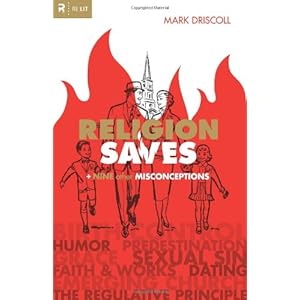
Book Review: Religion Saves
Religion Saves and Nine Other Misconceptions is one of the books from Mark Driscoll's pen, which is a straight sermon-to-book set-up. It's a series that Driscoll preached a while back, having established an elaborate voting system on the church website to find the most popular questions being asked by those coming along on Sundays.
The pastor of Mars Hill Church in Seattle is becoming increasingly well known, having recently preached at Mandate in Belfast, and is one of those controversial people, whom some love and of whom some aren't as fond. Let's be honest, I'm not really a fan of Driscoll, with some major objections to the way things seem to be done in his church, but as many of our young people are reading and listening to Driscoll, I wanted to see what all the fuss was about.
There are things to commend Driscoll - his passion for Jesus shines through, as well as his commitment to the gospel as revealed in the Bible. He's also seeking to communicate that gospel to his generation in the least churched city in America. These are good things, and yet there are some issues I have with this book, and in particular his style of communication.
First of all, his title seems a bit harsh. To instantly label the genuine questions being asked as misconceptions may not be the best way to approach and answer those questions! The themes themselves include birth control, humour, predestination, grace, sexual sin, faith and works, dating, the emerging church, and the regulative principle (which I had never heard of before!).
As I've said, some of our young people are reading Driscoll, and I'm not sure it's always appropriate reading. He can be quite (unneccesarily) explicit sometimes, in his description of sexual acts, and particularly in claiming that these are mandated in Scripture, in the Song of Solomon / Song of Songs. (On a side issue, in the past few years, he has preached through Song of Songs twice, which is an unusual overemphasis for any church, I would think).
Again, later, he's fairly rough when speaking of 'the Pharisees. Jesus called them a bag of snakes and said that their moms had shagged the Devil.' He's referring there to John 8:44, which actually says 'You are of your father the devil' - where Jesus is saying that these people were not from God, but were on the devil's side - not that their mothers had had illicit sexual relations! Is it that he sometimes loses the run of himself and goes for the controversial line to make it stand out, or does he just not realise what he's actually saying?
Perhaps the biggest frustration I had with the book was that, despite each sermon/chapter being set out to answer a genuine question from someone in his congregation, he rarely actually answered or engaged with the question! In some chapters they could stand quite separate from the question they were supposed to be answering, with no attempt to engage with what had been asked at all.
An example is the chapter on faith and works. The original question was: If salvation is by faith alone, then why are there so many verses that say or imply the opposite - that salvation is by works? Yet he never actually tackles the question, suggesting what those verses may be, and what they actually say in context, or how they may appear to speak of works judgement; or how the judgement of our works fits into the grand scheme of the gospel. Instead, he focused only on regeneration - great stuff, for sure, but not really what the question was concerned with.
Similarly on the emerging church, and specifically what the traditional church can learn from emerging churches, he never really answers the question, but goes on a rant against the way out emergents. All in all, a better approach on this particular subject will be found in Don Carson's Becoming Conversant with the Emerging Church.
I'm not sure I would recommend this book - perhaps it's a style issue, but there are substantial issues too, I think. The same topics and themes are probably handled better by other authors, in a more gracious way, with less offense caused. Plus, all the audio transcripts of the book (in the original sermon format) are available to download from the Mars Hill website!
Labels:
apologetics,
books,
church,
reading
Monday, July 26, 2010
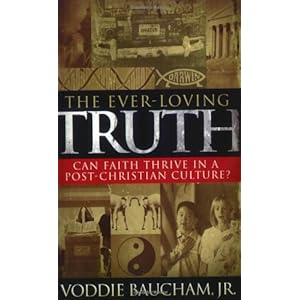
Book Review: The Ever-Loving Truth
Voddie Baucham is a big guy with a big personality, and a powerful Christian apologist in a hostile culture. Last November he spoke at the Northern Ireland Ministry Assembly, and made a big impact with his forthright style and cultural analysis. In this book, written back in 2004, Voddie examines the cultural opposition to Christianity before discussing what Christians should be doing in response.
In some senses, we've come full circle, to a similar culture to that of the early church. 'Much of what we are experiencing in post-Christian America is eerily similar to what the early church experienced in pre-Christian Rome.' The thing is that our response to this culture is so different to the first Christians - they challenged, we conform. Indeed, the problem is more stark than that - 'In many ways the church has begun to look too much like the prevailing culture and is therefore unable to provide a viable alternative.'
The three suppositions of our culture are relativism, tolerance and pluralism, which he discusses in turn before showing how they are myths. However I sometimes found his arguments hard to follow, with occasionally weak arguments. His purpose was spot on, but his arguments were weaker than (for example) Don Carson's in his 'Becoming Conversant with the Emerging Church.' He then moves on to survey the media's portrayal of Christians, with a number of stereotypes, never very positive.
In perhaps his strongest section, Voddie moves on to present an exposition of 2 Peter 1 on why we believe the Bible (which he had preached at NIMA, and which inspired my own sermon a couple of months ago), as well as the essential truth about Jesus. It was a good reminder of the 'fundamentals' of the faith, if that word can be used in a positive sense.
However, I did feel that sometimes I wasn't following what was being said, due to it being primarily an examination of American culture. For us Brits/Irish/outsiders, while we can find the cultural analysis helpful to some degree, it was very American. Further, Voddie seems to be writing with a certain political agenda regarding affirmative action and racial politics in the US, which may or may not be a greater influence than the gospel at certain points.
All in all, those interested in apologetics and culture could well find this useful, but really, it would be most useful for American Christians.
Labels:
apologetics,
books,
Christianity,
culture,
reading
Monday, May 31, 2010
Book Review: The Books The Church Suppressed
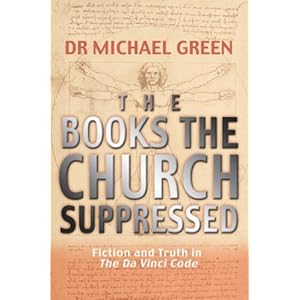
On the blog, we're getting into the swing of book reviews, but the books that I'm reading aren't always the latest books to be found in the bookshops. As I've written previously, I enjoy hunting through secondhand bookshops because you never know what you might find. On a recent visit, I came across the book with this intriguing title - 'The Books The Church Suppressed: Fiction and Truth in The Da Vinci Code' from Dr Michael Green.
Now obviously The Da Vinci Code has been out for a few years now, and this response to it has also been around for about five years, but it was a very useful book in setting out the key issues clearly and concisely. Green identifies the issues at hand in the claims of The Da Vinci code's narrator and characters - that Jesus was only thought of as divine after 325 at the Council of Nicaea, and that in the same year, the pagan emperor Constantine commissioned a new Bible for political motives, which is secondary and later than the Coptic Gnostic gospels from Nag Hammadi and the Dead Sea Scrolls.
Green, in refuting these ridiculous ideas, takes us on a whirlwind tour of Church History, back to the formation of the Canon of Scripture (where the Church recognised the authority of the apostolic writings, rather than giving them authority), and the beginnings of the Gnostic heresies. Or in Green's words: 'The church did not impose some list of books for the faithful to regard as authoritative. They recognised one!'
He expertly exposes the roots of Gnosticism, and how it is a completely different religious system to Christianity: 'Two different worlds, are they not? One rooted in human potential, the other rooted in the person and work of the divine Jesus.' Indeed, perhaps the strongest part of the book is where Green asks why it all matters, and then exposes the current trend towards Gnosticism in The Episcopal Church in the USA, and in liberal denominations in general. I don't think that I've read a better analysis of the mess we're in than his paragraphs on modern day Gnostics in the Church.
Thus far it's all been good, but in his comparison of Gnostic thought and Christianity, there was one weak point. In seeking to oppose the individualistic and superiority complex of the Gnostic elect, Green says this: 'Authentic Christianity... relies not on the salvation of those randomly predestined, but on the sheer generosity of God, whose free gift is eternal life for all who repent and believe.'
I understand that the book is perhaps aimed mostly for interested sceptics, those who will be drawn in by the title, and that Green wishes to greet them with the gospel as they think through the issues involved - but surely predestination is an important element of the gospel. To me, it seems that the biblical doctrine of predestination is being ignored, to emphasise the free offer to all. Perhaps there would have been a better way of phrasing it.
All in all, though, the book is excellent. It's a clear, concise defence of the truth, which acts as a good introduction to the early Church, its history and the Bible's authority. Christians wishing to engage in apologetics and learn more of Church History will benefit, but equally will non-Christians wishing to examine the truth claims of Dan Brown's writings. As I've said, this book's best contribution may well be as an exposition and refutation of Gnosticism, both ancient and modern.
Sunday, November 15, 2009
Where Is God When I Need Him? (Sermon: Psalm 34)
It’s a tough question we’re looking at tonight as we begin our new series of Open House. Where is God when I need him? It seems to be a question for many people - a serious question, and a serious challenge. Type that phrase into Google (which might be an indicator of where we’re at), and you get almost 92 million results. It’s a popular question, and lots of people are trying to answer it.
The immediate problem is clear - I need God because of some particular situation in my life, but he seems absent, distant, uninterested. Perhaps you find yourself asking this question tonight - it might be because of some illness you’re battling, or long-term suffering, or some home situation, or you have a decision and need some help or guidance or intervention.
You pray, you search for God, but he appears to be absent. Where is God? Why does he not do something? Why does he not answer my prayers?
Where is God? The question brings us to the heart of the matter - what is God like? What can we expect or demand of God? Or, perhaps the more pressing issue - what do we think God is like?
In The Hobbit, the story before the Lord of the Rings, Gandalf the wizard is described in these words: ‘Gandalf thought of most things; and though he could not do everything, he could do a great deal for friends in a tight corner.’ Is this how we think of God as well? Can’t do everything, but should do a great deal for us when we’re in a tight corner?
Let’s look at the testimony of one person who has experienced God’s help and salvation when he needed it. We heard Psalm 34, one of the Psalms written by King David. He was in a tight spot, and God rescued him.
Why does David begin by praising God, and calling for others to praise God with him? ‘I sought the LORD, and he answered me and delivered me from all my fears.’ (34:4) Later he says ‘This poor man cried, and the LORD heard him and saved him out of all his troubles.’ (34:6)
That’s all very well, you might say, but what about me? I’ve been crying to the Lord and he hasn’t answered me. What does David tell us about the Lord in this Psalm? First of all, we have particular comfort if we’re going through time of trouble or suffering: ‘The LORD is near to the broken-hearted and saves the crushed in spirit.’ (34:18) ‘The eyes of the LORD are toward the righteous and his ears toward their cry.’ (34:15)
What we’re seeing here is that, rather than God being absent or distant, God is near as we suffer, that God is watching - not in a nosy, or spiteful way - but watching with eyes of compassion, and quick to listen. You know the way a parent always hears when their baby cries out, no matter how deep a sleep they’re in? My wife’s sister was over last week, and she could hear baby Elizabeth crying in the next room even over the noise of the TV and us talking... But God doesn’t sleep, God isn’t distracted - he always watches and listens to us.
But what does it mean when it says ‘The eyes of the LORD are toward the righteous’? It has nothing to do with us - as if you have to be ‘good’ for God to listen - you know, as if God’s help is a barter system - if I’ve done my good deed of the day, or if I’ve helped an old lady across the road, or if I’ve been to church or whatever... The righteous are those who are trusting in the Lord, or as verse 5 says ‘those who look to him’. In verse 22, we have the promise that ‘The LORD redeems the life of his servants; none of those who take refuge in him will be condemned.’ The picture here is of trouble coming, like a huge shower of rain, and taking shelter in the Lord, trusting him for protection. But it’s not protection from suffering or trouble - it is protection forever - our future is secure and there is no condemnation.
So far we’ve seen the particular comfort the Lord provides, but David also invites us to praise God all the time, to get to know him all the time: ‘Oh, taste and see that the LORD is good!’ (34:8) I love it when I’m going round the supermarket and there’s a free sample - recently it was mince pies in Marks and Spencers - and I’ll always try a wee bit (so long as I can). We’re being invited here to sample the Lord’s character, to experience who he is, and to trust in him.
Because the Lord is good, we can and should depend on him all the time, not just when things are rough. God is not just a rainy day God - just sitting waiting around until we think we need him. I recently read on a blog this exact attitude: ‘I had made him a God of weeping and tears. When life got hard and painful, I would go see him, take my problems and weep with him. When life got good, I would walk away and eventually pat myself on the back for all the good times I was experiencing.’
Do we do this with God? We demand him to be present and helping when we need him, but then when we don’t need him we’re not interested. Where is God when I need him? The very same place he is when we think we don’t need him!
But this might raise another question for you - if God is right there, near to the broken hearted, and I’m taking refuge in him, then why doesn’t he do something to show it? Why doesn’t he answer my prayers or intervene to change things when I cry to him?
Consider Paul. Paul was one of the first Christian leaders, a missionary who travelled vast distances telling people about Jesus. One of the leading Christians, and yet he suffered from what is described as a ‘thorn in the flesh.’ It was some particular ailment or illness or situation, which Paul found incredibly difficult, so he does what you or I would do, and prays to God to take it away. Here’s the answer the Lord gave: ‘My grace is sufficient for you, for my power is made perfect in weakness.’ (2 Cor 12:9)
It’s not that the Lord didn’t answer Paul’s prayer - it’s just not the answer Paul expected. Could it be that when we pray to God that we have one desired outcome, like taking a shopping list to God, wanting ‘yes’ answers all the time?
CS Lewis once asked if God forsakes those who serve him best. ‘He who served him best of all said, near his tortured death, ‘My hast thou forsaken me?’ When God becomes man, that Man of all others, is least comforted by God, at his greatest need.’
As Jesus died on the cross, he knew the loneliness of separation from God. He suffers in our place, stands where we should have stood, and therefore is the one who sympathises with our weakness and suffering. Indeed, the Lord Jesus promises all who trust in him: ‘I will never leave you nor forsake you.’ (Hebrews 13:5).
Where is God when I need him? Closer than you think, if you will but cry out to him, and take refuge in him.
This sermon was preached at Open House at St Elizabeth's Church, Dundonald on Sunday 15th November 2009.
The immediate problem is clear - I need God because of some particular situation in my life, but he seems absent, distant, uninterested. Perhaps you find yourself asking this question tonight - it might be because of some illness you’re battling, or long-term suffering, or some home situation, or you have a decision and need some help or guidance or intervention.
You pray, you search for God, but he appears to be absent. Where is God? Why does he not do something? Why does he not answer my prayers?
Where is God? The question brings us to the heart of the matter - what is God like? What can we expect or demand of God? Or, perhaps the more pressing issue - what do we think God is like?
In The Hobbit, the story before the Lord of the Rings, Gandalf the wizard is described in these words: ‘Gandalf thought of most things; and though he could not do everything, he could do a great deal for friends in a tight corner.’ Is this how we think of God as well? Can’t do everything, but should do a great deal for us when we’re in a tight corner?
Let’s look at the testimony of one person who has experienced God’s help and salvation when he needed it. We heard Psalm 34, one of the Psalms written by King David. He was in a tight spot, and God rescued him.
Why does David begin by praising God, and calling for others to praise God with him? ‘I sought the LORD, and he answered me and delivered me from all my fears.’ (34:4) Later he says ‘This poor man cried, and the LORD heard him and saved him out of all his troubles.’ (34:6)
That’s all very well, you might say, but what about me? I’ve been crying to the Lord and he hasn’t answered me. What does David tell us about the Lord in this Psalm? First of all, we have particular comfort if we’re going through time of trouble or suffering: ‘The LORD is near to the broken-hearted and saves the crushed in spirit.’ (34:18) ‘The eyes of the LORD are toward the righteous and his ears toward their cry.’ (34:15)
What we’re seeing here is that, rather than God being absent or distant, God is near as we suffer, that God is watching - not in a nosy, or spiteful way - but watching with eyes of compassion, and quick to listen. You know the way a parent always hears when their baby cries out, no matter how deep a sleep they’re in? My wife’s sister was over last week, and she could hear baby Elizabeth crying in the next room even over the noise of the TV and us talking... But God doesn’t sleep, God isn’t distracted - he always watches and listens to us.
But what does it mean when it says ‘The eyes of the LORD are toward the righteous’? It has nothing to do with us - as if you have to be ‘good’ for God to listen - you know, as if God’s help is a barter system - if I’ve done my good deed of the day, or if I’ve helped an old lady across the road, or if I’ve been to church or whatever... The righteous are those who are trusting in the Lord, or as verse 5 says ‘those who look to him’. In verse 22, we have the promise that ‘The LORD redeems the life of his servants; none of those who take refuge in him will be condemned.’ The picture here is of trouble coming, like a huge shower of rain, and taking shelter in the Lord, trusting him for protection. But it’s not protection from suffering or trouble - it is protection forever - our future is secure and there is no condemnation.
So far we’ve seen the particular comfort the Lord provides, but David also invites us to praise God all the time, to get to know him all the time: ‘Oh, taste and see that the LORD is good!’ (34:8) I love it when I’m going round the supermarket and there’s a free sample - recently it was mince pies in Marks and Spencers - and I’ll always try a wee bit (so long as I can). We’re being invited here to sample the Lord’s character, to experience who he is, and to trust in him.
Because the Lord is good, we can and should depend on him all the time, not just when things are rough. God is not just a rainy day God - just sitting waiting around until we think we need him. I recently read on a blog this exact attitude: ‘I had made him a God of weeping and tears. When life got hard and painful, I would go see him, take my problems and weep with him. When life got good, I would walk away and eventually pat myself on the back for all the good times I was experiencing.’
Do we do this with God? We demand him to be present and helping when we need him, but then when we don’t need him we’re not interested. Where is God when I need him? The very same place he is when we think we don’t need him!
But this might raise another question for you - if God is right there, near to the broken hearted, and I’m taking refuge in him, then why doesn’t he do something to show it? Why doesn’t he answer my prayers or intervene to change things when I cry to him?
Consider Paul. Paul was one of the first Christian leaders, a missionary who travelled vast distances telling people about Jesus. One of the leading Christians, and yet he suffered from what is described as a ‘thorn in the flesh.’ It was some particular ailment or illness or situation, which Paul found incredibly difficult, so he does what you or I would do, and prays to God to take it away. Here’s the answer the Lord gave: ‘My grace is sufficient for you, for my power is made perfect in weakness.’ (2 Cor 12:9)
It’s not that the Lord didn’t answer Paul’s prayer - it’s just not the answer Paul expected. Could it be that when we pray to God that we have one desired outcome, like taking a shopping list to God, wanting ‘yes’ answers all the time?
CS Lewis once asked if God forsakes those who serve him best. ‘He who served him best of all said, near his tortured death, ‘My hast thou forsaken me?’ When God becomes man, that Man of all others, is least comforted by God, at his greatest need.’
As Jesus died on the cross, he knew the loneliness of separation from God. He suffers in our place, stands where we should have stood, and therefore is the one who sympathises with our weakness and suffering. Indeed, the Lord Jesus promises all who trust in him: ‘I will never leave you nor forsake you.’ (Hebrews 13:5).
Where is God when I need him? Closer than you think, if you will but cry out to him, and take refuge in him.
This sermon was preached at Open House at St Elizabeth's Church, Dundonald on Sunday 15th November 2009.
Labels:
apologetics,
Psalms,
sermons
Sunday, February 08, 2009
How Can I Believe That God is Good?
As we look at the world, you might be tempted to ask – what’s going on? You only have to look in the newspapers or on TV to see bad things happening. War. Famine. Earthquakes. Hurricanes. Or maybe we don’t even have to go to outside. We see bad things happening in our families, friends, or even our own lives.
Why do bad things happen? Or rather, why does a God who is meant to be good let bad things happen? Does God not care? Is God not powerful to stop them from happening? Or is God simply not good?
The first thing we have to do is sort out what we mean by good – and where it comes from in the first place. When we say that something is good, what do we mean? Is it just what feels good for us, or is there an ultimate standard? Is ‘good’ a subjective thing – what’s right for me is good? Well, surely not. Just think of two children being given sweets. If there’s a difference between the two, then you’ll probably hear ‘that’s not fair’ – from we’re no height, we appeal to a standard of fairness – we know good and evil, right and wrong.
So where does this standard of good and evil come from? Is it just something that evolved – evolutionary principles? Or is it implanted deep within us – a shadow of the divine image we were created with – an echo of the goodness of God?
Yet, when we hear that phrase – the goodness of God, some of us may well doubt it. How can God be good when … You fill in the blank. You know how it ends.
Humans have always been questioning God’s goodness. Think of Adam and Eve in the Garden of Eden. They had all they needed; they enjoyed God’s company, truly they were in Paradise. Even in Paradise, God told them not to eat of the fruit of the tree in the middle of the garden – the tree of the knowledge of good and evil.
The serpent comes along and asks Eve about this. Why was it God had told them not to eat of it? ‘Did God actually say…?’ Surely God was holding something back – or in other words, God wasn’t truly good. If God was good, so the devil’s lie goes, he would have given them all things without limits. ‘You will not surely die…’
So Adam and Eve take the fruit, eat it, and suddenly everything changes. Banished from the garden. Cut off from God’s company. Turned against one another. Perhaps God was good all along – knowing what would happen when Adam and Eve – and us – want to make our own decisions; try to be god ourselves.
Now you might be thinking that God can’t be good if he removed Adam and Eve from the garden. Surely he was being bad there? Yet even in this, God was acting according to his character of goodness, holiness, and love.
Later, Moses is granted a vision of God’s goodness, and the name of the LORD is proclaimed: ‘The LORD, the LORD, a God merciful and gracious, slow to anger, and abounding in steadfast love and faithfulness, keeping steadfast love for thousands, forgiving sin and iniquity and transgression and sin, but who will by no means clear the guilty, visiting the iniquity of the fathers on the children and the children’s children to the third and the fourth generation.’ (Exodus 34:6-7)
So you see that a vital part of God’s goodness is his being merciful, gracious, slow to anger, abounding in steadfast love and faithfulness. Rather than judging Adam and Eve straight away, he graciously allows them to live and produce children, as well as promising the one who will deal with their sin.
When Moses first encountered the LORD, Moses asks what his name is. “I AM WHO I AM” (Exodus 3:14) – which speaks of God’s unchanging nature, as well as his endless existence – always present tense. In this again, we see something of God’s goodness – because he never changes.
You see, when the Israelites went into the promised land, they were warned not to turn and follow the idols and false gods of the natives of the land. In and around the area you had Baal and Asherah – husband and wife farming gods, who needed sacrifices to be kept on your side to boost your crops. Molech was another false god – to keep him happy, you had to sacrifice your son or daughter. Do you see the problem? These gods were so unpredictable – you had to keep giving them things so they would like you and help you.
In contrast, the Living God never changes – his nature is as it always has been – that of mercy, love, grace, slow to anger. I’m not saying that we can take God for granted as a result – but he is not capricious or likely to suddenly change his mind.
So if God never changes, then can we see how he is good? Theologians talk of ‘common grace.’ What they mean by this is a practical, permanent grace that God extends to the whole of the world, both saved and unsaved. Jesus speaks of it in the Sermon on the Mount, calling for his followers to love your enemies ‘so that you may be sons of your Father who is in heaven. For he makes his sun rise on the evil and the good, and sends rain on the just and on the unjust.’ (Matthew 5:44-45)
The sun and the rain (and even the snow), are God’s good gifts to everyone – not just those who follow him. Even the rebellious benefit from the sun and the rain. As James says, ‘Every good and every perfect gift is from above, coming down from the Father of lights with whom there is no variation or shadow due to change’ (James 1:17)
However, a wider application of common grace can also be seen. Earlier I mentioned that God graciously allowed Adam and Eve to live and have children, rather than immediately judging their sin.
Does God not do the same today with us? Imagine that there was immediate judgement for our sins, so that as we committed a sin, we were struck down. How long would anyone survive? As the Psalmist says: ‘If you, O LORD, should mark iniquities, O Lord, who could stand?’ (Psalm 130:3) God’s goodness in his common grace not only gives us things we don’t deserve like sun and rain, but also withholds judgement until the proper time – giving us the opportunity to repent and believe.
As Don Carson says, ‘Acts of kindness and self-sacrifice surface among every race and class of human beings, not because we are simple mixtures of good and evil, but because even in the midst of our deep rebellion God restrains us and displays his glory and goodness.’
But maybe the sun and rain just don’t cut it for you. The rain seems to complement your tears of pain and suffering. If God was good, then this wouldn’t happen. Let me take you to a prison cell. A man has just been thrown into jail accused of assaulting his boss’ wife. It’s the low point having been attacked by his brothers and sold as a slave far away from home. Joseph (minus his Amazing Technicolor Dreamcoat) languishes in prison, but ultimately ends up as Egypt’s Prime Minister to guide the country through years of famine. After his father dies, his brothers are fearful of what Joseph will do to them. But here’s what he says: “As for you, you meant evil against me, but God meant it for good, to bring it about that many people should be kept alive, as they are today.” (Genesis 50: 20).
Or let me take you to the town of Bethlehem as two women arrive after a long journey. The older of the two had left ten years before with a husband and two sons. Now, she just has one daughter-in-law, and she wants to be called Mara (which means bitter), because the LORD has brought her back empty, and the Almighty has afflicted her. Yet for Naomi, God’s goodness is always with her, and is completed when she has a grandson. Her suffering was bitter, but God’s goodness did not fail her or Ruth.
Let me take you on to a hill outside a city. Three crosses stand waiting for their victims. The men are nailed to the crosses, and the crowd watches to see what will happen. The man on the middle cross had been making deaf people hear and blind people see. Lame men had been walking, and he had even raised the dead. But now he hangs on the cross, his back lacerated from the flogging, his head pierced with the crown of thorns, struggling to breathe, in agony.
He saved others – let him save himself. Yet he dies, a cruel death on a Roman cross. Where was God in this? Was it a mistake, after everything had been going so well? No, even in the death of the cross, God was working his purpose for good – demonstrating his goodness and his love for the world.
‘For while we were still weak, at the right time Christ died for the ungodly. For one will scarcely die for a righteous person – though perhaps for a good person one would dare even to die – but God shows his love for us in that while we were still sinners, Christ died for us.’ (Romans 5:6-8)
Can you imagine it? While we were still God’s enemies, Jesus died for us to make us his friends! When we’re tempted to think that God is not good, that God does not care, we can look and see the Lord Jesus, who still bears the marks of the cross – the wounds of love. Jesus lives, assuring us of God’s goodness, and his love.
How can I believe that God is good? We see it in his common grace, but we also see it much clearer in Jesus. Throughout the Psalms we see a theme being repeated: ‘Give thanks to the LORD, for he is good; his steadfast love endures for ever!’ (Ps 118:1). ‘Oh taste and see that the LORD is good! Blessed is the man who takes refuge in him!’ (Psalm 34:8).
This talk was presented at Open HouseDundonald on Sunday 8th February 2009.
Why do bad things happen? Or rather, why does a God who is meant to be good let bad things happen? Does God not care? Is God not powerful to stop them from happening? Or is God simply not good?
The first thing we have to do is sort out what we mean by good – and where it comes from in the first place. When we say that something is good, what do we mean? Is it just what feels good for us, or is there an ultimate standard? Is ‘good’ a subjective thing – what’s right for me is good? Well, surely not. Just think of two children being given sweets. If there’s a difference between the two, then you’ll probably hear ‘that’s not fair’ – from we’re no height, we appeal to a standard of fairness – we know good and evil, right and wrong.
So where does this standard of good and evil come from? Is it just something that evolved – evolutionary principles? Or is it implanted deep within us – a shadow of the divine image we were created with – an echo of the goodness of God?
Yet, when we hear that phrase – the goodness of God, some of us may well doubt it. How can God be good when … You fill in the blank. You know how it ends.
Humans have always been questioning God’s goodness. Think of Adam and Eve in the Garden of Eden. They had all they needed; they enjoyed God’s company, truly they were in Paradise. Even in Paradise, God told them not to eat of the fruit of the tree in the middle of the garden – the tree of the knowledge of good and evil.
The serpent comes along and asks Eve about this. Why was it God had told them not to eat of it? ‘Did God actually say…?’ Surely God was holding something back – or in other words, God wasn’t truly good. If God was good, so the devil’s lie goes, he would have given them all things without limits. ‘You will not surely die…’
So Adam and Eve take the fruit, eat it, and suddenly everything changes. Banished from the garden. Cut off from God’s company. Turned against one another. Perhaps God was good all along – knowing what would happen when Adam and Eve – and us – want to make our own decisions; try to be god ourselves.
Now you might be thinking that God can’t be good if he removed Adam and Eve from the garden. Surely he was being bad there? Yet even in this, God was acting according to his character of goodness, holiness, and love.
Later, Moses is granted a vision of God’s goodness, and the name of the LORD is proclaimed: ‘The LORD, the LORD, a God merciful and gracious, slow to anger, and abounding in steadfast love and faithfulness, keeping steadfast love for thousands, forgiving sin and iniquity and transgression and sin, but who will by no means clear the guilty, visiting the iniquity of the fathers on the children and the children’s children to the third and the fourth generation.’ (Exodus 34:6-7)
So you see that a vital part of God’s goodness is his being merciful, gracious, slow to anger, abounding in steadfast love and faithfulness. Rather than judging Adam and Eve straight away, he graciously allows them to live and produce children, as well as promising the one who will deal with their sin.
When Moses first encountered the LORD, Moses asks what his name is. “I AM WHO I AM” (Exodus 3:14) – which speaks of God’s unchanging nature, as well as his endless existence – always present tense. In this again, we see something of God’s goodness – because he never changes.
You see, when the Israelites went into the promised land, they were warned not to turn and follow the idols and false gods of the natives of the land. In and around the area you had Baal and Asherah – husband and wife farming gods, who needed sacrifices to be kept on your side to boost your crops. Molech was another false god – to keep him happy, you had to sacrifice your son or daughter. Do you see the problem? These gods were so unpredictable – you had to keep giving them things so they would like you and help you.
In contrast, the Living God never changes – his nature is as it always has been – that of mercy, love, grace, slow to anger. I’m not saying that we can take God for granted as a result – but he is not capricious or likely to suddenly change his mind.
So if God never changes, then can we see how he is good? Theologians talk of ‘common grace.’ What they mean by this is a practical, permanent grace that God extends to the whole of the world, both saved and unsaved. Jesus speaks of it in the Sermon on the Mount, calling for his followers to love your enemies ‘so that you may be sons of your Father who is in heaven. For he makes his sun rise on the evil and the good, and sends rain on the just and on the unjust.’ (Matthew 5:44-45)
The sun and the rain (and even the snow), are God’s good gifts to everyone – not just those who follow him. Even the rebellious benefit from the sun and the rain. As James says, ‘Every good and every perfect gift is from above, coming down from the Father of lights with whom there is no variation or shadow due to change’ (James 1:17)
However, a wider application of common grace can also be seen. Earlier I mentioned that God graciously allowed Adam and Eve to live and have children, rather than immediately judging their sin.
Does God not do the same today with us? Imagine that there was immediate judgement for our sins, so that as we committed a sin, we were struck down. How long would anyone survive? As the Psalmist says: ‘If you, O LORD, should mark iniquities, O Lord, who could stand?’ (Psalm 130:3) God’s goodness in his common grace not only gives us things we don’t deserve like sun and rain, but also withholds judgement until the proper time – giving us the opportunity to repent and believe.
As Don Carson says, ‘Acts of kindness and self-sacrifice surface among every race and class of human beings, not because we are simple mixtures of good and evil, but because even in the midst of our deep rebellion God restrains us and displays his glory and goodness.’
But maybe the sun and rain just don’t cut it for you. The rain seems to complement your tears of pain and suffering. If God was good, then this wouldn’t happen. Let me take you to a prison cell. A man has just been thrown into jail accused of assaulting his boss’ wife. It’s the low point having been attacked by his brothers and sold as a slave far away from home. Joseph (minus his Amazing Technicolor Dreamcoat) languishes in prison, but ultimately ends up as Egypt’s Prime Minister to guide the country through years of famine. After his father dies, his brothers are fearful of what Joseph will do to them. But here’s what he says: “As for you, you meant evil against me, but God meant it for good, to bring it about that many people should be kept alive, as they are today.” (Genesis 50: 20).
Or let me take you to the town of Bethlehem as two women arrive after a long journey. The older of the two had left ten years before with a husband and two sons. Now, she just has one daughter-in-law, and she wants to be called Mara (which means bitter), because the LORD has brought her back empty, and the Almighty has afflicted her. Yet for Naomi, God’s goodness is always with her, and is completed when she has a grandson. Her suffering was bitter, but God’s goodness did not fail her or Ruth.
Let me take you on to a hill outside a city. Three crosses stand waiting for their victims. The men are nailed to the crosses, and the crowd watches to see what will happen. The man on the middle cross had been making deaf people hear and blind people see. Lame men had been walking, and he had even raised the dead. But now he hangs on the cross, his back lacerated from the flogging, his head pierced with the crown of thorns, struggling to breathe, in agony.
He saved others – let him save himself. Yet he dies, a cruel death on a Roman cross. Where was God in this? Was it a mistake, after everything had been going so well? No, even in the death of the cross, God was working his purpose for good – demonstrating his goodness and his love for the world.
‘For while we were still weak, at the right time Christ died for the ungodly. For one will scarcely die for a righteous person – though perhaps for a good person one would dare even to die – but God shows his love for us in that while we were still sinners, Christ died for us.’ (Romans 5:6-8)
Can you imagine it? While we were still God’s enemies, Jesus died for us to make us his friends! When we’re tempted to think that God is not good, that God does not care, we can look and see the Lord Jesus, who still bears the marks of the cross – the wounds of love. Jesus lives, assuring us of God’s goodness, and his love.
How can I believe that God is good? We see it in his common grace, but we also see it much clearer in Jesus. Throughout the Psalms we see a theme being repeated: ‘Give thanks to the LORD, for he is good; his steadfast love endures for ever!’ (Ps 118:1). ‘Oh taste and see that the LORD is good! Blessed is the man who takes refuge in him!’ (Psalm 34:8).
This talk was presented at Open HouseDundonald on Sunday 8th February 2009.
Friday, February 06, 2009
The Reason for God
Timothy Keller's magisterial book The Reason for God is such a book. Split into two sections, the first deals with common misconceptions and problems non-believers have with the Christian faith, and the second presents the reasons why it is logical, consistent, and acceptable to believe in God.
On the whole, I enjoyed the book, and will certainly return to it in the future to think through the issues again. His treatment of sin was different to how I would have approached it, but I can see how his approach may work, and also what he was communicating when he proposed sin (following Kirkegaard) as "in despair not wanting to be oneself before God." (p. 162). Through the following pages he unpacks this somewhat, but I don't think this is the line I would have gone down.
Granted the subject and the nature of the discussion, some parts of the book were philosophically heavy, and I struggled to keep going through them, particularly some of the early chapters. Perhaps this is because I had never read any of Keller's material before, or perhaps I wasnt focused on the topic at hand. Despite this minor problem (which may be me, and not the book), I would highly recommend The Reason for God.
Labels:
apologetics,
books,
Christianity,
reading,
review
Subscribe to:
Posts (Atom)