Showing posts with label biography. Show all posts

Friday, December 12, 2014

Book Review: The Poetic Wonder of Isaac Watts


If you peruse any of the hymbooks in use today, or glance at the author's name as you sing soild traditional hymns in church, one of the names you'll notice popping up regularly is Isaac Watts. Not knowing anything about him beyond his famous hymns, this little book appeared on Kindle for free back in the summer, so I bought it to discover more about the hymnwriter.

As the foreword puts it, in Christian history there are 'followers worthy to be followed' - godly men and women who should be imitated. The author, Douglas Bond, contends that Isaac Watts is such a follower, as they portray his life, his influences, and focus in on his hymnwriting. This is the focus because 'in a day where there is much shallowness in corporate worship, the church must recapture a high view of God that leads to transcendent worship. In the final analysis, it is theology that inevitably produces doxology.'

So why look at Isaac Watts? 'First, we need Watts' poetry in our lives... Second, we need Watts' voice in our worship... and Third, we need Watts' example as we live in our frailty.'

There was much that I learned about Watts. I had never realised he was a nonconformist, his father the pastor of Above Bar Church in Southampton (where David Jackman was pastor much more recently), refusing to take a scholarship to Oxford or Cambridge in order to 'take his lot among the dissenters.' He began hymnwriting at the age of 16, when walking home from church one Sunday in 1690, referring to the 'ugly hymns' they had sung, and challenged by his father to 'give us something better.' What a challenge, and what a result!

The rest of the book takes the themes of some of the hymns he has written, including When I survey the wondrous cross; Joy to the world; Jesus shall reign where'er the sun; and O God our help in ages past.

Watts based many of his hymns on the Psalms, some of which we still sing. Yet there was always something I couldn't quite understand when we sung them in church. He seemed to introduce Jesus/the cross into the otherwise faithful Psalm paraphrase. Why did he do it? The author quotes Watts in his own words:

His defence of his method indicates that Watts wanted the Old Testament to be understood in light of its fulfillment in Christ: Where the Psalmist... speaks of the pardon of sin through the mercies of God, I have added the merits of a Saviour. Where he talks of sacrificing goats or bullocks, I rather choose to mention the sacrifice of Christ, the Lamb of God. Where he promises abundance of wealth, honour, and long life, I have changed some of these typical blessings for grace, glory, and life eternal, which are brought to light by the Gospel, and promised in the New Testament. And I am fully satisfied, that more honour is done to our blessed Saviour by speaking his name, his graces, his actions, in his own language, according to the brighter discoveries he hath now made, than by going back again to the Jewish forms of worship, and the language of types and figures.

An interesting idea, which needs more thought, I reckon, and not entirely positively.

There was one little bit I didn't quite understand. The author appeared in one chapter to show that Watts refused to go up to Oxford and Cambridge, but in another chapter, reflecting on the irony that a textbook he wrote became the standard text at those institutions, 'institutions that refused to admit a Nonconformist such as Watts.' Both can't be the case!

Overall, this is a really good book. His life is detailed, and his hymns are explained with stories from his life. Those who enjoy hymns, theology or church history will particularly enjoy it. At times, though, there is a slight American bias to the writing and focus - in addressing his legacy in the 'New World' more than in his native England. It's also slightly disappointing to see great English compositions and diary entries rendered in American English!

The Poetic Wonder of Isaac Watts by Douglas Bond is available from Amazon for Kindle.

Tuesday, August 28, 2012

Book Review: John Charles Ryle 1816-1900


JC Ryle has gone down in history as the first Protestant (Anglican) Bishop of Liverpool, a leading evangelical churchman, and a prolific writer of books and tracts. It's probably no surprise that his books feature on my shelves, both his commentaries and his devotional, doctrinal works, but I couldn't have told you that much about him. That malady has now been corrected through this little biographical book by Marcus Loane, the former Archbishop of Sydney.

Even before you get to the stuff about JC Ryle, this book is worth getting and reading. Loane begins by presenting an introduction to Evangelical belief and continuity focusing on the fact that evangelical faith is not novel or new, neither during the Evangelical Awakenings nor the Reformation, but rather: 'Our faith... can be traced back through all the ages of its primitive origin in the revelation of the Gospel of the Lord Christ himself.' (p. 12) Alongside this continuity, Loane demonstrates the 'fact that our faith draws its strength from recognised scholarship: it is nothing if not reasonable in its approach to the New Testament.' (p. 14) The third element of Evangelical faith is that 'our faith proves its worth in personal devotion: it is nothing if not spiritual in its response to the New Testament' - a devotion which bears fruit in self-giving and service. These are the qualities which are seen in the life of JC Ryle, which the rest of the biography displays.

Having been educated at Eton and Oxford, where he was cricket captain, and where he learnt important lessons in leadership, Ryle was converted at the age of 21, on hearing Ephesians 2:8-9 being read aloud in his parish church. He was wonderfully converted, yet it was not universally welcomed: 'But the great change in his life was hardly welcome at home. It led to an awkwardness and a sense of estrangement in his own family; it drove a wedge between him and old friends.' (p. 35)

He's not the first, nor even the last to experience such frustration and disappointment, and yet his story is an encouragement for the rest of us. 'In calm retrospect he came to see how God was fitting him for after work in a way he did not know.' (p. 36) Isn't that often the case - our difficult experiences are paving the way for what will later come.

In Ryle's case, it was his father's sudden bankruptcy, going from wealthy banker, silk trader and MP to being left with nothing, virtually overnight, that directed Ryle towards his place in the world, not in the family business, but in the Father's business: 'But there can be no doubt that God used this calamity to turn his heart towards his true life work, for the thought of ordination had not even crossed his mind as long as his hope for a political career had been practicable.' (p. 38)

Being ordained in 1841 at the age of 25, he became Curate of Fawley with responsibility for the Chapel of Ease at Exbury. In a remarkable ministry, he was in every home in the parish every month - something the recent Church of Ireland Gazette letter-writers would be most impressed with! However, such a course of action may have been his downfall, and within two years he had moved to Winchester as incumbent because 'his own health broke down at the end of two years.' (p. 40) Just six months later, he was on the move again, to a better living, that of Helmingham in Suffolk.

It was here that disaster struck for poor Ryle, being quickly widowed twice, with five children between the ages of two and fourteen. Yet even then, 'his faith did not falter; it taught him to echo the words of the Psalmist: "As for God, His way is perfect."' (p. 48).

His next parish was that of Stradbroke, and it was here that he came to national prominence, as a preacher and tract writer. Seeking to promote and maintain the true religion of the 39 Articles in the face of the rise of the Tractarians (the Oxford Movement / Anglo-Catholics), he wrote several more books including Knots Untied, and Old Paths.

Having been appointed as Dean of Salisbury, he never took up his place, instead being appointed as the first bishop of the new diocese of Liverpool by the Prime Minister of the time, Disraeli.

Having mentioned his books, perhaps the most famous of them all were his series of Devotional Thoughts on the Gospels - a useful running commentary on the scriptures, three of which were written in his incumbency in Helmingham (and the fourth in Stradbroke). If I'm to write, perhaps it'll be during my time here?

All in all, this was a good little book to read. It provided an account of a faithful minister's struggles and triumphs, and encourages other ministers to remain faithful and to give all they have in the cause of the gospel, for the glory of Jesus.

Friday, July 08, 2011

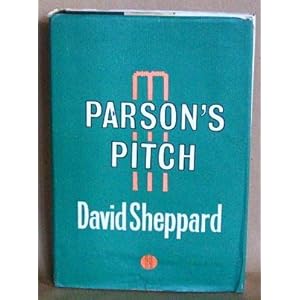
Book Review: Parson's Pitch


I got the loan of this 1964 book through a pastoral visit, and so it managed to jump the to-be-read queue in order to be returned before I leave this parish! It came into my brief possession through a guy who played cricket, so I lent him Penguins Stopped Play, and he gave me this one.

Parson's Pitch is a sort of autobiography of the cricketing cleric, David Sheppard, who eventually went on to become Bishop of Liverpool, having been the only Test cricketer to have been ordained. As such, there were some chapters that were more interesting and appealing than others, as the material switched from cricketing stories and matches to the story of his conversion and faith.

As I've said, the book was written in the early 1960s and so seems quite time-bound in the cricket details. I don't know quite enough about cricket, nor about the famous players from the 1930s to 60s to have appreciated some of what he was writing about. This was especially the case given the last three chapters are an almost blow-by-blow account of the English tour of Australia in the 1962-63 season, with much more detail than the casual reader would have wanted, even more so fifty years later! Perhaps it was a huge selling point when it first came out, but less so with the passing of time.

That being said, it would still be useful as an evangelistic book for sport mad men, if you had a local cricket team you were trying to reach with the gospel. They may better appreciate the cricket stories, but within they will also find a clear explanation of the good news of Jesus Christ, how Sheppard was soundly converted, and how he openly talks of his Christian faith affecting every part of his life, even his sport.

There were some choice quotes, which might whet your appetite:

'It is all too easy to handle holy things without consciously coming close to God at all.'

'I found it fascinating and important, but tried to keep firmly in my mind that all this was a background to meeting real needs of real people, and not simply some unending intellectual argument.' (On his theological studies at Ridley College)

I'm glad to have read it, and I'm sure it had a great impact when first released, but perhaps the passing of time has been less kind to this book. Nevertheless, the timeless gospel is presented clearly within, and therefore it may yet nudge people along the way as they read a cricket autobiography and find the living Lord Jesus who saved David Sheppard, Test Cricketer and Clergyman.

Wednesday, April 07, 2010

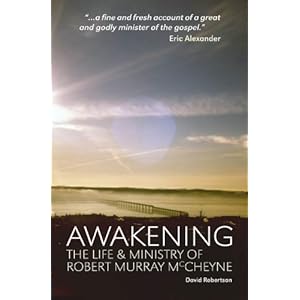
Book Review: Awakening


Dundee has played its part in our wider family story over the past few years, being the place of studies, of a wedding, and numerous visits. Anyone familiar with Dundee will probably be aware of the ministry and legacy of one young man connected with the city, namely Robert Murray McCheyne.

McCheyne was minister of St Peter's Church on the Perth Road, Dundee, the church where my brother-in-law is now working, so I've been interested in M'Cheyne for quite a while, having first heard of him at a Proc Trust Student Ministers' Preaching Conference five years ago. Awakening is the remarkable story of McCheyne, written by the current minister of St Peter's, David Robertson (of The Dawkins Letters fame).

The book is divided into twenty small, manageable chapters, each covering an aspect of the background, history, life, ministry and effects of McCheyne, and is a wealth of information and inspiring (and challenging) stories and nuggets of gospel truth and ministry practice. Robertson presents a well researched and readable biography, presenting a fair picture of McCheyne, steering clear of the hagiography (or exaggerated accounts of the lives of saints as can sometimes be presented), as he says: 'As the research progressed, I became amazed, angry and awakened. Amazed at the relevance of McCheyne for today, angry that the hagiography and ignorance about him has largely obscured that relevance and awakened to the wonder of the gospel.'

Some interesting aspects of his short life (he died before his thirtieth birthday) include his pastoral visitation model (visiting each house in a street through the day, then having a 'street' meeting in a large house or hall that evening), and the account of the revival which broke out while he was away in Palestine on a mission trip to survey the state of the Jews in Israel.

Perhaps the most interesting feature of this book (and one that sets it apart from other biographies of McCheyne) is that Robertson includes a question or two for meditation and reflection based on the subject matter of the preceding chapter, as well as a prayer. The book is therefore not just for information, but also for further reflection and application to our own situation in a more structured way than would normally happen.

While the book may particularly be appropriate for ministers, it would be a great read for all Christians (indeed, Robertson expresses a wish that even non-Christians may read it, interested in Dundee, and through it experience the gospel by seeing it lived by McCheyne). My 2004 copy was from Authentic Media, but it has recently been re-released (as in the picture) by Christian Focus Publications.

Thursday, August 20, 2009

The Gospel According To Peter Kay


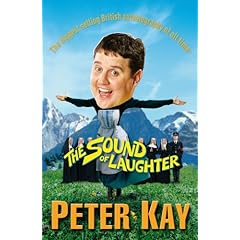
I've recently finished Peter Kay's autobiography 'The Sound of Laughter', and found it very funny. Some laugh out loud moments, which is bad enough at home on your own, but when you're in a public place is just downright embarrassing!

Peter Kay is a funny man, and at the tender age of 33, had written his autobiography charting his life to date, and the hilarious happenings from his school days, a multitude of part time jobs, and his move into stand up comedy, finishing off with what may have been the biggest week of his life - winning a comedy competition, meeting his wife-to-be and (eventually) passing his driving test.

Kay's comedy is simple life observation stuff, from the things his mum will come out with, to the hijinks of friends, colleagues, classmates and lecturers. There are lots of laughs in the 271 pages, although sometimes his language is a bit choice with some rudeness.

In an interesting section, Kay recounts his days as an altar boy in the local Catholic Church in Bolton, and his schooling at the hands of nuns and real people as well. When writing about sex education (or the lack of), he remembers the nuns showing an anti-abortion slideshow and plastic replica of an aborted foetus, which he says was 'completely out of order for subjecting us to that... they never gave us both sides of the story.'

It leads him to the conclusion that:

It made me realise how dangerous Catholicism could be. When I was at school I was always told that if I was bad God would pubish me and in the same breath I was told that God would forgive me for my sins whatever they were. It was a bit like being slapped one minute and getting a big cuddle the next. Catholicism sure knew how to mess with a child's head...

Over the years I've come to the conclusion that Catholicism is rife with hypocrisy and confusion. It's preyed on people like myself while people like myself were praying.


He then comes on to discussing Jesus, again with interesting thoughts:

I also belueve that a man called Jesus did walk the earth at one time but I don't think he was the superhero that the bible makes him out to be. Could he really turn water into wine? Did he raise people from the dead? Well if David Blaine can't survive underwater in a tank for seven days without needing medical attention, then I very much doubt it. I think Jesus was just an ordinary person like me and you (well, I'm comparing you with myself in the hope you're not a mentalist). I believe that Jesus spoke about peace, he spoke about turning love into hate (sic), tears into laughter, war into peace and - hold on a minute, this is Johnny Mathis. Jesus' teachings spread and quickly he built up a passionate following. People hung on to his every word, some would even walk for miles just to catch a glimpse of him... Ultimately Jesus' success bred contempt, people of power weren't fond of this hip and trendy preacher and before you could say 'Happy Days' Jesus was beaten, whipped, nailed to a cross and crucified. They didn't understand him, so they murdered him, in their ignorance and fear.

But Jesus had the last laugh. Apparently two days later on Easter Sunday he came back from the dead. Well, he'd have been daft not to with all those chocolate eggs knocking around.


After a discussion of Judas, he comes to the conclusion of his religious thought:

The reason I'm telling you all this is that basically I believe in the same principles as Jesus, or, as they've now become known in the last few paragraphs, 'The Johnny Mathis Principles'. And these fundamental teachings are at the core of most religions.

Basically we should try to follow the fundamental rules that were laid out for us in the Ten Commandments (obviously use your own judgement when coveting your neighbour's ox). Treat others like you would like to be treated (that obviously excludes people like Gary Glitter). And try to stand up for old people on public transport every once in a while (no mater how badly they smell of [wee] and biscuits). If we all did this then I'm confident that the world will be a better place for all of us.


So is this really what it's all about then? Being nice to other people and making the world a better place? Sadly it seems that Peter misses the point of Christianity, which is certainly not a religion like all the others.

To insist the Ten Commandments are just about doing to others what you would have them do to you ignores the first four - our duty to God, serving him only, not creating idols or images, not taking his name in vain, and keeping a Sabbath. If religion is just about how we treat other people, then we can do without those first four commandments.

Christianity is not a religion, but rather a relationship with the Lord Jesus Christ, the Son of God, who has died for our sins to bring us back into relationship with God. The world may be a better place as Christians live out their faith in practical ways, but that's not the whole purpose. Rather, we look forward to new heavens and a new earth, made perfect, paradise restored. These are the principles that Jesus believed in, because they were all about Jesus, who he is and what he has done - yet they're sadly absent from Peter Kay's religious worldview. If Jesus is just a man, then not even his resurrection has a purpose. The miracles, the crucifixion, and the resurrection all hang together, and all have a purpose only because Jesus is God's Son, our Saviour.

Serving on the altar won't get you to heaven, nor even get a Fast track entry like at Alton Towers, as he later hopes. The only way to be sure of heaven is faith in Jesus. Nothing else is good enough, because we aren't good enough. Not even our funniest jokes, or a shiny autobiography. Just Jesus.

Saturday, January 13, 2007

Clear visions?

Another quick update from Lamentations. I have found Lamentations 2:14 quite a challenging verse. Here it is, then we'll think about it for a moment:

'Your prophets have seen for you false and deceptive visions; they have not exposed your iniquity to restore your fortunes, but have seen for you oracles that are false and misleading.'

The verse comes in the context of a chapter of mourning for Jerusalem, describing in detail horrific aspects of the city's ruin - the gates sunk (8), bodies slain in the city (21), and infants and babies fainting in the streets (11). And how has this all come about? Why are there Lamentations at all?

Because God's spokesmen weren't actually speaking God's words. Instead, they were seeing false visions, deceptive visions, false oracles and misleading oracles. Not very helpful, I think you'll agree. But what were they like? Well, we find one such example in Jeremiah 6: 'They have healed the would of my people lightly, saying "Peace, peace," when there is no peace' (Jer 6:14).

Imagine the situation. The people are listening to the prophets, thinking they are hearing from God, hearing this message of peace, even as the Babylonians are coming towards the city. All will turn out well - for sure, the prophets are speaking this in God's name.

Except, they weren't. The prophets were making up their own messages, and speaking from their own hearts and minds. Not only that, they were also failing to do their duty, from the middle part of the verse: 'they have not exposed your iniquity to restore your fortunes.'

Rather than promising peace for the city and people that disobeyed the commands of God, the prophets should have been exposing the sin of the people; speaking against it, and calling them to repentance. It was only this recognising and confessing sin that would lead to the restoration of the people and their fortunes.

Look, after all, at what brought about the restoration of the exiles to the city - it was the confessing of corporate sin by Daniel (Daniel 9:3-23).

So why has this verse been challenging for me? As I approach the full-time task of gospel ministry, or rather, as I engage in full-time gospel ministry and prepare for ordination, how do I speak? How accurate are my messages? Do I preach the full counsel of God? Do I expose sin, and demonstrate the need of people to accept Jesus as their saviour?

I'm reading 'Robert Murray M'Cheyne: A Good Minister of Jesus Christ' by JC Smith at present. Have you heard of him? He was a minister in Dundee around 1839, and saw revival hit the city (ironically while he was on a mission to the Holy Land) - but the revival came through the grace of God and the faithfulness of M'Cheyne in praying for the people and preaching the sinfulness of sin. Revival was marked by the recognition of the people's sin.

O Lord, grant that I would not speak false and misleading messages, but would always speak your truth. Amen