Showing posts with label war. Show all posts

Wednesday, November 25, 2015

Book Review: Waterloo


I've always been interested in history. It probably traces back to a leaflet produced by Banbridge District Council many years ago called 'Historic Dromore.' The sheer number of historical features in the wee town I lived in blew my mind - the cathedral, the high cross, the Norman motte and bailey (the best preserved example in Ulster), the stocks, the town hall, the gallows street, the castle; all these gave me an interest in the past. Yet for all my interest, there are some periods where I don't really know very much. I knew of Waterloo, but I couldn't have told you much about it, even having been driven on a bus near the battleground on the way from Charleroi airport into Brussels. I probably knew more about the Abba song than the battle.

I was vaguely aware of the Fermanagh connection to Waterloo, the Inniskilling Dragoons having fought there. So when the 200th anniversary of the battle came on 18th June 2015 and I spotted Bernard Cornwell's new book on Waterloo, I knew I had to read it and start to understand it. I'm so glad that I did.

Cornwell is probably best known for his fictional Sharpe books, which were adapted for television. His previous grounding in fiction helps him to tell a gripping factual tale, with lots of drama, excitement, and personal interest. An epic story of an epic battle, or rather three battles, as the subtitle summarises: 'The history of four days, three armies and three battles.'

Drawing on many firsthand accounts of private soldiers, official records, and observations, Cornwell weaves the material together to keep track of the Prussians, the French and the British through the phases of the battles, in a way that the very amateur historian can follow. Technical language is explained and the objectives of each section and force are described clearly. The full complement of maps (at the start of each chapter) helps to place the action and build up the entire battlefield.

For some, the story of Waterloo is the story of the mighty generals, the clash of Napolean Bonaparte and the Duke of Wellington. While Cornwell keeps us up to date with their movements, he also provides enough detail of the experiences and difficulties of the ordinary solider in the armies.

I really enjoyed the book, as it helped to fill in a gap in my historical knowledge. The book managed to do it in a way that was accessible, exciting, and engaging, and for this reason I'd definitely recommend it. If you'd like to know what all the hype about Waterloo was, then this is the book to read.

Waterloo is available from Amazon and for the Kindle.

Tuesday, December 17, 2013

Book Review: The Thirty-Nine Steps


I'd never really heard about this book before, but when loading my Kindle for holiday reading back in the summer, it came highly recommended by my brother-in-law. It was free, and so on it went, in the off-chance it would get read. I'm glad I did - for the rip-roaring tale is quite the adventure.

Set in the period just before World War One, the story is narrated by Richard Hannay, a man who has returned from service in South Africa and is seeking some adventure. In this case, what he wishes for comes true, with a bigger adventure than he would have expected. From his flat, where a mysterious visitor is murdered, the chase is on as Hannay flees from the law, discovering that he is in over his head in a fast-paced and funny spy thriller. London, to the Scottish lowlands, and back to the south coast of England, the action continues with mad-cap escapes, disguises, twists and life on the run.

Some of the language is a bit archaic, and the story can be at times a little overly inventive, but on the whole, it's a good tale well told, as the fugitive turned tramp Hannay tries to convince the Cabinet to strike and capture the German spies at high tide where the thirty-nine steps lead from the clifftop to the sea. Well worth loading onto your Kindlefor free!

Tuesday, November 12, 2013

Remembrance Sermon: Romans 5: 1-11 Peace With God


After years of fighting across Europe, with devastation on an unimaginable scale, the guns fell silent at 11am on the eleventh day of the eleventh month, 1918. We gather today on Remembrance Sunday, the Sunday closest to Armistice Day to remember all that happened. 9 million had died. But on that day, eventually, peace had been achieved.

For a time it had seemed impossible. The conflict seemed to go on and on, the two sides facing one another in the trench warfare, but now peace was here.

The outbreak of peace was welcome news. The surviving soldiers could return home. The conflict was ended. The war to end all wars had finished. Peace was the result.

In a world of war, with conflict seen on our TV news nearly every day, we long for peace, whether that’s in our province or in our homes; our work or our hearts. The desire for peace is strong. And in our reading today, Paul declares the good news that war is over: ‘Therefore, since we are justified by faith, we have peace with God through our Lord Jesus Christ.’ (1) For those who are justified by faith, the rebellion against God has ended, there is now peace.

You see, our reading comes in the middle of what Paul is saying. He starts off in Romans by declaring that we are all in rebellion against God. We have taken what he gives and have used it against him. We have turned away from God - whether we are religious or not. No matter how respectable we may look today, the fact is that we have declared war on the Creator of the universe.

In return, God has set the penalty for our sins. Each of us are sinners, fully deserving God’s wrath. As Paul writes in chapter 3, all have sinned and fall short of the glory of God. We might aim for it, but it’s like an arrow that doesn’t hit the target. We all fall short.

But the good news is that Jesus Christ has come to turn us around, to announce the message of peace. As we trust in him (put our faith in him and what he has done), we can be justified - that is, it is just-as-if-I’d never sinned. Rather than being in rebellion, we are welcomed in. We have peace with God - no more hostility, when we simply come and bow before him.

Now, when you think of it, that would be great in itself, wouldn’t it? Your sins wiped out. The assurance that they don’t stand against you any more. They’ve been dealt with. But there’s more. You see, God doesn’t just deal with our sins and grudgingly let us just inside heaven, as the least he can do. No, we receive even more: ‘through whom we have obtained access to this grace in which we stand; and we boast in our hope of sharing the glory of God.’

There’s two things there - we have obtained access to God’s grace - it’s not that our debt is cancelled and we now sit on the breadline, but rather, our debt is cancelled and we’re given millions into our bank account. God’s grace is credited to us, we are given out of the riches of his grace.

But even more than that, we have the hope of what will happen in the future - the certain and sure sharing in God’s glory. What a turn around! This is the amazing offer of peace with God that is extended to us today. Pardon for sin and a peace that endureth, as the hymn puts it.

Now all that sounds great, doesn’t it? Of course you would rejoice in being justified, in having peace with God, receiving his grace, and the promise of hope. But then Paul says something that is a little bit strange. ‘And not only that, but we also boast in our sufferings...’ Now why does he say this? He shows that God can use all things, even our sufferings, for his glory and our good.

‘knowing that suffering produces endurance, and endurance produces character, and character produces hope, and hope does not disappoint us, because God’s love has been poured into our hearts through the Holy Spirit that has been given to us.’

It’s not that Paul was a bit weird and loved feeling miserable. It’s not that he quite enjoyed suffering. But rather, he points to the process that can happen as suffering brings endurance, and character, which leads to hope. It’s all guaranteed, Paul says, because God’s love has been poured into our hearts through the Holy Spirit.

But how can we really know that God loves us? How can we be sure that it’s love? We see it by his actions. At this time of the year we hear many stories of bravery and courage. Let me tell you about Billy MacFadzean.

Billy was a young man in Belfast when the First World War began. He joined up with the Ulster Volunteers, but never came home. On the morning of the Battle of the Somme he died, and received the Victoria Cross:

‘For most conspicuous bravery near Thiepval Wood, on 1st July 1916. While in a concentration trench and opening a box of bombs for the distribution prior to an attack, the box slipped down into the trench, which was crowded with men, and two of the safety pins fell out. Pte McFadzean, instantly realising the danger to his comrades, with heroic courage threw himself on the top of the bombs. The bombs exploded, blowing him to pieces, but only one other man was injured. He well knew his danger, being himself a bomber, but without a moment's hesitation he gave his life for his comrades.’

Billy gave himself for his friends. Seeing the danger, he willingly gave his life for them. What an amazing sacrifice. The love that he showed to die for his friends was incredible.

But what Jesus has done is even more incredible. Billy died for his friends, but Jesus died for his enemies. ‘For while we were still weak, at the right time Christ died for the ungodly.’

As he goes on to say, ‘But God proves his love for us in that while we were still sinners Christ died for us.’ The message isn’t: clean yourself up and then we’ll see about making things better. No, the message is that when you were at your worst; when you were still fighting against him, Christ died for you.

The Lord Jesus, who had committed no sin dying for sinners. He gave up his life so that we might have eternal life. A demonstration of his great love for us.

It’s the message of peace. An invitation to receive his love, to lay down your weapons, and be welcomed in. And it’s there at the cross, the place of the ultimate sacrifice, where everlasting peace has been guaranteed, if you’ll but come.

This sermon was preached in Aghavea Parish Church on Remembrance Sunday, 10th November 2013.

Saturday, November 17, 2012

Sermon Audio: Psalm 46


Last Sunday morning being Remembrance Sunday, I preached from Psalm 46: Refuge and Strength. Here's how it sounded.

Sunday, November 11, 2012

Sermon: Psalm 46 Refuge and Strength


Charles Blondin was a famous tightrope walker. He made a name for himself by crossing the Niagra Falls many times on a tightrope. Massive crowds would come along to watch him perform his amazing feats. One day, he was about to set off, pushing a wheelbarrow across the tightrope, when he asked the crowd a question. ‘Do you believe that I can carry a person across in this wheelbarrow?’ The people quickly responded, ‘Yes, yes, you are the greatest tightrope walker in the world! You can do anything!’ Okay, he says, ‘Get in the wheelbarrow.’

I wonder if you had been in the crowd that day, would you have got in? It’s one thing to believe something is possible, in theory, when there’s no pressure. It’s quite different when it’s for real. Does the belief hold true? Is the faith genuine?

As we gather on Sunday mornings, we’re not just indulging in fairy stories. We don’t gather to feel good about ourselves for a wee while. Rather, we come together to declare what it is we believe about God. We remind ourselves and each other of the truth that we have received, and which we believe. But just like Blondin’s barrow, it’s not enough to just say we believe it. Does it hold true? When things are difficult, can we depend on God, or was it all just pious, religious waffle which won’t actually help or make a difference when it really matters?

Take Psalm 46, our reading today. The opening verse declares some things about God. They’re comforting things, reassuring reminders: ‘God is our refuge and strength, a very present help in trouble.’ It’s a bold declaration about who God is, and what he is like. It’s a great verse for today and each day, something to recall every morning.

God is our refuge - a place of safety and shelter - whether it’s a mountain refuge where climbers can take cover in a storm, or a place where those in danger can be protected. The Lord is like a refuge; and is also our strength - the one who gives us power when we are weak. As well as those emergency times, this verse reminds us that God is also ‘a very present help in trouble.’ Like the RAC slogan: ‘There when you need us.’

Verse one is something that we can declare. But does it hold true when we face times of trouble? Does it make a difference to our lives when we need him most? Or are these just nice sounding, but empty words? Let’s examine the psalm.

If you have opened your pew Bibles to page 529, you’ll see that Psalm 46 breaks into three sections (1-3, 4-7, 8-11). We’ll see that the message of each of these three sections is loud and clear: God is with us as our refuge.

Have you ever seen one of those disaster /apocalyptic movies? A few years back there was a film called 2012. It showed what could happen if freak weather was unleashed on the world - and included a memorable scene where the city of New York was flooded in October 2012 - something which happened last week... A few years ago, Kevin Costner starred in a film called Waterworld - no, not about the swimming pool in Portrush, but rather about a massive worldwide flood due to global warming.

It’s a bit like the scene in view here - mountains shaking in the heart of the sea, waters roaring and foaming. This autumn we’ve been looking at the creation - this is as if creation is going in reverse, dry land consumed by the waters. Yet the writer declares: ‘God is our refuge and strength, a very present help in trouble. Therefore we will not fear, though the earth should change...’ Even in the worst case scenario, we don’t need to fear, because God is our refuge and strength. What a great declaration of faith and trust!

Scene two moves us from geographical tumult to political turmoil. The focus shifts from the earth to the city of God. A city under attack, as the nations are in uproar, the kingdoms totter. God’s people are in danger - should we be afraid here?

Instead of the chaotic sea, we’re drawn to the river flowing in the city of God, an important water supply. But more important than the resources, we’re told that God is in the midst of the city, and therefore it will not be moved. So even if the nations attack, God will be our help - ‘he utters his voice, the earth melts.’

While the words are different, the idea is the same at the end of the section - here’s the summary: ‘The Lord of hosts is with us; the God of Jacob is our refuge.’ It’s the other way round from verse 1, but it’s the same theme - God is with us, God is our refuge.

Scene three takes us to the battlefield after the war. God has defeated his enemies. Wars have ceased. God gives peace to his people. The weapons of war have proven useless against him, they are destroyed. The writer is showing us how foolish it is to oppose God - we simply cannot win against him.

Then suddenly, unexpectedly, God himself speaks in verse 10. This is both a rebuke to those who would oppose God, as well as a comfort to those who are trusting in him: ‘Be still, and know that I am God! I am exalted among the nations, I am exalted in the earth.’

To those who oppose God, who fight against God, who have rejected God (and let’s face it, that’s all of us), it’s a call to lay down our weapons, to realise how foolish it is to fight against God, the one who rules over the whole earth.

Instead, we need to hear these words as those trusting in the Lord, in the real world of danger and trouble. You see, so often you hear this verse taken out of context as a cosy meditation, on a retreat in a posh hotel, surrounded by luxury, as if it’s just asking us to pause for a moment to remember that God exists. But look at the context - this is God’s word to us when things are dangerous and difficult; when we’re fearful and frightened. It’s in this context that God speaks: even though you want to fight or take flight; ‘Be still, and know that I am God! I am exalted among the nations, I am exalted in the earth.’

When we receive this reassurance, it’s only right and proper that we respond, in the only way we can - by trusting in the Lord, as we find that he is with us, he is our refuge. Whether in times of change, war or peace, ‘The Lord of hosts is with us; the God of Jacob is our refuge.’

As we come to our final hymn this morning, a version of this very Psalm, the challenge is there: can you make these words your own? Can you say God is my refuge? And as you say it (and sing it), will that make a difference to you this week in the difficulties you face? It’s time to get in the wheelbarrow, and turn words into deeds, and trust the Lord as we declare: ‘The Lord of hosts is with me, the God of Jacob is my refuge.’

This sermon was preached on Remembrance Sunday, 11th November 2012 in Aghavea Parish Church.

Sunday, July 08, 2012

Sermon: Ephesians 6: 10-24 The Armour of God


Have you ever seen the old TV programme ‘Dad’s Army’? It’s set in the second world war, in the town of Walmington-on-Sea and follows the exploits of the Home Guard as they await the invasion of Britain by the Germans. Alongside the main characters of Captain Mainwaring, Wilson, Jones and Pike, one of the minor characters is Hodges, the ARP warden, watching out for air raids. He’s very fussy, making sure there are no lights during a blackout, nothing to guide the bombers. Very often, he comes out with his catchphrase: Don’t you know there’s a war on?

Those same words could be addressed to us today: Don’t you know there’s a war on? But we’re not talking about the ongoing wars in Iraq or Afghanistan. We’re not thinking about the other places where there is conflict in the world. Rather, it’s a war that has been raging from the start of creation. Verse 12, Paul says that it’s not a struggle against blood and flesh - we don’t take up arms like in the crusades of old, we’re not fighting for territory - ‘but against the rulers, against the authorities, against the cosmic powers of this present darkness, against the spiritual forces of evil in the heavenly places.’ The enemies of God are our enemies. As we join God’s team, we’re in the firing line for God’s enemies. Don’t you know there’s a war on?

Now immediately when we speak of spiritual forces of evil or the devil you might think that it’s all nonsense. But the Bible tells us about the devil, his life’s work is to steal and kill and destroy; he stands in opposition to God and his work. The devil has almost convinced the western world that he doesn’t exist (or at least is only to be thought of as a cartoon figure of fun) - this is just one of the ‘wiles of the devil’ (11). He doesn’t want to see churches grow; people saved; lives turned around. He’s out to oppose us. He knows his time is short, and so wants to do as much damage as he can.

His time is short because of what the Lord Jesus has already done. In World War Two, the decisive battle was the D-Day landings on the beaches of Normandy. Once the British and American army gained a foothold on the continent, Hitler’s army was sure to be defeated. Yet there was almost another full year before the war ended (6th June 1944 - 8th May 1945). The battle was won, but the war continued. In a similar way, Jesus has already won the war. The cross was the decisive battle. Victory is sure - we saw this in 1:20 - ‘God put this power to work in Christ when he raised him from the dead and seated him at his right hand in the heavenly places, far above all rule and authority and power and dominion...’ Satan knows he is defeated, and so is out to do as much as he can before the end.

You might even be thinking, well, it’s ok for Jesus - he’s in heaven, but it’s us that has to face Satan. Are we helpless or hopeless? Not at all. Paul tells us what we need to do, and what we have to do it.

‘Finally, be strong in the Lord and in the strength of his power,’ Our strength comes not from ourselves, but from God. That same power we’ve seen throughout Ephesians is the power that God gives us to be strong. But more than that, we are to ‘Put on the whole armour of God...’

Paul was writing this letter in prison, probably in Rome. He was constantly in the company of soldiers, chained to them, so he had plenty of time to think about their armour. But in the Old Testament, we find some of these pieces - the breastplate of righteousness and the helmet of salvation (Is 59:17). Each piece of the armour is for protection - God’s truth wrapped around you; the righteousness of Christ guarding your heart; God’s salvation protecting your head; ready to go with the good news; faith as a shield against the flaming arrows of the evil one. The whole armour represents all that God provides for us in salvation, and is God’s protection for us in life.

Alongside all these defensive pieces, though, there is just one weapon: the sword of the Spirit, which is the word of God. We don’t take up physical weapons against the enemy, but the word of God, the Bible, is what we wield.

Perhaps you’re attacked by a flaming arrow shot by the enemy. “You’re not good enough for God. Just look at your heart, how sinful your thoughts.” The flames are quenched by the shield of faith - we know we’re not good enough, but we believe in the Lord Jesus, his death on the cross, where he took our sin and gave us his righteousness - the arrow is stopped, we can attack with the sword as we believe God’s word and stand on it.

God gives us his own armour, and in a passage like this, it’s probably the thing that we want to focus on - maybe that’s just a little boy thing, thinking about soldiers and armour and weapons. But it’s important to see that God has given us something else as well - as vital as the armour - something we neglect at our peril.

You see, when we think about the armour of God, it’s almost always thinking about it on our own. You imagine yourself, as you awake, maybe in the shower, maybe as you’re pulling on your clothes, thinking about the armour of God, asking God to be with you in the day, to guard your heart and your mind. It’s mostly as an individual we think of the armour.

But the other thing God gives us reminds us that we’re not in the battle alone. We’re not the lone ranger, having to fight on our own. We’re not even the gallant prince in a fairy story having to rescue the princess on our own. We’re soldiers in a battle together in an army; don’t you know there’s a war on, and the church is fighting together. Here’s what Paul says: ‘Pray in the Spirit at all times in every prayer and supplication. To that end keep alert and always persevere in supplication for all the saints. Pray also for me... that I may declare it boldly, as I must speak.’

It’s the furthest thing from just me and my God, isn’t it? Pray at ALL times in EVERY prayer for ALL the saints - we’re in this together. It was seen in the contrast between Holland and Spain in the European Championship - Holland had, on paper, a good team (they put 6 past Northern Ireland in the warm up). Great players, but they were all individuals, they didn’t play together as a team. Spain, on the other hand are a team in their total football pass-a-thon.

Sometimes we forget that Ephesians is a letter, written from Paul to the church in Ephesus. Right at the end, we have the personal bit that we sometimes don’t know what to do with it. Here, it’s another reminder that we’re in this together - one church connected to another, encouraging each other in their faith as they stand together.

We’re called to stand firm, to stand on God’s word, in the armour God has provided. Our task is to pray - for ourselves, for our church family, for all Christians. I really appreciate your prayers too - please do pray for me as I study God’s word and speak his word.

This sermon was preached in Aghavea Parish Church on Sunday 8th July 2012.

Thursday, November 11, 2010

We Will Remember Them

060/365:2010 Unfaded Memories

While the poppy crosses fade away, our memories must never fade. Remembrance is an essential element of the human experience. Today, and on Sunday, we particularly remember the dead of two world wars, as well as those who have died in many other conflicts across the world. We especially remember those who have given their lives in this province to protect the whole community.

Remembrance is at the heart of the Christian faith. We remember the greatest sacrifice of all, as the Lord Jesus Christ hung on the cross at Golgotha, dying that we might live.

This is my commandment, that you love one another as I have loved you. Greater love has no one than this, that someone lay down his life for his friends. You are my friends if you do what I command you. - Jesus (John 15:12-14)

Wednesday, November 11, 2009

The North Irish Horse

Today is Armistice Day, and I thought I would post an old photograph that belonged to my grandfather. He had served in the North Irish Horse regiment during the Second World War, and the photo was of the regiment football team. Grandda Moles is not actually in the picture, but here it is anyway:

North Irish Horse XI 1945

The fading writing on the back says this:

North Irish Horse Soccer XI 1945
Back row: Hamilton, Millson, Day, Hutchman, Gault, Richmond, Scott (Trainers).
Front row: McDonald, Marshal, Robinson, LT Ingram (Sports Officer), Gettings, Lees, Lester

Wednesday, July 01, 2009

The Somme

Ninety-three years ago today, almost a generation of my countrymen, many of whom were probably younger than myself, were wiped out in one action. The action was the Battle of the Somme, as the 36th (Ulster) Division attacked the German lines by the river Ancre and Thiepval Wood.

The men and boys had signed up to the war effort so readily. In the midst of the constitutional crisis of Home Rule for Ireland (a form of devolution), the Ulstermen sought to prove their loyalty to the Crown and thereby avoid Rome Rule. However, they could never have foreseen the disaster that was to befall them as the generals and commanders urged men to run across no mans land to attack the German trenches. Some made it, but many more were cut down in their prime by the established German snipers and artillery. Whatever gains were made came at such a high price, and in the end, had to be given up as they hadn't the strength of numbers of soldiers to retain the hard fought possession.

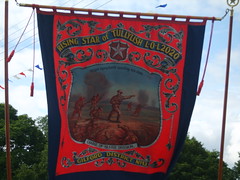
An Orange banner from Dollingstown's Wickliffe's Invincible Morning Star LOL 62 says it all: Every House Mourned. Such a tremendous sense of loss through the province, given that 5500 men died on that one morning, as well as injuries and other losses throughout the war. It had a profound effect on the unionist community in Ulster (and what later became Northern Ireland), to the extent that church bells will toll the funeral toll this morning, and Union flags will be flown at half mast, then raised to full mast tomorrow in memorial.

Among the fallen, one man stands out - Private William McFadzean. He didn't even survive to see the attack, being blown to bits before it happened, and yet he received a posthumous Victoria Cross.

For most conspicuous bravery near Thiepval Wood, on 1st July 1916. While in a concentration trench and opening a box of bombs for the distribution prior to an attack, the box slipped down into the trench, which was crowded with men, and two of the safety pins fell out. Pte McFadzean, instantly realising the danger to his comrades, with heroic courage threw himself on the top of the bombs. The bombs exploded, blowing him to pieces, but only one other man was injured. He well knew his danger, being himself a bomber, but without a moment's hesitation he gave his life for his comrades.


Today we give thanks to God for the great sacrifice of the Ulster Division, and recall their death so that we can live.

Friday, April 17, 2009

Remembering the Belfast Blitz


Last night in Belfast, a new war memorial was being dedicated. But rather than commemorating the sacrifice of soldiers, it remembers innocent civilians living in their own homes. They never went to war, but the war came to them.

The Second World War is famous for the air raids on both sides, with films like Dambusters celebrating the ingenuity of the British bouncing bombs. Yet the war came to the UK, with incendiary devices and bombs dropped from the skies on the main cities involved in the war effort. Churches, factories, and homes were all destroyed. Over 1000 people died in Belfast alone. Until now there was no memorial, but this has been set right.

On a family level, my grandmother can still remember the Dillon children coming to live with them in their house in the country, those evacuees from Belfast. Behind the fatalities there must have been countless others traumatized by the sudden separation from family, especially at such a young age.

All of which makes me wonder what the impact is today in the places of conflict, where air raids / mortars / long range weapons are used. What is the impact in Afghanistan when innocent people suffer, or as soon may be the case, Pakistan. Yes, it's right that we seek to prevent Al-Qaeda from wreaking havoc and terror across the world, but at what cost to people going about their business in Afghanistan and Pakistan?

It is right and proper to recall the loss of life in Belfast and other cities in the UK, but let's not stop there, in our own community. Let's also recall the ongoing suffering of others caught up in war through no fault of their own.

Tuesday, November 11, 2008

Armistice Day : Peace in our Time?

Today is the 90th anniversary of the ending of World War One - the Great War. The guns fell silent and peace came to the world. Or not, as the history books are quick to remind us. As has often been said, this was supposed to be the war to end all wars, and yet on our troubled island, the conflict was not long in starting again.

You see, in 1914, Ireland was divided into unionists and nationalists. Some wanted to remain part of the United Kingdom, and some wanted to have Home Rule - probably the best they were likely to get short of full independence. When the war began, both sides sought to prove their loyalty to the British, and to have leverage over the government when the war ended, so that the British would honour their claims. The Ulster Volunteer Force (UVF) and the Irish Volunteers both signed up to the war effort. Meanwhile, some of the Irish Volunteers stayed behind and launched the Easter Rebellion in 1916.

So on the 11th of the 11th 1918, peace was meant to have arrived. Yet, as we perhaps forget all too easily, Ireland would soon see not one, but two wars within the space of five years.

The December 1918 General Election showed a massive surge of support for Sinn Fein, and those MPs held a meeting in Dublin where they declared themselves to be the Parliament of Ireland - the Dail Eireann. The very same day that the first meeting of the Dail was held, was the day that the War of Independence started, with the murder of two RIC men in Soloheadbeg in County Tipperary. Less than two months of peace, and Ireland was at war.

The British Government moved on with the Government of Ireland Act 1920, which created the two Home Rule Parliaments in Belfast and Dublin. Only the Northern Ireland Parliament ever sat under this Act, as the Dail claimed to be the rightful assembly for the rest of the island.

To return to our main theme, though, it appears that history is repeating itself, as we can learn from the end of the War of Independence. Michael Collins and several colleagues travelled to London to sign the Anglo-Irish treaty of 1921, which recognised Dail Eireann and also promised a Border Commission to evaluate the final border between the South and the North. Yet Collins, in the end, was not speaking for the whole republican movement - dissidents existed even in 1921.

The Republican movement was split between those who were pro-Treaty, and those who were anti-Treaty (holding out for the whole island's independence). The War of Independence was over, but the Irish Civil War began, and would see two years of bloody conflict.

If anything, this period in Irish history reminds us that yesterday's IMC report is not surprising. The republican movement always seems to divide when there are agreements to be reached. The dissidents are still active. Peace in our time? Let's hope that on this Armistice Day, ninety years since the end of the Great War, Ireland will not be plunged into war yet again by the Real IRA or the Continuity IRA.