We're now in the run-up to the General Election on 6th May, and candidates have a few days left to decide if they're standing. This is our first General Election since we moved home, and already we're on the move again.
Up to now, Dundonald was part of the Strangford constituency (formerly represented by Iris Robinson MP), but before we get a chance to vote on Iris' replacement, we've been moved into her husband's constituency, East Belfast due to the boundary changes. Both Dundonald and the surrounding wards have been added to East Belfast, so as well as getting to know the constituency (which stretches from the Odyssey to Ballybeen), we'll have a new bunch of candidates to get to know.
Following the deadline of 20th April I'll have a full list of candidates, but for now, those confirmed include under pressure First Minister Peter Robinson (DUP), Trevor Ringland (UCUNF), David Vance (TUV), Naomi Long (Alliance), Mary Muldoon (SDLP) and Niall O Donnghaile (Sinn Fein).
Saturday, April 10, 2010
Friday, April 09, 2010
Book Review: God's Word (The Alan Stibbs Trilogy)

Alan Stibbs was the Vice Principal at Oak Hill Theological College, and as part of his vast pile of publications, he produced three short books entitled Understanding God's Word, Expounding God's Word, and Obeying God's Word. The three books have recently been published in one book by Authentic Media and 10 Publishing, and it came with me on my recent holiday (so in effect, I actually read nine books, not seven!)
Understanding God's Word does what it says on the tin. From the fixed starting point (found in each of the three volumes), that of the divinely inspired Bible, the 'next thing of supreme importance is its right understanding.' Because the Bible is God's word, we want to give our greatest effort to understanding what he is saying, and Stibbs outlines some useful pieces of advice for getting to the meaning of the text. Some particularly helpful insights for me were the declaration that every single word matters - that God divinely inspired the particularly appropriate words to communicate what he wanted to say, therefore we shouldn't miss out words or misunderstand what they are saying.
The most helpful thing, and something I don't think I have ever seen or heard spelled out, but which makes perfect sense - that prophecy is essentially the word of divine omniscience - that prophecy is more than prediction (although we normally think of it in that way), that prophecy can be backsight, insight, and foresight. For me, seeing this has clarified the Genesis account - obviously no one was around when the world was formed, on the first five days of creation - but God was there, and his divine knowledge was given / revealed to Moses, who wrote down the creation account. This isn't foresight, but rather, in Stibbs' word: backsight.
Expounding God's Word builds on the foundation of understanding what God is saying, and moves to the teaching it to others. Stibbs is firmly in the expository preaching camp, calling for exposition not imposition on God's word. Following a brief discussion of the task of preaching, the remainder of the book consists of a series of worked examples of expository preaching, from verses, narrative texts, and longer passages. There are some helpful insights and useful structures to build sermons from for the preacher.
Obeying God's Word moves from understanding God's word to doing what it says. Stibbs insists that the only way to confirm our confession of divine inspiration is by consistent and conscientious use of the Bible as our rule of faith and conduct.
One portion particularly resonated with me, in the face of the current Anglican concerns. Stibbs insists that Eve's disobedience (Genesis 3) is still a pattern of our disobedience: first, we depart in thought (to doubt the authority of the Bible), second, we depart in word (to deny the truth of the Bible), and third, we depart in deed to act in disobedience and deliberate defiance of the plain instructions of the Bible. The slippery slope is set, and we can see how easily we fall away from God's word.
All in all, the three books had some useful points, and things that I have certainly benefited from being reminded of (or of hearing for the first time set out clearly). Yet at times his style of writing seemed to be dated (he was writing the books in the 1950s), and that made it harder to follow. For that reason, they may not be top of my recommendations this year, but if you see it on sale, grab a copy and learn from this grandfather of the modern evangelicals in the UK.
(For a time it was £2.50 in The Evangelical Bookshop, Belfast, and may still be that price!)


Who's Judging?
The world thought that it was passing judgement on Jesus, not only as it perpetually debated who he was, but climactically in the cross. In reality, the cross was passing judgement on them. Since Jesus was sent as his Father's representative, his agent and the supreme divine revelation, rejection of the Son is rejection of God himself. In the callous murder of the Son of God, sin displays itself in it's most virulently evil form. But in that death, God was also giving his Son as a sacrifice, the Lamb of God; in that death, Jesus was securing the life of 'many seeds'. Thus Jesus' passion/glorification signifies judgement both positively and negatively.
- Don Carson, The Gospel According to John, p. 443, commenting on John 12:31-33.
- Don Carson, The Gospel According to John, p. 443, commenting on John 12:31-33.
Thursday, April 08, 2010
Book Review: The Last King of Scotland

It is said that books can transport you to other places, so really, I was doubly well travelled on my recent holiday. In the course of the week, as well as being in Lanzarote, I was in Tudor England, Sydney, the United States, the Congo and Zaire, as well as Uganda.
I'm still reviewing the books I read on holiday in Lanzarote, and my (unintended) pattern seems to have been one 'secular' and then two Christian books. So book number four was The Last King of Scotland.
I'd seen the film a few years ago - it may even be in my dvd collection - but had forgotten the story altogether. The book was a charity shop buy for £1, so I snapped it up and I was instantly transported to Uganda, during the brutal reign of Idi Amin. Once again, the book was better than the film, but also more horrific.
The plot is that a young Scottish doctor is serving in Uganda, and having coincidentally treated Idi Amin after an accident, he is appointed his personal physician. Nicholas Garrigan is setting out his memoirs, trying to tell his own story, to justify his decisions and choices in the midst of chaos during the devastating dictatorship of Amin.
Life in Africa is wonderfully observed, with the contrasts between the life of Idi Amin and that of the ordinary people, caught up in 'civil' wars and coups. There are moments of humour, as well as moments of darkness and evil.
All in all, it's a gripping story on the inside of life in Uganda at the height of Idi Amin's powers. The moral anguish is clear, as Garrigan struggles with leaving or staying, being simultaneously attracted and repelled by Idi Amin.
The Bible Version Survey
Just over a month ago, we had a survey running to see which Bible version was used by my blog readers. It's obviously not scientific, but here are the results:
Authorised Version - 2 (15.4%)
ESV - 4 (30.8%)
NIV - 7 (53.8%)
NRSV - 2 (15.4%)
The Message - 2 (15.4%)
Total Poll responses were 13, with a majority of this sample using the New International Version.
A big thank you to all who took part in the poll - it exceeded my expectations for responses! Open Forum now for you to suggest why you read that particular version...
Authorised Version - 2 (15.4%)
ESV - 4 (30.8%)
NIV - 7 (53.8%)
NRSV - 2 (15.4%)
The Message - 2 (15.4%)
Total Poll responses were 13, with a majority of this sample using the New International Version.
A big thank you to all who took part in the poll - it exceeded my expectations for responses! Open Forum now for you to suggest why you read that particular version...
Wednesday, April 07, 2010
Book Review: Awakening
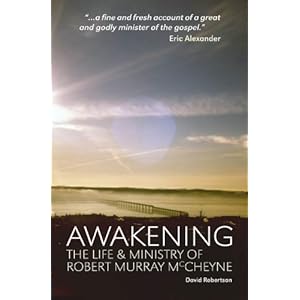
Dundee has played its part in our wider family story over the past few years, being the place of studies, of a wedding, and numerous visits. Anyone familiar with Dundee will probably be aware of the ministry and legacy of one young man connected with the city, namely Robert Murray McCheyne.
McCheyne was minister of St Peter's Church on the Perth Road, Dundee, the church where my brother-in-law is now working, so I've been interested in M'Cheyne for quite a while, having first heard of him at a Proc Trust Student Ministers' Preaching Conference five years ago. Awakening is the remarkable story of McCheyne, written by the current minister of St Peter's, David Robertson (of The Dawkins Letters fame).
The book is divided into twenty small, manageable chapters, each covering an aspect of the background, history, life, ministry and effects of McCheyne, and is a wealth of information and inspiring (and challenging) stories and nuggets of gospel truth and ministry practice. Robertson presents a well researched and readable biography, presenting a fair picture of McCheyne, steering clear of the hagiography (or exaggerated accounts of the lives of saints as can sometimes be presented), as he says: 'As the research progressed, I became amazed, angry and awakened. Amazed at the relevance of McCheyne for today, angry that the hagiography and ignorance about him has largely obscured that relevance and awakened to the wonder of the gospel.'
Some interesting aspects of his short life (he died before his thirtieth birthday) include his pastoral visitation model (visiting each house in a street through the day, then having a 'street' meeting in a large house or hall that evening), and the account of the revival which broke out while he was away in Palestine on a mission trip to survey the state of the Jews in Israel.
Perhaps the most interesting feature of this book (and one that sets it apart from other biographies of McCheyne) is that Robertson includes a question or two for meditation and reflection based on the subject matter of the preceding chapter, as well as a prayer. The book is therefore not just for information, but also for further reflection and application to our own situation in a more structured way than would normally happen.
While the book may particularly be appropriate for ministers, it would be a great read for all Christians (indeed, Robertson expresses a wish that even non-Christians may read it, interested in Dundee, and through it experience the gospel by seeing it lived by McCheyne). My 2004 copy was from Authentic Media, but it has recently been re-released (as in the picture) by Christian Focus Publications.
Tuesday, April 06, 2010
Sermon: Luke 24: 13-35 Disappointment to Delight
This morning I have a few pictures to show you, and I want you to spot what they all have in common. [...] What was it they had in common?
All the pictures were of disappointment - Chelsea having lost the FA Cup Final - and one guy crying. Diana Vickers after being put out of the X Factor in 2008. Northern Ireland players with heads low after letting Slovakia score (which meant we couldn’t go to the World Cup this summer).
There’s disappointment and sadness all around. Hopes were high, and then they come crashing down. Perhaps we can also be disappointed - maybe our school team gets to the final of a competition, only to lose out. Maybe we have hopes for the future, and then you get sick and can’t go to that birthday party. Maybe you can’t wait for the holidays, but then you’re bored all through them. Or maybe someone you love has died. You don’t get to see them any more, you miss them.
In our Bible reading today, there was some disappointment. Some sadness. The two people are on a long walk. Next month some people from church are doing the Belfast Marathon - and the walkers will be walking nine miles each. Well, the two people here, friends of Jesus, were walking home from Jersualem. They had about 7 miles to go - about from here to Bangor.
And they’re walking slowly. They’re sad. Disappointed. You see, they had been following Jesus, but just two days before they had seen him being crucified. Killed on the cross. They had seen him heal the sick and raise the dead, feed the five thousand and all the rest, but he had died on the cross.
They just can’t believe it. Their hero, the one they thought was going to be the King, God’s King, and he has been defeated. As they walk along, they are joined by a stranger on the road, who joins them, and asks them what they’re talking about.
Do you see the disappointment? Verse 21: ‘But we had hoped that he was the one to redeem Israel.’ We had hoped - but not any more. Jesus has died.
Well, they get to the village, and the stranger is still with them, so they invite him in. He’s talked to them along the road, but we’ll come back to that in a wee minute. Remember, they’ve just walked seven miles from Jerusalem to Emmaus, they’re tired, it’s getting late and dark.
Yet within an hour or so, they’re out of the house again, and walking back towards Jerusalem - maybe even running! Back the seven miles again, there’s no stopping them now. No hint of disappointment or sadness. Why? What has changed?
Well, in the house, they were having a meal, and the stranger took the bread and gave thanks and gave it to them - and in that moment they realised that it was Jesus! Jesus was not dead, but very much alive! As they recognised Jesus, he disappeared, but they knew it was him - there was no doubt now!
So what was it that Jesus had talked to them about on the road? Let’s look at verse 25-26. Listen out for what Jesus calls the two people: ‘O foolish ones, and slow of heart to believe all that the prophets have spoken! Was it not necessary that the Christ should suffer these things and enter into his glory?’ And beginning with Moses and all the Prophets, he interpreted to them in all the Scriptures the things concerning himself.’
Thursday past was the 1st April - April Fools Day (was anyone caught out?) Jesus here calls the two disciples foolish, because they didn’t believe what the Bible said.
You see, Jesus says that the prophets had promised both the crucifixion and also Jesus’ resurrection to new life. It was revealed by God hundreds of years before Jesus was born - but the disciples didn’t understand it all. On Sunday evenings we’ve been looking at some of the passages that spoke in advance about the cross (listen to them online), and tonight we’ll be looking at one of the passages that speak about Jesus’ new life.
Because the Bible tells us about them - written hundreds of years beforehand - we can be sure that the cross wasn’t a defeat. The disciples had been disappointed because they thought Jesus had been defeated. But it was God’s plan for Jesus to die for our sins, and then to rise to new life, defeating death. Jesus had said it several times before he died (e.g. Mark’s Gospel has three predictions), but the disciples didn’t listen or understand.
So what does all this mean for us? 1. Jesus is alive - yes, he died on the cross, but he didn’t stay dead. Elvis Presley is dead. Mohammed is dead. Any other founder of a religion is dead. Jesus is alive. Because he is alive, he offers us new life too.
To understand what Jesus has done, we need to read our Bibles, asking ourselves, how does this help us to see and understand Jesus?
Because Jesus is alive, according to God’s plan, we don’t have to be afraid of death - you remember at the start how we saw the two disciples were really sad and disappointed? Jesus is alive, and has power over death - it cannot harm us or hold us if we are friends with Jesus.
Because Jesus is alive, we can trust the eye witness accounts of the people who saw Jesus after he rose - when the two got back to Jerusalem (having walked 14 miles that night!) they said ‘The Lord has risen indeed, and has appeared to Simon!’ These two hadn’t believed it when the women had said Jesus was alive, but then they met him themselves. We can’t meet Jesus in the same way today - but we have the eye witness accounts written down so we can be sure that Jesus is alive!
Remember the disappointment at the start? Jesus can take away our disappointment, and instead gives us happiness and joy, because he is alive!
This sermon was preached at the Easter Morning Family Service in St Elizabeth's Church Dundonald on 4th April 2010.
All the pictures were of disappointment - Chelsea having lost the FA Cup Final - and one guy crying. Diana Vickers after being put out of the X Factor in 2008. Northern Ireland players with heads low after letting Slovakia score (which meant we couldn’t go to the World Cup this summer).
There’s disappointment and sadness all around. Hopes were high, and then they come crashing down. Perhaps we can also be disappointed - maybe our school team gets to the final of a competition, only to lose out. Maybe we have hopes for the future, and then you get sick and can’t go to that birthday party. Maybe you can’t wait for the holidays, but then you’re bored all through them. Or maybe someone you love has died. You don’t get to see them any more, you miss them.
In our Bible reading today, there was some disappointment. Some sadness. The two people are on a long walk. Next month some people from church are doing the Belfast Marathon - and the walkers will be walking nine miles each. Well, the two people here, friends of Jesus, were walking home from Jersualem. They had about 7 miles to go - about from here to Bangor.
And they’re walking slowly. They’re sad. Disappointed. You see, they had been following Jesus, but just two days before they had seen him being crucified. Killed on the cross. They had seen him heal the sick and raise the dead, feed the five thousand and all the rest, but he had died on the cross.
They just can’t believe it. Their hero, the one they thought was going to be the King, God’s King, and he has been defeated. As they walk along, they are joined by a stranger on the road, who joins them, and asks them what they’re talking about.
Do you see the disappointment? Verse 21: ‘But we had hoped that he was the one to redeem Israel.’ We had hoped - but not any more. Jesus has died.
Well, they get to the village, and the stranger is still with them, so they invite him in. He’s talked to them along the road, but we’ll come back to that in a wee minute. Remember, they’ve just walked seven miles from Jerusalem to Emmaus, they’re tired, it’s getting late and dark.
Yet within an hour or so, they’re out of the house again, and walking back towards Jerusalem - maybe even running! Back the seven miles again, there’s no stopping them now. No hint of disappointment or sadness. Why? What has changed?
Well, in the house, they were having a meal, and the stranger took the bread and gave thanks and gave it to them - and in that moment they realised that it was Jesus! Jesus was not dead, but very much alive! As they recognised Jesus, he disappeared, but they knew it was him - there was no doubt now!
So what was it that Jesus had talked to them about on the road? Let’s look at verse 25-26. Listen out for what Jesus calls the two people: ‘O foolish ones, and slow of heart to believe all that the prophets have spoken! Was it not necessary that the Christ should suffer these things and enter into his glory?’ And beginning with Moses and all the Prophets, he interpreted to them in all the Scriptures the things concerning himself.’
Thursday past was the 1st April - April Fools Day (was anyone caught out?) Jesus here calls the two disciples foolish, because they didn’t believe what the Bible said.
You see, Jesus says that the prophets had promised both the crucifixion and also Jesus’ resurrection to new life. It was revealed by God hundreds of years before Jesus was born - but the disciples didn’t understand it all. On Sunday evenings we’ve been looking at some of the passages that spoke in advance about the cross (listen to them online), and tonight we’ll be looking at one of the passages that speak about Jesus’ new life.
Because the Bible tells us about them - written hundreds of years beforehand - we can be sure that the cross wasn’t a defeat. The disciples had been disappointed because they thought Jesus had been defeated. But it was God’s plan for Jesus to die for our sins, and then to rise to new life, defeating death. Jesus had said it several times before he died (e.g. Mark’s Gospel has three predictions), but the disciples didn’t listen or understand.
So what does all this mean for us? 1. Jesus is alive - yes, he died on the cross, but he didn’t stay dead. Elvis Presley is dead. Mohammed is dead. Any other founder of a religion is dead. Jesus is alive. Because he is alive, he offers us new life too.
To understand what Jesus has done, we need to read our Bibles, asking ourselves, how does this help us to see and understand Jesus?
Because Jesus is alive, according to God’s plan, we don’t have to be afraid of death - you remember at the start how we saw the two disciples were really sad and disappointed? Jesus is alive, and has power over death - it cannot harm us or hold us if we are friends with Jesus.
Because Jesus is alive, we can trust the eye witness accounts of the people who saw Jesus after he rose - when the two got back to Jerusalem (having walked 14 miles that night!) they said ‘The Lord has risen indeed, and has appeared to Simon!’ These two hadn’t believed it when the women had said Jesus was alive, but then they met him themselves. We can’t meet Jesus in the same way today - but we have the eye witness accounts written down so we can be sure that Jesus is alive!
Remember the disappointment at the start? Jesus can take away our disappointment, and instead gives us happiness and joy, because he is alive!
This sermon was preached at the Easter Morning Family Service in St Elizabeth's Church Dundonald on 4th April 2010.
Sunday, April 04, 2010
Not Here

But on the first day of the week, at early dawn, they went to the tomb, taking the spices they had prepared. And they found the stone rolled away from the tomb, but when they went in they did not find the body of the Lord Jesus. While they were perplexed about this, behold, two men stood by them in dazzling apparel. And as they were frightened and bowed their faces to the ground, the men said to them, "Why do you seek the living among the dead? He is not here, but has risen. Remember how he told you, while he was still in Galilee, that the Son of Man must be delivered into the hands of sinful men and be crucified and on the third day rise." And they remembered his words, and returning from the tomb they told all these things to the eleven and to all the rest. Now it was Mary Magdalene and Joanna and Mary the mother of James and the other women with them who told these things to the apostles, but these words seemed to them an idle tale, and they did not believe them. But Peter rose and ran to the tomb; stooping and looking in, he saw the linen cloths by themselves; and he went home marveling at what had happened. (Luke 24:1-12)
Jesus is alive, and that changes everything!
Happy Easter.
(Photo by DT Christner)
Friday, April 02, 2010
Good Friday

For Christ also suffered once for sins, the righteous for the unrighteous, that he might bring us to God. (1 Peter 3:18)
But now the righteousness of God has been manifested apart from the law, although the Law and the Prophets bear witness to it- the righteousness of God through faith in Jesus Christ for all who believe. For there is no distinction: for all have sinned and fall short of the glory of God, and are justified by his grace as a gift, through the redemption that is in Christ Jesus, whom God put forward as a propitiation by his blood, to be received by faith. This was to show God's righteousness, because in his divine forbearance he had passed over former sins. It was to show his righteousness at the present time, so that he might be just and the justifier of the one who has faith in Jesus. (Romans 3:21-26)
In this the love of God was made manifest among us, that God sent his only Son into the world, so that we might live through him. In this is love, not that we have loved God but that he loved us and sent his Son to be the propitiation for our sins. Beloved, if God so loved us, we also ought to love one another. (1 John 4:9-11)
Thursday, April 01, 2010
On The Night He Was Betrayed
Those words in the title will be very familiar to most Christians, and especially Anglican Christians. Taken from 1 Corinthians 11, and used in the Thanksgiving Prayer at the Lord's Supper, they remind us that in the intense time of suffering, just before he went to the Garden of Gethsemane, where he would be arrested, the Lord Jesus broke bread and drank wine with his followers.
He started something new, something to be continued - but not for ever. Until He Comes. The sharing of bread and wine, remembering the broken body and shed blood of the Son of God, the Saviour. The gathering of God's people together as we await the heavenly banquet, the wedding supper of the Lamb. Our bread and wine just a foretaste of the party in heaven.
I used those words today as I shared in the Lord's Supper with some who can't make it out to church any more. Despite their physical separation from the meeting place, they are still part of the body of Christ, the family of the church. Today we joined with angels and archangels and all the company of heaven as we lauded and magnified the name of our great God.
Tonight, in just over an hour, we will hear those words again, as we join together - not Anglicans, Baptists and Presbyterians - but Christians. The Lord's people around the Lord's Table, a powerful testimony to all that we hold in common rather than our differences.
Tonight we recall that night, the night that he was betrayed, when he took bread, gave thanks, and broke it and gave it to his disciples. When he took wine and gave it to them.
Remember, remember, not the fifth of November. Remember, remember, rather, that Christ has died (for our sins), Christ is risen, Christ will come again. Amen.
He started something new, something to be continued - but not for ever. Until He Comes. The sharing of bread and wine, remembering the broken body and shed blood of the Son of God, the Saviour. The gathering of God's people together as we await the heavenly banquet, the wedding supper of the Lamb. Our bread and wine just a foretaste of the party in heaven.
I used those words today as I shared in the Lord's Supper with some who can't make it out to church any more. Despite their physical separation from the meeting place, they are still part of the body of Christ, the family of the church. Today we joined with angels and archangels and all the company of heaven as we lauded and magnified the name of our great God.
Tonight, in just over an hour, we will hear those words again, as we join together - not Anglicans, Baptists and Presbyterians - but Christians. The Lord's people around the Lord's Table, a powerful testimony to all that we hold in common rather than our differences.
Tonight we recall that night, the night that he was betrayed, when he took bread, gave thanks, and broke it and gave it to his disciples. When he took wine and gave it to them.
Remember, remember, not the fifth of November. Remember, remember, rather, that Christ has died (for our sins), Christ is risen, Christ will come again. Amen.
Wednesday, March 31, 2010
March 2010 Review
22 posts this month (including this one), which again is down on last year, but things have been busy, and I'm not blogging just as frequently as I did last year. All in all, we've had 77 posts so far this year, which isn't bad, out of 90 days.
March is (becoming) traditionally our holiday month, so once again it was nice to have a little holiday last week over in Lanzarote to catch up on some warmth, sun, and reading. So while the posts were down (with a pleasant and almost complete break from the internet), the books read were up - some reviews still to come, but so far this month I've reviewed Journey by Alec Motyer; The God I Don't Understand by Christopher Wright; Scandalous by Don Carson, Dissolution by CJ Sansom; and The Trellis and the Vine by Col Marshall and Tony Payne.
Also, partly due to holidays, youth weekends, and a visiting preacher, I didn't actually preach in St Elizabeth's for the whole month of March. Remarkable! Yet I was still preaching and teaching, with several funerals conducted (the sermons of which I don't publish online as some may be recycled), and one of the Bible overview sessions, which I didn't put up, and this sermon from James 1:18-27 from Mindset, the Youth Leaders' Training Network (next meeting on 13th April).
In other news, there was some schools' cup rugby action (with saddening results), and some scattered thoughts on greetings and fellowship from Romans, some contrasts between Demas and Mark from 2 Timothy, and some Holy Week thoughts from Dundonald Bible Week.
My favourite post of the month is on which Bible version.
The 365 photo of the month was:

March is (becoming) traditionally our holiday month, so once again it was nice to have a little holiday last week over in Lanzarote to catch up on some warmth, sun, and reading. So while the posts were down (with a pleasant and almost complete break from the internet), the books read were up - some reviews still to come, but so far this month I've reviewed Journey by Alec Motyer; The God I Don't Understand by Christopher Wright; Scandalous by Don Carson, Dissolution by CJ Sansom; and The Trellis and the Vine by Col Marshall and Tony Payne.
Also, partly due to holidays, youth weekends, and a visiting preacher, I didn't actually preach in St Elizabeth's for the whole month of March. Remarkable! Yet I was still preaching and teaching, with several funerals conducted (the sermons of which I don't publish online as some may be recycled), and one of the Bible overview sessions, which I didn't put up, and this sermon from James 1:18-27 from Mindset, the Youth Leaders' Training Network (next meeting on 13th April).
In other news, there was some schools' cup rugby action (with saddening results), and some scattered thoughts on greetings and fellowship from Romans, some contrasts between Demas and Mark from 2 Timothy, and some Holy Week thoughts from Dundonald Bible Week.
My favourite post of the month is on which Bible version.
The 365 photo of the month was:
Book Review: The Trellis and the Vine

If there's one book that should be read by all in ministry (apart from the Bible, of course), it is definitely this book. Drawing on thirty years of ministry and training gospel workers, Colin Marshall (affectionately known as Col Marshall) and Tony Payne, present a parable of church life in The Trellis and the Vine.
Drawing on John 15, the vine is the church, the people of God. Jesus, the vine, is growing his church, as more people are drawn into relationship with him, and they become fruitful in the kingdom. Vine work is to preach the gospel and bring the people of God to maturity. Vital stuff - there's something wrong if churches and ministers in particular aren't doing this.
But at the same time, the vine needs to be supported. This is where the trellis comes in - the trellis supports the vine, and so we have the necessary factors of finance, organisation, a meeting place, leadership, denominational structures etc. Yet it's so easy to get diverted away from Vine work into Trellis work - to be very busy, yes, but to completely neglect the very purpose the church exists for: vine work.
Having identified the 'root' problem, Marshall and Payne help ministers to work out their working out, and how to get the church back on track to the primacy of vine work. To get there, we need a change in ministry mindset, as well as identifying the leaders to train up, and help others get involved in vine work (which is for all Christians, not just 'ordained' people).
As I've said, this book is vital for church leaders to consider their priorities and to help them get back to vine work, which is the reason we're in church leadership in the first place. Lots of challenges in the book, but that's no bad thing, so there's plenty to think through and work through both now, and in the next x years of ministry. This might even be a good book for church committees / elderships / Select Vestries to work through together, discussing the issues that are raised. Get it from the Good Book Company. Check out the recommendation by Mark Dever:
Tuesday, March 30, 2010
Three Ways To Live
The second night of our Holy Week meetings in Dundonald, this time in St Elizabeth's, and we had an interesting night with the rough weather blinking the lights on and off through the sermon. Andy Lines was speaking from Mark 10:32-45. Here's an outline of what he said.
1. The way of the Son of Man - the way to the cross, to be rejected and killed, serving and giving his life as a ransom for many. This way f living has been taken, and we can't live this way.
2. The way of the world - self-interest, we see this in James and John asking for the places of honour in the kingdom, and the ten being indignant because they didn't get in there first. Gentile rulers live this way, and everyone lives this way, out for themselves and what they can get.
3 The way of the cross - the followers of Jesus, those who are served by the Son of Man, who has died for them. The way we live is the way Jesus lived, not to be served but to serve, to take up our cross as we follow him.
So, are you being served?
1. The way of the Son of Man - the way to the cross, to be rejected and killed, serving and giving his life as a ransom for many. This way f living has been taken, and we can't live this way.
2. The way of the world - self-interest, we see this in James and John asking for the places of honour in the kingdom, and the ten being indignant because they didn't get in there first. Gentile rulers live this way, and everyone lives this way, out for themselves and what they can get.
3 The way of the cross - the followers of Jesus, those who are served by the Son of Man, who has died for them. The way we live is the way Jesus lived, not to be served but to serve, to take up our cross as we follow him.
So, are you being served?
Book Review: Dissolution
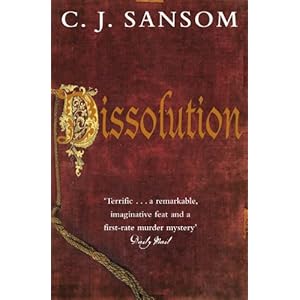
I have, it must be admitted, come to this series quite late! I noticed the fifth in the series when it recently came out, and then realised I should start at the beginning, a very good place to start. So off I began on one of my favourite adventures, to find the books in secondhand bookshops or charity shops, and have now accumulated the first four books in the Shardlake series. This one, the first in the series by CJ Sansom, was taken on holiday, and speedily enjoyed.
Shardlake is a lawyer in Tudor England. At times, he is called on by Lord Thomas Cromwell to do some investigations, and so off he goes to a monastery in Scarnsea where a foul murder of a King's Commissioner has taken place. This is a murder mystery set in a traumatic and exciting period in English history, as Henry VIII is breaking with Rome and setting himself as Supreme Governor (on earth) of the Church of England.
As well as the unfolding murder mystery (with plenty of surprising twists), the book also charts the opinions of 'ordinary people' on the ideas surrounding the Reformation, as well as presenting the gruesomeness of life in the 1500s, through the sights, smells and situations that Shardlake finds himself in.
Yet at times, Shardlake seems very politically correctly modern, for example in driving a wedge between the church and Jesus: 'Christ himself had comforted me against the words of the Church that was supposed to be his.' (p. 40). Or similarly, as the dissolution of the monasteries is being accomplished, Shardlake seems to become weary of the whole reform project, becoming disillusioned with it, and declaring 'in my willful blindness I had refused to see what was before me eyes. How men fear the chaos of the world, I thought, and the yawning eternity hereafter. So we build patterns to explain its terrible mysteries and reassure ourselves we are safe in this world and beyond.' (p. 382) Or again, on the reform party, 'There Bible says God made man in his image but I think we make and remake him, in whatever image happens to suit our shifting needs.' (p. 439)
Dodgy religious commentary aside, the book is great, both at raising the issues of the reformation, but much more at the straightforward murder mystery in a historical setting - a difficult genre to get just right, but something that Sansom has definitely succeeded in doing! The second in the series, Dark Fire, is in my to-read pile already...
Monday, March 29, 2010
Who is Jesus?
That was the question being asked tonight in Dundonald Baptist Church as the week of special meetings for holy week began. It's the midpoint of Mark's Gospel, the disciples have been getting to know Jesus over two years or so, watching him teach and heal, drive out demons and raise the dead, feed the crowds and calm the waves. Earlier, they were asking who Jesus was, but now he turns the tables.
Who do the crowds say I am? And who do you say I am? An important question to answer. Peter gets the right answer, but also the wrong answer. He says the right words, that Jesus is the Christ (God's anointed King), but gets it wrong as he can't understand a crucified Christ, a suffering Messiah. From hero to zero as Peter goes from top of the class to the bottom of the bunch.
Jesus spells out the necessity that the Son of Man must suffer, be rejected and be killed. It is God's way, the way of the cross, but Peter can't see it. Not then, not before the event. He would, of course, but not there, at Caeserea Philippi.
There are many opinions in the world about who Jesus is and what he does. Many wrong ideas. But this Holy Week, let's listen to Jesus' own words. He is the Christ, the Son of Man, the ransom.
So what about you? Who do you say that Jesus is?
Who do the crowds say I am? And who do you say I am? An important question to answer. Peter gets the right answer, but also the wrong answer. He says the right words, that Jesus is the Christ (God's anointed King), but gets it wrong as he can't understand a crucified Christ, a suffering Messiah. From hero to zero as Peter goes from top of the class to the bottom of the bunch.
Jesus spells out the necessity that the Son of Man must suffer, be rejected and be killed. It is God's way, the way of the cross, but Peter can't see it. Not then, not before the event. He would, of course, but not there, at Caeserea Philippi.
There are many opinions in the world about who Jesus is and what he does. Many wrong ideas. But this Holy Week, let's listen to Jesus' own words. He is the Christ, the Son of Man, the ransom.
So what about you? Who do you say that Jesus is?
Sunday, March 28, 2010
Home Again
Well, you might have noticed the silence on the blog over the past few days. A week off, in Lanzarote, and mostly away from the Internet. So there were no updates. However, there were plenty of books read - 7, to be precise, which will be reviewed (or at least mentioned) in due course. Makes me wonder just how many more books I could get read if some of my free time wasn't spent on Facebook and such like.
As well as reading the books I also made sure that my photo a day was taken so I'll need to update those as well this week. In due course I'll blog a bit more about the holiday, but for now I'll relax and take it easy!
I'm back to work on perhaps one of the busiest weeks in the church year - Holy Week. We're doing things differently this year, with St Elizabeth's, Dundonald Presbyterian and Dundonald Baptist coming together for the week, meetings rotating round the various churches. Tomorrow night is a Youth Night, and meetings each evening are at 8pm. The speaker is Andy Lines from Crosslinks, taking us through the account of the Passion from Mark's Gospel. You'll be most welcome to join us for any or all of the meetings!
As well as reading the books I also made sure that my photo a day was taken so I'll need to update those as well this week. In due course I'll blog a bit more about the holiday, but for now I'll relax and take it easy!
I'm back to work on perhaps one of the busiest weeks in the church year - Holy Week. We're doing things differently this year, with St Elizabeth's, Dundonald Presbyterian and Dundonald Baptist coming together for the week, meetings rotating round the various churches. Tomorrow night is a Youth Night, and meetings each evening are at 8pm. The speaker is Andy Lines from Crosslinks, taking us through the account of the Passion from Mark's Gospel. You'll be most welcome to join us for any or all of the meetings!
Monday, March 22, 2010
Book Review: Scandalous
Don Carson has long been one of my favourite Bible teachers, preachers and authors. This year I've been wading my way through his epic commentary on the Gospel according to John. At times, it must be admitted, he can be hard going to read, such is the depth to his thinking and writing. Yet his latest book is not one of those occasions. Scandalous is a simple to read thorough explanation of five key Bible passages on the theme of the Lord Jesus' death and resurrection.
The chapters were previously presented as a Day with Dr Don at Mars Hill Church - I had listened to the sermon audio perhaps a year ago, so recognised some of the illustrations. Yet even so, it was a great and valuable introduction to the cross and resurrection, and all the more so to have it in book format to return and savour many times.
The main themes raised are the ironies of the crucifixion from Matthew 27 (the way he divides the passage is something I wish I had spotted!), the very centre of the Bible in Romans 3, the strange triumph of a slain lamb (Revelation 12), the surprises of the raising of Lazarus (John 11), and the role of 'doubting Thomas' and how helpful he is.
I've already quoted one section of the book in a previous posting, and could provide many
more quotations from the book! What was particularly interesting was to read his sermon on John 11 having previously read the huge section on John 11 from his commentary, to notice what is left in and what isn't shared in order to pursue the precise explanation and apply it to the readers or hearers.
A brilliant book, and well worth reading, particularly as we approach Good Friday and Easter Sunday.
The chapters were previously presented as a Day with Dr Don at Mars Hill Church - I had listened to the sermon audio perhaps a year ago, so recognised some of the illustrations. Yet even so, it was a great and valuable introduction to the cross and resurrection, and all the more so to have it in book format to return and savour many times.
The main themes raised are the ironies of the crucifixion from Matthew 27 (the way he divides the passage is something I wish I had spotted!), the very centre of the Bible in Romans 3, the strange triumph of a slain lamb (Revelation 12), the surprises of the raising of Lazarus (John 11), and the role of 'doubting Thomas' and how helpful he is.
I've already quoted one section of the book in a previous posting, and could provide many
more quotations from the book! What was particularly interesting was to read his sermon on John 11 having previously read the huge section on John 11 from his commentary, to notice what is left in and what isn't shared in order to pursue the precise explanation and apply it to the readers or hearers.
A brilliant book, and well worth reading, particularly as we approach Good Friday and Easter Sunday.
Saturday, March 20, 2010
Staggering Substitution
'Two thousand years later, we who read John's words observe not only the mind-bending notion of the incarnation, God becoming a human being, but the utterly shattering fact that this God-man died a substitutionary death, the death of a redeeming lamb. It is staggering to contemplate the God of the Bible becoming a man; it is even more staggering to contemplate him as he dies our death - and is then vindicated in resurrection. Yes, yes, no lesser words of acclamation will do: "My Lord and my God!" The confession is scandalous; the confession is glorious.'
- Don Carson, Scandalous, 2010, p 162.
- Don Carson, Scandalous, 2010, p 162.
Friday, March 19, 2010
Book Review: The God I Don't Understand
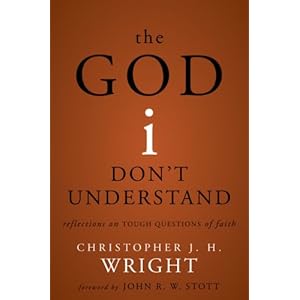
Previously, Christopher Wright has written books on Knowing God (the Father, the Son and the Holy Spirit) through the Old Testament. His latest book might come as a surprise - as he confesses that he doesn't always understand God. Yet what might be a surprise is also a comfort, as we realise that because God is so majestic and glorious, we don't always understand everything about Him.
Wright helpfully identifies various different ways of not understanding God - for example, non-understanding which leads to us being angry or grieved (as a result of suffering), morally disturbed (for example the treatment of the Canaanites in the conquest of the promised land), puzzling (in relation to the last things, and how so many misunderstand and promote false ideas of raptures etc), and gratitude (for the cross, even though we can't fully understand how it works). These four areas are the four major divisions in the book, with each topic thoughtfully dealt with in turn.
Wright is painfully honest that there are things we just can't understand - but at the same time he engagingly and fully asserts that there are things that we definitely can know, which God has revealed to us. Therefore, while we're faced with uncertainties, there are nevertheless certainties which we can hold on to and trust in.
All in all, this is a great book for those who sometimes struggle with doubts, or face tough questions from friends. Well worth reading and remembering some of the arguments presented, as well as the affirmations of faith in God and his sufficient word.
Subscribe to:
Posts (Atom)