The wind.
The storm.
A dry place.
A weary land.
Four unpleasant situations, in the extreme. Survival is hard if you're caught in a strong gust of wind which threatens to blow you off your feet. Or if you're stuck in the open with a full-blown storm lashing rain onto you. Or, from the extreme of plenty of water, to the other of being in a dry place, a parched land. Or, if carried even further, to a weary land, the heat unbearable, the sun scorching, sapping life itself from your tired body.
In some ways, they could describe the people of Jerusalem when Isaiah was prophesying. Not in the geographical details of climate, but in their spiritual situation. The cold wind of God's displeasure and judgement was blowing on them, which brought the storm of the threat of the Assyrians, that great ancient superpower. It was a dry place, because they had rejected God's word and were trying to live by their own wisdom. The end result was that they were weary, scared for their lives.
The people were like this, because the leaders of God's people hadn't been much better. Prophet and priest were more keen on getting drunk, and disregarded God's word. They said smooth things rather than true things. The king was a bit of a failure, thinking that Egypt, the ancient place of slavery, might just be a better option than facing the Assyrian army.
Isaiah appears on the scene, God's prophet declaring God's word. Here's what he says:
Behold, a king will reign in righteousness, and princes will rule in justice.
Each will be like a hiding place from the wind,
a shelter from the storm,
like streams of water in a dry place,
like the shade of a great rock in a weary land. (Isaiah 32:1-2)
On the immediate level, Isaiah was looking to the promise of one of the reforming kings - Hezekiah or Josiah, and yet, as we read these words, how clearly they refer to the King of Kings!
Jesus the King gives us rest, shelter, refreshing water, and shade - the very things that are needed in each extreme climate. How wonderfully and graciously the Lord provides those things that we need! In coming across this verse, it has also explained something that was a bit of a mystery to me for many a year.
In the hymn 'Beneath the cross of Jesus' by Elizabeth C Clephane, there is a line:
Beneath the cross of Jesus I fain would take my stand,
The shadow of a mighty rock within a weary land;
Here is where she got the inspiration for the line! It's as if the Lord takes the full glare of the burning light of the sun, and we can shelter in the shade, safe.
Thursday, May 14, 2009
Prince Caspian: The Movie
Astute readers may have noticed a common thread running through my recent posts. The film was actually the reason why I re-read CS Lewis' Prince Caspian.
Following the success of the Disney and Walden Media's movie version of The Lion, The Witch and The Wardrobe, the sequel was released in cinemas last summer. As you might recall, last summer was exceptionally busy, what with the exams, ordination, new jobs, new house, wedding and all that. We had hoped to see Prince Caspian while on honeymoon in Killarney, but it had finished showing a couple of days before.
I was destined to a patient wait for the DVD release. When it was released, it was consistently at £15.38 or so in Asda, and the other retailers were similarly high. Right through Christmas and afterwards, including the clearout sale at Zavvi, it was still too expensive. I was playing the waiting game for when it would be more justifiable.
Eventually, I found it on Play.com for £5, and it was ordered and dispatched. But then I had to wait until I had read the book, and Inside Prince Caspian too. The time had come, the DVD was to be watched, and... I didn't like it.
In fact, I didn't like it so much that I couldn't even watch it the whole way through. I lost interest, as it wasn't telling the story of Prince Caspian. In an attempt to make the film more dramatic than the book, the first thing we see is the birth of the heir of Miraz, and Caspian fleeing for his life.
Rather than being on a bench at a country train station (remembering that this is still during the Second World War), the four Pevensie children leave for Narnia in an underground tube station which is crowded with children, just after Peter has had a fight with another schoolboy.
Rather than the story being about the children's journey to Caspian, that is all completed very quickly, and the one-on-one duel between Peter and Miraz is replaced with an all-out storming the castle battle scene which is certainly not in the book!
I do think it's great that the Narnia stories are being brought alive through the movie world, I just wish they would stick to the stories themselves, rather than creating whole new stories which while more dramatic, don't quite fit with the image of Caspian's army as being unable to fight against the might of Miraz.
Some time soon I'll maybe try to watch it again, but for now, I'm not impressed!
Following the success of the Disney and Walden Media's movie version of The Lion, The Witch and The Wardrobe, the sequel was released in cinemas last summer. As you might recall, last summer was exceptionally busy, what with the exams, ordination, new jobs, new house, wedding and all that. We had hoped to see Prince Caspian while on honeymoon in Killarney, but it had finished showing a couple of days before.
I was destined to a patient wait for the DVD release. When it was released, it was consistently at £15.38 or so in Asda, and the other retailers were similarly high. Right through Christmas and afterwards, including the clearout sale at Zavvi, it was still too expensive. I was playing the waiting game for when it would be more justifiable.
Eventually, I found it on Play.com for £5, and it was ordered and dispatched. But then I had to wait until I had read the book, and Inside Prince Caspian too. The time had come, the DVD was to be watched, and... I didn't like it.
In fact, I didn't like it so much that I couldn't even watch it the whole way through. I lost interest, as it wasn't telling the story of Prince Caspian. In an attempt to make the film more dramatic than the book, the first thing we see is the birth of the heir of Miraz, and Caspian fleeing for his life.
Rather than being on a bench at a country train station (remembering that this is still during the Second World War), the four Pevensie children leave for Narnia in an underground tube station which is crowded with children, just after Peter has had a fight with another schoolboy.
Rather than the story being about the children's journey to Caspian, that is all completed very quickly, and the one-on-one duel between Peter and Miraz is replaced with an all-out storming the castle battle scene which is certainly not in the book!
I do think it's great that the Narnia stories are being brought alive through the movie world, I just wish they would stick to the stories themselves, rather than creating whole new stories which while more dramatic, don't quite fit with the image of Caspian's army as being unable to fight against the might of Miraz.
Some time soon I'll maybe try to watch it again, but for now, I'm not impressed!


Tuesday, May 12, 2009
Inside Prince Caspian: Book Review
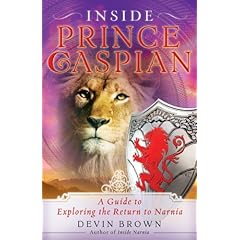
Devin Brown has done it again! Probably to tie in with the cinema launch of Inside Narnia, Brown released his Inside Narnia book, and sometime last year, the commentary on the sequel was published, Inside Prince Caspian. Yes, I know that according to the official order, TLTWATW is book 2, and Prince Caspian is book 4, but they are books 1 and 2 according to the original order of writing and publication.
Brown is a serious scholar who has devoted much of his academic life to the study of CS Lewis and his writings, and this shines through the latest volume. Each chapter in his book corresponds to the original chapters, and he highlights links to other works by Lewis, similarities of theme with JRR Tolkein (a close friend of CS Lewis), and wider links and insights to the Christian life and other authors.
Many allusions can be missed by the casual reader, and these are helpfully highlighted and discussed. The key themes arising from the book are also discussed at length, and all in all, it was an interesting book to read.
The Narnia stories are magical in and of themselves, but Brown's commentaries add some extra sparkle, so that future re-readings of the stories will shine even brighter.
Sermon Audio: 1 Corinthians 12: 12-31
Here's the mp3 file from Sunday's sermon on the Body of Christ from 1 Corinthians 12.
Download this sermon
Download this sermon
Monday, May 11, 2009
Prince Caspian: Book Review
Near the end of The Lion, The Witch and The Wardrobe, the Professor tells the children 'Yes, of course you'll get back to Narnia again some day.' (p. 170) In Prince Caspian, this promise is fulfilled, as Peter, Susan, Edmund and Lucy return to the magical land of Narnia. However, it is not Narnia as they knew it just one year before. Over a thousand years have passed, and an evil tyrant has risen to the throne of Narnia through treachery and force. Miraz is the great pretender, having murdered his brother, King Caspian, and taken over from the true heir, his nephew Prince Caspian.
Miraz' rule has seen the devastation of old Narnia, with the talking beasts taking refuge underground, and the tree spirits asleep. He is seen to represent the materialistic world, believing only in what he can see and control.
Through good providence, Caspian discovers some of the old Narnians while fleeing for his life on the birth of a son to Miraz, and is introduced to the resistance movement. Badgers, dwarves (or dwarfs), bears, squirrels, centaurs, mice, and many more are the remnant of old Narnia who recognise their new king, Caspian. Yet they are not enough for the powerful force of Miraz, so Susan's royal horn is blown, which will summon help.
The help is in the form of the four children, kings and queens from the past. Yet, the children have more to do in this book, as they make it to Aslan's How, where the Stone Table was located from their landing place of the ruins of Cair Paravel. Peter eventually takes on Miraz in a duel, and wins when Miraz stumbles and is finished off by one of his own court who envies the evil dictator. The Calormenes (Miraz' people) then begin to fight against the Narnians, only to be frightened and defeated by the now awakened tree spirits, who responded to Aslan's call.
Two main themes emerge, which we'll now think about.
Firstly, the idea of following Aslan. As the children make their way towards Aslan's How, they come to a steep river ravine, and have a choice of upstream or downstream. Lucy maintains she sees Aslan further up the slope, but no one else does. They decide to go downstream, following their instinct, and after a day's hard descent, are attacked by an outpost of the army. They immediately have to return up the slope, to return to where they were. Through the night, Aslan again calls Lucy, and urges her to bring the others quickly. They are reluctant, thinking Lucy is making it up as they can't yet see him.
The way of discipleship isn't easy - we walk by faith, and not sight. This is certainly something the children struggle with, and we find resonance for our Christian walk too. Part of the problem is that Peter and Lucy both have preconceived ideas of how Aslan will act - expecting him to repeat what has gone before. But this isn't how Aslan acts.
The second main theme is that of the liberation and freedom which Aslan brings. While Peter and the others are facing Miraz' army, Aslan takes Lucy and Susan on the long march of liberation. Where Miraz brought strictness and misery, Aslan brings joy and gladness. This is seen in the great river being unchained (as the Bridge of Beruna is destroyed), schools are broken up and 'some of the unnecessary and uncomfortable clothes' are removed from the schoolgirls.
Another aspect of this liberation theme that has brought some controversy is the introduction of Bacchus and Silenus into the story. Partly because these are gods and fables from other cultures (much like the introduction of Father Christmas into Narnia in TLTWATW), but also because Bacchus and Silenus are the Greek god of wine and his companion. Is Lewis promoting alcohol and wine in his children's books? It appears that Bacchus is merely to demonstrate joy and celebration, and not drunkeness per se, especially since Susan and Lucy discuss his appearance. Susan's comment is: "I wouldn't have felt safe with Bacchus and all his wild girls if we'd met them without Aslan." "I should think not," said Lucy (p. 138)
The implication being that wine on its own is a dangerous thing, but seen in the context of Aslan, and approaching it with him is a much better prospect. So it's liberation, but not licentiousness.
Having enjoyed the Chronicles of Narnia many times before, I again enjoyed reading this story, and heartily recommend the books!
Miraz' rule has seen the devastation of old Narnia, with the talking beasts taking refuge underground, and the tree spirits asleep. He is seen to represent the materialistic world, believing only in what he can see and control.
Through good providence, Caspian discovers some of the old Narnians while fleeing for his life on the birth of a son to Miraz, and is introduced to the resistance movement. Badgers, dwarves (or dwarfs), bears, squirrels, centaurs, mice, and many more are the remnant of old Narnia who recognise their new king, Caspian. Yet they are not enough for the powerful force of Miraz, so Susan's royal horn is blown, which will summon help.
The help is in the form of the four children, kings and queens from the past. Yet, the children have more to do in this book, as they make it to Aslan's How, where the Stone Table was located from their landing place of the ruins of Cair Paravel. Peter eventually takes on Miraz in a duel, and wins when Miraz stumbles and is finished off by one of his own court who envies the evil dictator. The Calormenes (Miraz' people) then begin to fight against the Narnians, only to be frightened and defeated by the now awakened tree spirits, who responded to Aslan's call.
Two main themes emerge, which we'll now think about.
Firstly, the idea of following Aslan. As the children make their way towards Aslan's How, they come to a steep river ravine, and have a choice of upstream or downstream. Lucy maintains she sees Aslan further up the slope, but no one else does. They decide to go downstream, following their instinct, and after a day's hard descent, are attacked by an outpost of the army. They immediately have to return up the slope, to return to where they were. Through the night, Aslan again calls Lucy, and urges her to bring the others quickly. They are reluctant, thinking Lucy is making it up as they can't yet see him.
The way of discipleship isn't easy - we walk by faith, and not sight. This is certainly something the children struggle with, and we find resonance for our Christian walk too. Part of the problem is that Peter and Lucy both have preconceived ideas of how Aslan will act - expecting him to repeat what has gone before. But this isn't how Aslan acts.
The second main theme is that of the liberation and freedom which Aslan brings. While Peter and the others are facing Miraz' army, Aslan takes Lucy and Susan on the long march of liberation. Where Miraz brought strictness and misery, Aslan brings joy and gladness. This is seen in the great river being unchained (as the Bridge of Beruna is destroyed), schools are broken up and 'some of the unnecessary and uncomfortable clothes' are removed from the schoolgirls.
Another aspect of this liberation theme that has brought some controversy is the introduction of Bacchus and Silenus into the story. Partly because these are gods and fables from other cultures (much like the introduction of Father Christmas into Narnia in TLTWATW), but also because Bacchus and Silenus are the Greek god of wine and his companion. Is Lewis promoting alcohol and wine in his children's books? It appears that Bacchus is merely to demonstrate joy and celebration, and not drunkeness per se, especially since Susan and Lucy discuss his appearance. Susan's comment is: "I wouldn't have felt safe with Bacchus and all his wild girls if we'd met them without Aslan." "I should think not," said Lucy (p. 138)
The implication being that wine on its own is a dangerous thing, but seen in the context of Aslan, and approaching it with him is a much better prospect. So it's liberation, but not licentiousness.
Having enjoyed the Chronicles of Narnia many times before, I again enjoyed reading this story, and heartily recommend the books!
Total Titus
Last night we completed the first entire preaching through a Bible book series since I began in Dundonald. The mornings have been taken up with 1 Corinthians since the start of September, and we've reached the end of chapter 12. But there are special Sundays inserted for family services etc, so that's why we haven't finished it yet.
So to learn some of what Titus is all about, you can now check out the entire sermon series on Paul's epistle to Titus:
Titus 1: 1-4 5-9 10-16
Titus 2: 1-10 11-15
Titus 3: 1-7 8-15
So to learn some of what Titus is all about, you can now check out the entire sermon series on Paul's epistle to Titus:
Titus 1: 1-4 5-9 10-16
Titus 2: 1-10 11-15
Titus 3: 1-7 8-15
Sunday, May 10, 2009
Sermon: 1 Corinthians 12: 12-31 The Body of Christ
Imagine you were going along to watch the Ulster Orchestra. You’d been looking forward to the concert for a long time, and eventually it had arrived. You go along to the Waterfront Hall, and take your seat. But then you notice that something is wrong. Normally, the orchestra has lots of different instruments, but as the orchestra comes out, they’re all pushing a kettle drum in front of them. The conductor explains that everyone wanted to play the big loud, drum part, and that everyone went out and bought their own kettle drum today. There are no kettle drums left in Belfast. Can you imagine how the concert would go?
The situation might seem ridiculous - and if you ever go to see the Ulster Orchestra, I hope that doesn’t happen. And yet, this was what was happening in Corinth. Not with musical instruments, but with God’s gifts. Everyone wanted to have the gift of tongues, because some were using it all the time, and worse, they were insisting that if you didn’t have the gift of speaking in unknown languages, then you weren’t really a proper Christian in the first place.
Paul is writing then, to correct the situation. Last week, we saw how spiritual gifts are given by God to each Christian, for the common good. As we look at the passage this morning, we’ll see that the Body of Christ (the church) is one, made up of many members, with a common entry, a common purpose, and a common care. Paul gives us a great illustration, using the parts of the body to understand the variety in the church. Just like our body parts, we’re all different, yet we together make up the body.
So let’s look firstly at the common entry to the body of Christ. Paul highlights the variety in the body of Christ, but shows that each one of the believers is truly a part of the body - through the Spirit in baptism. So in the church at Corinth there were Jews, and there were also Greeks (Gentiles, those who were foreigners and pagans), but it makes no difference, because they are part of the one body, through baptism in the Spirit.
Similarly, while some were slaves and some were freemen, that makes no difference because they are part of the body. Do you see what Paul is saying here? It doesn’t matter who we are or where we come from, we’re one in Christ, as we become part of his body through Baptism and the Holy Spirit.
It’s the opposite of the old song: ‘If you’re Irish, come into the parlour, there’s a welcome here for you’. The song says that only Irish people need apply. In the church, anyone from any background can apply - we are one in Christ as we come to faith and believe in the Lord Jesus and are baptised by His Spirit.
Paul takes this variety and shows how the different members of the body have a common purpose. What this means is that there is no place for someone to feel inferior, but also that there is no place for someone to feel superior.
‘If the foot should say, “Because I am not a hand, I do not belong to the body,” that would not make it any less a part of the body.’ (15) Some members of the church in Corinth were looking at others with their loud upfront gifts, and saying to themselves, well, I’m not like them, so I’m not really part of the church; maybe I’m not even a Christian. Maybe for us it could be someone who quietly counts the envelopes but feels less important than someone who sings, or welcomes visitors at the door. Paul shows that if everyone were to do one thing, then nothing else would get done!
He pictures the whole body as one giant eye - almost a horror science-fiction movie where something has gone wrong - but how would it hear, or move or speak? It’s like the left-back in a football team moaning because he isn’t the striker, playing up front and scoring lots of goals. If everyone was playing upfront, then there would be no defence, no goalkeeper! Each part is vital - our unity in grace is expressed through a diversity of gifts.
But if the supposedly weaker members aren’t to look down on themselves, then neither are the stronger members to look down on them either. It seems that some Christians with some gifts were looking at other Christians with different gifts and saying ‘I don’t need you.’ Look at verse 23 - Paul continues the illustration. ‘The eye cannot say to the hand, “I have no need of you”.
How do we view those around us? Maybe some are quieter, or have different gifts they can contribute. It’s not for us to say to someone else, you’re not needed! In actual fact, Paul goes on to say that what we might think are the weaker members are actually indispensable. For example, you might not think you need your liver, or kidneys. You never see them, and they’re just taking up space in the body. But they are actually important - the body doesn’t function properly without them. They have their own essential part to play. Similarly in the church - each one, no matter how young or old, has their part to play, contributing to the common purpose.
So far we’ve thought about the common entry, and the common purpose. This leads us on to think about the common care each part has for the other. Think about your body for a minute. If you’ve got a sore head, then nothing else seems right, you can’t do much. Or if your tummy is sore, then you’re feeling ill all over.
This is to be the way it is in the church too. ‘If one member suffers, all suffer together; if one member is honoured, all rejoice together.’ (26) You might have heard me say this before - there is no such thing as the Lone Ranger in the Christian life. We’re called to community, to the common life together, both in the local congregation, and also across the worldwide church.
This wasn’t happening in Corinth, with people thinking themselves better than others and thinking others should leave. Church was merely another platform for some high-risers to assert their dominance and control. But that’s not what church is for. Having all entered the Body by the same way (through faith and baptism by the Holy Spirit), we are called to a common purpose, showing common care towards each other.
Within the congregation, this might be through spending time with those who need our company, an older member who can’t make it out as often who longs for human contact. Or it might be through working together in serving tea and coffee, or doing a Bible study together, or some street evangelism.
And within the wider church, the worldwide body of Christ, how can we demonstrate our common care? Be praying this month especially for the General Assembly of the Church of Scotland, as faithful men seek to stand for gospel truth and the authority of Christ over his church. And for the faithful confessing Anglicans in Canada who face possible eviction from their buildings because they stand for truth. (St John’s Shaughnessy, Vancouver).
In the last few verses, Paul applies the extended metaphor of the body to the church in Corinth. Here again, he lists some of the various gifts and functions in the church, putting tongues at the very bottom of the list. Do you see how word ministry is at the top of the list? These are the ‘higher gifts’ Paul speaks of at the end - apostles, prophets, and teachers. Apostles were the original word ministers, those twelve, plus Paul, who were authorised and commissioned by Christ to preach and teach the gospel. Next, prophets and teachers are those who also teach the word, declaring God’s word to the contemporary situation.
The point is that there is variety - not all are apostles, not all are prophets, not all are teachers... yet all are involved in building up the body, with a common purpose to show the common care.
Despite God being the giver of the gifts, it appears that we can aspire to particular ones. In verse 31, Paul says ‘But earnestly desire the higher gifts.’ All the gifts are equally important, but there are some higher gifts - as we’ll see in chapter 14, where Paul contrasts speaking in tongues (the Corinthians’ pet gift) with prophecy.
We are the body of Christ, all who believe and have been baptised in one Spirit into one body. The common entry leads to a common purpose, and a common care. How are our relationships today within the congregation? Do we care about those around us? Do we suffer together, and rejoice together? Let’s take a moment to consider this, especially as we prepare to share in bread and wine. Then we’ll pray.
This sermon was preached in St Elizabeth's Dundonald on Sunday 10th May 2009.
The situation might seem ridiculous - and if you ever go to see the Ulster Orchestra, I hope that doesn’t happen. And yet, this was what was happening in Corinth. Not with musical instruments, but with God’s gifts. Everyone wanted to have the gift of tongues, because some were using it all the time, and worse, they were insisting that if you didn’t have the gift of speaking in unknown languages, then you weren’t really a proper Christian in the first place.
Paul is writing then, to correct the situation. Last week, we saw how spiritual gifts are given by God to each Christian, for the common good. As we look at the passage this morning, we’ll see that the Body of Christ (the church) is one, made up of many members, with a common entry, a common purpose, and a common care. Paul gives us a great illustration, using the parts of the body to understand the variety in the church. Just like our body parts, we’re all different, yet we together make up the body.
So let’s look firstly at the common entry to the body of Christ. Paul highlights the variety in the body of Christ, but shows that each one of the believers is truly a part of the body - through the Spirit in baptism. So in the church at Corinth there were Jews, and there were also Greeks (Gentiles, those who were foreigners and pagans), but it makes no difference, because they are part of the one body, through baptism in the Spirit.
Similarly, while some were slaves and some were freemen, that makes no difference because they are part of the body. Do you see what Paul is saying here? It doesn’t matter who we are or where we come from, we’re one in Christ, as we become part of his body through Baptism and the Holy Spirit.
It’s the opposite of the old song: ‘If you’re Irish, come into the parlour, there’s a welcome here for you’. The song says that only Irish people need apply. In the church, anyone from any background can apply - we are one in Christ as we come to faith and believe in the Lord Jesus and are baptised by His Spirit.
Paul takes this variety and shows how the different members of the body have a common purpose. What this means is that there is no place for someone to feel inferior, but also that there is no place for someone to feel superior.
‘If the foot should say, “Because I am not a hand, I do not belong to the body,” that would not make it any less a part of the body.’ (15) Some members of the church in Corinth were looking at others with their loud upfront gifts, and saying to themselves, well, I’m not like them, so I’m not really part of the church; maybe I’m not even a Christian. Maybe for us it could be someone who quietly counts the envelopes but feels less important than someone who sings, or welcomes visitors at the door. Paul shows that if everyone were to do one thing, then nothing else would get done!
He pictures the whole body as one giant eye - almost a horror science-fiction movie where something has gone wrong - but how would it hear, or move or speak? It’s like the left-back in a football team moaning because he isn’t the striker, playing up front and scoring lots of goals. If everyone was playing upfront, then there would be no defence, no goalkeeper! Each part is vital - our unity in grace is expressed through a diversity of gifts.
But if the supposedly weaker members aren’t to look down on themselves, then neither are the stronger members to look down on them either. It seems that some Christians with some gifts were looking at other Christians with different gifts and saying ‘I don’t need you.’ Look at verse 23 - Paul continues the illustration. ‘The eye cannot say to the hand, “I have no need of you”.
How do we view those around us? Maybe some are quieter, or have different gifts they can contribute. It’s not for us to say to someone else, you’re not needed! In actual fact, Paul goes on to say that what we might think are the weaker members are actually indispensable. For example, you might not think you need your liver, or kidneys. You never see them, and they’re just taking up space in the body. But they are actually important - the body doesn’t function properly without them. They have their own essential part to play. Similarly in the church - each one, no matter how young or old, has their part to play, contributing to the common purpose.
So far we’ve thought about the common entry, and the common purpose. This leads us on to think about the common care each part has for the other. Think about your body for a minute. If you’ve got a sore head, then nothing else seems right, you can’t do much. Or if your tummy is sore, then you’re feeling ill all over.
This is to be the way it is in the church too. ‘If one member suffers, all suffer together; if one member is honoured, all rejoice together.’ (26) You might have heard me say this before - there is no such thing as the Lone Ranger in the Christian life. We’re called to community, to the common life together, both in the local congregation, and also across the worldwide church.
This wasn’t happening in Corinth, with people thinking themselves better than others and thinking others should leave. Church was merely another platform for some high-risers to assert their dominance and control. But that’s not what church is for. Having all entered the Body by the same way (through faith and baptism by the Holy Spirit), we are called to a common purpose, showing common care towards each other.
Within the congregation, this might be through spending time with those who need our company, an older member who can’t make it out as often who longs for human contact. Or it might be through working together in serving tea and coffee, or doing a Bible study together, or some street evangelism.
And within the wider church, the worldwide body of Christ, how can we demonstrate our common care? Be praying this month especially for the General Assembly of the Church of Scotland, as faithful men seek to stand for gospel truth and the authority of Christ over his church. And for the faithful confessing Anglicans in Canada who face possible eviction from their buildings because they stand for truth. (St John’s Shaughnessy, Vancouver).
In the last few verses, Paul applies the extended metaphor of the body to the church in Corinth. Here again, he lists some of the various gifts and functions in the church, putting tongues at the very bottom of the list. Do you see how word ministry is at the top of the list? These are the ‘higher gifts’ Paul speaks of at the end - apostles, prophets, and teachers. Apostles were the original word ministers, those twelve, plus Paul, who were authorised and commissioned by Christ to preach and teach the gospel. Next, prophets and teachers are those who also teach the word, declaring God’s word to the contemporary situation.
The point is that there is variety - not all are apostles, not all are prophets, not all are teachers... yet all are involved in building up the body, with a common purpose to show the common care.
Despite God being the giver of the gifts, it appears that we can aspire to particular ones. In verse 31, Paul says ‘But earnestly desire the higher gifts.’ All the gifts are equally important, but there are some higher gifts - as we’ll see in chapter 14, where Paul contrasts speaking in tongues (the Corinthians’ pet gift) with prophecy.
We are the body of Christ, all who believe and have been baptised in one Spirit into one body. The common entry leads to a common purpose, and a common care. How are our relationships today within the congregation? Do we care about those around us? Do we suffer together, and rejoice together? Let’s take a moment to consider this, especially as we prepare to share in bread and wine. Then we’ll pray.
This sermon was preached in St Elizabeth's Dundonald on Sunday 10th May 2009.
Saturday, May 09, 2009
Digging Ditches: Book Review
I think this is my last holiday reading book review, which is terribly late, seeing as the holiday was two calendar months ago! Nevertheless this is a great book - to be read in its turn.
Digging Ditches is the third volume of the autobiography of Helen Roseveare, who as well as having served for twenty years in Africa with WEC (World Evangelism Crusade) just happens to be one of my parishioners in my current parish! Her first two books, Give Me This Mountain, and He Gave Us A Valley chart her missionary work in the Congo. In Digging Ditches, Helen updates her story by talking about adapting to life in the UK again after missionary service, as well as anecdotes from her many speaking tours from the United States, Australia, the UK and across the world.
As well as telling the stories of people she has met through those years, and sharing some of her struggles, Helen uses the book to outline talks on many verses of Scripture. These are great devotions, and demonstrate the great love for the Lord which has long been cultivated in her surrendered life, and which bubbles over when she speaks to a large group or in a one-to-one.
Digging Ditches is highly recommended, but only after you've read the first two books!
Digging Ditches is the third volume of the autobiography of Helen Roseveare, who as well as having served for twenty years in Africa with WEC (World Evangelism Crusade) just happens to be one of my parishioners in my current parish! Her first two books, Give Me This Mountain, and He Gave Us A Valley chart her missionary work in the Congo. In Digging Ditches, Helen updates her story by talking about adapting to life in the UK again after missionary service, as well as anecdotes from her many speaking tours from the United States, Australia, the UK and across the world.
As well as telling the stories of people she has met through those years, and sharing some of her struggles, Helen uses the book to outline talks on many verses of Scripture. These are great devotions, and demonstrate the great love for the Lord which has long been cultivated in her surrendered life, and which bubbles over when she speaks to a large group or in a one-to-one.
Digging Ditches is highly recommended, but only after you've read the first two books!
Friday, May 08, 2009
Black and Blue Boy
More B's for this week's edition of "what's on your iPod?"
Black Horse and the Cherry Tree - KT Tunstall
Black or White - Michael Jackson
Blackout - Muse
Blaze of Glory - Bon Jovi
Blessed Be Your Name - Matt Redman
Blessed Be Your Name - Robin Mark
Block Rockin' Beats - Chemical Brothers
Blue Ridge Mountains - Fleet Foxes
Born on the Fourth of July - Soundtrack
Both Sides Now - Hayley Westenra
A Boy Named Sue - Johnny Cash
Favourite song - definitely A Boy Named Sue.
Black Horse and the Cherry Tree - KT Tunstall
Black or White - Michael Jackson
Blackout - Muse
Blaze of Glory - Bon Jovi
Blessed Be Your Name - Matt Redman
Blessed Be Your Name - Robin Mark
Block Rockin' Beats - Chemical Brothers
Blue Ridge Mountains - Fleet Foxes
Born on the Fourth of July - Soundtrack
Both Sides Now - Hayley Westenra
A Boy Named Sue - Johnny Cash
Favourite song - definitely A Boy Named Sue.
Eat, Drink And Be Merry
At Inform on Tuesday night, we did a Bible study on 1 Corinthians 15. There we saw the importance of the resurrection in the Christian faith. Some in Corinth appear to have been saying that there was no resurrection. Paul therefore spells out what this would mean for Christ (he would still be dead), for the believer (we would still be dead in our sins, and our faith would be futile), and for Paul (he was calling God a liar and misrepresenting God).
As Paul continues, he warns the Corinthian Christians to be careful who they associate with. There's a danger in them hanging out with those who deny the resurrection, as they will be led astray. They'll end up believing the spirit of the world, the zeitgeist, and think that this world is all there is. If that's the case, then:
Let us eat and drink, for tomorrow we die. (1 Corinthians 15:32)
Basically, if this world is all there is, and there is no resurrection, no heaven to look forward to, then we might as well party now and make the most of what time we have left.
An example of this can be found in Tonight We Fly by The Divine Comedy. An ironic statement by their frontman, Neil Hannon, son of the former Bishop of Clogher, Brian Hannon. In the song, Hannon sings: 'And when we die, Oh, will we be that disappointed or sad if heaven doesn't exist. What will we have missed? This life is the best we've ever had.'
It's a fatalistic, depressive worldview with no hope, only a quiet desperation.
What I didn't realise the other night, though, was that Paul is actually quoting Scripture as he wrote to the Corinthians. I came across the reference when reading Isaiah. While the situation is different, the prevailing attitude is still one of enjoy what you have while you can.
Jerusalem had been under siege, with enemy forces camping around the city. So what do you do in that situation? Prepare to fight? Surrender? Pray? Turn to the Lord in repentance? The inhabitants of Jerusalem hadn't done any of these things. Rather, they turned to pleasure and enjoying the brief time they had left:
In that day the Lord God of hosts called for weeping and mourning, for baldness and wearing sackcloth; and behold, joy and gladness, killing oxen and slaughtering sheep, eating flesh and drinking wine. "Let us eat and drink, for tomorrow we die." (Isaiah 22:12-13)
They turned to fatalism, not faith; to pleasure, not repentance; to gluttony, not God. How do we demonstrate our faith in the God who raises us from the dead and guarantees eternal life through the victory of Jesus Christ? This world is not all there is - we look to our heavenly home.
As Paul continues, he warns the Corinthian Christians to be careful who they associate with. There's a danger in them hanging out with those who deny the resurrection, as they will be led astray. They'll end up believing the spirit of the world, the zeitgeist, and think that this world is all there is. If that's the case, then:
Let us eat and drink, for tomorrow we die. (1 Corinthians 15:32)
Basically, if this world is all there is, and there is no resurrection, no heaven to look forward to, then we might as well party now and make the most of what time we have left.
An example of this can be found in Tonight We Fly by The Divine Comedy. An ironic statement by their frontman, Neil Hannon, son of the former Bishop of Clogher, Brian Hannon. In the song, Hannon sings: 'And when we die, Oh, will we be that disappointed or sad if heaven doesn't exist. What will we have missed? This life is the best we've ever had.'
It's a fatalistic, depressive worldview with no hope, only a quiet desperation.
What I didn't realise the other night, though, was that Paul is actually quoting Scripture as he wrote to the Corinthians. I came across the reference when reading Isaiah. While the situation is different, the prevailing attitude is still one of enjoy what you have while you can.
Jerusalem had been under siege, with enemy forces camping around the city. So what do you do in that situation? Prepare to fight? Surrender? Pray? Turn to the Lord in repentance? The inhabitants of Jerusalem hadn't done any of these things. Rather, they turned to pleasure and enjoying the brief time they had left:
In that day the Lord God of hosts called for weeping and mourning, for baldness and wearing sackcloth; and behold, joy and gladness, killing oxen and slaughtering sheep, eating flesh and drinking wine. "Let us eat and drink, for tomorrow we die." (Isaiah 22:12-13)
They turned to fatalism, not faith; to pleasure, not repentance; to gluttony, not God. How do we demonstrate our faith in the God who raises us from the dead and guarantees eternal life through the victory of Jesus Christ? This world is not all there is - we look to our heavenly home.
Thursday, May 07, 2009
HM! No Tele For Queen
This afternoon I was driving up the Newtownards Road when I got held up in a traffic tail-back. Despite the lights being green, traffic wasn't moving at the Knock crossroads. Then I spotted the Police Officer standing stopping the traffic. What could be happening?
I remembered that Her Majesty Queen Elizabeth II was visiting Belfast today, and watched out for her coming past. I was about six cars back, and saw the cavalcade of PSNI motorcycles, Landrovers and vans, but I didn't get to see Her Brittanic Majesty herself.
What I did notice, though, was that the Belfast Telegraph sellers had been removed from the middle of the road by the police, and they were huddled in a wee group outside the Northern Bank at the crossroads. Which means that the Queen didn't get to sample a regular experience of drivers in East Belfast - the Tele sellers moving up and down the traffic offering their newspapers.
But then, she was going a bit too quick to stop for a paper, and she doesn't carry any cash, so no Telegraph for the Queen!
I remembered that Her Majesty Queen Elizabeth II was visiting Belfast today, and watched out for her coming past. I was about six cars back, and saw the cavalcade of PSNI motorcycles, Landrovers and vans, but I didn't get to see Her Brittanic Majesty herself.
What I did notice, though, was that the Belfast Telegraph sellers had been removed from the middle of the road by the police, and they were huddled in a wee group outside the Northern Bank at the crossroads. Which means that the Queen didn't get to sample a regular experience of drivers in East Belfast - the Tele sellers moving up and down the traffic offering their newspapers.
But then, she was going a bit too quick to stop for a paper, and she doesn't carry any cash, so no Telegraph for the Queen!
The Naked Prophet
Quick quiz question: Which prophet wandered round Jerusalem naked for three years?
It seems like a rather odd thing for God to ask someone to do.
Go and loose the sackcloth from your waist and take of your sandals from your feet.
The prophet walked about with no clothes on for quite a while. How embarrassed must he have been - you can imagine the media fuss nowadays if John Sentamu, the Archbishop of York had cut up his clothes and not just his dog collar! There was no hiding place for this cheeky prophet.
And yet, there was a point to his streaking. The visible word was explained by the spoken word of the LORD:
As my servant Isaiah has walked naked and barefoot for three years as a sign and a portent against Egypt and Cush, so shall the king of Assyria lead away the Egyptian captives and the Cushite exiles, both the young and the old, naked and barefoot, with buttocks uncovered, the nakedness of Egypt. Then they shall be ashamed because of Cush their hope and of Egypt their boast. And the inhabitants of this coastland will say in that day, 'Behold, this is what has happened to those in whom we fled for help to be delivered from the king of Assyria! And we, how shall we escape?' (Isaiah 20:3-6)
Not just Isaiah's words, but also his lifestyle was prophetic, and showed the glory of the word of God. His nakedness was a warning for those who trusted in men, rather than in God.
How do our words and lifestyle match up? Are we supremely concerned with God's glory, or with our comfort and security and 'respectability'?
It seems like a rather odd thing for God to ask someone to do.
Go and loose the sackcloth from your waist and take of your sandals from your feet.
The prophet walked about with no clothes on for quite a while. How embarrassed must he have been - you can imagine the media fuss nowadays if John Sentamu, the Archbishop of York had cut up his clothes and not just his dog collar! There was no hiding place for this cheeky prophet.
And yet, there was a point to his streaking. The visible word was explained by the spoken word of the LORD:
As my servant Isaiah has walked naked and barefoot for three years as a sign and a portent against Egypt and Cush, so shall the king of Assyria lead away the Egyptian captives and the Cushite exiles, both the young and the old, naked and barefoot, with buttocks uncovered, the nakedness of Egypt. Then they shall be ashamed because of Cush their hope and of Egypt their boast. And the inhabitants of this coastland will say in that day, 'Behold, this is what has happened to those in whom we fled for help to be delivered from the king of Assyria! And we, how shall we escape?' (Isaiah 20:3-6)
Not just Isaiah's words, but also his lifestyle was prophetic, and showed the glory of the word of God. His nakedness was a warning for those who trusted in men, rather than in God.
How do our words and lifestyle match up? Are we supremely concerned with God's glory, or with our comfort and security and 'respectability'?
Wednesday, May 06, 2009
Sermon Audio: 1 Corinthians 12: 1-11
On Sunday morning I was speaking on spiritual gifts from 1 Corinthians 12. Here's the sermon audio:
Download this sermon
Download this sermon
The Best Job in the World?
Over at the BBC, there's a report about a man who has landed "the best job in the world." In case you're interested, it's the position of caretaker on a tropical island off Australia's Great Barrier Reef. It's a six-month contract, with a salary of £73,500, and the other perks include a beach house, swimming pool and golf cart.
The job description requires Ben Southall "to explore the islands of the Great Barrier Reef, swim, snorkel, make friends with the locals and generally enjoy the tropical Queensland climate and lifestyle".
But the question has to be asked - it is really the world's best job?
What better than studying God's word, teaching God's word, and sharing people's lives in the good times and the sad, helping them to come to faith and grow more like Jesus, and preparing them for heaven? Give me this any day rather than life on a tropical island. The six months will soon come to an end, but the effects of our labour in the Lord stretch throughout eternity.
Therefore, my beloved brothers, be steadfast, immovable, always abounding in the work of the Lord, knowing that in the Lord your labour is not in vain. (1 Corinthians 15:58)
The job description requires Ben Southall "to explore the islands of the Great Barrier Reef, swim, snorkel, make friends with the locals and generally enjoy the tropical Queensland climate and lifestyle".
But the question has to be asked - it is really the world's best job?
What better than studying God's word, teaching God's word, and sharing people's lives in the good times and the sad, helping them to come to faith and grow more like Jesus, and preparing them for heaven? Give me this any day rather than life on a tropical island. The six months will soon come to an end, but the effects of our labour in the Lord stretch throughout eternity.
Therefore, my beloved brothers, be steadfast, immovable, always abounding in the work of the Lord, knowing that in the Lord your labour is not in vain. (1 Corinthians 15:58)
Tuesday, May 05, 2009
The Boasting Axe
Shall the axe boast over him who hews with it, or the saw magnify itself against him who wields it? As if a rod should wield him who lifts it, or as if a staff should lift him who is not wood! (Isaiah 10:15)
The word pictures in the words of the Lord here are utterly ridiculous! Obviously a tool can't claim that it's doing the work, rather than the labourer who is using the tool. Yet this was exactly what was happening in the case of the Assyrian king.
You see, Assyria was one of the world superpowers of its day. It was the USA of the ancient world. Like the height of the British Empire, Assyria had conquered nations around it. And now, Assyria had Jerusalem in its sights. Because of its success, it was boastful and proud:
'By the strength of my hand I have done it, and by my wisdom, for I have understanding; I remove the boundaries of peoples, and plunder their treasures; like a bull I bring down those who sit on thrones. My hand has found like a nest the wealth of the peoples; and as one gathers eggs that have been forsaken, so I have gathered all the earth; and there was none that moved a wing or opened the mouth or chirped.' (10:13-14)
For the troubled people of Jersualem, Isaiah's words provide hope, looking beyond the visible to see the invisible realm of God's power. Assyria may seem all-powerful, but God is the power behind the throne. God controls even the hostile powers, to further his purposes.
Assyria is 'the rod of my anger' and it carries out God's righteous judgement against the nations, and even against God's people. Yet Assyria itself will be judged, as God promises his people:
'O my people, who dwell in Zion, be not afraid of the Assyrians when they strike you with the rod and lift up their staff against you as the Egyptians did. For in a very little while my fury will come to an end, and my anger will be directed to their destruction.' (10:24-25)
God is king over all nations. Not the axe, but the one who wields the axe.
The word pictures in the words of the Lord here are utterly ridiculous! Obviously a tool can't claim that it's doing the work, rather than the labourer who is using the tool. Yet this was exactly what was happening in the case of the Assyrian king.
You see, Assyria was one of the world superpowers of its day. It was the USA of the ancient world. Like the height of the British Empire, Assyria had conquered nations around it. And now, Assyria had Jerusalem in its sights. Because of its success, it was boastful and proud:
'By the strength of my hand I have done it, and by my wisdom, for I have understanding; I remove the boundaries of peoples, and plunder their treasures; like a bull I bring down those who sit on thrones. My hand has found like a nest the wealth of the peoples; and as one gathers eggs that have been forsaken, so I have gathered all the earth; and there was none that moved a wing or opened the mouth or chirped.' (10:13-14)
For the troubled people of Jersualem, Isaiah's words provide hope, looking beyond the visible to see the invisible realm of God's power. Assyria may seem all-powerful, but God is the power behind the throne. God controls even the hostile powers, to further his purposes.
Assyria is 'the rod of my anger' and it carries out God's righteous judgement against the nations, and even against God's people. Yet Assyria itself will be judged, as God promises his people:
'O my people, who dwell in Zion, be not afraid of the Assyrians when they strike you with the rod and lift up their staff against you as the Egyptians did. For in a very little while my fury will come to an end, and my anger will be directed to their destruction.' (10:24-25)
God is king over all nations. Not the axe, but the one who wields the axe.
Monday, May 04, 2009
The Gazette on Jensen
Following the recent visit of Peter Jensen, the Archbishop of Sydney to St Saviour's Church, Dollingstown, the write-up in the Church of Ireland Gazette was very favourable. As well as the main article on Jensen's rallying cry, the editorial was positive in welcoming the development of the establishment of the Anglican Church in North America (ACNA). On the Gazette website there's also a half-hour interview with the Archbishop which is well worth a listen!
Sunday, May 03, 2009
Sermon: 1 Corinthians 12: 1-11
Through the week, I celebrated a birthday. One of the great things about birthdays is presents - those closest to you give you gifts to show their love and affection. I can’t show you what I got, as it was an iTunes voucher and some money! But more important than the presents and cards, was the people they came from.
In our passage this morning, Paul is beginning a new section in his letter to the Corinthians. You might like to have it open as we think about it. As we’ve seen, he has already discussed marriage (7:1), food offered to idols (8:1), and now he comes to spiritual gifts.
I don’t know what that means to you - maybe it’s something you’ve never thought of before, or maybe it’s something you’ve heard a lot about. This morning we’ll begin to look at what Paul says about spiritual gifts, although the whole section goes on until the end of chapter 14.
Sometimes when we think about spiritual gifts, we immediately jump to ourselves, and what gifts we have. This was certainly the case in the church in Corinth. If you’ve been with us through our series you’ll have seen that the Corinthian Christians were full of pride - think of how they divided into groups behind ‘their’ leader, or even from last week, how they were putting themselves first in how they ate the fellowship meal of the Lord’s Supper.
What this meant when it came to spiritual gifts in Corinth was that some were wanting to have and use the more ‘showy’ gifts - the stand out from the crowd, loud and upfront gifts that people would notice. In our passage, and in the whole section, we’ll find tongues being referred to. This is the ability to speak in other languages, unknown to the speaker. Some had this gift in Corinth, and so others were wanting it too - it was something special!
But rather than focussing on the recipients, or even on the gifts themselves, our passage this morning calls us to focus on the one who gives the spiritual gifts. We’ll see three things about God. First, God is the speaking God. Second, God is the one God. And third, God is the giving God. Or if you want a summary, Our God is one, who both speaks and gives for his glory.
As Paul begins to address the issue of spiritual gifts, he reminds the believers that they’re not exactly newcomers to spiritual things. Previously, they were pagans, with demonic spirits being very present in such religions. And yet, at the very heart of their paganism, were ‘mute idols’ - things worshipped which could not speak.
In contrast, though, we find that God is a speaking God - who enables his people to speak as well. In particular, we find that ‘no one can say “Jesus is Lord” except in the Holy Spirit.’ Now obviously, anyone could say those three words together, but what Paul means is that no one can truly say them, unless they are a believer. To declare Jesus is Lord in Corinth was to say ‘Caesar is not Lord’. It was to stand for Jesus, naming him Lord over every part of your life - which is a dangerous thing to do! None of us can do it by ourselves - we need the Holy Spirit to enable us and help us to say Jesus is Lord, both every day and for the rest of our days.
Mute idols look so promising, yet they can’t deliver any promises. In which camp are you - with the mute idols, or saying Jesus is Lord? Jesus is King over all I am and all I have - can you say this today?
God is the speaking God. He also helps us to speak out, to declare our faith. But more than that, God is the one God. Let’s read verses 4-6. I want you to look out for the two key words which appear in each verse.
‘Now there are varieties of gifts, but the same Spirit; and there are varieties of service, but the same Lord; and there are varieties of activities, but it is the same God who empowers them all in everyone.’
What were the two words? Varieties, and the same. Do you see what Paul is saying here? There is one God, yet he loves variety! It’s not that there is just one spiritual gift that is available, there are many! It’s not that there is just one type of service that is available, there are many! It’s not that there is just one type of activity (working with God’s energy), there are many!
Do you remember Henry Ford’s words when the Model T was first launched? You can have any colour, so long as it’s black. There was no diversity, or variety there! But God doesn’t work on a mass production line - he shapes us and makes us individually - no two of us are the same!
If you were following closely during the reading, you might have spotted a clue to why this variety is available. It actually goes to the heart of God’s nature and being. Look again at those verses - what are the same’s? Varieties ... but the same Spirit; varieties ... but the same Lord; varieties ... but the same God. Paul shows that God is, in his very nature, variety in unity - three ‘persons’ in the one God - Father, Son and Holy Spirit. Just as the three are totally united in purpose and love, so God showers his gifts on his people.
Which brings us to our third point. God is the speaking God. God is one God. And now, God is the giving God. Scan your eye down through verses 8 to 10. Paul outlines a list of some of the spiritual gifts that God has given to the congregation in Corinth. Again, we see the variety - utterance of wisdom, utterance of knowledge, faith, gifts of healing, working of miracles, prophecy, distinguishing between spirits, kinds of tongues, and their interpretation.
It might be useful to highlight some of these to explain what’s going on. Faith here is not the saving faith that all of us need (not just some) - rather it is a special gift of faith to step out for God, and to encourage others to come along - for example, in a building project, or in beginning a new venture. Gifts of healing and miracles relate to people, relationships or situations where conflict occurs and healing is needed, bringing people together. When we think of prophecy, it’s normally fore-telling - speaking about the future. But here it’s more usually forth-telling - proclaiming God’s word.
If you look later at Romans 12:6-8, Ephesians 4:7-11, and 1 Peter 4:7-11, you’ll see some similar and some other spiritual gifts. And where do they come from?
Verse 11 gives us the clear answer. ‘All these are empowered by one and the same Spirit, who apportions to each one individually as he wills.’ Each one has some spiritual gift, received from the Holy Spirit, who gives us these gifts.
And why are we given these gifts? Look back at verse 7. ‘To each is given the manifestation of the Spirit for the common good.’
The Corinthians wanted to have the showy gifts like tongues to put themselves forward, to steal the limelight. Did you notice that in the list of gifts, tongues came down at the bottom? Rather than being something to boost the individual believer, spiritual gifts are given to build up other believers - for the common good. So if the Spirit has enabled you to sing or play a musical instrument, you don’t do it to put yourself up at the front, but to encourage and build up others. Or through hospitality, or welcoming people, or by spending hours in prayer, or teaching - working with God’s power for the common good of giving glory to God and helping other believers grow.
This was something the Corinthians still had to learn - next week we’ll see how Paul develops this theme as he describes the church as the body of Christ and what this means for the use of spiritual gifts.
As I said at the start, it was my birthday through the week. I was away at a conference, and some of the other guys remembered it, and organised a cake for lunchtime. Out it came, and I had to blow out the candles - it was nearly a fire risk! Now, I could have tried to eat it all by myself, and got very sick in the process. But that’s not what you do - it was a gift to me, but it was really for everyone who was there. What was given to me benefited everyone. God’s gifts to the individual are for the whole body.
Maybe this talk of spiritual gifts has sparked your interest. What is it that God has given you to contribute to the body? How are you encouraging those around you? These are useful questions to be asking.
But if you know what your gifts are, if you know how God has blessed you, then are you using your gifts? Are you using them to promote yourself, to make a show of yourself? Or are you using the things God has given you for the common good, to help and support others?
Let’s thank God now for his gifts, and ask him to help us use them for his glory.
This sermon was preached in St Elizabeth's, Dundonald on Sunday 3rd May 2009.
In our passage this morning, Paul is beginning a new section in his letter to the Corinthians. You might like to have it open as we think about it. As we’ve seen, he has already discussed marriage (7:1), food offered to idols (8:1), and now he comes to spiritual gifts.
I don’t know what that means to you - maybe it’s something you’ve never thought of before, or maybe it’s something you’ve heard a lot about. This morning we’ll begin to look at what Paul says about spiritual gifts, although the whole section goes on until the end of chapter 14.
Sometimes when we think about spiritual gifts, we immediately jump to ourselves, and what gifts we have. This was certainly the case in the church in Corinth. If you’ve been with us through our series you’ll have seen that the Corinthian Christians were full of pride - think of how they divided into groups behind ‘their’ leader, or even from last week, how they were putting themselves first in how they ate the fellowship meal of the Lord’s Supper.
What this meant when it came to spiritual gifts in Corinth was that some were wanting to have and use the more ‘showy’ gifts - the stand out from the crowd, loud and upfront gifts that people would notice. In our passage, and in the whole section, we’ll find tongues being referred to. This is the ability to speak in other languages, unknown to the speaker. Some had this gift in Corinth, and so others were wanting it too - it was something special!
But rather than focussing on the recipients, or even on the gifts themselves, our passage this morning calls us to focus on the one who gives the spiritual gifts. We’ll see three things about God. First, God is the speaking God. Second, God is the one God. And third, God is the giving God. Or if you want a summary, Our God is one, who both speaks and gives for his glory.
As Paul begins to address the issue of spiritual gifts, he reminds the believers that they’re not exactly newcomers to spiritual things. Previously, they were pagans, with demonic spirits being very present in such religions. And yet, at the very heart of their paganism, were ‘mute idols’ - things worshipped which could not speak.
In contrast, though, we find that God is a speaking God - who enables his people to speak as well. In particular, we find that ‘no one can say “Jesus is Lord” except in the Holy Spirit.’ Now obviously, anyone could say those three words together, but what Paul means is that no one can truly say them, unless they are a believer. To declare Jesus is Lord in Corinth was to say ‘Caesar is not Lord’. It was to stand for Jesus, naming him Lord over every part of your life - which is a dangerous thing to do! None of us can do it by ourselves - we need the Holy Spirit to enable us and help us to say Jesus is Lord, both every day and for the rest of our days.
Mute idols look so promising, yet they can’t deliver any promises. In which camp are you - with the mute idols, or saying Jesus is Lord? Jesus is King over all I am and all I have - can you say this today?
God is the speaking God. He also helps us to speak out, to declare our faith. But more than that, God is the one God. Let’s read verses 4-6. I want you to look out for the two key words which appear in each verse.
‘Now there are varieties of gifts, but the same Spirit; and there are varieties of service, but the same Lord; and there are varieties of activities, but it is the same God who empowers them all in everyone.’
What were the two words? Varieties, and the same. Do you see what Paul is saying here? There is one God, yet he loves variety! It’s not that there is just one spiritual gift that is available, there are many! It’s not that there is just one type of service that is available, there are many! It’s not that there is just one type of activity (working with God’s energy), there are many!
Do you remember Henry Ford’s words when the Model T was first launched? You can have any colour, so long as it’s black. There was no diversity, or variety there! But God doesn’t work on a mass production line - he shapes us and makes us individually - no two of us are the same!
If you were following closely during the reading, you might have spotted a clue to why this variety is available. It actually goes to the heart of God’s nature and being. Look again at those verses - what are the same’s? Varieties ... but the same Spirit; varieties ... but the same Lord; varieties ... but the same God. Paul shows that God is, in his very nature, variety in unity - three ‘persons’ in the one God - Father, Son and Holy Spirit. Just as the three are totally united in purpose and love, so God showers his gifts on his people.
Which brings us to our third point. God is the speaking God. God is one God. And now, God is the giving God. Scan your eye down through verses 8 to 10. Paul outlines a list of some of the spiritual gifts that God has given to the congregation in Corinth. Again, we see the variety - utterance of wisdom, utterance of knowledge, faith, gifts of healing, working of miracles, prophecy, distinguishing between spirits, kinds of tongues, and their interpretation.
It might be useful to highlight some of these to explain what’s going on. Faith here is not the saving faith that all of us need (not just some) - rather it is a special gift of faith to step out for God, and to encourage others to come along - for example, in a building project, or in beginning a new venture. Gifts of healing and miracles relate to people, relationships or situations where conflict occurs and healing is needed, bringing people together. When we think of prophecy, it’s normally fore-telling - speaking about the future. But here it’s more usually forth-telling - proclaiming God’s word.
If you look later at Romans 12:6-8, Ephesians 4:7-11, and 1 Peter 4:7-11, you’ll see some similar and some other spiritual gifts. And where do they come from?
Verse 11 gives us the clear answer. ‘All these are empowered by one and the same Spirit, who apportions to each one individually as he wills.’ Each one has some spiritual gift, received from the Holy Spirit, who gives us these gifts.
And why are we given these gifts? Look back at verse 7. ‘To each is given the manifestation of the Spirit for the common good.’
The Corinthians wanted to have the showy gifts like tongues to put themselves forward, to steal the limelight. Did you notice that in the list of gifts, tongues came down at the bottom? Rather than being something to boost the individual believer, spiritual gifts are given to build up other believers - for the common good. So if the Spirit has enabled you to sing or play a musical instrument, you don’t do it to put yourself up at the front, but to encourage and build up others. Or through hospitality, or welcoming people, or by spending hours in prayer, or teaching - working with God’s power for the common good of giving glory to God and helping other believers grow.
This was something the Corinthians still had to learn - next week we’ll see how Paul develops this theme as he describes the church as the body of Christ and what this means for the use of spiritual gifts.
As I said at the start, it was my birthday through the week. I was away at a conference, and some of the other guys remembered it, and organised a cake for lunchtime. Out it came, and I had to blow out the candles - it was nearly a fire risk! Now, I could have tried to eat it all by myself, and got very sick in the process. But that’s not what you do - it was a gift to me, but it was really for everyone who was there. What was given to me benefited everyone. God’s gifts to the individual are for the whole body.
Maybe this talk of spiritual gifts has sparked your interest. What is it that God has given you to contribute to the body? How are you encouraging those around you? These are useful questions to be asking.
But if you know what your gifts are, if you know how God has blessed you, then are you using your gifts? Are you using them to promote yourself, to make a show of yourself? Or are you using the things God has given you for the common good, to help and support others?
Let’s thank God now for his gifts, and ask him to help us use them for his glory.
This sermon was preached in St Elizabeth's, Dundonald on Sunday 3rd May 2009.
Saturday, May 02, 2009
The Hunt For Gollum
Fan Fiction is big business, and The Lord of the Rings is no exception. Fans have recently worked on a forty minute film, which is to be released this weekend on the internet.
I heard about this on Radio Ulster earlier in the week, as the producer is a guy from Portadown. I wonder what JRR Tolkein would make of it!
I heard about this on Radio Ulster earlier in the week, as the producer is a guy from Portadown. I wonder what JRR Tolkein would make of it!
Friday, May 01, 2009
Baby Beautiful
We're hitting the B's this time in "what's on your iPod?"
Baby Boy - Beyonce
Baby, Now That I've Found You - Alison Krauss
Bad - Michael Jackson
Bad Medicine - Bon Jovi
Bailero - Katherine Jenkins
Ballymac Set - Haste to the Wedding
Ballymoor Grousebeaters - Clubsound
Bathroom Floor - Booley
Bat Out Of Hell - Meatloaf
Beat It - Michael Jackson
Beautiful - Christina Aguilera
Beautiful Day - U2
Haste to the Wedding were our wedding band (as their name even suggests!). Favourite song in this collection is Bad, but only if it's the John Piper edition:
Baby Boy - Beyonce
Baby, Now That I've Found You - Alison Krauss
Bad - Michael Jackson
Bad Medicine - Bon Jovi
Bailero - Katherine Jenkins
Ballymac Set - Haste to the Wedding
Ballymoor Grousebeaters - Clubsound
Bathroom Floor - Booley
Bat Out Of Hell - Meatloaf
Beat It - Michael Jackson
Beautiful - Christina Aguilera
Beautiful Day - U2
Haste to the Wedding were our wedding band (as their name even suggests!). Favourite song in this collection is Bad, but only if it's the John Piper edition:
The Challenge of Islam: Book Review

Recently, we had Patrick Sookhdeo of the Barnabas Fund speaking in our church, and after the services there was the opportunity to pick up some of his books. This one, to give it its full title of The Challenge of Islam to the Church and its Mission, was a great introduction to the beliefs and behaviours of Muslims, and provided some pointers on how to tell Muslims the good news of Jesus Christ, God's Son.
In the first section, he sets out some background to understanding Islam. Interesting topics such as Muhammad, the Qur'an, and the five pillars of Islam. Despite Islam being in the news so much, there's probably a general ignorance as to what it's all about, and the book helpfully highlights some of Islam's claims.
These claims are then weighed against the claims of Jesus Christ, with a useful comparison to show that, in the words of Al Mohler, 'We may find common ground on some issues, but the Muslim worldview and the Christian worldview differ radically. No informed person should be unaware of the basic incompatibility of Christianity and Islam.'
The key difference (among many others) is centred on the person of the Lord Jesus. Sookhdeo demonstrates that the Islamic declaration that 'There is no god but God (Allah) and Muhammad is his prophet' is aimed directly against the Son of God, Jesus Christ. By claiming that only Allah is God, they deny the divinity of Jesus Christ, and by claiming Mohammed as the only prophet, deny that Jesus Christ is the Word became flesh, the final revelation of God the Father, the one true capital P Prophet.
Certain key issues are then discussed, relating to cultural and social aspects, including the treatment of women, and the implementation of shari'a law in Western countries. In this section, Sookhdeo describes the reluctance of Islamic states to modernise, holding on to their customs which would horrify any liberal human rights lawyer, while seeking to try to introduce such laws and customs into the United Kingdom.
The final section of the book then seeks to help Christians, and especially Christian leaders to think through the issues involved in Christian-Muslim dialogue and shared projects. Here there is to be found some timely advice on inter-faith issues, particularly where the pattern appears to be that Christians bend over backwards to facilitate and welcome Muslims to speak in pulpits, but without any opportunity on the other side.
Patrick Sookhdeo has been a controversial figure - a google search of his name confirms this almost immediately - and yet the book is extremely important as we think through the issues and strategy to proclaim the good news of the Kingdom of God and of Jesus the King to all people, and especially Muslims.
Subscribe to:
Posts (Atom)