Tuesday, August 23, 2011

Guess Who's Back?

And we're not talking about Eminem, who's appearing at Tennent's Vital in Ward Park, Bangor tomorrow. We're now hopefully back on course with the blog, after another brief hiatus.

Removals
A fortnight ago, having packed up all our possessions into a big trailer the day before, the removals lorry arrived at our new house. Cue a couple of days of boxes sitting everywhere, as we tried to remember where some of the essentials had been carefully packed, and the gradual process of unpacking everything and finding a place for it.
Arrivals
The biggest job was to get my study into shape, a task which has finally come to an end. It's tidier now than it ever was in Dundonald, with a bit more space to move around it!

We've been adapting to life in Fermanagh, getting used to new surroundings and discovering new places (more of which to come), as well as meeting our new neighbours:
The New Neighbours!
I think I've adapted fairly well, to the extent that when I was up in Belfast for the afternoon and evening yesterday, I found it strange to be sitting in traffic, having so many cars all around!

At present I'm on holiday as I don't actually start in the new parish until the Institution service, so it's an extended staycation, sampling the delights of Fermanagh and meeting up with friends and family. Not long now and I'll be preaching my first sermons and getting stuck into parish life. Watch this space!

Monday, August 08, 2011

Farewell Sermon 2: Matthew 9: 35-38 The Lord's Other Prayer

When we think of the Lord’s Prayer, you immediately know what I’m talking about. In our services, the leader only has to say, ‘we’re now going to say the Lord’s Prayer’, and we instantly are ready to begin: ‘Our Father...’ It’s almost as if Jesus only ever prayed once, or only ever gave us one prayer.

As we read the gospels, though, there are lots of other prayers - just think of his high priestly prayer in John 17; or some of the other occasions when we see him in prayer, at the Garden of Gethsemane. This evening, though, I want to focus on his other prayer, the one found in Matthew 9. It’s a prayer that still needs to be prayed, as we’ll see as we turn to the text of Matthew 9.

As we come to the end of the chapter, it comes hot on the heels of the Sermon on the Mount, as Jesus is the centre of attention, as people flock to hear him teach and see him heal people, or try to be healed by him. So from the start of chapter 8, the action doesn’t stop - he comes down the mountain from the sermon on the mount, and there’s a leper to be cleansed, a centurion asking for healing for his servant (with great faith), Peter’s mother-in-law, crossing the lake and calming the storm, casting out demons on the other side, then coming back, healing the paralytic, calling Matthew, dealing with challenges from John’s disciples, and on and on.

So we come to verse 35, where he’s going through the cities and villages, teaching, and proclaiming the kingdom, and healing people. As Jesus’ fame grows, more and more people come to hear him. A great sea of people all trying to be near him.

In verse 36, we’re told what Jesus sees, then in verse 37, we’re told what Jesus says (and prays). So what Jesus sees: ‘When he saw the crowd, he had compassion for them, because they were harassed and helpless, like sheep without a shepherd.’

Have you ever noticed a field of sheep? They’ll not all be together in a nice bunch; they’ll be all over the place, doing their own thing. The other evening I climbed Slieve Croob with my brother-in-law and there were sheep roaming free on the path, in the ditch, all over the hill. They needed a shepherd to come and gather them together, keep them safe, and take them where they needed to go.

The people are lost, unsure of where to turn, without someone to guide them, trapped in their sins and burdens, wandering around aimlessly. Their life has no purpose; they have no king. Matthew tells us it’s as if they are sheep without a shepherd.

Many today are still like sheep without a shepherd. It might be seen particularly in young people, where trends develop and change, and they’ll follow the crowd (or at least feel the pressure to follow the crowd). But it’s not just young people like that. Just think of the things that drive people, that they follow and pursue in order to keep up with the Joneses - house, car, gadgets, holidays. Perhaps more money, but just as harassed and helpless.

And certainly harassed and helpless because of the burden of their sin. They may have a guilty conscience; they may keenly feel the weight of their sin, but are harassed and helpless, unable to know what to do or how to get rid of it.

I suspect that, just like Jesus, we won’t have to look too far to find people like this. Perhaps some who come along each week, yet still are harassed and helpless. Certainly not too far from these walls as we encounter people from Dundonald, our neighbours and friends and work colleagues. We may see what Jesus sees - but do we feel what Jesus feels towards them?

You see, we can talk until we’re blue in the face about evangelism, outreach, conversions - but if it’s just words, then nothing will be done. It’s nothing, if we turn away or refuse to engage with the people outside. But, we don’t want people like that coming here - we’ve got our reputation to think about! We don’t want any sinners coming in here - it would only get messy. Let’s just keep things the way they are.

Jesus, the good shepherd, sees these sheep without a shepherd, and he has compassion for them. He is moved with pity, with feeling for them, and so is moved to action. (Although, of course, he had already been moved to action because he had come to earth in the first place, already having compassion on his disciples). If Jesus has compassion for the lost, then how can we have a different reaction? How can we turn away, not wanting to get involved? Just as the Lord has saved us, so we need to share the good news with others who were just as lost as us.

Jesus sees the lost; he is moved to compassion; now let’s look at what he says, and then how he prays: ‘The harvest is plentiful, but the labourers are few.’

There’s a staffing problem - there’s more work than one man can take; an overwhelming burden. Just think of the huge job of harvesting crops before tractors and machinery came in. Nowadays a farmer in a tractor can harvest a field in no time, but what if he was going out with a scythe? The work would be overwhelming.

But Jesus isn’t talking about harvesting crops and gathering food into the barn - he’s still looking at this vast crowd of lost souls, people to be brought into God’s harvest-home. People who need to hear about the good shepherd who loved them so much that he gave his life for them, so that they might live; who need to be told that they are not helpless, or hopeless, but can have help and strength - grace - and hope through the Almighty and Everlasting One. The world is vast, the harvest is plentiful, but the labourers are few.

What do we need to do? Should we have a recruiting campaign for the Theological Institute? Should we (as the New York Roman Catholic Diocese had last year, a year of vocations - with the slogan ‘the world needs heroes: you have to be a real man if you want to become a priest.’?

Jesus’ action, having seen the need, having diagnosed the problem turns in prayer, calling his disciples to do the same: ‘The harvest is plentiful, but the labourers are few; therefore pray earnestly to the Lord of the harvest to send out labourers into his harvest.’

Jesus prays, because it is the Lord’s harvest - the very thing the Lord wants is for his harvest of his chosen people to be gathered in - and so he will answer this prayer, and will send workers into the harvest.

It’s not that we have to beg and plead and cajole God into sending more workers into his harvest - yet he delights to involve us, he calls us to partner him as we pray for gospel workers to be raised up and sent into the harvest field; to those places where the Lord directs, in order to bring in the full harvest.

For us, that means a change from Dundonald to rural Fermanagh, as we seek the harvest in those (literal!) fields; for Andrew it means heading to Dublin; for others it means new opportunities to serve through Crosslinks.

It’s perhaps the most surprising thing, maybe slightly scary, but very exciting, and it’s struck me again as I’ve thought of these verses. Jesus tells the disciples to pray for more labourers, and what is the very next thing that happens? They are the answer to their own prayers! They pray for labourers, and Jesus sends them out (10:5) to get on with the task at hand.

You don’t have to go away to be a missionary; you don’t need to go to a far off corner of the field to bring in a harvest. As we’ve seen, you just need to open your eyes, look around, and see the hopeless and helpless; the lost who are all around us, who desperately need to hear the good news, because each of us are full-time gospel workers, together on a mission.

This is a prayer that still needs to be prayed - the lost are still lost; the Lord still saves; and there’s still room in his glorious harvest-home. So pray - pray for our mission partners; pray for the continued outreach here in Dundonald; pray for us in Aghavea; and above all pray to the Lord of the harvest to send many more workers into his harvest to turn hopeless into hopeful; sinners into saints; and all for the glory of the Lord of the harvest.

This final farewell sermon was preached in St Elizabeth's Church, Dundonald on Sunday 7th August 2011.

Sunday, August 07, 2011

Farewell Sermon 1: 1 Corinthians 3: 5-17 God Gives The Growth

Have you noticed that we’re more and more living in a celebrity culture? People become famous, sometimes just being famous because they’re famous; and everyone is talking about them, following them on Twitter, supporting them - until someone new comes along. Every detail of their lives is celebrated and analysed. It really came home to me recently when at the wedding reception last week, news of Amy Winehouse’s death came through. Everyone knew about her; everyone talked about her.

What might be more surprising, though, is that we can have a similar celebrity culture in the church. Whether it’s Rob Bell, or John Piper, or Don Carson, or Tom Wright, people will buy only their books and celebrate them, and follow everything they say. Sometimes it can even happen within a congregation - I follow the Rector; or I would only listen to the Curate; or the youth worker is my hero.

Such a situation was happening within Corinth. If you look back to 1:12, you’ll see what it looked like there. I follow Paul; I follow Apollos; I follow Cephas (Peter); I follow Christ. A church divided, each celebrating their chosen celebrity. Paul is horrified, as we should be too - and in our reading this morning he reminds them of what gospel work is all about; and who should be the focus of our praise and appreciation. To that end, I’ve chosen this as one of my farewell texts because, while thankful for the fuss you’re making of us today, I, and indeed all of us, need to be reminded of the One who is to be praised.

Paul’s point is clear, as he gives us two pictures to show what the church is like, and how gospel ministry should be regarded. In the first picture, Paul takes us onto the farm, perhaps even a farm in rural County Fermanagh.

He begins by asking that question in verse 5. ‘What then is Apollos? What is Paul?’ On hearing the question, the Corinthians would have been quick to jump in and praise their favourite pastor. Paul is so great, because he was the very first to come and tell us about Jesus and planted this church. Meanwhile the Apollos cheerleaders are getting excited about him - Paul might have come at the start, but where is he now? Apollos is here, he’s been teaching us so much more and look how we’ve grown ever since. What Paul says next might be shocking for the Corinthians, and also for us, if we try to idolise our pastors:

‘What then is Apollos? What is Paul? Servants through whom you believed, as the Lord assigned to each.’ You might rate Apollos as a superstar celebrity speaker; he’s just a servant, someone under command, like a waiter. you might praise Paul as a perfect pastor; he’s just a servant, doing the task God assigned to him. It wasn’t even ‘who’ is Apollos or Paul; just what.

In the farming picture, Paul might have planted the seed (as he shared the gospel); Apollos might have watered the seeds; but neither can take any credit for how things have developed. ‘I planted, Apollos watered, but God gave the growth.’

You see, Paul and Apollos aren’t on different sides; they’re on the same team. God’s team, working with God, but it’s down to God to give the growth. To him, we must give thanks.

As I’ve been thinking about it this week, I’ve been encouraged to see the point Paul is making. You don’t have to know much about the church at Corinth to know that it was mixed up and messed up. Even scanning the letter shows that. There was immorality, worldly thinking, factions, doctrinal issues, superiority and a lack of love.

Yet even in Corinth, Paul can see growth; can see people who have been saved, who are growing in their faith. But it’s not due to Paul’s brilliance or Apollos’ special knack. It’s God who is in control, allocating his workers for their particular tasks; it’s God who gives the growth.

As we look back over these three years (and wonder where the time has gone!), there is much to be thankful for; much to rejoice in; many of us who are coming to faith and growing in faith - that’s not because of me, or Tim, or anyone - it’s God who is giving the growth, and to him be the praise.

From the farm, Paul takes us to the building site. In the first picture, we saw the principle that God gives the growth. But in case you’re tempted to lie back and think, God has it covered, we don’t have to do anything; we find that there is still much to do, as we work along with God and work for God.

On the building site, we see the foundation laid, ready for the building to rise up. Paul is like the master builder, laying the foundation - Jesus Christ. The question is, how will we build on that foundation. Look at the end of verse 10: ‘Let each one take care how he builds upon it.’

You see, as each of us build on the foundation of Jesus; as we trust in him and throw all our weight on him; as we build our lives on him, there are a variety of building materials at hand.

Perhaps you’ll go for a house of thatch - not just a thatched roof, but a whole house of straw. It might look pretty, but it might not last. Or a nice home of wood? (Do I sound like an estate agent to the three little pigs?) Or perhaps you’ll invest more in the building project and use gold, or silver, or precious stones.

We’re told to take care how we build because one day, (a bit like the three little pigs) our building will be tested. It won’t be a big bad wolf, though, but the Lord himself, testing our work for him; seeing how we have built up the church, the people of God.

As Paul continues, he speaks of testing with fire, of rewards for those whose work survives, and others being saved as if through fire, but let’s be clear. He isn’t speaking about some great test to get into heaven, as if we can earn our way by our own merits and just sneak in by the skin of our teeth. He’s speaking here about people who have built on the foundation; who have been trusting in Jesus and building their lives on him.

The challenge for all of us is this - how are you building on the foundation of Jesus? What are you building with? Are you giving God the best, or what’s left? In the last verses from our reading we’re given a glimpse at the plans; we’re reminded of what it is we’re building on the foundation of Jesus. And this glimpse will spur us on to give our very best to the work, because we find that we’re not just building a shack or a hut, or even a regular house. No, we’re building the very temple of God, the house of God, the place where God dwells.

It’s the same building project Peter writes about when he says ‘As you come to him, a living stone rejected by men but in the sight of God chosen and precious, you yourselves like living stones are being built up as a spiritual house, to be a holy priesthood, to offer spiritual sacrifices acceptable to God through Jesus Christ.’ (1 Pet 2:4-5)

It’s not a physical church building; rather, we are building the church, the people of God, where in God’s Spirit dwells. That building project has been going on since the foundation was laid and the apostles built upon Christ, so that we too are part of this great temple which will shortly be revealed on that day. As Paul will say near the end of this letter, your labour for the Lord is not in vain - remember what our business is: we are building the temple of the Lord; building his church.

My time here is nearly done, and the Lord has assigned me another place in the work, but the work goes on, because thankfully, it isn’t all resting on me. Despite being at the other end of the country, we will continue to be praying for the work here; earnestly asking God to continue to work to build his church and bring much fruit.

So keep going, keep serving, and see what God will do in the place.

God gives the growth, and God builds his church; but we are called to faithful service in whatever way he calls, wherever he calls, and all for his praise and glory.

This first farewell sermon was preached in St Elizabeth's Church, Dundonald on Sunday 7th August 2011.

Wednesday, August 03, 2011

Sermon: Colossians 1:24-2:5 Him We Proclaim

How would you summarise the work of a gospel minister? What is the essential message each one of us has to share, because we’re all full time gospel workers?

In our Epistle reading today, we find one such summary, as Paul writes to the Christians in Colossae. You would be hard pressed to find a shorter summary - look at verse 28: ‘Him we proclaim.’ What is it that Paul has been doing, devoting his life to? Him we proclaim. As we see those three words in their context, we’ll see why this is the essential summary of all gospel work.

First up, him. Paul writes about a mystery, and I don’t know about you, but I naturally think of Miss Marple or Inspector Morse, a murder mystery. There’ll be a gruesome killing, and suddenly the hunt is on, meeting a variety of candidates, all possible suspects, all with hidden agendas and grudges. But you know, when you start reading or watching, that everything will be worked out by the last page of the book, or just in time for the 10 o’clock news.

The mystery Paul has in mind isn’t exactly like those - it’s more of an open secret. He writes about making ‘the word of God fully known.’ This was the task he had been given, he is a steward, given a deposit, to be passed on. It’s in making the word of God fully known that he speaks of mystery - ‘the mystery hidden for ages and generations but now revealed to his saints.’ God’s plan from all ages has now been revealed, it’s an open secret, but what is it? What is the mystery now being revealed?

‘Christ in you, the hope of glory.’ The Colossians Christians weren’t Jewish believers; they were Gentiles. They were far from God, aliens to the promises, without God and without hope. But when Epaphras (who was from there) heard the good news and believed, he went back home to share the gospel with them. These Colossian Gentiles also believed, and so they are now in the company of God’s people, but also, Christ is in them.

This was always God’s plan, for the Gentiles to share in the promises through Christ - just think of the promise to Abraham that in his seed all families of the earth would be blessed. We see glimpses of it in the Old Testament, where Ruth, a Moabite becomes the great-granny of David, or in the Gospel reading today, where the Centurion has more faith than Israel.

We too, have come to share in the blessings of Christ through faith in him. But learning about Jesus and coming to know him isn’t just for when we’re coming to faith, as if we can forget him once we become a Christian. You see, Paul is still committed to ‘Him we proclaim’ even when relating to these believers. He proclaims Christ as he shares the gospel, but also as he warns and teaches everyone with all wisdom.

Why is this? Why have we been (and will continue to be) committed to proclaiming Christ? ‘That we may present everyone mature in Christ.’ When we’re saved, we’re just babies in Christ - we have a long way still to go. Even after being Christians for a long time - perhaps even longer than I have been born! Still there are areas for each of us to grow; to become more like Jesus; to become more mature in Christ. It’s a long term project; the Further Education Colleges will be presenting their prospectus soon, lots of evening classes to get us involved in lifelong learning - it’s precisely the same in the Christian life - lifelong learning, becoming mature in Christ.

Now that might put you off. That might discourage you. How will I possibly keep going? Paul continues proclaiming, teaching, maturing ‘For this I toil, struggling with all his energy that he powerfully works within me.’ God equips and strengthens us for his work. It’s not all down to me and what I can do. God is helping us.

Colossians is an odd letter - in most of his letters, Paul is writing to people he knows, in places he has visited. He has never been to Colossae; has never met most of the people who will hear his letter read. Yet that doesn’t stop him from struggling for them in prayer; praying that they wull be encouraged, knit together in love, and to fully appreciate the wisdom and knowledge of Jesus Christ.

These past few weeks have been a odd time for us. Almost everyone we see, we’re saying goodbye to. The time is getting very short, the removals van is waiting, poised for Monday morning. We’ll not be around here much longer. But be assured that we will still be struggling for you in prayer, from the wild west.

Are we going on towards maturity? Are we helping others towards maturity? Paul proclaimed Christ, because in him we have all we need for salvation, life, contentment, wisdom and knowledge. My prayer is that Christ will be proclaimed here, and that you will indeed grow to maturity; will you pray for me, that I too will continue to proclaim Christ, and him only, and all for the praise of God the Father who is high over all. Amen.

This sermon was preached in St Elizabeth's Church, Dundonald at the Midweek Communion service on Wednesday 3rd August 2011.

Tuesday, August 02, 2011

Book Review: The Long of it


My earliest memories of the author of this autobiography were in the Diocesan Magazine he edited, with his name emblazoned in bold letters. An appropriate, if slightly humorous name for a minister with journalistic tendencies: S. E. Long (read it as 'essay long' and you'll get my drift!).

Ernest Long is now in his eighties, and in this book presents a series of memories and anecdotes from his life and ministry. Having served curacies in St Donard's and Willowfield in East Belfast, the rest of his stipendiary ministry was in Dromara, not too far from where I grew up. There were interesting stories of how the self-confessed city boy adapted to life in rural County Down, which may be useful for me as I move to Fermanagh in the near future!

Despite very different times, what shines through is the gospel is the same in every generation, it just needs to be communicated to the people in ways they understand. Community involvement, outreach, all the buzz words of the emerging era were already in place in Long's rural ministry, as he relates his experiences of community life and outreach in Dromara.

Long is also well known locally for his prominent position in the Orange Order, and a considerable portion of the book was given to detailing his involvement with the Order, including his international speaking tours on behalf of the Grand Lodge. Perhaps my only regret is that he didn't spend much time discussing the recent difficulties, instead skirting around them.

All in all, The Long of it is an interesting read to discover the impact the gospel has had on an individual life, and the wider impact through that one person to reach and change so many. It will be particularly interesting for those with some knowledge of the local area, but would be profitable for a wider audience too.

The Long of it is available from Slieve Croob Press and has one of my photos on the front cover!

Monday, August 01, 2011

Up Slieve Croob

This evening we conquered Slieve Croob!

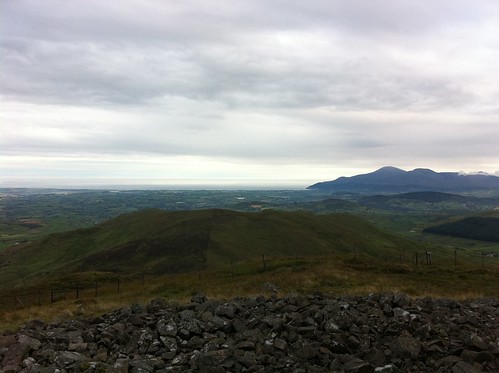
Towards the Mournes

This was the view from the top when Bryan and me made it to the height of 1755 feet above sea level, where the river Lagan begins it's course to Belfast and the sea. The Mournes were looking well. Sadly, I forgot my camera so this was from my iPhone camera, but I'll go back sometime with the big camera.

Sunday, July 31, 2011

July 2011 Review

As noted at the start of the week, it's been a lean month for blogging - just fourteen posts.

Mostly, it's been sermons, from Psalm 119: 1-8, 65-72 and 145-152, but there have also been preaches from Romans 5, and from the Creed on the Holy Spirit and the forgiveness of sins. Rather than individual audio postings, there have been an omnibus and a special!

In other news, there was one book review, Parson's Pitch by David Sheppard, some thoughts on the death of John Stott, and a look at cellular data network usage by my new iPhone 4. And that's it in terms of blog postings!

My photo of the month was the taste of the summer, entitled No Owl, No Pussy Cat:
No Owl, No Pussy Cat

Sermon: Psalm 119: 145-152 Crying to the Lord

What has been your experience of prayer? Have you seen any of your prayers answered? Perhaps it can feel as if your prayers bounce off the ceiling, unheard and unanswered. As we continue in Psalm 119 (in our last section of it), we find the writer thinking about prayer, about calling out to the Lord, crying to him.

In these verses we find Passionate Prayer. Look again at 145. ‘With my whole heart I cry; answer me O LORD!’ or in 146, he speaks about how ‘I call to you.’ I wonder is this true of us - that we turn to the Lord, calling out to him; or do we first try to fix things ourselves.

The writer is committed to praying - look at verse 147. ‘I rise before dawn and cry for help’, or again in 148 ‘My eyes are awake before the watches of the night.’ Morning, noon and night, he will be praying, crying out to God, asking for his help. It reminds us of Paul’s instruction to ‘pray without ceasing’ (1 Thes 5) - this is more than just a ten minute quiet time or a quick prayer before bed and that’s you done with God for the day.

Now perhaps you’re waiting for some instruction, some rule on how long we should pray for; or how many times in the day we should pray. I think lots of us, if not every one of us, are legalists at heart - we turn something that’s a joy, a delight, into a duty and want to set up rules. Perhaps you look at the Muslims and their five times of prayer in a day and think - why don’t we have something laid down. Perhaps if the Bishops decreed set times each day, then it would be easier to pray.

But the Christian life is about grace, not rules - prayer is given to us not in order to follow specific rules about how often and how long. God isn’t like a vending machine - you put your coin in and the can of coke pops out. You can’t just come to God and put a prayer in and expect him to comply. He’s not a machine, he is our Father, and prayer isn’t just about asking for things, it’s about relating to our Father; getting to know him better, and express our dependence on him. We’ll want to be praying to God because of this, not because of some external rule.

We also find passionate prayer from the writer because of the circumstances he’s facing. In 149 he’s asking God to ‘hear my voice’, because he’s facing a difficult time - there’s opposition, persecution: ‘they draw near who persecute me with evil purpose; they are far from your law.’

We’re not told exactly what they’re doing, and yet we’ve already seen some of what that meant from earlier weeks and other sections of 119. They are his foes (139), cunning (118), evildoers (115), persecute with falsehood (86). So he’s under attack; these evil men are making life difficult for him - and that’s a spur to pray.

Things haven’t changed - there are still those who are far from God who attack the people of God. Paul, writing to Timothy, warned him that ‘everyone who desires to live a godly life will be persecuted.’ While we may not face the extremes of persecution that some Christians may face in other countries; there will still be a level of persecution. That may be in the workplace (where you could be shunned or refused promotion because of your faith); in the home (if your parents aren’t Christians); among friends (where you’re left out of dinner parties or not invited because of your faith).

The writer is facing this persecution, but he doesn’t sort it out himself - rather it drives him to pray, to call out to the Lord.

So we’ve seen passionate prayer - vocal, dedicated, intense. And you might be thinking to yourself - yes, I need to be more active in prayer; I want to do more; I want to depend on God more and myself less. Yet you’re left wondering - how do I pray? What should I pray?

There’s no doubt that prayer can be passionate, and pointless. Just think of the showdown at Mount Carmel from 1 Kings 18. The prophet Elijah confronts the 450 prophets of Baal (and 400 of Asherah) and set up two sacrifices with the challenge - the God who answers by fire, he is God. The prophets of Baal show plenty of passion; crying out until they’re hoarse; dancing around the altar; cutting themselves even, yet there’s no answer.

Or perhaps we can be passionate in prayer by heaping up grand sounding words and phrases (especially if we’re leading the church in prayer!), but Jesus reminds us to avoid ‘empty phrases... for they think that they will be heard for their many words.’ (Matt 6:7).

So how should we pray? What can we pray, that we can be sure God will hear us and answer us? The answer isn’t very surprising, especially if you’ve been with us on these other weeks in Psalm 119. Let’s read the passage again, and look for the emphasis: [READ] It’s the word words, isn’t it?

This section of Psalm 119 calls us to passionate prayer built on permanent promises. ‘I rise before dawn and cry for help; I hope in your words. My eyes are awake before the watches of the night, that I may meditate on your promise.’ He’s saying that as he cries for help, he finds hope in God’s word; he meditates on God’s promise so that he can pray. His prayers are built on God’s word and promise.

Do you remember when you were a child, or if you’ve seen kids interacting and they’ll say something and make a promise. Now, sometimes those promises can quickly be broken and there might be a falling out. But God doesn’t break his promises - we can depend on them; and so we can pray from them.

We see it everywhere in this section, but particularly 149: ‘Hear my voice according to your steadfast love; O LORD, according to your justice give me life.’ Why should God hear our prayers? It’s not because we deserve for God to listen to us - after all, God is immense, powerful, almighty, beyond comprehension. We, in contrast, are so very small (just one of 7 billion alive at this moment), on a small planet in a small solar system in a small galaxy... Why should God listen to little old you or little old me? ‘Hear my voice according to your steadfast love.’ God has already declared his steadfast love for his people in covenant with him; we can be sure he will listen to us, and so we pray, expecting him to listen to us!

If that was true for the writer of Psalm 119, how much more for us, who are part of the new covenant, who have received the promises from The Word (the Lord Jesus), who have the assurance of grace and mercy and covenant through the death and resurrection of the Lord Jesus.

In the Church of Ireland we have those things called collects - set prayers for each Sunday. Over the course of a year lots of different themes are prayed for, but the pattern is usually the same - they always begin in a similar way. Take today’s: ‘Merciful God, you have prepared for those who love you such good things as pass our understanding: Pour into our hearts such love toward you...’ Before we get to ask what it is we want to ask, we’re reminding ourselves (and God!) of who he is, his character, what he has already done - our praying flows out of his promises.

The rest of this section is then like a case study of this principle in action. We’ve already thought about the opposition and persecution the writer is facing; the persecution we may also face. If these evil people are drawing near, what are we going to do about it? If you’re facing attack, what would you be doing?

The writer brings passionate prayer, based on the promise: ‘They draw near... But you are near, O LORD, and all your commandments are true.’ They may be near as they make life difficult, but the truth is that God is nearer to us - a truth we marvellously celebrate as we recall the Lord Jesus’ words that he would be with us to the end of the age; that he will never leave us or forsake us; that we have the Holy Spirit dwelling inside us! Greater is he that is in us than he that is in the world!

Now as we close, there’s a great encouragement to us to pray passionately based on God’s promises, precisely because they are permanent. Look at 152: ‘Long have I known from your testimonies that you have founded them forever.’ The word of our God endures forever - what God has said, he continues to say, so that we can build our life on it, can pray according to it, place our hope for the future on it. These are the things God has already promised to us in the covenant - therefore we can be bold and ask for them; we can be sure God will answer these prayers and give us his steadfast love, save us, and bring us safely to eternal life with him, no matter what we’re going through.

Friends, this is a great encouragement for us to pray - perhaps you realise that you’re outside the covenant today, well the good news is that you can be brought in as you call on the Lord - he has promised (!) to hear and save all who call on him.

Or perhaps you’re a Christian, have been for a long time - this is why it’s so important to have Bible reading and prayer together - to know the promises, be confident in the promises, meditate on them; and come boldly to your Heavenly Father in passionate prayer based on the promises.

This sermon was preached in St Elizabeth's Church, Dundonald on Sunday 31st July 2011.

Thursday, July 28, 2011

John Stott


The Christian blogosphere has exploded with tweets, Facebook messages and blog posts celebrating the legacy of the undoubted leader of British evangelicalism for the last fifty years. John Stott died yesterday at the age of 90, surrounded by family and friends as they listened to Handel's Messiah and 2 Timothy being read.

I only heard him preach once, just over five years ago, when he came to Belfast. Despite being frail, it was still incredible to hear his faithful teaching and passionate engagement with the text of Scripture and the congregation gathered before him. Nevertheless his legacy far exceeds his parish ministry in his one and only parish, All Souls Langham Place, through the Langham Partnership, his international speaking tours, and perhaps best known of all, his prolific writing ministry.

For many years I've appreciated his books, particularly his work on The Bible Speaks Today commentary series, as well as Basic Christianity and The Cross of Christ. In the past, I've reviewed some of his works, including The Cross of Christ and The Last Word, and have read something from his pen in each of the last five years, as well as the first volume of his weighty biography.

While there is a sadness at having lost such a godly gentleman, it is, as Mark Meynell commented, bitter-sweet, because of the unshakeable hope of the gospel. Truly 'Uncle John' was trusting in the Lord Jesus for salvation, and we can confidently say that he is at home with the Lord, in the joy of his Master.

Tuesday, July 26, 2011

McFlurry's McLinks (25)

Here's another batch of links for your enjoyment:


Undercover genius
from Alexander Rose. What if the world was 100 people (visual). Plus, have you heard this story before? Have you got mail?

After the cremation, I hope they didn't pop this can...

Challies shares some secrets of productivity. The Proclaimer was thinking about rest and technology. Speaking of technology, here's an infographic on twitter usage.

On ministry, the Vicar's Wife discusses making records and skittle prayers, while De Young looked at church websites.

Wils shared a recipe for elderflower cordial. Shelterrific had a note from the past - I remember a time capsule being discovered in the roof of Dromore Cathedral when repairs were being carried out.

As well as having a new book out, here are some videos of Helen Roseveare speaking at Ballymoney Baptist.

My (soon to be former) colleague, Johny Beare, has started a new blog: Beare Goggles. In one of his first articles, he thought about phone hacking.

Quaerentia reflected on Steve Jobs thinking about mortality. Slugger had that horrific crash from the Tour de France.

Alan in Belfast covered the Twelfth of July in East Belfast and Dublin.

Denny Burk writes about the oxymoron of Christian terrorism following the tragic events of last week in Norway.

This edition's video is Shallow Small Group:

Monday, July 25, 2011

Blog Break

Well, hasn't it been quiet here? Without intending to, I managed to go without blogging right through the Twelfth Fortnight (aside from sermons preached on the Sundays). I wasn't on holiday, but things have been steady in the parish, leaving no time to blog.

As things stand, I have less than two weeks left in St Elizabeth's, and the farewells have started already, with people who won't be around for my formal farewell preaches and lunch on 7th August. Then we'll be packing up and heading west that week, into the new house.

The Rector is still on sabbatical, returning to duty just before I leave, so it'll be a quick handover and update, with lots to share with him and also to hear of his study leave abroad and on this island.

I've a few ideas for articles buzzing away in my brain, so keep an eye out for them over the next few days!

Sunday, July 24, 2011

Sermon: Romans 3:21 - 4:8 I Believe in the Forgiveness of Sins

I believe in the forgiveness of sins. For most of us, I suspect that’s something that’s taken for granted, a sort of, yes, of course I believe that, and quickly move on. After all, we’re in church, we’re meeting around the Lord’s table, sharing the Lord’s Supper, of course we believe in the forgiveness of sins. Like so much of the Apostles’ Creed, we can recite it in church (from memory) and yet never appreciate or realise just what we’re saying.

It’s a bit like the North Coast for me. Any time I get the chance, I love going for a drive up to the North Coast, pausing on the way round to enjoy the spectacular scenery. I dream of having a wee cottage with great views. Yet I know that after time, it would become so ordinary that I might not even notice it, wouldn’t marvel over it the way visitors would.

Could it be that way with the forgiveness of sins? Is there a need for us to slow down, pause, take stock, appreciate the view, and marvel at what the forgiveness of sins is all about? We’re hopefully going to do that this evening, as we concentrate on what Paul writes to the Romans from chapters 3 and 4, and illustrate from other parts of the Scripture as well.

As he begins his letter, Paul says that he is keen to come to Rome, in order to preach the gospel there too, and then he makes his big statement that drives the rest of the letter: ‘For I am not ashamed of the gospel, for it is the power of God for salvation to everyone who believes, to the Jew first and also to the Greek.’ (Rom 1:16) It’s all motherhood and apple pie type stuff - everyone is going to agree with it.

But then comes the bombshell. Think of Spotlight when they uncover a shocking story, and expose the details of dodgy dealings. Or think of the BBC investigation into phone hacking in the (former) News of the World - and how the story keeps on running. No one, it seems, is innocent, no one is safe.

‘For the wrath of God is revealed from heaven against all ungodliness and unrighteousness of men, who by their unrighteousness suppress the truth.’ (Rom 1:18) Paul chronicles the total depravity of man, how the Gentiles have turned away from the God who made them, descending into pagan idolatry. They ‘did not honour him as God or give thanks to him... claiming to be wise, they became fools, and exchanged the glory of the immortal God for images... they exchanged the truth about God for a lie...’

You can almost hear the Jews tut tut, as they gasp at the shocking sinfulness. Just like in the documentary, though, the biggest shock is yet to come - the Jew is just as sinful, just as guilty as the Gentile. In chapter 3, Paul heaps Bible verse on Bible verse to show that ‘all, both Jews and Greeks, are under sin.’ (3:9). The effect is that ‘every mouth may be stopped, and the whole world may be held accountable to God.’

The whole world is on trial, and no one has any excuse, any mitigating circumstances. Guilty as charged. As the writer of Psalm 130 says, ‘If you, O LORD, should mark iniquities, O LORD, who could stand?’ (Ps 130:3). As Paul puts it, ‘for all have sinned and fall short of the glory of God.’ (Rom 3:23).

It can be easy to see the sins of others, but sometimes we try to convince ourselves that we’re not so bad; we’re good, decent people, certainly better than Mr so-and-so down the street. This verse cuts right through our veneer of respectability - all have sinned; all fall short of the glory of God. We miss the mark. For a few years, I helped out at the Diocesan Confirmation Weekend at the Share Centre in Fermanagh (not far from my new parish!). Not fancying spending the morning in a cold Lough Erne, I volunteered to help with the archery. Sometimes the younger boys and girls didn’t have the strength to get the arrow down the course, they fell short. None of us can meet God’s standards, we all fall short.

Now thankfully, we don’t just stop there. God doesn’t show us our sin without showing us the Saviour; alongside the ‘bad news’ comes the good news that rescue is possible. Paul continues: ‘for all [types of people] have sinned and fall short of the glory of God, and are justified by his grace as a gift, through the redemption that is in Christ Jesus, whom God put forward as a propitiation by his blood, to be received by faith.’

You have sinned, yes, but you can be justified (just as if I’d never sinned), through the sacrifice of Jesus’ blood, shed on the cross to take away your sins. He is the substitute, the one who takes our place, who bears the wrath that we deserved - it’s the reverse of those exchanges we saw in Romans 1 - so that this is the great exchange, as Paul would write in 2 Cor 5: ‘For our sake he made him to be sin who knew no sin, so that in him we might become the righteousness of God.’

If you’ve ever attended a Christianity Explored Course, then you’ll remember the illustration of the room where everything you have ever done is recorded; or in the youth edition, it’s a room with TVs playing every second of your life, the hard drive with everything stored on it. There might be some good things to show, but lots of it we would be embarrassed, ashamed, if others were to see it.

Through what Jesus has done on the cross, all those sins are wiped away; they have been dealt with and so can be discarded. And how do we get rid of our sins? It’s not through working hard to remove them; not through attending church and reversing the balance; not by accumulating good credits to outweigh the bad. It’s simply by faith. It’s why Paul mentions Abraham - he heard God’s promise and believed; and it was counted to him as righteousness - being right with God, not by doing anything, but by believing. And again as Paul quotes from Psalm 32: ‘Blessed are those whose lawless deeds are forgiven, and whose sins are covered; blessed is the man against whom the Lord will not count his sin.’

And how does all this happen? It’s because of what Jesus has done for us. His birth, life, death, resurrection and ascension. All those things we’ve already looked at as we’ve gone through the Creed. The whole of the Christian faith hangs together - in a sense it’s like a jigsaw, we need every piece together to have the whole thing.

It’s not like a religious pick and mix where you think - yes, I want forgiveness of sins, but don’t want to bother about Jesus; or forgiveness of sins, yes, but I don’t want to have to think about the cross. Precisely becuase of who God the Father Almighty is; precisely because of who Jesus is and what he has done; precisely because of the work of the Holy Spirit - we can have those blessings at the end of the Creed: the holy catholic church, the communion of saints, the forgiveness of sins, the resurrection of the body and the life everlasting.

But it would be remiss of me to stop there. As I’ve said, it can be fairly comfortable for us to hear about the forgiveness of sins; I’m pretty sure that most of us have experienced that blessing; we are rejoicing in having our sins dealt with; being justified by Jesus. But we can’t stop there. The fact that we have been forgiven must lead to a change in us. If you have been forgiven, then you must also be forgiving.

We acknowledge that every time we say the Lord’s Prayer - forgive us our sins, as we forgive those who sin against us. Isn’t it here that we find the challenge? Isn’t this the difficult part? Forgiving others, when you’ve experienced wrongs done against you; hurt by physical, verbal, emotional violence. Yet Jesus calls us to it, leaving us a pattern - remember how Jesus prayed for his persecutors, prayed for those who nailed him to the cross?

Perhaps even as I mention this, your sense of anger is rising; your call for justice expands - justice for your hurts, but mercy for your sins? Can we really expect this double treatment? As always, we find in the teaching of Jesus an example of the mercy we have received being passed on to others - read Matthew 18:23-35.

May we recognise the great debt we have been forgiven, and so forgive others when they harm us. The challenge is particularly apt as we prepare to share around the Lord’s Table and again aer confronted with the great love and mercy of the Lord Jesus. As I finish, let us hear those words of challenge and comfort from the introduction to the confession:

Ye that do truly and earnestly repent you of your sins,
and are in love and charity with your neighbours,
and intend to lead a new life,
following the commandments of God,
and walking from henceforth in his holy ways:
Draw near with faith,
and take this Holy Sacrament to your comfort;
and make your humble confession to Almighty God,


After a moment of quietness, Margaret is going to come and lead us in our confession. But now, let us pause, and give thanks, for the fact that we can truly say: I believe in the forgiveness of sins. Amen.

This sermon was preached in St Elizabeth's Church, Dundonald on Sunday 24th July 2011.

Friday, July 22, 2011

Sermon Audio Special

Here are the links to my last two sermons, from the Apostles' Creed series on I Believe in... the Holy Spirit, and from Psalm 119 on The Adversity Gospel.

Sunday, July 17, 2011

Sermon: Psalm 119:65-72 The Adversity Gospel

Have you ever heard a message which goes a little something like this: God is ready to bless you, and fulfil all your needs, if you will just trust him. All God’s blessings are available for you tonight - God owns the cattle on a thousand hills and he wants to rain down blessings on you - your bank balance will increase; your home will be extended; you will never again be sick, sad, or suffer; you might even have a private jet just like mine.

Now perhaps it hasn’t been just as blunt as that, but the message suggests that, in the words of one book, you can have ‘Your Best Life Now’ (Joel Osteen). Now if you heard that message, you’d want to jump in straight away, wouldn’t you? You would even send in a cheque to his ministry if it guaranteed an easy life - wealth, health, happiness.

Even when we don’t hear a message like that, we might still have the assumption that everything will be better when we’re a Christian. But what happens when things don’t turn out the way we hope? When we find ourselves in hospital, either ourselves or visiting a family member. When you’ve lost your job, and fifty applications later, you’re still looking. When the exam results aren’t what we thought they would be. When a planned long and happy retirement is suddenly cut short. What do we think then? If you’re anything like me, you’ll probably ask the question - is God really good?

If God has promised to bless us, then why do we find ourselves in dire straits? Does God not care? Is he not good after all? We’re continuing our series in Psalm 119 this morning, having jumped over a few sections. I do hope you’ve been reading it through the whole way - if not, there’s still time to start as we’ve another two weeks in Psalm 119.

If you have been reading through it, you’ll have noticed a few times already where the writer mentions some difficulties - princes plotting against him (23), taunts (42), and affliction (50). In this 9th section, he reflects further on his affliction, and how it relates to God’s goodness. Our natural reaction might be to question God’s goodness, but the writer’s response is to declare and confirm God’s goodness. As we’ll see, God’s goodness means that he helps us in our troubles, rather than removing them.

We’re going to use verse 68 as the lens through which to view this section, using each of its phrases to explore what Christopher Ash calls ‘the Adversity Gospel’. The writer says to God: ‘You are good and do good; teach me your statutes.’

So first up - ‘you are good.’ Is God good? In verse 65, we find these words: ‘You have dealt well with your servant, O LORD, according to your word.’ Throughout the Psalm, the writer uses this capital letters LORD to address God - it’s the rendering of what we would have known as Jehovah (Yahweh), which is the covenant name of God. It’s the name God reveals to Moses at the burning bush when he begins the process of bringing his people out of Egypt, rescuing them, and forming his covenant with them.

In the covenant, the LORD has promised to bless them, be gracious towards them, and so the writer says yes, the LORD has done this - he has acted ‘according to your word.’ The covenant-making LORD is the covenant-keeping LORD. His word, his covenant, is the expression of his character. God is good - perfect, holy, noble, true, all these and more.

But if this is what God is like, then what will the good that God is working towards in our life be? Happiness and healthiness? Will it not be holiness that reflects our God? Holy living, not easy living?

If you stopped people on the street (or even in the church) and asked them what the good life looks like, they’ll picture a Caribbean island, white beach, drinks from waiter service, beautiful partner, and perfect health which goes on forever. The good life God has for us reflects his own goodness, and wants us to become more like him. And surprisingly for us, that includes affliction.

‘You are good and do good.’ I wonder if you ever think like this - when things are going well, God is in control, he is in charge, working out his purposes. But once things start going wrong, then we assume God is no longer in control. Has God taken a coffee break, or slipped up in some way?

The Psalmist isn’t engaging in this double-mindedness. Rather, he sees that God is in control even when these afflictions come. The remarkable thing is that God can use afflictions in order to help us grow as Christians - it is his good gift to us.

Just think of that famous verse from Romans 8 - ‘And we know that for those who love God all things work together for good, for those who are called according to his purpose.’ (Rom 8:28) The NIV renders it ‘in all things God works...’, but either way, doesn’t it express what we’re seeing here?

Now perhaps you’re going through a really tough time at the moment. It’s even hard to listen to this, but let’s look at what the writer has learnt about God doing good even through afflictions. ‘Before I was afflicted I went astray, but now I keep your word.’ And later, ‘It is good for me that I was afflicted, that I might learn your statutes.’

He’s looking back, thinking back to what happened, and how it has changed him. And what he has realised is that he was going astray, going his own way. When afflictions came, they brought him back to God, they left him with nowhere else to turn, they brought him to his senses (like the Prodigal Son in the pigpen). Christopher Ash remarks that God can use afflictions like an electric fence around a sheep pen, to keep the sheep from wandering. There may be a little pain, but they don’t stray.

Have you ever felt at the end of yourself? Realised that there was nothing you could do to help yourself? As the situation crowded in on top of you, you need someone to help. You rarely feel that way if you’re on top of the world, succeeding, do you?

Let’s be clear that this affliction is not a punishment for our sins - if you’re in Christ, then he has already borne the punishment, there is no condemnation. The truth is that Jesus himself, who committed no sin, knew this affliction. Hebrews 2 tells us that Jesus ‘Although he was a son, he learned obedience through what he suffered.’ (Heb 5:8). Jesus was afflicted in order to bring us to God. Rather, what’s in view here is the discipline of the Lord (see Hebrews 12), ‘he disciplines us for our good, that we may share his holiness.’ (Heb 12:10).

‘You are good and you do good; teach me your statutes.’ As we learn that God is good (even in our afflictions), and that he does good (even in our afflictions), what will our response be? If we’re in tune with the writer of the psalm, then our desire will be his desire - for God to teach us his statutes. But what will that look like? What is it we should be asking God to do in our lives as we cling to him in the adversity gospel?

We’ll be wanting to learn how to live as a Christian, seeking to please God. That’s what the writer is saying in verse 66: ‘Teach me good judgement and knowledge, for I believe in your commandments.’ Help me to make good decisions and to be wise. Help me to walk in your ways.

These good decisions and wise ways are even more important when we remember that we’re still facing struggles and opposition. The insolent smear me with lies - it’s still going on - so teach me how to respond to opposition. How should we respond? Not with threats or retaliation, but by focusing still on God’s word - ‘I keep your precepts... I delight in your law.’

All the time, we should be asking what is God teaching me through this? How can I become closer to God through my circumstances? What have I been learning from God’s word that will help me deal with this?

Afflictions bring us nearer to God as they remind us how dependent on him we truly are. They drive us to know him more and more, and also, as we see in the final verse, to value God’s word, because it brings us to know him.

The news this week has been buzzing with that big win in the Euromillions lottery. £161 million won by a couple in Scotland. No matter where I’ve gone this week, people have been talking about it - discussing what they would do if it had been them - the holidays they would go on, the houses they would buy, the fashion and new car they would be seen in, on and on it went.

Psalm 119 reminds us that we have something more valuable than a lottery win, more precious then thousands of gold and silver pieces. That precious thing isn’t locked away in a bank, under guard. We hold it in our hands - ‘The law of your mouth is better to me than thousands of gold and silver pieces.’ The law (or teaching) of his mouth is the expression of God’s character, which helps us keep going even when the odds are stacked against us, even when times are hard.

You are good and do good; teach me your statutes - so that we can glorify you through the hard times as well as the good, and know you better, as we journey towards heaven. Amen.

This sermon was preached in St Elizabeth's Church, Dundonald on Sunday 17th July 2011.

Sunday, July 10, 2011

Sermon: I Believe in the Holy Spirit - John 14,16

For many in the church today, it might seem as if the Holy Spirit is the forgotten person of the Trinity. We’re comfortable thinking about and talking about God the Father, and also God the Son, the Lord Jesus. We’re much less sure when it comes to the Spirit. Perhaps it’s because we used to speak of him as the Holy Ghost, which added to the mystery, the spookiness.

Of course, others have gone overboard on the Holy Spirit, so much focusing on him that they almost completely neglect or ignore the Father and the Son. For them it’s all about tongues and experiences and feeling the Spirit move.

Tonight we’re going to survey the Bible quickly, before focusing in on the two closely connected passages from John’s Gospel, as we seek to discover (or re-learn) who the Holy Spirit is, and what he does.

Firstly, it’s important to state that the Holy Spirit is God. He is God in the same way the Father is and the Son is - fully God, as together, they are God. It’s not that the Spirit is less than God or even a lesser God. So we find the first reference to the Holy Spirit in the second verse of the Bible - Genesis 1:2. ‘The spirit of God was hovering over the face of the waters.’ At creation, God the Holy Spirit is intimately involved, brooding over the waters. He is connected to life.

More than that, through the Old Testament, we find that the Spirit comes upon, or empowers, certain individuals for certain tasks. We saw that from 2 Peter where the prophets ‘spoke from God as they were carried along by the Holy Spirit.’ (2 Pet 1:21) It’s also the case with Bezalel (Ex 35) who is ‘filled with the Spirit of God’ in order to build the ark of the covenant, and later King David, who is empowered for kingship. But it’s still just particular people, not every person.

Yet the sense of anticipation is rising, with Joel’s prophecy that ‘And it shall come to pass afterward, that I will pour out my Spirit on all flesh; your sons and daughters shall prophesy etc...’ (Joel 2:28-29). It will come afterward - after the day of the Lord, and so God’s people are looking forward to this day, waiting for it. All the more so when Ezekiel ministers to the people at the time of the exile.

This morning we were reminded of how we can’t meet God’s law, we can’t do what pleases him by ourselves, and the city of Jerusalem was the Exhibit A of that. God’s city, the place he had chosen to dwell amongst his people, where he had established his temple, it all lies in ruins, because the people failed to keep to the covenant. They rebelled, disobeyed, and so the people go into exile. And when they’re sitting in Babylon, remembering home, they’re wondering - is there any hope for the future? Can things be different?

Here’s what God says through Ezekiel: ‘I will sprinkle clean water on you, and you shall be clean from all your uncleannesses, and from all your idols I will cleanse you. And I will give you a new heart, and a new spirit I will put within you. And I will remove the heart of stone from your flesh and give you a heart of flesh. And I will put my Spirit within you, and cause you to walk in my statutes and be careful to obey my rules.’ (Ezek 36:25-27). As if that wasn’t enough, in the next chapter, he’s given a vision of the valley of bones. It’s a picture of Israel, dead, dry, without hope. The bones come together, flesh comes on them, and the breath comes in them - ‘And I will put my Spirit within you, and you shall live, and I will place you in your own land.’ (Exek 37:14).

They’re looking forward to this, but nothing happens for a long time. Then, at just the right time, the Spirit-filled Man appears on the scene. The Lord Jesus was ‘anointed with the Holy Spirit and with power. He went about doing good and healing all who were oppressed by the devil, for God was with him.’ (Acts 10:38). That brings us to our readings from tonight. In them, Jesus is in the upper room with his disciples. It’s a matter of hours before he is arrested and crucified, and he’s preparing the disciples for this time, and also afterwards.

So who is the Spirit, and what does he do? The two answers are really connected, and virtually the same - because the way Jesus speaks of the Spirit tells us who he is and what he does. He is the Spirit of Truth (14:17) - just as the Father and the Son, he is the truth, there is no falsehood, no lies from the Spirit. He is also ‘another Helper’. It’s not that he’s the first Helper - he is another Helper. So what Jesus has already been doing with the disciples, this is what the Spirit will do.

He is the presence of Jesus with them, he helps them to come to faith (1 Cor 12:3), pray (Rom 8), to grow in the likeness of the Lord Jesus (Eph 3:16), as well as convicting the world of sin. So you see, the Holy Spirit is given to us to bring us to faith, and keep us in faith, by dwelling with us and in us. What has been promised in the Old Testament is now, through Jesus, given to us in the New Covenant. Every Christian has the Holy Spirit, ever since Pentecost, when the Spirit came in power to help the first apostles declare and proclaim the good news in Jerusalem.

Sometimes people think that it’s only the spiritual Christians or the keen Christians who have the Spirit. It’s as if they’re in the Premier League of spiritual experience while I’m just a ‘Dromore Amateurs’ kind of Christian. You may have met someone who says that you need an extra baptism in the Spirit, or some particular experience, or speak in tongues or somesuch. That’s not what the Bible says. If you are a Christian, you have the Spirit living in you. It is possible to grieve the Spirit, but you have him nonetheless.

Now you might have noticed near the end of the second passage something that is bandied about fairly often, particularly in the controversies and debates at the present time. Jesus says: ‘I still have many things to say to you, but you cannot bear them now. When the Spirit of truth comes, he will guide you into all the truth.’

So it is commonly argued that the Spirit is continuing to lead us into all truth and new truth, so we should accept homosexual ‘marriage’ and ordination in every instance, as the Spirit leads us on. Is this really what Jesus was saying?

Remember where Jesus is, and who he is speaking to. He’s in the upper room, with his disciples. It’s well known that the disciples were slow at catching on to what Jesus was teaching - just think of their inability to understand him as Messiah. Jesus will be crucified, and after forty days with them, will be ascended. The Holy Spirit is given to the first disciples to lead them into all truth, which they can better understand after Jesus is crucified and risen, as they’re helped by the Spirit.

As they are helped by the Spirit, they proclaim the apostolic message, as they preach across the world, as they write the gospels, and as they write those pastoral letters to churches and individuals. The Holy Spirit guiding the first disciples into all truth has been completed when the canon of the New Testament is finished - what Jude calls ‘the faith that was once for all delivered to the saints.’ (Jude 3). What the Scripture says is what the Spirit is saying - the one who wrote the Old Testament by speaking through the prophets does the same through the apostles to give us the New Testament.

If this is what the Spirit has said (the Spirit of Truth, who illuminates the Scripture and helps us understand what it says), then he is not going to contradict himself now, twenty centuries later. What the Spirit has said, he continues to say. As an example, just think of the letters to the churches in Revelation 2-3, which Trevor preached recently in the mornings. In each of them, Jesus says ‘He who has an ear, let him hear what the Spirit says to the churches.’

As most of you probably know by now, we’re shortly moving on. Come the middle of August, we’ll be moving into our new house. There’ll be boxes everywhere! But over time, we’ll be unpacking those boxes, cleaning up any messes, fixing any leaky taps, and making the rectory our own. It’ll reflect our personality and likes, in the furniture and decor, ornaments and pictures.

The Holy Spirit, the Spirit of Truth, the Spirit of Christ, is also involved in renovations. He moves into our hearts when they are dark and dingy, with mess everywhere. He brings us to faith, and continues to change us to reflect his personality, transforming us through the word of Christ, to be people who are becoming more like Jesus. It is his desire for every Christian - and every person. Are you listening to the Holy Spirit today?

This sermon was preached in St Elizabeth's Church, Dundonald on Sunday 10th July 2011

Friday, July 08, 2011

Book Review: Parson's Pitch


I got the loan of this 1964 book through a pastoral visit, and so it managed to jump the to-be-read queue in order to be returned before I leave this parish! It came into my brief possession through a guy who played cricket, so I lent him Penguins Stopped Play, and he gave me this one.

Parson's Pitch is a sort of autobiography of the cricketing cleric, David Sheppard, who eventually went on to become Bishop of Liverpool, having been the only Test cricketer to have been ordained. As such, there were some chapters that were more interesting and appealing than others, as the material switched from cricketing stories and matches to the story of his conversion and faith.

As I've said, the book was written in the early 1960s and so seems quite time-bound in the cricket details. I don't know quite enough about cricket, nor about the famous players from the 1930s to 60s to have appreciated some of what he was writing about. This was especially the case given the last three chapters are an almost blow-by-blow account of the English tour of Australia in the 1962-63 season, with much more detail than the casual reader would have wanted, even more so fifty years later! Perhaps it was a huge selling point when it first came out, but less so with the passing of time.

That being said, it would still be useful as an evangelistic book for sport mad men, if you had a local cricket team you were trying to reach with the gospel. They may better appreciate the cricket stories, but within they will also find a clear explanation of the good news of Jesus Christ, how Sheppard was soundly converted, and how he openly talks of his Christian faith affecting every part of his life, even his sport.

There were some choice quotes, which might whet your appetite:

'It is all too easy to handle holy things without consciously coming close to God at all.'

'I found it fascinating and important, but tried to keep firmly in my mind that all this was a background to meeting real needs of real people, and not simply some unending intellectual argument.' (On his theological studies at Ridley College)

I'm glad to have read it, and I'm sure it had a great impact when first released, but perhaps the passing of time has been less kind to this book. Nevertheless, the timeless gospel is presented clearly within, and therefore it may yet nudge people along the way as they read a cricket autobiography and find the living Lord Jesus who saved David Sheppard, Test Cricketer and Clergyman.

Thursday, July 07, 2011

Audio Omnibus

Here's a collection of recent sermon mp3s from the past few Sundays, finally uploaded to our sermons website and also available here: 19 June - The Trinity in Action; I Believe... in Jesus crucified; 26 June - I Believe... in Jesus risen, ascended and coming again; 3 July - How to be Happy.

Wednesday, July 06, 2011

Sermon: Romans 5: 1-11 Rejoicing in Suffering?

What are some of the things you might rejoice over? It could be a birthday, or maybe a family wedding. You might rejoice over a new baby in the family, or perhaps if Britain wins any gold medals at the Olympics next year. We all know how to rejoice, how to celebrate good things that happen. But did you notice the most remarkable and strange thing that Paul said in our reading today, something to rejoice over?

As he begins chapter 5, Paul reminds us of the ground he has already covered in his letter to the Romans. Despite the wrath of God being revealed against sin (all sin, all people), God has made a way for sinners to be justified - by faith. We have been justified - it has already happened. That means that now, we have peace with God - the war is over, he is no longer angry at us or hostile to us. All this comes through the death of Christ.

More than that, we also have obtained access to grace - no longer in guilt but in grace, it’s like a door has been opened, and we can come inside. God is gracious towards us; and we can look forward in hope to what God has prepared. No wonder Paul says we can rejoice in hope. All these things are brilliant blessings!

But in the very next verse (3), we find this strange rejoicing. Let’s look at it together. ‘More than that, we rejoice in our sufferings.’ If it was Family Fortunes, we asked 100 people name one thing you would rejoice in - would sufferings be in the list? You’d probably get the X and the noise. You almost want to ask him, Paul, are you wise, rejoicing in sufferings? Is he a sadist, taking pleasure from pain?

It’s not what we expect, or even want to hear, is it? Yet Paul is saying that suffering is the normal Christian life. It’s not that when you become a Christian everything is sweetness and light, and all your troubles disappear. It’s more likely that your suffering will increase - yet Paul says we can rejoice. Why?

It’s not that we rejoice in sufferings, full stop. It’s rather that our sufferings are almost like a production line. For a couple of summers, I worked in a factory on a production line. Each section had their own thing to contribute to the overall product. So it is here - suffering produces endurance (as we keep going under pressure); endurance produces character (the fruit of the Spirit, the tested genuineness of who we are); and character produces hope (as we look forward to what God has prepared). We can go through this process and not ‘crack’ because God’s love has been poured into our hearts through the Holy Spirit given to us.

Now you might be thinking to yourself, well, if God loved me, he wouldn’t let me go through... (you fill in the blanks). Perhaps you doubt God’s love when you face those sufferings. It seems like God has abandoned you. Just in case that’s where you are, Paul includes another reminder of just how much God loved you, loves you, and will continue to love you. Once again, he takes us back to the cross, and points to it and says - this is how God loves you! ‘but God shows his love for us in that while we were still sinners, Christ died for us.’

It’s not that you were good or righteous - no, it was while you were God’s enemy, Jesus died for you! What love, that gives himself for enemies. If God has already done that, if Jesus has already died for you, then how can you now doubt his love?

It’s the point Paul draws out in the rest of our passage. Since you’ve been justified, much more shall we be saved... if this, then much more that.

I cannot know precisely what you may be going through today. There may be depths of sufferings that no one else knows about, and you wonder how you can continue, you wonder if these sufferings mean God doesn’t love you. That could not be further from the truth.

God has already demonstrated his love for you in the cross of the Lord Jesus. His love is sure. As you have been justified, you stand in his grace, with the assurance of his love poured into your hearts by his Holy Spirit. Your sufferings are producing eternal fruit as you endure, your character is formed, and hope bursts forth. Suffering is not the absence of God’s love, but the assurance of God’s love - helping us and preparing us for his eternal glory. So hold in there, and be sure that Christ is holding you!

This sermon was preached at the Midweek Holy Communion in St Elizabeth's Church, Dundonald on Wednesday 6th July

Tuesday, July 05, 2011

Cellular Network Data

It's almost a month since I upgraded my O2 pay monthly mobile from an iPhone 3GS to an iPhone 4. It's been nice to get started on the newer phone, learning how to work it and the extra things it can do - including my first FaceTime conversation!

This post, though, is more concerned with the change in O2's cellular charging policy. When the iPhone first came out, there was unlimited data available. It meant you could endlessly surf the internet, check emails, use maps, and all the rest across the 3G and cellular data networks (as long as your battery continued!). Not long after I got my iPhone, I noticed that O2 were changing the contract, and a separate subscription was required for pay monthly data usage - £6 per 500MB or £10 for 1GB. It was in place straight away for new customers, but would only be forced on current customers when their contract finished or an upgrade was completed.

I have to admit, I was worried by these new charges. I would tend to use the mobile web quite a bit, finding it useful to have email on the go, as well as using apps like Lookaly to find restaurant recommendations, Google maps, Facebook, Twitter and all the rest. Would I be caught out by the extra charges? Were O2 going to make a lot more money off me through the new contract when I upgraded?

After the first month, I can safely say they won't be using me to fund their retirement plan. While I may have been slightly cautious on the mobile web, at the end of my first month, it looks a bit like this:


Less than one-fifth of the network data allowance used! It certainly seems that perhaps 500MB is a reasonable allowance and one that I won't be topping any time soon, given that I've been using my phone to navigate to some rural churches as well as updating Facebook and Twitter when I've had opportunity.

Sunday, July 03, 2011

Sermon: How to be happy Psalm 119:1-8

Are you happy? The boys and girls might be happy because they’ve got off school; you might be happy because you’re looking forward to a holiday. But are you really happy this morning?

It’s a question that many today are trying to answer, in all sorts of different ways. You might be dissatisfied with life as it is, frustrated with circumstances, overpowered by problems. It’s why you work hard and play hard; why you throw yourself into your family or friends; why you keep the house just so; dash from one party to the next, updating Facebook and Twitter every five minutes; invest so much in your clothes and hair and beauty. Happiness is just out of your reach - so near and yet so far.

Being happy seems to be something that’s here now, and quickly disappears - when the credit card bill lands on the doorstep; or when the hangover kicks in. How can we be happy? Where do we find it? How do we keep it? As we’ll see, we might just find happiness in a most surprising place - a place that many refuse to look; the last place you might think of looking.

This morning we’re beginning a mini series in Psalm 119. It’s a mini series because, well, have you seen the length of it?! 176 verses, it’s the longest Psalm, and the longest chapter in the Bible. Had ... not stopped at verse 8, they would still be going to read right through it. But don’t be put off by its length - as you might notice, it’s divided into sections of eight verses each - more manageable chunks.

Each of those eight verse sections begin with the same letter (in Hebrew, of course, not English!) - as you can see at the head of each bit. Aleph, then Beth, and so on. It’s like an A-Z psalm, a carefully worked piece of poetry, and it’s all about God’s word, the Bible. If you look over it quickly, you’ll find the same words repeated throughout - law, testimonies, precepts, statutes, commandments, rules, word and promises.

But you might be asking yourself - what has that got to do with being happy? Have a look at the very first word of the Psalm - what is that word? ‘Blessed’. Blessed is a churchy word, isn’t it? It’s one of those words we talk about and use, but what does it really mean? It’s all about being happy, receiving from the Lord. True happiness comes from receiving from the Lord, from being blessed. And who is the one who is blessed? What does it say about the blessed? ‘Blessed are those whose way is blameless, who walk in the law of the LORD.’

How do you hear that? How do you read that? Is it saying that you’ll be happy if you manage to keep all God’s laws and never do anything wrong? If so, then none of us will ever be happy, we should just stop reading right now, close our Bibles and go home. We could never do it, if it depends on us. If blessing depends on us first being perfect, then none of us will be blessed.

Remember, blessing is something God does, something God gives. Do you remember Psalm 32? It begins with the same word: ‘Blessed is the one whose transgression is forgiven, whose sin is covered.’ Psalm 119 is saying the same thing - the one who is blessed is the one who is blameless because of what God has done. Yes, we have sinned, but if we have come to trust in the Lord, then our way is blameless, because our sins are gone.

Psalm 119 is not about us trying our hardest to get ourselves into God’s good book. It’s about God accepting us by grace, and giving us his good book to live it out. It’s grace, not effort; grace, not good works; grace, not achievement - but we cannot just be saved and stuck. Do you see how that verse continues? ‘Blessed are those whose way is blameless, who walk in the law of the LORD.’ So those who are blameless are the people who will walk in God’s law (his teaching Torah - the word describes the first five books of the Bible, not just laws). When you’re saved, God calls you on a journey, to walk his way the rest of your life.

Do you see how this continues through the rest of 2 and 3? Keeping God’s testimonies is to seek him with your whole heart; doing no wrong is to walk in his ways. The one who is blessed, the one who is happy, is the one who is blameless, going God’s way.

It’s a statement of fact - it’s a declaration of God’s mind on how to be happy, how to be blessed. It’s the same kind of declaration as we find right at the start of the book of Psalms: ‘Blessed is the man who walks not in the counsel of the wicked, nor stands in the way of sinners, nor sits in the seat of scoffers; but his delight is in the law of the LORD.’ (Ps 1:1-2)

How can we be sure that there is happiness in the law of the Lord? Think for a moment of those other things people chase after to find happiness - and how temporary they really are. A fancy car? It’ll get dinged or crashed or rust. Drink? It’ll damage your liver. House? A burglar could break in. Beauty? You can’t stop the march of time. Parties and friends? Some day you could be lonely - maybe even in a crowd. Money? You can’t take it with you.

In contrast, the law of the LORD is perfect, his word is a lamp to our feet, no matter what we’re going through. As we read elsewhere, All flesh is like grass - the flower fades, the grass withers, but the word of our God stands forever. His word endures because God endures. The God who blesses endures, so his blessing endures.

God says in his word how to be blessed - by being blameless, having our sins washed away through trusting in his word. Our response must be the same as the writer of the Psalm - to take God at his word, and seek to walk in his ways. Do you see how verses 1-3 are speaking about God (it’s all he and him). From verse 4 on, the writer speaks directly to God himself as he responds to the offering of blessing, of happiness. His response goes from verse 4 right through to verse 176, as he speaks to God about his word.

In St Elizabeth’s we are rightly concerned with reading and understanding the Bible. The staff team and volunteers put a lot of time and effort into studying the text to see what it says. That’s right and proper. But if we only go that far, then it’s a waste of time. You see, it’s not just an English Comprehension class we’re running on Sundays and midweek. We devote ourselves to the word in order to get to know the Lord who spoke it, and so that we actually do what it says.

This is what we find in Psalm 119. ‘Oh that my ways may be steadfast in keeping your statutes!’ The writer desires to do what God commands, to please the Lord, so he asks God to help him do that. Do we have the same passion for holiness, the same desire to obey the Lord, to get to know the Lord better?

As we will see - when we seek to live for the Lord, everything is not suddenly sweetness and light. It’s harder to live for the Lord than to live for yourself. That’s why we need the Lord and his word, to help us live in a hostile world - it reminds us of God’s standards and values when we’re so immersed in the values of the world.

I want to challenge you over the next few weeks to take some time and read Psalm 119 right through. See how the writer is delighted with God and his word - and ask yourself, can I say these words myself? Can I echo what the Psalm is saying?

How to be happy - being blessed by the Lord is the path to true happiness, and walking in his way. He makes us blameless, he turns us around from going our own way to walking in his way. It’s no wonder that as Jesus begins to teach his disciples, he also begins with similar declarations of blessedness - ‘Blessed are the poor in spirit, for theirs is the kingdom of heaven.’

Are you happy this morning?

This sermon was preached in St Elizabeth's Church, Dundonald on Sunday 3rd July 2011.