
The Cheeky Girls were on the Richard and Judy show there, and Judy Finnegan has just asked them: 'Are you twins, or brother and sister?' Hmm... is it the one on the left, or the right?


Would you do me a wee favour? Would you nudge the person sitting beside you, just to make sure they’re not sleeping? That’s good! Now we’re all wide awake!
I’m sure you’re familiar with the idea of a wee favour – something that you do for someone else (or that they do for you), out of the kindness of your heart. Or maybe when you hear the word favour, you think of the wee gifts that are distributed at wedding parties- normally sugared almonds or wee sweets. In fact, I was at a wedding over in
As we turn to Ruth chapter 2 tonight, we encounter Ruth as the harvest is beginning. If you were with us this morning you’ll remember that Ruth and her mother-in-law Naomi returned to
In the passage we’re going to see how Ruth finds favour in the eyes of Boaz – a very important man, as we’ll find both tonight and next week – and we’ll also see how Ruth’s favour is a picture of the favour we receive from God.
Notice, though, before we launch into the passage that verse one introduces the man Boaz, who is a relative of Naomi’s husband. In ancient
Take a look now to see the man of standing. He owns fields and has a team of harvesters, so presumably he was wealthy. But more than that, he was, as the ESV puts it, ‘a worthy man.’ We see his goodness in verse 9, as he tells Ruth he had told the men not to touch her – evidently others were not worthy, but he was. Was he a sort of Prince Charming in this unfolding romance?
Let’s look at verse two. Remember, Naomi and Ruth have returned to
You see, the Old Testament Law provided some rules for agriculture. There were things like giving the land a fallow year, a Sabbath, so that it could be ‘rested’ too. But what concerns us here is in Leviticus 19:9 – ‘when you reap the harvest of your land, do not reap to the very edges of your field or gather the gleanings of your harvest. Do not go over your vineyard a second time or pick up the grapes that have fallen, Leave them for the poor and the alien. I an the LORD your God.’
Our God is concerned for the poor, and those who have nothing. The Law therefore made sure that the poor would be able to glean whatever was left behind or dropped by the harvesters.
Ruth was able then, to go to any field and there should be something to glean. Do you notice the middle of verse 3? ‘As it turned out, she found herself working in a field belonging to Boaz, who was from the clan of Elimelech.’ As it turned out. Just a co-incidence. Or was it? As we saw in chapter one, God was working behind the scenes in bringing his purposes, and we can see it here again.
After the formal (but probably heartfelt) greeting in the name of the Lord, Boaz was scanning the field when he saw an unfamiliar face. Who was the new girl working in the field, gleaning behind his harvesters? Was it that he knew she wasn’t a local girl? Who could it be?
The stranger is identified as Ruth, the Moabite girl who had returned with Naomi. So Boaz goes over to speak to her, and showers blessings on her. She is granted protection, supplies, water, and comfort. Look at verses 8 and 9.
Obviously Ruth recognises that Boaz is the owner of the field, and is overwhelmed by his generosity. ‘Why have I found such favour in your eyes that you notice me – a foreigner?’ In other words, why are you being so kind to me, even though I don’t deserve anything as I’m an outsider? In her opinion, his favour is undeserved, but gratefully received.
And why is it that Boaz favours her? First, he roots it in the kindness that she has shown to her mother-in-law; sticking with her, returning with her, and even abandoning home and family to do it. But then he shows that his favour is small compared to the favour of God. It’s as if his favour is just a smaller copy or version of God’s great favour. So he prays that she will find that great favour. Look at verse 12: ‘May the LORD repay you for what you have done. May you be richly rewarded by the LORD, the God of Israel, under whose wings you have come to take refuge.’
Once again we see that Ruth had not just left her family and been faithful to her mother-in-law Naomi. Rather, she had turned her back on her gods, and taken shelter in the God of Israel, the living God. It is by coming to the God of Israel that she will be richly rewarded.
Look at verse 13, as Ruth responds to the favour. Boaz gave her comfort and spoke kindly, ‘though I do not have the standing of one of your servant girls.’ Boaz pours out favour on her, even though she doesn’t deserve it, she has no standing. It reminds me of the parable of the Prodigal Son. Do you remember the speech he rehearsed as he travelled along the road home, reminding himself that he wasn’t worthy to go back. ‘I am no longer worthy to be called your son.’ (Luke 15:19) Even though he doesn’t deserve anything, he is met with his father’s favour, his father’s grace; restored to his position as a son and welcomed with open arms.
Look also at how Ruth responds in verse 13. It’s as if the rest of the story is being set up, as she requests continuing favour from Boaz – looking to the future, and pleading for him to protect her as he has done. Yet at the time, it appears as if Ruth doesn’t realise that Boaz is a relative of her family. Only later will she find out when she reports back to Naomi.
Do you notice that the favour shown towards Ruth is seen as kindness towards the living and dead (of her family) – we see this in verse 20, as Ruth tells Naomi of her day gleaning? But even more than that, do you see the change in Naomi?
Flick back for a moment to Ruth 1:20-21. There we see Naomi saddened, afflicted, empty, and she attributes it to the Lord, the Almighty. Then at verse 2 in our chapter tonight. It’s Ruth who takes the initiative and acts as the breadwinner. Naomi is still bitter, still (as it were) far away from
Look now at 2:19-20, and see the excitement of Naomi on seeing the rich blessings from the field of Boaz, and how quickly she turns to praise and blessing – ‘Blessed be the man who took notice of you!’ (19), ‘The LORD bless him!’ (20). The favour, and the blessings spill over into yet more blessings and favour.
Favour, or grace brings about this tremendous change in Naomi, and it ripples out!
As we look towards next week, Naomi declares that Boaz is not just a relative, but is a close relative; and even more than that, is a kinsman-redeemer. Boaz will have a specific function to fulfil in his bringing of favour, but we will see that next week.
For now though, you might be asking yourself what to do with this passage tonight. After all, what seems to be beginning to blossom into an ancient romance story in a harvest field might be touching enough, or slightly interesting, but how does it impact on our lives today?
This morning as we looked at chapter one, we saw that the picture of Ruth’s faithfulness was a reflection of the faithfulness of Jesus. So too, this evening, we see that the favour that Boaz shows to Ruth is a reflection of God’s favour towards us.
So far, I’ve used the word favour, but you might be more used to the word ‘grace’. Can you see how it links? The favour that Boaz showed to the foreign slave girl was completely undeserved; and how much more is God’s grace undeserved by us? Grace is when God gives us what we don’t deserve.
How he reached out on the cross, through Jesus, and offers us pardon and peace, forgiveness and freedom, new life and new hope. We didn’t deserve it at all, yet in love, in grace, he came to us and gave us all those blessings.
Like Ruth in verse 13, we didn’t even have the standing of servants, yet God in his grace makes us his children. Like Ruth in verse 10, we were foreigners, outsiders to God’s promises of mercy; we had separated ourselves because of our sins, yet God in his grace brings us into his kingdom. And like Ruth in verse 10, as she marvels over the favour, the grace that Boaz is showing her, so we will marvel and wonder over the grace that Christ has shown us through all eternity.
I stand amazed in the presence of Jesus the Nazarene,
And wonder how he could love me, a sinner, condemned, unclean
How marvellous, how wonderful, And my song shall ever be,
How marvellous, how wonderful, is my Saviour’s love for me.
Maybe you have been coming to church for many a year and have heard about the grace of God, but you’ve never experienced it, never known it for yourself. Won’t you come tonight, and take refuge under the wings of the God of Israel? That grace is there for you. The offer is open. Won’t you come, and know and rejoice in that grace?
Or maybe you’re like the Prodigal, knowing that you don’t deserve anything. God offers you his grace – the blessings he has for you – precisely because you don’t deserve them. You can’t win them for yourself, you can only be given them by the grace of God.
How do you deal with tragic circumstances? How do you cope when bad things happen to you? What is your reaction to sad events in your life? As we begin our study in the book of Ruth, we encounter a very tragic story as the life of Naomi unfolds. We’ll look at what happened to Naomi, before seeing how she dealt with those events. Hopefully through all this, we will see the gracious and good hand of God, not only in Naomi’s life, but also in our lives as well.
Look with me at verse two. We’re introduced to Naomi and her husband Elimelech, as well as their sons Mahlon and Kilion. They lived in
But if you jump down to verse 20, we find Naomi returning to
How has this change been brought about? Why has Naomi gone from being pleasant to being bitter? Let’s look at the tragedy as it unfolds.
As I said, at the start of the book of Ruth, we encounter Elimelech, Naomi, Mahlon and Kilion. They live in
So what are the family to do? What would you do? Verses one and two both tell us that the family decides to move away from
You see, when Elimelech (‘God is my king’) was faced with his problem, he didn’t consider it in the light of God’s word. Remember, they were living in the promised land, in the first few generations of those living in the land God had given them. Do you not think that if God had went to all the trouble of bringing the people of Israel out of Egypt (with the plagues, signs and wonders), and brought them through the wilderness those forty years, then brought them into the promised land, that he would supply for them to live there?
If Elimelech had only recalled the promises of God given through Moses to his ancestors – promises that if they continued to worship God, they would be blessed in the land; and promises that if they forgot God, then they would face famine and drought and ruin. (Deut 8:6-9, 19-20; 11:13-17; 28:9-14, 45-48). Then he would have recognised the signs of the times, and see what needed to be done.
But rather than this difficult step of humbling himself before God and admitting his faults, he ran off to
How do you respond to a problem? Do you take it to the Lord, and search the Scriptures for light? It may be easier to run away from God, or take the pragmatic response, but it will not satisfy in the end.
Then, on top of these tragedies, we find that as they settle in the
No wonder Naomi claims that the Lord has afflicted her – could there have been anything worse happening to her? After all, if God is in control, then is it not his fault when bad things happen? I wonder do you blame God as well? So far, in the midst of all that has happened, we have seen Naomi blame God, despite their disobedience, their lack of faith, their running away from the problem.
Yet the wonderful news of the first chapter of Ruth is that God is in control. God’s purposes are for good, for those who love him, and we see in the chapter how God works for the good of Naomi.
God is in control when he (verse 6) came to the aid of his people again, by providing food for them. God keeps his promise for ever – he is faithful and true. While Naomi and her family fled, the rest of the people of God had remained in the promised land, waiting to receive the promise again.
God is in control when he brings Naomi back home again, back to her town, back to the promised land and the family inheritance. Her townsfolk hadn’t forgotten about her – when she arrived back they were stirred, they were excited or maybe just a bit nosy.
So far we have seen God being in control of the good things – maybe you’re thinking it all would have turned out ok anyway. After all, the rain wouldn’t fail forever, and there would be food again eventually. But even more amazing than these is that even in Naomi’s disobedience and disgust of God, God is in control, working for her good.
When the family fled to
Why is it that at the times we need family and friends the most, we seem to drive them away? The very times when we need help the most, we tend to be stubborn, and not to want any help. [We see it in suicide – those who would most benefit from sharing problems and lightening the load are those who withdraw and try to face up to things on their own – which overwhelm them. If you should be thinking about suicide – don’t keep it to yourself – talk to someone about it and get help for whatever problems you are facing.]
So we see it here – as Naomi sets off back for
Orpah leaves and goes back home. She’ll be on the look out for another husband, but Ruth refuses to leave. God is working in her life to bind Ruth to Naomi in her time of need, yes, but more than that, to bind Ruth to God himself.
Let’s read those words again we thought about with the children – ‘Don’t urge me to leave you or to turn back from you. Where you go I will go, and where you stay I will stay. Your people will be my people and your God my God. Where you die I will die, and there I will be buried. May the LORD deal with me, be it ever so severely, if anything but death separates you and me.’
Remember that these are words from a daughter-in-law to a mother-in-law. How many of you daughters-in-law would think of saying this to your mother-in-law?! Or sons-in-law to your mother-in-law? Do you see how radical these words are? Can you also see that they are the outworking of God’s in-working in the lives of the family, even in the midst of the bad times, even in the midst of the sad times, even in the midst of their disobedience and denial?
Naomi needed a companion on the road home and as they set up life again in
Even in the bad times, God is present in the situation, and working for our good. Maybe you were thinking of a specific problem or tragedy or situation that you have recently gone through, or you’re going through right now – be assured that God is with you.
On preparing for this morning, I was struck that verses 17 and 18 point beyond the faithfulness of Ruth to Naomi, to the truly Faithful One, to the Lord Jesus. Firstly, to that verse in Romans 8 which I have been hinting at, which tells us that ‘in all things God works for the good of those who love him, who have been called according to his purpose.’ (Romans 8:28) But also to the wonderful promise we have from the end of Matthew’s gospel – ‘And surely I am with you always, to the very end of the age.’ (Matt 28:20) and confirmed in Hebrews 13:5: ‘Never will I leave you, never will I forsake you.’
So Naomi (Mara) returns to
If you’re in the midst of the crisis, be assured that God is with you, and that God is working for your ultimate good, in ways you may not be able to see right now. That really is the grace of God that we have in Jesus Christ.
[Verse 23 tells us that they arrive back at the time of the barley harvest, which will lead us into chapter two. We’ll be looking at it tonight at 6pm, if you want to see how the story develops!]

Congratulations to Bryan and Louise Kee (nee Wilkinson) who were married on Saturday in St Peter's Free Church in Dundee. I was over for it, acting as best man, hence the quietness on the blog for the last few days. More photos and a full report will follow in due course!

As you have probably noticed, today is the Twelfth of July. It's a public holiday in Northern Ireland, and is marked by Orange parades across the country.
The South-West Conference of the Orange Order had their demonstration in Laurencetown and Lenaderg, at the place where King Billy forded the Bann at Huntly. This morning it was wet, wet, wet as the brethren assembled on the Huntly Road, and the rain persisted during the outward parade. Rain, as well as meaning there were umbrellas aplenty. But it also means that the lambeg drums couldn't be brought out.
During the service and speeches, the weather cleared, and the sun came out! All this meant that the parade on the way back was much better, and the lambeg drums could be heard! The photo illustrating this posting is of the drums with my brother's lodge, Magherabeg True Blues LOL 838.
In total, I took 550 or so photos, and am working through sorting and renaming them. So far I only have a few of Magherabeg online at Flickr, but more will come after the weekend... Tomorrow morning I'm heading off to Scotland for the Wilkinson-Kee wedding!
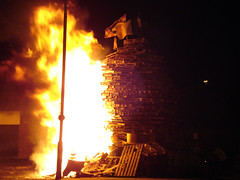
Once again it's the Eleventh night, when across Ulster, bonfires will be lit. You can't help wondering, though, if it's all eco-friendly, so soon after the Live Earth event. What ways can we celebrate Orange culture while being green? (Maybe our new power-sharing Assembly and its DUP ministers can tell us how to mix orange with green?)
How then, shall we live? So far in 1 Peter we have been seeing the greatness of God, in what he has done for us, and the hope he has given to us through Jesus Christ. One of the first things Peter talked about was the new birth to a living hope (3), and now tonight, in our passage, Peter again talks of being born again through the imperishable word of God.
The question for us, then, is this – what does the new life in Christ look like? Tonight won’t cover all of it, because Peter returns again and again to this theme, particularly in the ‘be subject to’ passages in chapter 2 & 3. Our passage shows us three important features of the new life in Christ – holiness, fear and love. But before we come to these three features, we’re urged to be ready, to be prepared for action.
Up to verse 12, we see what God has done for us. Verses 13 on show us what we have to do – how we should respond to God’s grace and mercy. See the ‘therefore’ at the start of verse 13? (As we heard at Summer Madness last week, whenever you see a ‘therefore’ in the Bible you have to ask what it’s ‘there for’!) That shows that there’s a link between what has gone before and what is coming now. Because of that, then this follows.
Verse 13 shows us that we need to be ready for the battle that is coming – and the battle starts in our minds. ‘Therefore, prepare your minds for action; be self-controlled; set your hope fully on the grace to be given you when Jesus Christ is revealed.’
Peter is saying that if you know what you know about God, then you can be prepared for what is coming. The new life in Christ is not easy, in the face of opposition and persecution. So how should we live out our hope?
Peter first appeals for the family likeness of holiness. Parents, have you ever heard yourself say this - ‘as long as you’re in this house, you’ll live by our rules’ – or if you’re a son or daughter have you ever been told - ‘this is how our family behaves (or doesn’t behave).’ In a sense, this is how Peter goes on to encourage his readers to respond to God’s grace.
Because we have been given new birth (into God’s family) – we are called to live up to the family likeness. Verse 14 says: ‘as obedient children, do not conform to the evil desires you had when you lived in ignorance. But just as he who called you is holy, so be holy in all you do, for it is written: “Be holy, because I am holy.”’
We aren’t called to be holy to win our salvation. We can’t get on the right side of God by doing good things. We are only made right with God through what Jesus has done for us on the cross. But when we are saved, then we have to live up to what we are (or whose we are).
No longer will we so easily give in to evil desires that arise within us – instead we seek to grow more like Jesus. The choice is, in one respect, very simple – are we going to live our own way, or are we going to live God’s way?
Sometimes when we mention the word holy, or holiness, it might conjure up images of rules and regulations or of joyless existence. This cannot be farther from the truth! For Peter, and therefore, for us, holiness is modelled on God, doing the things that he is doing. As one writer has said, ‘there is a marvellous simplicity in a holiness patterned on God himself; it does not require encyclopaedic grasp of endless directives and prohibitions. It flows from the heart; its key is love. To be holy is to love the Lord our God with heart, soul, strength and mind, and to love our neighbour as ourselves.’
What about you? Are you being conformed to the evil desires you had when you lived in ignorance? Whose standards are you lining up to? Are there situations where you have a choice of what to do?
Up to now, Peter hasn’t specifically mentioned the cross, even though it has been the background of all he has said. Now, Peter speaks of it directly, as he reminds us of judgement – and as he seeks to encourage us to live a holy life.
First, he says that we call on a Father who is the judge. One day at the end of time, God will indeed judge each of us for what we have done. It’s because of this judgement that we’re called to live in fear – looking forward to that day. But it’s not a fear because of the final result, in the same style as a fear of spiders or a fear of the dark. The reason we don’t have to fear the judgement itself is because Jesus has died for us, if you have accepted him as Lord and Saviour. There is no condemnation for those in Christ Jesus. However, the fear is to come precisely because Jesus has died for us.
We’re back to the precious theme again – we haven’t been redeemed by perishable things like gold or silver – but with the precious blood of Jesus Christ. Slaves could be ‘redeemed’ in the market place – bought with money. But it was something much more precious and important than money that was used to redeem and save us – Christ’s blood shed on the cross.
We’ve been saved because God gave that which cost so very much – so we should live in response to that fact, living what I would call a ‘thankful fearfulness, or a fearful thankfulness.’
Peter then goes on to show how precious Jesus is – ‘a lamb without blemish or defect’ – he is our Passover Lamb, the substitute who died in our place, taking our sins upon himself. This is why living a holy life is so important, because we have been redeemed by the blood of the Lamb.
So far we have seen that the new life in Christ is about holiness and fear (or rather, thankful fear). There’s one final bit of instruction in chapter one that Peter has for the Christians he’s writing to. That is to love one another deeply.
Look at verse 22 – ‘love one another earnestly from a pure heart.’ That word ‘earnestly’ calls us not to half-hearted love, or a cold formal relationship with those around us. Rather, it points us to an intense, deep love. The same word is used to describe the earnestness of Christ’s prayer in
The reason we have to love one another deeply is because we have been born again. By ourselves, we’re self-centred, and only interested in other people for what they can give us or how we can use them.
Having been born again, we are part of the new family of God. As well as loving God, we also have to love our brothers and sisters. Peter links this to us being redeemed through the living and enduring word of God – which stands for ever. Why is this? Well, because it is through the word of God that we first learnt of the love of God for us, and it is the source of our ongoing growth in love and holiness as we bask in God’s love.
Did you notice that the word of God is described as living and abiding (and which remains forever)? Because the word of God abides forever, it also means that its message endures forever. Our new birth isn’t just for a week or two, but will last forever, into eternity. Similarly, God’s love for us lasts for ever, and so we are called to love one another earnestly, because we have been born again.
As we come to a close tonight, did you notice the double contrast between perishable things and imperishable? In verse 18, we are reminded we’re not redeemed by perishable things (such as silver or gold), but are redeemed by the precious blood of Christ; and also that we have been born again, not of imperishable seed but of imperishable, through the living and abiding word of God.
So how do we respond to God’s grace in this passage? First of all, do you know this new life in Christ? Have you been born again through the living word of God?
If you have been born again, then are you progressing in holiness, in fear, and in love? Remember, these are all to be rooted in the grace of God, and in what he has done for us. Let’s pray that we will grow in grace together, in our new life in Christ.
Have you ever watched one of those make-over programmes on television? The format is very similar, across the wide range of programmes. You begin by introducing a person, or a room, or a garden in dire need of help. The person’s style isn’t considered fashionable, or the room hasn’t been decorated in thirty years, or the garden is actually a jungle.
Then the experts come on side and over the course of an afternoon or a few days, there is a transformation! The person changes from being unfashionable to being fashionable; the room looks completely different, the garden is now suitable for barbecues on the newly installed patio.
In our reading this morning, Peter tells of something similar that has happened to his readers. Look with me at verse 10. ‘Once you were not a people, but now you are God’s people; once you had not received mercy, but now you have received mercy.’ Verse 9 further talks about how they have been called out of darkness into God’s marvellous light. These Christians have been completely changed and transformed – but not by a make-over, where the outside appearance is changed. We’ll see in a minute or two how they have been changed. But for now, I want you to see how radical and shocking these words of Peter were in the first century, especially when written by a Jew to Gentiles.
Most of Peter’s readers would have been Gentile Christians – that is, they were pagans or heathens before they became Christians. They weren’t Jews. Yet here Peter calls them God’s people, and the recipients of mercy. It would have been unthinkable for a Jew to call Gentiles part of God’s people.
After all, everyone knew that
But
Again, look at verse 9, remembering that these descriptions are being used by Peter when he talks about Gentile Christians – ‘you are a chosen race, a royal priesthood, a holy nation, a people for his own possession.’ All of these titles, these descriptions were used of
Do you see how shocking this is – that Peter takes the words used to describe the nation of
So the question must be: how did this happen? Did the ‘Changing Rooms’ or ‘What Not To Wear’ team come along and with a slap of paint, or a new colour scheme achieve the transformation? No!
The transformation has come about because of their response to Jesus Christ. Look at verse 6 and the start of 7: ‘For it stands in Scripture: “Behold, I am laying in Zion a stone, a cornerstone chosen and precious, and whoever believes in him will not be put to shame.” So the honour is for you who believe …’
In the first part of the passage, Peter speaks about stones and building, describing Jesus as ‘a living stone’ and a ‘cornerstone.’ A cornerstone is the main foundation stone, on which all the other stones in a building are built. As such, it is the most important stone, as it determines the firmness of the walls and the strength of the building. Notice that Jesus is described as the ‘living stone’ – reminding us again that Jesus is alive, risen from the dead, and active.
But more than that, the living stone was ‘rejected by men but in the sight of God (is) chosen and precious’. There can be no doubt that Jesus was rejected by men – he was put to death by the religious leaders of the day, and executed by the political authorities. By dying on the cross he was under a curse in the Law, yet he was chosen and precious in the sight of God.
Peter tells his readers that God is building something on the cornerstone, on Jesus Christ. In verse 5 we read that it is ‘a spiritual house’ – a temple as some other versions put it – which has the idea of both the house itself, as well as the family, the household of faith, which will be, in the words of verse 5, ‘a holy priesthood.’
You see, the religion of
The
Are you beginning to see how these Gentiles have been changed and transformed? As Peter has quoted the words of Isaiah 28, he shows that God has laid the chosen and precious cornerstone – that is, Jesus Christ. Those who believe in him will not be put to shame. By believing in Jesus, the Gentile believers have become part of the household of God, part of the new temple (where God dwells by his Spirit in the hearts of believers), and have received God’s mercy.
Jesus is the cornerstone, the foundation stone for building on. But not everyone will do so. As we heard earlier, Jesus, the living stone, was rejected by men. Many people still reject Jesus, refusing to come to him, or to believe in him. Our passage this morning also contains a fearful warning for those who reject Jesus.
Earlier, I read the first half of verse 7: ‘So the honour is for you who believe’ … but it goes on to make clear that not everyone believes, and that there are consequences – ‘but for those who do not believe, “The stone that the builders rejected has become the cornerstone,” and “A stone of stumbling and a rock of offence.”’
The image here is of people rejecting a stone as being not suitable for building, yet it turns out to be the most important one for building. And then, those very same people, rather than building on the cornerstone, end up tripping on it, stumbling over it. The next verse (from Isaiah 8) speaks of ‘And many shall stumble on it. They shall fall and be broken; they shall be snared and taken.’ (Isaiah 8:14-15)
[Are you building on the stone, or tripping over it? Not long after I started preaching, I was climbing into the pulpit in Magheralin. Pulpits are great places of stone – yet I tripped and almost didn’t make it into the pulpit!]
So I want to ask you this morning – where are you in relation to Jesus, the living stone? Are you still a stranger to him? You are outside of the people of God, a stranger to his mercy, in danger of tripping over the cornerstone? I urge you today to come to Christ, to come to the living stone. Receive that great promise that ‘whoever believes in him will not be put to shame.’
Or maybe you have come to Christ, and trusted in him. You are that treasured possession of God, having known his mercy and the joy of being in the people of God. Look again at verse 9. There’s something for you to do – you haven’t been saved to be stuck; you are saved for a purpose. You are ‘a people for his own possession, that you may proclaim the excellencies of him who called you out of darkness and into his marvellous light.’
You know the change that Jesus has brought about in your life – hopefully others will see that change too. Your task is to praise the God who has saved you, and to tell others about what God has done for you!


I was out today with mum for a while, and called into Bessbrook village. What about this view? The foreground shows the house tops in Bessbrook; then you can see Craigmore viaduct; then Newry City; and finally in the background, the Mourne Mountains. Check out my Flickr account for photos of the Enterprise train on top of the viaduct, and many more!
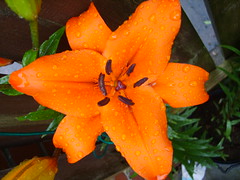
... the orange lilies are out. This is one of ours from the back yard. Over the past couple of days they have come out in full bloom. An amazing blast of orange in time for the Twelfth!