Tuesday, July 14, 2009

Aerial View


Aerial View
Originally uploaded by Garibaldi McFlurry.

Photos from the Twelfth parade in Banbridge are now online at my Flickr page. Have a look at them. I've still got about 250 images from the Belfast parade to sort through and upload.

With the Twelfth being on the 13th, the 13th is shifted to the 14th - the County Armagh Royal Black Preceptory parade in Scarva. Expect some more updates and pictures from it in due course.

Monday, July 13, 2009

The Belfast Twelfth

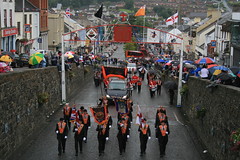
I'm currently standing on the Dublin Road in Belfast, watching the Twelfth parade on the 13th. An hour of the parade has gone by but now there's a long delay. Not quite sure why. We're up to the middle of District 6 Ballymacarrett.

The Twelfth in the city is a lot different to a country Twelfth such as I'm more used to. So far it has all been flute bands, apart from two accordian bands. No pipes, no silver or brass bands. A couple of lambeg drums were out before the parade started on Royal Avenue, outside City Hall and then at Bedford Street. But being here means I get to see different people, including some parishioners, and a new set of banners to take photos of.

Weather has been great, sunny and warm although there's a bit of a breeze which makes it hard to photograph the banners as they wave.

After this I'm off to Banbridge to get my fill of pipe bands and lambeg drums on the return parade

Sunday, July 12, 2009

When is the Twelfth not the Twelfth?

When it's the Thirteenth!

With the Twelfth of July on a Sunday this year, the Orange parades have been deferred until the next day. It led to some confusion about the lighting of the Eleventh Night bonfires - Saturday or Sunday night? I've never been to a bonfire, and yet for many, it's an essential part of the culture. The closest we ever got was sitting watching the Thornhill bonfire from a distance on the other side of the A1 dual carriageway.

But why bonfires? In some ways, those lighting the bonfires are celebrating the mobile phone of the Williamite era. Nowadays we're used to twenty-four hour news channels, mobile phone coverage and even Twitter to know what's going on in the world. But back in 1690, as William took to the battlefield on the green grassy slopes of the Boyne, how would the folks at home know who had won? Twitter is restricted to 140 characters, but the bonfire communicated one word: victory!

The word could spread quickly, from one hilltop to the next, with beacons blazing in the night sky. Ancient communications being continued, only now it's from one housing estate to another! That's why the commemoration of the Battle of the Boyne is (normally) held on the Twelfth. You see, the Battle of the Boyne was fought on the 1st July 1690 under the Julian calendar. In 1750, when Britain adopted the Gregorian calendar, ten days were added to bring Britain in line with Europe, which makes the 1st July Old Style into 11th July New Style. The bonfires on the evening of the 11th are as if the word is just reaching the towns and villages, and then the celebrations and processions are held on the next day, the Twelfth, unless it's on a Sunday.

Sermon: 1 Corinthians 15: 20-34 The Resurrection

I wonder if you’ve ever had the misfortune to include a red sock among a washing machine load of white shirts? You know what happens - the white shirts are changed, nothing is the same again, everything turns a pinky shade. One thing changes everything else.

As we continue our series in 1 Corinthians 15, Paul shows that the resurrection of Jesus is like that. Nothing will be the same again. Paul writes about the resurrection because, as we saw last week, some people in Corinth were saying that there was no resurrection - that this world is all there is. Pure materialism. But as Paul pointed out, if there is no resurrection, then our preaching is pointless, our faith is in vain, our sins are not forgiven, Christians who have died have perished, and that we are just pitied fools. Without the resurrection, we’re idiots.

But as Paul goes on, he says that Christ has been raised from the dead. Forget about those consequences - Christ Jesus is alive, and because he is alive, everything is and will be changed. We’ll see this in three key areas: our future, our world, and our behaviour. In other words, what has happened in the past (Christ’s resurrection) affects what will happen in the future (our resurrection), and therefore must affect our present (how we behave).

Let’s look at our future. As we stand, our future is not a pleasant prospect. Death is what lies ahead, both physical and spiritual. Death is the consequence of our rebellion against God - something that we share in common with everyone else, as children of Adam. Look at the start of verse 22. ‘in Adam all die’. Four devastating words. All of us are sinners, all of us will die because of our disobedience. Further, the start of 21 shows that death came into the world by a man - by Adam - death was not part of the original order - it was brought in by Adam.

Because of him, but also because of our own sin, we share in the curse of death. And yet, it doesn’t have to be this way. Continue with me in 21. ‘For as by a man came death, by a man has come also the resurrection of the dead.’ Adam introduced us to death, but another man has introduced us to life. ‘If Adam’s sin had far-reaching consequences, so had Christ’s resurrection.’ (Morris)

‘Christ has been raised from the dead, the firstfruits of those who have fallen asleep.’ The Corinthians thought that there was no resurrection. Paul says that Christ has been raised, but more than that - we too can share in the resurrection. The reference to firstfruits there comes from Leviticus, and was one of the festivals in the Jewish calendar. Firstfruits, as the name suggests, was the first pickings of the harvest, which were brought and dedicated to the Lord. The firstfruits implied that there was a great harvest to come. So, as Jesus has been raised, so we shall be raised. Firstfruits (according to Leviticus 23:10), was celebrated on the day after the Passover Sabbath - which is in fact Easter Day!

Christ reverses the curse and promises life through his resurrection. As in Adam all die, so also in Christ shall all be made alive. But let’s be clear that those two ‘alls’ don’t point to the same group of people. Just because all are in Adam doesn’t mean that all - everyone - will be made alive. Rather Adam and Christ are contrasted as the representative head of two groups of people: those in Adam, and those in Christ. Verse 23 helps us to understand: ‘at his coming those who belong to Christ.’ All of us will die physically, as we are all in Adam. But those of us who are in Christ will be raised to life eternal with him.

Which group are you a part of today? You’re automatically in Adam by nature, but are you also in Christ? It’s not an automatic entry, but comes by faith in Jesus. Have you taken that step?

Christ’s resurrection changes our future. But more than that, it also changes our world. When Adam sinned, he led humanity into sin and death, but more than that, he also unleashed the forces of sin and death on the world. Remember the curse on the ground in Genesis 3? The opposition to God’s kingdom became widespread, urged on by the devil and his demonic powers.

On the cross, though, Jesus took on the evil powers and our sin, and defeated them (Colossians 2:15) there. D-Day has been won, now we’re in the mopping-up stage, until all his enemies are put under his feet. The final enemy to be defeated is death - when all Christians who have died are released from its power, and are resurrected to live forever, body and soul.

The resurrection demonstrates, therefore, that Jesus reigns in triumph. Every objection to his rule is removed, and all things are in subjection under him. Verses 27 and 28 have a lot of subjections - but what Paul is saying is that all things are put under Christ’s feet, but obviously not God the Father, who reigns over all. Christ returns the kingdom to God the Father, and God reigns over all forever, Father, Son and Holy Spirit.

Christ’s final consummation has been guaranteed by his resurrection to life. It’s like one of those domino set-ups, where when you flick one domino, everything follows in sequence, leading to the end. Christ’s resurrection leads to Christ’s complete glorification. All his enemies will be destroyed - are you living as his enemy today? Then you stand in real danger.

So far we’ve thought about the future - both Christ’s glorification when all enemies are destroyed forever at his return, and our own future hope of eternal life guaranteed through Christ’s resurrection. These together with Christ’s resurrection have an impact on us today - it should also make a difference to how we live now, as we look towards the future. Paul shows this in three areas - practice, mission, and morals.

Verse 29 is tricky - this baptism on behalf of the dead. One writer has suggested as many as 400 possible meanings of what was happening. It seems, though, that in Corinth, some people were being baptised for the sake of a fellow Christian who had already died before being baptised. It’s not something that Paul recommends, and quickly fades away, but he points even to their strange practice as something which affirms the resurrection. Why bother doing it if there’s no resurrection in the first place?

The resurrection is the motivation and drive for mission, for spreading the gospel. It’s what pushes Paul: look at verse 32. ‘What do I gain if, humanly speaking, I fought with beasts at Ephesus? If the dead are not raised, Let us eat and drink, for tomorrow we die.’ Without the resurrection, our faith and mission is pointless. But in fact Christ has been raised from the dead. So we must get out there and tell people - no matter what the cost. Those wild beasts were those who opposed the gospel, who persecuted Paul for his message. There is a world to win, souls to save, through the preaching of the gospel. Are you excited about the resurrection?

At FCA on Monday, we sang a hymn: ‘We have a gospel to proclaim, good news for men in all the earth, The gospel of a saviour’s name, we sing his glory, tell his worth.’

The resurrection affects what we do in church, and drives our mission. But it must also have an impact on our morals, on our behaviour. You see, Paul spends a whole 58 verses and one whole chapter of his letter to the Corinthians because they had got into a terrible muddle about the resurrection. They were listening to the wrong people, drinking in what society and culture said, and it was leading not just to wrong doctrine, but also wrong behaviour.

To make the point, Paul quotes a Greek poet to say ‘Bad company ruins good morals.’ By not believing in the resurrection, they were tempted into the eat and drink for tomorrow we die mode of behaviour, because they figured this world was all they would know.

What about us? Are we listening to the wrong voices too? If we do, then we’re in danger of those voices dictating how we lead our lives. Did you see any of the Michael Jackson tribute show the other night? The message that came from the most of it was that Michael is obviously in heaven, possibly because everyone goes to heaven. Friends, not everyone will be raised to life - only those whose trust is in Jesus, those who are his. By thinking everyone goes to heaven, then we can live how we please - it doesn’t matter what you do. Or on the other side, if you listen to Richard Dawkins and the scientific atheistic materialistic fundamentalists, who (like the Greeks) say this world is all there is, then again, it doesn’t matter what you do.

Who are you listening to? Paul says their confusion is like a drunken stupor, and calls the Corinthians to wise up, to wake up, and not continue sinning. Are we also confused in our thinking, and our behaviour?

Just like the red sock in the wash, Christ’s resurrection changes everything. Our future is no longer bleak, so let us celebrate. The opposition to Christ will end, so let us look for the coming of his kingdom. Our resurrection is sure, so let us live up to it. And let us pray...

This sermon was preached at the Lord's Supper in St Elizabeth's on Sunday 12th July 2009.
Saturday, July 11, 2009

Wimbledon, Here I Come. Not!

A few Sundays ago, I'd heard a guy from church talking about playing tennis with his brother. Ah, I thought, I like tennis, and can play a wee bit. Maybe we should play some day. Despite the fact that it's two or three summers since we played tennis, and my last organised games would have been back when I went to the summer scheme at Dromore Community Centre, about twelve years ago.

So earlier this week, we played some tennis. Or rather, he played some tennis and I struggled. The end result? 6-0 6-0 6-0. The Beatles were wrong. Love is not all you need- some points would be nice! Several times I had the opportunity of winning a game, but my service was letting me down- either too short or too long. Total humiliation, even though Richard tried to help me out with some training tips to improve my serves and returns.

So I won't be booking a place at Wimbledon in the near future. The British hopes won't be carried on these shoulders. But a good hour of exercise, especially running to get the ball all the time! A rematch has been planned for some time in August when we're back from holidays. Somehow I don't rate my chances too highly!

Friday, July 10, 2009

Jacob to Jenny

Some J songs in what's on your iPod?

Jacob and Sons / Joseph's Coat - Joseph and the Amazing Technicolour Dreamcoat Soundtrack
Jacob in Egypt - Joseph and the Amazing Technicolour Dreamcoat Soundtrack
Jailhouse Rock - Elvis Presley
James Bond Suite - John Barry
James Bond Theme - Moby
Janie, Don't Take Your Love To Town - Jon Bon Jovi
Javert's Suicide - Les Miserables
Jaws Theme - The City of Prague Orchestra
JCB Song - Nizlopi
Jenny Was A Friend Of Mine - The Killers

A smaller batch than normal, but these are all the songs in this section - the next song opens a new (huge) batch of songs about Jesus, which will come next week! Favourite song in this batch is maybe Moby's take on the James Bond Theme.

Thursday, July 09, 2009

McFlurry's McLinks (5) FCA Special

Following the UK and Ireland Launch of the Fellowship of Confessing Anglicans (FCA) on Monday in London, the blogs have been red hot with comments, reflections, debates, and discussion.

The Ugley Vicar had some reflections, more reflections, and some thoughts on financial implications. Nick Jones was present, as was Jody, the Radical Evangelical (in 2 parts), the Urban Pastor,

Some Anglo-Catholic reactions from Edward Tomlinson, Giles Pinnock (2 posts), and Ross Northing.

Stephen Sizer quoted Maria Mackey's Christianity Today article on the FCA Launch at length. Wannabepriest asks what would Ignatius do?

Transfigurations has the text of Archbishop Peter Jensen's speech.

James Cary writes on homosexuality and Nazir-Ali, while Peter Ould missed FCA but attended one of the rallies the night before.

As with all links, the opinions are those of the authors of the blogs and sites, and may not necessarily have my approval. Nevertheless, there is quite a range of opinion there, and lots to think through. If you know of any other blogs writing about FCA, leave a comment, to continue the debate.

Wednesday, July 08, 2009

My First Communion

This morning I celebrated my first Lord's Supper at our traditional midweek service. An apostolic number of communicants, and all seemed to go well. It's strange, having watched others leading the service for my first 28 years, and now suddenly finding myself saying the words and leading the service.

The sermon was from Romans 5, reflecting on the wonderful love of God, in that Christ died for us while we were still his enemies. The cross is central to our celebration of the sacrament, as we recall the death of Jesus in our place, for our sake, for our sins. Along with his death, we celebrate his victory over death in the resurrection, as we proclaim Christ's death until he comes.

One thing I need to work on is the words of administration, and remembering that the bread is the body, not the blood! Had one slight mistook, but rectified it and managed to get the right words the rest of the time! Still, it's only my second time of distributing bread, as I normally distribute the cup.

So that's my first Holy Communion done, another first completed in the experiences of ministry, and a new experience as a Presbyter (or Priest). Sunday's will have a larger congregation than twelve, in my first main Sunday Communion. Here goes for it, and on the Twelfth of July too!

Sermon Audio: Psalm 125

Here's Sunday night's mp3 from Psalm 125.


Download this sermon

Monday, July 06, 2009

FCA: United in the Gospel

Afternoon tea at the FCA conference, and time to take stock of all that has been said thus far. A variety of speakers have spoken on the big theme of being faithful. Indeed, we've seen speakers from both evangelical and Anglo-Catholic backgrounds standing together in the faith.

Greg Venables spoke on what GAFCON has achieved and why the FCA is necessary at this point in time. While society says that we cannot be sure of anything any more, Christianity says something very different. Christianity is not a man-made invented religion, but revealed by God through the Lord Jesus and his apostles. He pointed us to Hebrews 2, with the warning that we can drift away from what we have heard and received.

He went on to point out that FCA is not dividing the Church- that has already happened through the actions of the Episcopal Church in the USA as they proceeded against the will of the Anglican Communion to ordain Gene Robinson in 2003. We have not moved from the apostolic gospel once for all entrusted to the saints.

Keith Ackerman displayed his commitment to the gospel and affirmed that we need a Dependence Day, depending wholly on the Lord Jesus Christ for our salvation. Coming from an Anglo-Catholic position, he called for us to set aside issues of style and come together on the basics of faith. He attacked those who hold to a canonical fundamentalism, elevating canon law to a position above Scripture.

In one of the funniest quotes of the day, he criticised those who seek to change the Trinity to suit their own purposes, by reducing it to mere functionalism, those of Creator, Saviour and Sustainer, as if that was all God was. He said it was like him ringing his parents and saying to his mother "Hi life-giver, is the sperm donor there?"

Other speakers have included Bob Duncan, Peter Jensen, Vaughan Roberts, Vinay Samuel, and Wallace Benn. The afternoon has been taken up with reports of mission, ministry, money, fellowship and oversight in the local situations of the churches in England, Scotland, Ireland and Wales.

Later, the Bishop of Rochester, Michael Nazir-Ali will preside and preach at a closing Communion service.

The Fellowship of Confessing Anglicans is united in the gospel essentials. This is the resounding message coming from Methodist Central Hall in Westminster. Now to do the work of mission together, standig firm in the faith and being faithful.

FCA Launch

First posting from the Launch of the Fellowship of Confessing Anglicans in the UK and Ireland, in London. Huge crowd in the Central Hall at Westminster, and no trouble thus far.

The morning started with worship led by Stuart Townend before the introduction and welcome from Paul Perkin and Janice Whyte. A greeting was read from Rowan Williams, Archbishop of Canterbury, as well as messages of support from the previous Archbishop, George Carey, and from Her Majesty, Queen Elizabeth. The Queen conveyed her "good wishes to all concerned for a successful and memorable event."

We've just heard from two Nigerian Bishops, as well as video messages from the other GAFCON Primates. The English Bishops have now been welcomed, as well as two Bishops from the Church of Ireland, Ken Clarke and Harold Miller.

Greg Venables is about to speak on what GAFCON achieved.

Sunday, July 05, 2009

London Calling

Tomorrow I'm off for a day trip to London. No sight-seeing, as we'll be in Methodist Central Hall at Westminster. The reason for the trip is to attend the UK and Ireland launch of the Fellowship of Confessing Anglicans, a global fellowship of Anglican Christians committed to Scripture and mission together.

From what I can gather, there's wifi available in the hall, so I may be able to blog throughout the day - if so, watch this space.

The London-in-a-day thing means that it's an early start and a late return, but here goes...

Sermon: Psalm 125 Peace Be Upon Israel

How can we know peace in the midst of this world? Where does our security lie? These are the questions that our Psalm answers tonight.

Throughout these summer evenings, we’re looking at the Songs of Ascents, the Psalms sung by the pilgrims as they travelled up to Jerusalem. As they walk along, the view in the distance of Jerusalem sets them off with another Psalm which speaks of security, goodness and peace.

Verses one and two present us with two similes, two word pictures of the security for God’s people. Three gives the reason, or the purpose for this security, and then four and five present the two ways to live, two alternatives for living, in the form of a prayer. It all drives towards the final line, the climax of the Psalm, ‘Peace be upon Israel.’

Let’s look at the pathway to peace then. Verse 1 shows the first simile. ‘Those who trust in the LORD are like Mount Zion, which cannot be moved, but abides forever.’ As the pilgrims journey closer to Jerusalem, to Mount Zion, they can see Jerusalem sitting up on the horizon, in a fixed position, secure. Mount Zion is presented as the simile for the people of God, ‘those who trust in the LORD.’

Do we see the significance of this? So often it appeared that the Jews thought that they were God’s people simply because of ancestry, who their father and grandfather etc was... But here it’s clear that it is those who trust in the LORD who are God’s people. It’s not enough to be part of the ‘right’ family, or even to be in church. We must be trusting in the LORD.

And as we trust in the LORD, we have this image of being immovable, established, abiding forever. What a great promise! As we go into verse two, we can see exactly why this is so.

You see, Jerusalem was sitting on top of a hill / mountain, and yet, it was surrounded by higher mountains all around. ‘As the mountains surround Jerusalem...’ The geographical landscape helped Jerusalem be protected from enemies (just think of how David captured the city in the first place in 2 Samuel 5 - by going up the water shaft (sewer?)). And yet that wasn’t the reason for Jerusalem’s security. Rather, the mountains were just a picture of the real protection: ‘As the mountains surround Jerusalem, so the LORD surrounds his people, from this time forth and forevermore.’

The mountains point to the LORD’s protection, watching over his people, like a hedge or a fence around them. This is why those who trust in the LORD cannot be moved - because the LORD guards them.

This protection is seen demonstrated as we move into verse 3. ‘For the sceptre of wickedness shall not rest on the land allotted to the righteous.’ The threat of outsiders is maybe what you immediately think of here - given that the LORD is the protection of his people. But as we think about the history of Israel and Judah, we see that there was plenty of wickedness in the homegrown kings, without needing to import any in from elsewhere. Just think of Ahaz (who burned his son as an offering 2 Kings 16:3), or Manasseh (who rebuilt the altars his father had destroyed 2 Kings 21:3). How can the Psalmist say that the sceptre of wickedness shall not rest on the land?

The key is in the word rest - which the NIV translates ‘remain’. The sceptre of the wicked shall not remain on the land. Yes, evil kings will rise up, as they have done, but they will not remain, and will not prosper for long. As the Psalm expresses the ideal situation for Israel, and admits that things are not as they should be, the long view is taken. God’s people cannot be moved, but abide forever. The LORD surrounds his people forevermore.

The reason why the LORD surrounds his people and will not allow the sceptre of the wicked to rest on the land is ‘lest the righteous stretch out their hands to do wrong.’ If evil men prosper and are in charge, then the righteous may be drawn into their evil. To prevent this from happening, the LORD does not permit wicked men to rule for long.

Think back over the kings of Israel and Judah. Even the good ones were bad. David, Solomon, Jehoshaphat, Josiah, Hezekiah. The kings failed, and were in some ways wicked. But the good news is that God has a king who will not fail, whose sceptre is not wicked, whose kingdom is good and true and pure and right and just.

Just as the LORD protects his people, so the Lord Jesus, the Christ (the anointed one) is King over his people. If Jesus is our king, how can we stretch out our hands to do evil? It happens, yes, sadly, we still sin, but our desire is to please him. We’re not being led astray by our king.

As we move towards the end of the Psalm, the two ways to live are placed side by side, in comparison, as the Psalmist cries out a prayer to the LORD, the king. ‘Do good, o LORD, to those who are good, and to those who are upright in their hearts! But those who turn aside to their crooked ways the LORD will lead away with evildoers! Peace be upon Israel!’

Two ways to live - those who are good and upright, and those who turn aside, the evildoers. Given the two categories of people, I wonder where you put yourself? Or where you hope you are? Few people would describe themselves as the evildoers - we like to think of ourselves as the good and upright (maybe even the decent!).

Yet as we look at the Psalm, we have to admit that we find ourselves in the second category. That’s where we are - those who turn aside in crooked ways. But the good news is that we don’t have to stay there. There is a way to be good and upright, but it doesn’t come through being good and doing good. No, rather, the only way to be good is, as the Psalm highlighted at the start, to trust in the LORD. As we trust in the LORD, we are brought from the way of destruction to the way of life. Not because of ourselves, but through the grace and goodness of our God and Saviour.

Yet others remain on the path of wickedness, turning aside on their crooked ways. If you can imagine the pilgrims going up to Jerusalem, they tread the narrow way. the path is sure, but if they turn off and go their own way, then they completely miss the blessings of Jersualem. The end result of their turning away is to be completely led away, in the company of other evildoers. As CS Lewis once wrote, “There are only two kinds of people in the end: those who say to God, ‘Thy will be done,’ And those to whom God says, in the end, ‘Thy will be done’ All that are in Hell, choose it.”

Verses 4 and 5 together sit as a prayer. It’s more obvious in 4 than 5, and yet they sit together. ‘Do good, O LORD, to those who are good’ - we’re asking God to do something for his people. Similarly, verse 5 may be asking the LORD to deal with the evildoers, asking him to lead them astray.

And so we come to the final petition. Peace be upon Israel! This peace, the Shalom, is more than the absence of conflict, but is more positive, speaking of wholeness, contentment, satisfaction. Again, this peace comes from the LORD, and is rooted in his protection, his kingly rule, and his grace to sinners, turning them into the upright of heart.

Do you know that peace tonight? Paul applies it in Galatians 6 to those who are a new creation through the cross of our Lord Jesus Christ. My prayer is that you will know that peace in your heart tonight, and throughout this summer.

This sermon was preached in St Elizabeth's Church, Dundonald on Sunday 5th July 2009

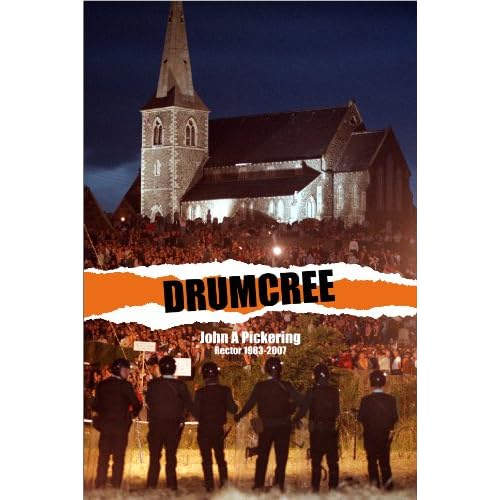
Book Review: Drumcree


The name of a parish church sitting on a hill outside Portadown has become famous across the world, and became one of the landmarks of the post-ceasefire Northern Ireland. Drumcree is famous because the Portadown District of the Orange Order attends Morning Prayer on the first Sunday in July, and that was as far as they were allowed for some years, being blocked and banned from their traditional route back to the County Armagh town via the Garvaghy Road.

The first Drumcree dispute was in 1995, with the stand off lasting for several days, until the parade was permitted on 11th July. During the stand off, main roads across Northern Ireland were blocked, and there was the threat of electricity supplies being turned off at Ballylumford. Something similar happened in 1996, with a stand off until the 11th. In 1997, the parade was immediately permitted following the church service, although trouble later flared in nationalist areas of Northern Ireland. Since 1998, the Orangemen have been prevented from returning along the Garvaghy Road, and the district is still symbolically remaining 'on the hill' at Drumcree. Indeed, today is 'Drumcree Sunday.'

As well as the Orange aspect of things, the political negotiations involved have been continuing, both through and despite the Parades Commission. Most recently, the First Minister has offered to meet both the Portadown District and the Garvaghy Road Residents Coalition. Away from these aspects of the dispute, however, there have also been pressures brought on the parish and rector of Drumcree by the Church of Ireland General Synod, and also by the former Archbishop of Dublin, Walton Empey.

Synod resolutions were passed calling on the Rector, John Pickering, to ban Orangemen from attending morning worship, thus (by their logic) removing the problem. Empey even went as far as to suggest that John Pickering could be sacked if he refused to obey the Synod, which was manifestly not true.

Much ink has been spilled and many books written about the Orange Order, and in particular, the Drumcree standoff. Recently released, however, is the insider view, from the pen of the Rector himself, following his retirement in September 2007. John kept scrupulous notes and notebooks as well as press cuttings from the years of dispute, and has collected them together to tell the story of Drumcree from his perspective. As well as the news events, the book opens us to life in a rectory, and the normal highs and lows of parish ministry. John then takes some time to reflect on the key issues at hand - those of Civil Freedom, Religious Freedom, The Church of Ireland, the media, and his own role in the situation.

Certainly not an easy place for parish ministry, with the focus of the world's media, and no support from a sizeable proportion of the wider Church of Ireland. Yet John displays grace and humility as he recalls the events, and reveals his principled stand rooted in God's faithfulness. By listening to him, we may even see a way forward for the future.

Saturday, July 04, 2009

Independence Day

The 4th of July is the Day of Independence for Americans, but seven years ago, it was also our Independence Day. In 2002, our graduation from Queen's was on this very day.

Don't we look well?! The photo wasn't great, and the scan hasn't helped much, but this was David and myself before we graduated in the Whitla Hall at Queen's University Belfast, having completed our BA (Hons) in Politics.

Thinking about Indepedence Day, though, makes me wonder about it all. Americans are justly proud of their rebellion against the British, to make them an independent nation, and many countries mark important dates in their history. Indeed, July is quite a bit month, with Independence Day on the 4th, the Battle of the Boyne on the 12th, and Bastille Day on the 14th. But are we right to celebrate independence?

Surely independence is at the root of all our sin - not needing God and his commands, just going our own way? To celebrate this form of independence is to turn our back on God, the most grievous thing that can be done in all creation.

The good news is that Jesus died to take the punishment for our rebellion, and that we can be welcomed in by God, turned around, and brought to a right dependence on our Creator and provider, even God our Father himself. Independence? No, give me dependence any day!

Friday, July 03, 2009

Saints Alive!

Today's big news has been the imminent beatification of Cardinal John Henry Newman. That doesn't mean that he's having a make over (beatification, not beautification), but rather has passed one step closer to being recognised as a saint by the Roman Catholic Church. The news has been welcomed by Ruth Gledhill, Archbishop Cranmer, and others.

Ruth Gledhill has also happily included an in depth look at the stages to sainthood, just in case you're tempted to want to become a Saint.

Step 1: Die

Step 2: A cult is formed for the cause of sainthood.

Step 3: An investigation into the life of the candidate - if sufficiently holy, then the title Venerable is awarded.

Step 4: Have done miracles, either in your lifetime, or through your intercession, in which case, you'll be beatified.

Step 5: Perform a second miracle, and you'll be canonised as a Saint.

Step 6: Die as a martyr and you can skip the miracles bit.

So there you have it, the way to be a saint in the Roman Catholic Church. The question is, what's it all about? What's the point of it? You see, the Bible talks about saints, but the Bible is talking about something completely different.

So, just for comparison's sake, here's the in depth look at the stages to become a biblical saint:

Step 1: Trust in Jesus Christ.

Step 2: There is no step two. All believers are saints!

It's true. Paul writes to 'all the saints who are in the whole of Achaia' (2 Corinthians 1:1), 'to the saints who are in Ephesus' (Ephesians 1:1), 'to the saints in Christ Jesus who are at Philippi, with the overseers and deacons' (Philippians 1:1), 'to the saints and faithful brothers in Christ at Colossae' (Colossians 1:2), and to those 'called to be saints' in Rome (Romans 1:7) and Corinth (1 Corinthians 1:2). Paul isn't writing to dead people already in heaven - what would be the point? Rather, he is writing to Christians living in the world, who are very much alive. All believers are saints! All believers are already saints, without the proclamation of popes or councils.

As to the stuff about praying to (or even through) Cardinal Newman, well, what's that all about? There is only one mediator between God and men - the man Christ Jesus (1 Timothy 2:6). Why pray to someone else when the Lord is always ready to hear our prayer? Is it a sign of humility, not wanting to trouble the boss? Nonsense - God our Father delights to hear our prayers. Is it a sign that we don't think the Lord can help us, or that he would be unwilling unless someone on the inside helped us out? What a sign of unbelief in the Lord's gracious provision!

As the Thirty-Nine Articles states, '... and also invocation of Saints, is a fond thing, vainly invented, and grounded upon no warranty of Scripture, but rather repugnant to the Word of God.' (Article 22) There are no first class Christians and second class Christians. All believers are similarly sufficiently saved, and are all equally under no condemnation.

If you are a Christian, you are a saint, without any need of the pope's promulgation, nor anyone else. Take the word of God to heart, which declares you forgiven, sanctified, justified, and set apart as holy unto the Lord, as a saint, a child of God and an inheritor of his Kingdom.

- Saint Gary.

If In

Moving on to a batch of I songs. Back at the start, we did a batch of I, so we're onto the if's and in's.

If - YFriday
If God Be For Us - Handel's Messiah
If I Have Not Love - Matt Redman
If Only - Amy Studt
If There's Any Justice - Lemar
If You Come Back - Blue
If You're Not The One - Daniel Bedingfield
In All The Right Places - Lisa Stansfield
In Christ Alone - Margaret Becker
In Christ Alone - Newsboys
In Christ Alone - Summer Madness
In Da Club - 50 Cent
In My Arms - Mylo
In Pursuit of Happiness - The Divine Comedy
In The Hall of the Mountain King - Grieg

Favourite in this section is In Christ Alone by Newsboys. Best version of the three on my iPod of one of the songs from our wedding!

Thursday, July 02, 2009

Peter's Gospel Mission

Has revival broken out at the heart of the Northern Ireland Assembly? This evening the BBC were reporting that First Minister Peter Robinson MP MLA had unveiled his new Executive Ministers following a DUP cabinet reshuffle. They also reported that Robinson has called for his colleagues to spread the gospel. Great stuff, you say, but the quote didn't end there. The First Minister, a parishioner of the Whitewell Metropolitan Tabernacle, isn't sending out apostles to preach the Kingdom of God, but rather the Kingdom of Peter and Martin. The new DUP ministers are being sent out to preach the gospel of devolution.

Following the major disappointment of the European Election, where Jim Allister of the TUV took a substantial number of votes from Diane Dodds, the fear is that many unionists are turning their back on the DUP and therefore on the Assembly. Peter is sending out his heralds to declare the good news of the kingdom of devolution, so as to defeat the "wreckers" who are trying to destroy the power-sharing Assembly.

Archbishop Cranmer, when not battling Facebook, is always interested in politico-religious matters and religio-political matters and so my ears pricked up immediately with this news. Indeed, it would be easy to see the religious elements of the First Minister's crusade. At one time this Peter was opposed to any elements of powersharing. It is hard to know when he was converted, but in a Damascus Road moment, Peter and his fellow apostle Ian led their party into the newly formed Executive. Having been converted, in a complete turn around, Peter now wants other unionists to share his vision of political ecumenism and has sent out his devolution evangelists to the ends of the province. The question is, will this word of Peter be as sure and as successful as the Gospel of our Lord Jesus?

One thinks not. But it's interesting to see the use of religious language in the political sphere.

Book Review: The Deliberate Church

There has been a flood of books on the church in recent years. From the Purpose Driven Church, to Liquid Church, to Emerging Churches, to Contagious Churches, to Cell Church, and the Provocative Church, you can have any type of church you like, and probably far more - this was just a selection from the books on my shelves.

So what's different about The Deliberate Church? Isn't it just another type of gimmicky church built around what we want? Well, no. Building on the Nine Marks of a Healthy Church, Mark Dever and Paul Alexander lay out the road map for taking a church from a single pastor who does everything, to being a biblical church which is healthy, and functions for the glory of God and the extension of his Kingdom.

Rather than being another program of church growth, Dever urges us to return to the Word, to let the Word of God build and shape the Church of God - in everything, not just in some elements. As part of this, he urges that the classical definition of church is not sufficient: a faithful gathering of men where the word is truly preached and the sacraments duly administered. Rather, to these he would include the practice of church discipline.

On this matter, he urges for strict and definite boundaries concerning who is a member of the church or not. He recommends interviews and a unanimous vote by the elders before anyone is welcomed into church membership. New members are also made to sign a covenant of membership which governs their conduct as a member of the church. These steps are recommended so as to be sure of who is a member, and to make sure that they are truly converted before becoming members, so as to not bring public disgrace on the witness of the church through having unregenerate members, and so as to be sure of who is included in the pastor's remit, as he will be answerable for them on the Day of Judgement.

While I can see some benefits in what he says, the situation is more complicated in a 'traditional' or 'mainstream' church such as the Church of Ireland. Church Discipline is, as far as I can see, few and far between.

Further, he recommends the extension of the staff team over time to include pastoral assistants, assistant pastors, associate pastors and other interns. This seems to me to be the American way of building superchurches, which I'm not convinced is the way to go - much better a smaller church where everyone can know each other and be supported.

All in all, some of his recommendations seem way out there, and based as much in his American culture, and not really applicable in the Northern Ireland context of ministry. The book is useful, though, as something to stir us up to think through what we do and why we do it, as well as returning us to the Bible to see what God says on his church. Deliberate on the Deliberate Church - it will serve you well!

Wednesday, July 01, 2009

The Somme

Ninety-three years ago today, almost a generation of my countrymen, many of whom were probably younger than myself, were wiped out in one action. The action was the Battle of the Somme, as the 36th (Ulster) Division attacked the German lines by the river Ancre and Thiepval Wood.

The men and boys had signed up to the war effort so readily. In the midst of the constitutional crisis of Home Rule for Ireland (a form of devolution), the Ulstermen sought to prove their loyalty to the Crown and thereby avoid Rome Rule. However, they could never have foreseen the disaster that was to befall them as the generals and commanders urged men to run across no mans land to attack the German trenches. Some made it, but many more were cut down in their prime by the established German snipers and artillery. Whatever gains were made came at such a high price, and in the end, had to be given up as they hadn't the strength of numbers of soldiers to retain the hard fought possession.

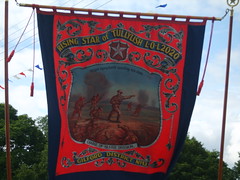
An Orange banner from Dollingstown's Wickliffe's Invincible Morning Star LOL 62 says it all: Every House Mourned. Such a tremendous sense of loss through the province, given that 5500 men died on that one morning, as well as injuries and other losses throughout the war. It had a profound effect on the unionist community in Ulster (and what later became Northern Ireland), to the extent that church bells will toll the funeral toll this morning, and Union flags will be flown at half mast, then raised to full mast tomorrow in memorial.

Among the fallen, one man stands out - Private William McFadzean. He didn't even survive to see the attack, being blown to bits before it happened, and yet he received a posthumous Victoria Cross.

For most conspicuous bravery near Thiepval Wood, on 1st July 1916. While in a concentration trench and opening a box of bombs for the distribution prior to an attack, the box slipped down into the trench, which was crowded with men, and two of the safety pins fell out. Pte McFadzean, instantly realising the danger to his comrades, with heroic courage threw himself on the top of the bombs. The bombs exploded, blowing him to pieces, but only one other man was injured. He well knew his danger, being himself a bomber, but without a moment's hesitation he gave his life for his comrades.


Today we give thanks to God for the great sacrifice of the Ulster Division, and recall their death so that we can live.