As we approach our Psalm tonight, we’re faced with a big question. Who is it that David is talking about? Even a quick scan of the Psalm tells us that the person in question is king, priest and judge. Who could this be?
The three job titles might lead us to think that the person will be very important, very great. And if we consider the very first words of the Psalm, we’re struck again by the greatness of the person in question. ‘The LORD says to my Lord.’ Who is this Lord, ‘my Lord’ that the LORD God speaks to?
Have you ever noticed the words above the Psalms? Not the words in bold which the ESV has – these are a summary of the Psalm, added in by the publisher. The words in capital letters – so, for example, in Psalm 110, we see ‘A Psalm of David’, or if you look back to Psalm 109 ‘To the choirmaster. A Psalm of David.’ These are a key element of the Scriptures, having been preserved with the text.
So this is David talking. David, the king. David, the chief over Israel. And David refers to someone else as ‘my Lord?’ Who could this be? In a sense, it’s like the Players’ Player of the Year Award. Each year, the footballers in the English Premiership vote among themselves about who they think was the best player of the year. It’s one of the many player of the year awards, but perhaps this one is best regarded, because it is voted by their colleagues. Christiano Ronaldo is the current holder. Here in Psalm 110, David the King is recognising a king who is much superior to himself.
From the earliest times, Psalm 110 has been regarded as one of the Messianic Psalms. These are the Psalms which specifically look forward to the Messiah, to the Christ, the king who was to come. As we consider this Psalm more carefully, we’ll see glimpses of the Messiah’s greatness, and also his work. We’ll also see how this Psalm was taken up and used by the apostles to understand and explain how Jesus is the Christ.
Firstly, we see the Messiah as King. In our Psalm there are two great oracles, or declarations from the LORD God (capital letters) to the Lord. We find the first in verse 1. ‘The LORD says to my Lord: “Sit at my right hand, until I make your enemies your footstool.”’ The Messiah is told to sit on the right hand of God. This is the position of authority, delegated authority. The king, sitting at the right hand, is to reign in the authority of the LORD.
The purpose of the reign is to conquer his enemies, but notice that God will do it! ‘…Until I make your enemies your footstool.’ What a picture that is. No longer will the king’s enemies stand in opposition, but they will kneel before him, to be used as a footstool.
But until that happens, we see the reign of the king in verses 2 and 3. ‘The LORD sends forth from Zion your mighty sceptre. Rule in the midst of your enemies.’ I don’t know if you have seen pictures or footage from the coronation of Queen Elizabeth. During part of the service, she was presented with various symbolic items to show that she was reigning. There was the crown, and the orb, and the Bible. But another one was the sceptre.
The sceptre is the symbol of authority, and here we see that it is sent forth from Zion. Despite the presence of enemies, God’s king will reign.
As we look at verses two and three, we notice two different types of people. In verse two, it’s the enemies, but in verse three, we find the king’s people. In contrast to the opposition, these people ‘will offer themselves freely on the day of your power.’ These are not conscripts, but are willing volunteers, the glad surrender. Look also how they are dressed. ‘In holy garments.’
Two types of people. Some gladly surrender to the King, freely offering themselves to him. Others refuse, becoming his enemies. And the question tonight is this – in which group of people do you stand? Are you part of the freewill offering to the king, or are you one of his enemies?
[As the king reigns, he will be sustained, and fresh, and youthful – having the dew of his youth.]
This is what David says of his Lord, of the king who will come. Now, who was it he was speaking of? The consistent Jewish hope was that the Messiah would come. He would be the Son of David, the one whose kingdom would never end. Great David’s greater Son.
If you know your New Testament, you’ll perhaps have recognised these verses already. Looking from this side of the death, resurrection and ascension of Jesus, it is obvious who these verses speak of. You might be aware that Jesus uses the first verse to challenge the Pharisees in the days leading up to his death.
In Matthew 22:41-46, Jesus asks them how David’s son can be the Christ, if David calls him Lord. It pulls them up short. They weren’t able to answer. They just can’t see how a son of David can be greater than David. Yet it’s clear that Jesus says that this is a prophecy of the Messiah. How can it be? Well, David, in the Holy Spirit, prophesying, sees one who is king, greater than him, on an entirely different level – in a different league. Yes, David was the king of Israel, but he sees one who is his King, his Lord, to whom he gives his allegiance.
The New Testament writers repeatedly use this verse to point to Jesus, the one seated on the right hand of the Father, risen, ascended, glorified. We find it in Romans, Ephesians, Colossians, Hebrews and 1 Peter. Jesus is the king, David’s Lord, who sits at the right hand of the LORD, and will reign forever.
As we move on, though, we find the second divine oracle in verse 4. Remember that in Israel, the offices of king and priest were separate. The king was originally (in Saul’s case) part of the tribe of Benjamin, and then of the tribe of Judah, but the priest was of the tribe of Levi, the sons of Aaron. Yet here, the LORD God declares (with an unbreakable oath), that this Messiah, this king to come, ‘You are a priest for ever after the order of Melchizedek.’
As well as being a king, the Messiah will also be a priest. That is, one who offers sacrifice on behalf of the people, and who intercedes for them, as well as the one who represents God to the people. There’s that double mediatory role. So what does it mean when it says ‘after the order of Melchizedek’?
Turn with me to Genesis 14 (page 12). This is the only time we encounter this man called Melchizedek. Abram (Abraham) had gone to battle to rescue Lot from Cedoalaomer, king of Elam and the kings who were with him. Having defeated the kings, Abram meets this Melchizedek, who brings bread and wine. Now, we expect that Abraham, the great father of the people of promise would be the greater of the two, but it’s actually Melchizedek who blesses Abram, and receives a tithe from him.
So who is this mysterious figure? Melchizedek is the king of Salem (which means king of peace), and his name means ‘king of righteousness’. And Genesis 14:18 tells us that he is priest of God Most High. Now flip with me over to Hebrews 7. Perhaps you’ll read this chapter later when you get home. There, the writer takes time to establish that Jesus is the priest after the order of Melchizedek, having become a priest ‘not on the basis of a legal requirement concerning bodily descent, but by the power of an indestructible life… (thereby) a better hope is introduced, through which we draw near to God.’ (Heb 7:16, 19)
Jesus is a better priest than Aaron because of his indestructible life. Jesus lives, and so his priesthood, his ministry of intercession for his people continues. God will not change his mind nor his oath. Jesus continues, therefore our hope is secure.
In verses 5 to 7, you might notice a change. In verses two to four, David is speaking to his Lord, to the Messiah-king who is also the priest. Look carefully at the opening words of verse 5. ‘The Lord is at your right hand.’ This is Lord in small letters, not capital letters LORD. So David is now speaking to the LORD God, and describing what his Lord will do.
So far the Psalm has presented the Messiah as the king and the priest. Here, in these closing verses, we see the Messiah as the judge. Here is what he will do. ‘The Lord is at your right hand; he will shatter kings on the day of his wrath. He will execute judgement among the nations, filling them with corpses; he will shatter chiefs over the wide earth.’ (5-6)
The kingly Messiah will have a day of wrath – ‘the day of his wrath.’ Earlier in the Psalm, the Messiah was told to ‘Rule in the midst of your enemies.’ His enemies were still living in opposition to him. But there will come a final day, the day of his wrath, when all opposition will end. One of the great hopes of the Old Testament is the looking for the Day of the Lord. On that day, there would be peace for God’s people, and final defeat for the enemies of God’s people. Here we see that it is the Messiah who will accomplish this. Jesus Christ will be vindicated, and his enemies will be shattered. Have you ever seen a shattered window? I remember one time I was on a bus, and one of the windows was shattered. It was good for nothing then. It was finished. This is how it will be for those who stand in opposition against Jesus.
Friends, this is not something that the world wants to hear. It may even be something that we don’t want to hear. Many think that they can merrily go their own way, without consequence, and do what they wish. Yet here we see plainly that God’s word declares that this Messiah, the king, the priest, is also the judge, and that there is coming a day of judgement. How terrible to be found wanting on that day.
In verse 7 we see a picture of that peace and vindication for the Messiah, as he shatters kings and chiefs over the wide earth. Along the way, he will be refreshed by drinking from the brook. That brings to mind the drink at the brook for the men of Gideon, when just 300 were chosen to face the Midianite army. Again, there’s the reminder that the battle belongs to the LORD. As a result, therefore he will lift up his head, in victory.
So what can we take away with us tonight? What is the impact of God’s word in Psalm 110? The first thing to be clear about is the person in view. We may have been unsure at the start, but by now, we know that the Messiah in question is our Lord Jesus. He is who the Psalm is about.
Perhaps you’ve been a Christian for a long time, or even a short time. Hopefully you will have seen more of the work of Christ in this Psalm. Too often we can be satisfied to depend on wee summaries of who Jesus is, and what he has done for us. Yes, Jesus is the Son of God, but he’s much more. He’s our king, our priest and our judge. We haven’t had much time to get into these, but maybe you’ll explore these further through the week.
Or maybe you recognise that you are one of Christ’s enemies. You haven’t trusted in him, and are content to go your own way, hoping that there are no consequences to your action. In Acts 2, Peter speaks to the crowd in Jerusalem on the Day of Pentecost. His theme is how Jesus is the Christ, and he uses the opening words from our Psalm to illustrate that Jesus lives, and sits on the right hand of the Father. Here’s what he says: ‘Let all the house of Israel therefore know for certain that God has made him both Lord and Christ, this Jesus whom you crucified.’ When the crowd ask how what they should do, Peter’s answer is clear: ‘Repent and be baptised every one of you in the name of Jesus Christ for the forgiveness of your sins, and you will receive the gift of the Holy Spirit.’ (Acts 2:36, 38)
Will you bow the knee tonight, and name Jesus as your king?
Monday, September 15, 2008
Thursday, September 11, 2008
Sermon Audio: Psalm 109
Through the week we've realised that the google mp3 player I had been using both here and on the St Elizabeth's sermon page doesn't seem to work for Internet Explorer visitors. We've now switched to the Yahoo player, which will hopefully work better to stream the sermons through both blogs. Below is my latest sermon, from Sunday night. Apologies for the loud bangs - we were experiencing some technical difficulties with the radio mic and had to change halfway through the sermon!
Download this sermon
Download this sermon


Tuesday, September 09, 2008
Neon Socks!

Neon Socks!
Originally uploaded by Gary McMurray.
Last Friday I had a mini-meetup with a Flickr buddy. MacBern has an amazing photostream, and you should definitely check it out. After a dander round St George's Market and then a look round St Anne's Cathedral in Belfast, I took her out to Dundonald to show her the interior of St Elizabeth's. Got some nice photos, which you can see at my Flickr - if you've never seen what the inside looks like yet!
The photo above, however, was my photo of the day. This was on a stall over in the corner, and the colours are so bright and clashy! I'm thinking that these socks would be useful if you were getting dressed in the dark. Someone asked on Flickr which pair I had bought. None, yet - any ideas?
Could it unleash a cyberpunk or cybergoth or whatever streak in me? Probably not!
Monday, September 08, 2008
Crying for Help - A sermon preached in St Elizabeth's Dundonald on Sunday 7th September 2008 - Psalm 109
Sticks and stones my break my bones but names will never harm me. Would you agree with that? We find that words have a way of getting under our skin, especially the hateful, spiteful words intended to harm us. How do you respond when people are nasty to you? Or when they go out of their way to make your life miserable? It might be hard enough if it is people we barely know, but what if it is our close friends?
In our Psalm this evening, David is under attack. He has been the victim of an attack – not physical, but verbal. Lying lips surround him, wicked and deceitful mouths are opened against him. But what makes it harder to bear is the fact that they are his close friends who are attacking him. These are people he knows well, and they have turned on him.
Notice, first, that the Psalmist starts in the right place, with the initial cry in verses 1-4. From the outset, he knows who he is addressing, as he cries out for help. This is the God of my praise. The one that he has cried out to before, the one who is worthy to be praised. And what is it that the Psalmist wants God to do? ‘Be not silent.’ It was bad enough that the evil men were surrounding him with lies and evil words, but then it seemed as if God were silent. The crown on the assault. Voices of hate around him and silence from God.
The argument is saying – look, if they’re speaking all this evil against me, will you not speak up in my defence? Speak and act to prevent this assault. As we’ve already thought about, the ones who attacked him were his closest friends. Look at verses 4 and 5 – there’s a frustrating exchange going on there. ‘In return for my love they accuse me … so they reward me evil for good, and hatred for my love.’ He keeps giving and giving and giving good and love, while they pour out accusations, evil and hatred.
Yet in the midst of all that is going on, ‘I give myself to prayer.’ The NRSV expands this to say ‘even as I make prayer for them.’ It’s this sense of seeking their welfare, even while they attack him.
But if this is the case, then how do we understand the central section, verses 6-20. The psalm quickly changes from third person to second person – from ‘they’ to ‘him’. As we read the psalm, the requests can seem brutal or barbaric. Even a quick scan shows the brutality – ‘may his days be few … may his children be fatherless and his wife a widow … may his children wander and beg … let there be no one to extend kindness to him, nor any to pity his fatherless children.’ What do we make of this passage of Scripture?
Verse 6 brings to mind the image of a court. The Psalmist wants his attacker to be tried for his actions. He wants his day in court, and for a guilty verdict. Do you see in the second half of verse 6 – ‘let an accuser stand at his right hand’ – an accuser is the word ‘Satan’. A friend’s wife is training to be a barrister in Dublin, and her position at present is ‘a devil’ – one who files motions and appears in court to argue cases for their barrister.
This serves to remind us of what the devil’s business is. Satan is, according to Revelation 12:10 ‘the accuser of our brothers and sisters.’
For some, it is unseemly for David to have expressed these words. So, for example, the NRSV inserts two extra words into verse 6 to make it ‘they say …’ The long litany of doom is then presented as the words of his attackers. The ‘him’ is then David. This seeks to make sense of the change of person, up to verse 19, but even then, verse 20 is presented as the words of the Psalmist, in seeking to turn all these things back on the accusers.
But the Psalm lacks the two words ‘they say.’ So how can we presume to include them? We should always be careful to sit under Scripture, listening to it, not sitting in judgement over Scripture, imposing our own standards.
It seems to me that the words of verses 6 – 20 must be seen as the heartfelt condemnation of the guilty. This is the cry of the oppressed. In at least one instance, God is seen to honour this very cry. Turn with me to Acts 1 (page 1095). It’s the ten days between Jesus’ ascension and the outpouring of the Holy Spirit on Pentecost. The Twelve have become the Eleven, with Judas’ suicide.
Peter clearly links the words of our psalm with the situation of Judas. Look, more than that, he states ‘Brothers, the scripture had to be fulfilled, which the Holy Spirit spoke beforehand by the mouth of David concerning Judas, who became a guide to those who arrested Jesus… For it is written in the book of Psalms, “May his camp become desolate, and let there be no one to dwell in it”; and “Let another take his office.”
David is seen to have prophesied the betrayal of Judas and his subsequent removal from his privileges. This is why we cannot see it as the curses of David’s attackers coming down on his head.
It is clear that the feelings are very strong for the Psalmist. His desire is for vengeance and justice for his cause. The strong calls for punishment are based on the immorality of the people involved. Look at verses 16-18. Here we have a string of evil practices, deserving justice. Failure to show kindness, and instead exploiting and persecuting the poor and needy. Clothing himself in cursing.
Notice the downward spiral in 17. ‘He loved to curse; let curses come upon him! He did not delight in blessing; may it be far from him!’ David is praying here that the natural consequences of his enemies’ life be fulfilled. So that if we are bitter and resentful, then we’ll become more bitter and more resentful. Or if we spend our life in cursing others, then we will in the end, be cursed. CS Lewis once wrote that those in hell are those who have consistently said to God, ‘my will be done’, and God has honoured their wish. We must be careful of the patterns we put in place in our own lives. (Galatians reminds us that what a man sows, that shall he reap).
We’ve been thinking about the string of evil practices committed by the attacker. No doubt these are sins that are deserving of punishment. But the question is – should we follow in the footsteps of the Psalmist? When we are the victims of attacks, should we recite these curses against them?
How does it all fit with the command for us to ‘bless those who persecute you: bless and do not curse them’? (Rom 12:14). Well, we have to view the Psalm through the lens of the cross. Things are not the same. Jesus has dealt with sin, and even while he was being crucified, he did not revile – he was silent like a lamb before its shearers. Rather, he prayed ‘Father, forgive them, for they know not what they do.’ (Luke 23:34).
As a result of the cross, the Day is coming when God will finally deal with sin, on the great Day of the Lord, which we were thinking about this morning. As Peter writes in his second letter, ‘The Lord is not slow to fulfil his promise as some count slowness, but is patient towards you, not wishing that any should perish, but that all should reach repentance.’ (2 Peter 3:9). On that Day, God will punish sin, all sin, and justice will be seen to be done.
And in the meantime? We have a mission. Our task is not to call down judgement on our oppressors, but rather to call our oppressors to escape the judgement – to pray for them to be saved. How much harder this is, than to call down fire and brimstone on them – yet it is not our job to judge. In this matter, we must let God be God – who will surely punish sins.
Rather, with the Psalmist, we should flee to God, looking to him to save us. Notice that from verses 21 on, David returns again to God. He knows that God will act ‘for your names’ sake’. His focus moves from his accusers to himself, to his God. Twice he reminds himself of the Lord my God’s steadfast love, calling on God to act according to it.
And what will it look like when God acts for his servant? ‘Let them curse, but you will bless!’ Despite all the words of his accusers and his attackers, despite their lies and words of hate, God will have the last word. Rather than heeding the curses, God pours out blessings on his servants. This is why, in the end, we have nothing to fear, if we are trusting in the Lord Jesus. He has the final word.
It doesn’t matter what the devil accuses us of – if we are trusting in Jesus, our sins are wiped out, paid by the death of Christ on the cross, and we are granted a clean slate. We thought about this earlier today, in 1 Corinthians, when we were reminded that the church of God is a holy church, sanctified in Christ Jesus.
So let the devil accuse us, or our enemies hurl curses at us – ‘let them curse, but you will bless!’ I’m reminded of Balaam in the book of Numbers. Balaam was a diviner, one who, for a fee, would bless or curse. Barak, the king of Moab, was afraid of the Israelites, who had come out of Egypt, and were on their way to the Promised Land. So he brought Balaam along, promising great wealth if he would curse Israel. Three times, Balaam begins a prophetic speech, but can only bless Israel, time and again. Here’s just a few words from his first oracle: ‘From Aram Balak has brought me, the king of Moab from the eastern mountains: Come, curse Jacob for me, and come, denounce Israel! How can I curse whom God has not cursed? How can I denounce whom the Lord has not denounced?’ (Numbers 23:7-8).
If you’re trusting in Jesus tonight, then this could be spoken of you. God’s verdict of you is one of blessing, not one of cursing. There is now no condemnation for those who are in Christ Jesus (Romans 8:1). Oh how we need to revel in these glorious words! Spend some time in Scripture this week drinking in the wonder of God’s word towards you. Blessing, not cursing.
Building on this theme, as we come to the last couple of verses, we see that not only does the Lord bless those who serve him, he also stands with them. Verse 30 is the pledge of the saved – to sing and praise the Lord, giving him thanks and praising him in the midst of the throng. (Worship is a corporate activity!)
Why this outburst of praise? ‘For he (the Lord) stands at the right hand of the needy, to save him from those who condemn his soul to death.’ Earlier we saw in verse 6 the accuser, the Satan, standing at the right hand. Here, there’s no room for the accuser, because the Lord stands at the right hand of the needy.
While we can perhaps see the reason behind the outpouring of curses in verses 6-20, we do better to flee with the Psalmist to God when we are under attack. By doing so, we find the Lord’s protection, we hear his word towards us, and we know the Lord is with us. And, in the end, we can leave our attackers in his hands – praying for them, so that perhaps the Lord will have mercy even on them.
a
Friday, September 05, 2008
Follow, Follow
Recently Blogger announced another new feature. Now you can 'follow' blogs, with the Following feature. I'm not really sure where they're going with this one -to me it seems to be a weaker version of Google Reader. I certainly won't be adding the gadget showing my followers on the blog. If I get any!
If you would like to be kept up to speed with the latest updates on the site (or indeed on any site), then Google Reader is the way to go. Sign up with your Google account and that's it sorted. Just remember to keep visiting the site too!!!
If you would like to be kept up to speed with the latest updates on the site (or indeed on any site), then Google Reader is the way to go. Sign up with your Google account and that's it sorted. Just remember to keep visiting the site too!!!
Thursday, September 04, 2008
Outdated Preaching?
For quite a while I've been reading Irish Calvinist. This guy talks a lot of sense. One of his latest postings is an incisive analysis of the claim that preaching as a form of communicating a message is outdated. Well, if that's the case, then how come the USA Presidential Race depends on the same style for its message? Read it and be encouraged to continue to preach the word.
Wednesday, September 03, 2008
Sermon Audio: Luke 8:40-56
The end of our mini series in Luke's Gospel, here we consider the importance of faith for Jairus and the woman who caused an interruption.
Download this sermon here
Download this sermon here
Sunday, August 31, 2008
Go In Peace! A Sermon preached in St Elizabeth's Dundonald on Sunday 31st August 2008. Luke 8:40-56
How do you cope with interruptions? If you’re in work and you’re waiting to speak to the manager, then someone else butts in just as he’s about to help you, how do you feel? If you’re anything like me, you can be slightly impatient at times. But as we’ll see, for Jesus, there is no such thing as a distraction or an interruption. Rather, what seems like a distraction is in fact the opportunity for a troubled woman to receive his peace and his wholeness.
If you were with us last week, you’ll remember that Jesus had crossed the lake of Galilee with his disciples, calming the storm on the way. On the other side, he had met the man named Legion, afflicted with many demons. But when Jesus had healed the man, the people of that region were afraid, and asked Jesus to leave. Imagine it, asking Jesus to get out of town!
What a contrast to the scene when Jesus crosses the lake again. The crowds are standing waiting on him. They’re glad to see him. And no one more so than Jairus. He’s the first of two people Luke introduces to us in the passage today. Jairus, we read, is an important man in the local community. He is a ruler of the synagogue, so he’s a religious man, responsible for services, inviting people to speak and read the Scriptures. But despite his lofty position in the community, he falls at Jesus’ feet, begging him to come to his house. His situation is a truly awful one – his only daughter is dying. Such a young life, aged about twelve years of age.
Perhaps he had watched out especially for Jesus’ return – his situation was desperate. Even the going for help would be agony, away from his daughter. Jesus agrees, and sets off, following Jairus to his home. The crowds come too, pressing in.
But then, suddenly, Jesus stops, and asks who touched him. Can you imagine it? There’s a huge crowd of people around, and Jesus wonders who touched him. Probably one of the biggest crowds I’ve been in was 80,000 people after a football match between the Republic of Ireland and Brazil earlier in the year. One of the guys in college got us tickets for it, and off we went. Never have I seen so many people – leaving the stadium, it was as if your feet weren’t even touching the ground – carried along by the crowd.
So when Jesus asks who touched him, Peter almost tells him to wise up – of course he’s going to be touched, when the crowds surround him, and are pressing in on him. But Jesus doesn’t relent. “Someone touched me, for I perceive that power has gone out from me.”
As we read the passage, we already know who it was had touched Jesus. The woman is the second person Luke introduces in the passage. If you were looking for a complete opposite to Jairus, then this is it. Jairus was a man of standing in the community. The woman was probably an outcast. Jairus was a religious man, observing the Law read and preached in the synagogue. The woman probably hadn’t been to the synagogue for years. You see, her discharge of blood made her ceremonially unclean. Jairus was probably a man of means, financially secure. The woman, on the other hand, had spent all her money on doctors bills, getting second opinion after second opinion, but without success or cure. Notice, even, that Jairus is named, whereas the woman is simply described as ‘a woman.’
The woman had thought that if she could just touch the edge of Jesus’ garment, then she would be all right. That’s exactly what happened, verse 44 – immediately her discharge of blood ceased. Perhaps she thought she could touch Jesus and go, slip away into the crowd again. But that’s not what Jesus plans.
He knew that power had gone out from him, that the woman had been powerfully affected. Eventually the woman realises that she can’t remain hidden, and – full of fear – trembling, declares what had happened. Notice that she appears in the same position as Jairus had done earlier – falling down before him. What a powerful testimony of what Jesus had done for her – her life changed around, and made whole again.
But more than that – the people who knew this woman would have known about her affliction. They would have known her shame at being ceremonially unclean all the time – this had gone on for twelve years. Being forced to come and tell was the way that she could be received back into the life of the community. Jesus was being kind to her as well, when he brought her out to tell of what he had done.
Look at verse 48. These are Jesus’ words to her: “Daughter” - This is the only person that Jesus describes in this way – daughter – a word of tenderness and compassion. But his next words are words that we have encountered before. “Your faith has made you well; go in peace.” If you have your Bible open, look across to the top of the opposite page, to Luke 7:50. Remember the woman who had come into Simon the Pharisee’s house and anointed Jesus’ feet? Jesus says the same thing to her – ‘Your faith has saved you; go in peace.”
While the phrases are translated differently, the Greek words are exactly the same in 7:50 and 8:48. The woman has been saved, made well – this complete word picture of wholeness and healing and salvation suggested by the word. This is the complete salvation that Jesus still offers today - the call is to be saved, and made whole. And how do we achieve this salvation, this wholeness? The answer is the same as ever – only by faith – faith alone in Jesus alone.
One commentator has said that Jesus’ words seek to show that it’s not a superstitious touch or action that saves the woman – but that it is her faith. Obviously today we can’t touch Jesus’ cloak, but we can approach him in faith, taking hold of his promises.
As Jesus has been dealing with the woman, you might have forgotten that this was only a distraction. Remember, he was on his way to the house of Jairus, where the dying daughter lay. But now someone comes from the house to break bad news. The daughter has died. It’s as if the messenger is considerate of Jesus – don’t trouble him any more. There’s not point taking up his time any more, seeing the girl is dead. What the messenger is really saying is that there must be limits to the power of Jesus – as if he could only heal, but not raise the dead. All hope is gone.
Perhaps Jairus was thinking the same. He maybe even thought that it would have been all right if Jesus hadn’t been distracted by the woman. He had been on the way, after all. But look at Jesus’ words to him. “Do not fear; only believe, and she will be well.”
Do you see the key words in this sentence? Where have we found them already today? Believe (literally, have faith) and she will be well (healed, made whole, saved). It’s as if the lowly woman, the outcast, is held up as a sign of faith for Jairus, the ruler of the synagogue.
So when they got to the house, already it was a scene of mourning. Loud wailing – perhaps even professional mourners. A scene without hope. And look what Jesus does – tells them not to weep because the girl is not dead, only sleeping. Instantly their tears turn to laughs – they know better than Jesus – of course the girl is dead!
In the presence of just five other people (parents and Peter, James and John), Jesus takes her by the hand, and says, “Child, arise.” Arise. That’s the same word that’s used of Jesus when he is raised from the dead. Remember that Jesus had said to Jairus to have faith, to believe, and she would be well? It’s as if she has arisen – the word picture becomes more complete for us again – wholeness, completeness, life, salvation, health.
I always find it interesting that Jesus made the woman come forward and tell what had happened, but here, at the end of the passage, he tells the parents to tell no one what had happened. Of course, it would be obvious – for those who were planning a funeral, the girl was up and walking around again. No funeral needed. The testimony was truly alive.
So what can we take away with us today? How will this Scripture impact on us? For me, it reminds us again that all of us need a Saviour, the one who restores, no matter who we are or where we come from. Jairus and the woman were from different backgrounds, social groups, standing in the community. Yet both needed Jesus.
More than that – the only appropriate approach was one of faith. It doesn’t matter if you have been coming to church all your life, or if this is the first time you have been here – the important thing is having faith in Jesus.
Perhaps you have never trusted before. You have your share of shame, like the woman who had been in shame and distress. Reach out today, and take hold of Jesus by faith. If you do, then these words are for you as well – ‘your faith has made you well (has saved you); go in peace.’
Or maybe you’ve been part of the community of faith for a long time. You’ve come to Jesus, you’re trusting in him. But you’re wavering. God seems to be taking his time in coming to your aid. Things are tough, and you see others advancing but you seem to be stuck. Or you’ve been going through a hard time of illness or sadness, bereavement or unemployment. Jesus’ words to Jairus are for you today – ‘Do not fear; only believe.’ Stick in there – keep trusting.
Your faith has made you well; go in peace.
Saturday, August 30, 2008
Black Saturday in Dromore
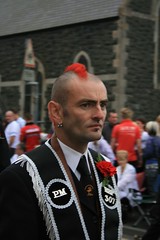
Last of the Mohicans
Originally uploaded by Gary McMurray.
Today was the annual Black Saturday parade, hosted in Dromore for the first time in thirteen years. 120 Royal Black Preceptories from across County Down and from further afield were on parade, accompanied by 100 or so bands. I took a quick race home to see the first parade, and have still loads of photos to upload to Flickr. I'm working through them in reverse order so that eventually, you'll be able to see the pictures in order of the parade.
This is one of my favourite photos of the day. Looks like he is the Last of the Mohicans, from RBP 307 in Newtownards District.
Friday, August 29, 2008
Shining Cross

Shining Cross
Originally uploaded by Gary McMurray.
The other Friday I ended up in Larne, visiting one of my colleagues from college. Martin Hilliard is the new Curate in Larne and Inver, Glynn and Gleno, and he kindly showed me around his churches. Of course, my camera was in tow, and this was one of the shots I took in St Cedmas Church, Larne. It's been good to hear how the other new curates are doing, comparing notes on workload, first funerals and general impressions of the parishes. I wonder where my next visit will be?
Wednesday, August 27, 2008
Sermon Audio: Luke 8:4-21
Following on from my previous sermon audio posting, you'll find below my most recent sermon. This was my first morning preach in Dundonald as Curate, with a bigger congregation than the evening service. The passage we're looking at contains some of Jesus' teaching and parables - the parable of the sower (alternatively the parable of the seed, or the parable of the soils), and an incident when Jesus redefines his family based on obedience to God's word.
080817am Luke 8 4-21 The Family of Jesus - Gary McMurray.mp3
Remember that all the sermons from St Elizabeth's can be found on our new sermon audio blog.
080817am Luke 8 4-21 The Family of Jesus - Gary McMurray.mp3
Remember that all the sermons from St Elizabeth's can be found on our new sermon audio blog.
Monday, August 25, 2008
Endings
I wonder if you're like me. When it comes to near the end of the toilet roll, I'm a bit more careful how I use it, to make it last a bit longer. I only think of it when the end is in sight. Or when I'm driving, and the petrol tank is getting empty, or the petrol light has come on, then I start to drive really carefully to conserve the remaining petrol to get me to the filling station. Again, no thought of it until it is almost too late.
Was thinking of this the other day, and it reminded me of that verse in Ecclesiastes:
Remember also your Creator in the days of your youth, before the evil days come and the years draw near of which you will say, "I have no pleasure in them."
Don't leave thinking about God until you're nearly finished. Do it now!
Thursday, August 21, 2008
New Blog
Just a quick note to say that I've set up a new blog for sermon audio from St Elizabeth's Church, Dundonald. Both morning and evening sermons will be available to listen and download, but we hope it won't be an excuse not to come to meet with us on Sundays!
Monday, August 18, 2008
Sermon Audio
Over the coming months, we're hoping to be able to provide sermon audio from Dundonald. As a test run, here's the mp3 file of my first sermon (as curate) in the parish. Feedback on the sermon, as well as the format will be greatly appreciated.
The sermon was entitled 'A Promising Start' - an exposition of 1 Samuel 11:1-15, looking at the beginning of Saul's reign as King of Israel.
080810pm 1 Samuel 11 A Promising Start Gary McMurray.mp3
The sermon was entitled 'A Promising Start' - an exposition of 1 Samuel 11:1-15, looking at the beginning of Saul's reign as King of Israel.
080810pm 1 Samuel 11 A Promising Start Gary McMurray.mp3
Sunday, August 17, 2008
The Family of Jesus - Luke 8:4-21. Sermon on Sunday 17th August 2008 in St Elizabeth's Parish Church, Dundonald
I wonder how good you are at spotting family resemblances. As some of you will know, we got married last month. Weddings are a time when the families come together, especially some people you haven’t seen for a while. I don’t know about you, but when our family comes together, they start into the comparisons. I have one cousin in particular, who some people think looks a bit like me.
So in our reading today, when Jesus’ mother and his brothers come along, perhaps people noticed some similarities. But when they try to get to see Jesus, they can’t make it – the crowds are too large. Instead, they send a message to Jesus that they are there. They wanted to see him. Maybe they thought they had some priority over the crowds. Jesus would make time for them because they were his family.
Yet what Jesus says may seem surprising, perhaps even rude. ‘My mother and my brothers are those who hear the word of God and do it.’ (8:21) Jesus is redefining who belongs to his family. No longer is it on the basis of human relationships – being born into the right family. Rather, it is on the basis of hearing and doing God’s word.
We’ll see now as we consider the whole passage that this hearing and doing of God’s word is the key. In fact, you could say that the family likeness in the family of God is this very feature of hearing and doing. You’ll remember that in the Letter to the Hebrews, the author spells out how Jesus is our brother: ‘Therefore he had to be made like his brothers in every respect, so that he might become a merciful and faithful high priest in the service of God, to make propitiation for the sins of the people.’ (Heb 2:17)
For Jesus, therefore, the family likeness for his brothers and sisters is to hear and do the word of the Father. But before we look at the passage, we first need to do a hearing test. At the end of verse 8, Jesus cries out ‘He who has ears to hear, let him hear.’ It’s almost like a sound check, making sure that people are listening, and are really hearing him – not just hearing the stories he tells, but actually listening and understanding.
For example, a few months ago I was in
This is precisely what Jesus is talking about when the disciples ask him to explain the parable (of the sower). ‘To you it has been given to know the secrets of the
When you listen to the teaching of Jesus, do you just hear the stories, or are you really hearing – hearing to understand the secrets of the kingdom? How is your hearing?
We see the importance of hearing in the parable of the sower (although perhaps it should be known as the parable of the soils). You’ve probably heard the parable before – the sower sows his seed, with it landing in various places, with the corresponding response.
Some people in the crowd may have thought that Jesus was talking about farming methods, as if he was from the Department of Agriculture and Rural Development. But there’s more going on here than just a story about a farmer. We get the hint in Jesus’ words in verse 8 – let him who has ears to hear, let him hear.
Notice, as Jesus explains the parable to his disciples, that the people represented by the four kinds of soil all heard the word – none can be excused for not knowing or hearing. Look with me at verses 12-15 – look at the repeated pattern in each verse of ‘those who hear (the word).’ All hear – that’s for sure. But not all do. Remember the family likeness we’re thinking of this morning – hearing and doing. It’s not enough to just hear the word of God – we also have to do it, obey it.
Otherwise, then the seed on the path would have been fine. But as we see, the seed, the word, is snatched away. (Notice that the devil will try to take the word away, to stop us from reading our Bibles – there are so many attractive alternatives!). The seed on rocky soil had immediate impact, but also immediate failing when the hard times came, because they weren’t building their life on the word. Or the seed among weeds, which began to flourish under the word, but then was choked by the cares and the riches and the pleasures of life. The Word wasn’t first priority for these people. It got crowded out. It’s easier just to watch TV in the evening rather than reading the bible. We would rather just read a novel or the newspaper, than spend time in our Bibles.
How’s your hearing today? Do you take the time to hear and understand? What about through the week? Do you immerse yourself in your Bible reading to hear God’s word? You could get involved in the fellowship groups when they begin again to share with others in learning and hearing and encourage one another to the doing of God’s word.
Yes, hearing the word of God is so very important. As if to underline that and put it in bold with flashing lights, Jesus says in verse 18 ‘Take care how you hear.’ And we need to take care how we hear, because it is reflected in our doing.
At first reading, it appears that verses 16-17 don’t seem to fit. It’s hard to see what Jesus is getting at. And yet, as we recall the twin themes of hearing and doing, it all makes sense.
Imagine, for a second, that there was a power cut, as there was at home yesterday. Everyone scrambles for the candles, trying to remember where they were left. But when you light them, you wouldn’t hide them down the back of the sofa. No, you would put them in the centre of the room, or up on a table so that everyone can see.
What Jesus is saying here is that when we hear the word, then we really have to do it – we have to obey. If we just hear the word and do nothing about it, then it’s like lighting a lamp and putting it away.
But more than that, if we have heard the good news of the word of God, then we need to pass it on. If we have been lit up by the gospel, then we should be shining so that others can see the light.
Think of Paul’s words to the Colossian Christians, reminding them of what God has done for them. ‘He has delivered us from the domain of darkness and transferred us to the kingdom of his beloved Son.’ (
This is all the more so when we consider verse 17 – we’re to shine, to show God’s word in our doing, because there will come a day when all the secret things will be revealed, and brought to light. It appears that this refers to the secrets of the kingdom (10). While some people are blinded now, there will come a day when all will see Jesus for who he is – the King of Kings and the Lord of Lords. But on that day it will be too late.
This is why Jesus tells us to take care how you hear. You see, some people read verse 18 and think that it’s all about possessions or money or wealth. To the one who has, more will be given, and from the one who has not, even what he thinks he has will be taken away.
But it’s all about hearing the word, and doing it! Here there are two types of people. First, there are those who have, and there are those who don’t have, but who think they do.
The first group are those who have the word of God. These are the people who hear the word, and obey it – like the good soil of the parable. They’re also the people who have heard the word, the light has been lit, and they shine, doing God’s word and telling others.
At the end, when the judgement comes, they will be rewarded with the promise of ‘more will be given.’ Those who delight in hearing and doing God’s word will be given more – they will spend eternity with Him, in close fellowship with Him. They are displaying the family likeness – becoming more like Jesus.
But the second group, well that’s a different story. These people may well have been good churchgoers. They maybe knew their memory verses off by heart at Sunday School. They could quote chapter and verse on any subject. They thought they had God’s word nailed.
But it turns out that they had not. Yes, they had heard the word, but they had done nothing about it. No obedience, just a building up of knowledge, a puffing up of pride. There’s no family likeness in them – they aren’t becoming more like Jesus, and in the end, on that day, even what they think they have is taken away from them.
Friends, this was me. I grew up through Sunday School and church. I was involved in Boys' Brigade, in the choir, and anything else that was going. At BB, I would always win the Scripture Cup. I knew my Bible. I knew about God. But here’s the thing – I didn’t know God. I thought I knew, but I wasn’t living in obedience and faith.
Thankfully the Lord saved me, and my life has been turned around. Hearing and doing God’s word is not easy – it’s so much easier to go with the flow with the world around us. But in the end, it doesn’t profit to go with the flow. Rather, we need to ‘hear the word, hold it fast in an honest and good heart, and bear fruit with patience.’
We’re called today to hear, to truly hear God’s word. But not just to hear, we’re also called to obey – to do it. Remember the words of James – ‘But be doers of the word, and not hearers only, deceiving yourselves.’ (James 1:22).
Why not take a hearing test this afternoon. Take half an hour to pray, and consider how you hear God – and what you do about what you read in his word.
Jesus calls us to display the family likeness – just like my former church, which had the mission statement ‘more like Jesus’ – ‘my mother and my brothers are those who hear the word of God and do it.’
He who has ears, let him hear… Take care then how you hear.
Tuesday, August 12, 2008
The Word on Wordle
Have you encountered Wordle before? It's a web program which analyses websites or documents to gauge the frequency of words. It then creates a Wordle cloud, where the most often used words are bigger in size, and the least used words are smaller.
I can see this being a useful tool for preachers to help them determine the way words are used in a text. Not that it will replace much of the hard work of preaching, but it will be of some help at an early stage.
With that in mind, I submitted the text of next Sunday morning's Bible reading, to see what came up. This is the Wordle for Luke 8:4-21:

So what are the key words? Hear and Word, it seems to me. This is what the sermon draft has been built upon, and the final product will be available online early next week.
I can see this being a useful tool for preachers to help them determine the way words are used in a text. Not that it will replace much of the hard work of preaching, but it will be of some help at an early stage.
With that in mind, I submitted the text of next Sunday morning's Bible reading, to see what came up. This is the Wordle for Luke 8:4-21:
So what are the key words? Hear and Word, it seems to me. This is what the sermon draft has been built upon, and the final product will be available online early next week.
Sunday, August 10, 2008
A Promising Start! 1 Samuel 11:1-15 Sermon in St Elizabeth's Church, Dundonald on Sunday evening 10th August 2008
He’ll not be any good. What can he do for us? With a new leader, all eyes are on them for the first few weeks. Indeed, a year into Gordon Brown being Prime Minister, people are still trying to get rid of him. Trying to size them up. Trying to work out what they’re really like. If they’ll be up to the job at hand.
Tonight, we’re thinking about Saul’s kingship, and specifically his first battle. Initially, we’ll see that Saul starts well. What a contrast to his downward pattern in the weeks to come. So what was it that makes Saul’s start a promising one? And as we look at the passage, let’s also be looking for the marks of a good leader of God’s people. What should we be looking for in leaders, and what should we be praying for them?
As we approach the passage tonight, it’s good to have the key question before us. In some ways, it is the challenge that this chapter answers. Look with me at chapter 10:27. ‘But some worthless fellows said, “How can this man save us?” And they despised him and brought him no present. But he held his peace.’
Saul had just been crowned as the first king over
Yet here again, the men are falling into the same sin of rebellion against God – looking to the man, as if he was their hope and their security, while all the time forgetting about God.
Perhaps we do the same, don’t we, when we have new colleagues at work, or a new curate! Indeed, it was the same for some in the early church, when they encountered the Apostle Paul. People thought he wasn’t good for much. His opponents in
As we’ll see, though, we continue in sin if we place our trust in our leaders – even God-given leaders. Rather, our trust should be in God.
1. Who can save?
Saul’s first test, therefore, came about when a town in
Saul was the first king of
During this period, as the writer of Judges says, ‘ In those days there was no king in
In order to summon
In many ways it seems to have been independent, so that in Judges 21 when all
Maybe it was this independent attitude again, or maybe they thought that no one would help them – having previously been attacked by the other tribes. Whatever it was, whenever the Ammonites came and besieged them, they quickly wanted to surrender. They were ready to compromise straight away. No thought of their fellow countrymen, nor of their God.
It’s interesting to note, therefore, that it’s their enemy who reminds them of who they are. Look at verse 2. ‘”On this condition I will make a treaty with you, that I gouge out all your right eyes, and thus bring disgrace on all Israel.”’ The terms of surrender would be their right eyes – a way of disfiguring them, and making them less than whole. To lose an eye would make them useless in battle, with their left eye behind their shield. But more than that, it would cause shame and disgrace on
Note also, that Nahash reminds them that they are part of the people of
The people of God are in a terrible situation. Besieged by enemies. Threatened with violence. Yet still they refuse to turn to God. Instead they look for some one else to save them. At least the people of Jabesh knew they needed a saviour, even if they were looking in the wrong places. Many in our own land tonight don’t even realise their need of the Saviour.
2. Saul the saviour?
News spreads throughout
We’re told in verse 6 that ‘the Spirit of God rushed upon Saul when he heard these words, and his anger was greatly kindled.’ There’s the repeat of his previous experience – the Spirit of God rushing upon him (c.f. 10:10). Let us never forget that God is passionate, firstly for his own glory, but also for his people. We’re reminded so often about God’s love, but it’s also important to recall God’s anger and hatred of sin and injustice, which is just as much a part of the Gospel as God’s love.
Notice also that the Spirit of God moves Saul into action. Far too many Christians imagine that God gives us his Holy Spirit to give us a warm fuzzy feeling in our hearts. But the Spirit is given to move us to action, to mission, to service in the world.
As we read of Saul’s actions today, they may seem a bit gruesome. See how he takes the oxen he had been ploughing with, and hacks them into pieces, and sends off his amateur butchery to the tribes of
The recruiting campaign seems to have been successful, with three hundred thousand from
In order to throw the besiegers off course, and to relax them, the men of Jabesh-Gilead tell their attackers that they will surrender tomorrow. Obviously the Ammonites weren’t expecting a battle, and were unprepared when Saul and his three companies come to attack. The result? Complete success. The Ammonites are defeated, and either slaughtered or scattered, and Jabesh-Gilead has been saved.
3. God the Saviour
For most Israelites that day, it seemed that Saul had vindicated himself. Obviously Saul was able to reign, given that he was the one who had saved Jabesh-Gilead from the Ammonites. After all, he was able to answer the challenge of Jabesh – if there is no one to save us, we will give ourselves up to you. More than that, he was able to answer the challenge we thought of at the very start – ‘How can this man save us?’
In verse twelve, then, in the aftermath of the battle, as the dust settles, we see
But look at what Saul says in verse 13. He steps into the debate and reminds the people of where their true focus should be. Rather than focusing on Saul as their rescuer and deliverer, he points them back to the LORD, the true saviour.
When the men of Jabesh-Gilead had been in trouble, they looked for some one to rescue them. When Saul’s opponents had sized him up, they thought he would be unable to save them. They were quite right, from the human perspective.
But the secret of Saul’s promising start was that he was God’s man, doing the work of the Lord, in full trust of him. After all, wasn’t it the Spirit of God who had come upon Saul, inspiring him and calling him to action? Wasn’t it God who had brought out the huge army after Saul, when the dread of the LORD fell upon the people? Wasn’t it God who had guided the battle, and won the victory?
As Saul states clearly in verse 13: ‘Not a man shall be put to death this day, for today the LORD has worked salvation in
Once again, geography has something important to share here. Sometimes when we’re reading through the Bible, we just read the place names and maybe vaguely recognise them, but they don’t mean very much to us. Earlier, I said that Jabesh-Gilead was on the east of the
Saul had a promising start in leadership because he obeyed the command of God, through the Spirit’s prompting, and because he gave all the glory to God, in pointing to the God who saves. We see his humility, his willingness to serve and his commitment.
These are the qualities, the characteristics that we should be looking for in our leadership. Will you join with me in praying for these very things? Oh how we need them. But more than that – in the passage we also see the benefits to God’s people when the leaders are obeying God’s command and pointing to the God who saves.
First, we see a unity among the people – ‘they came out as one man’. We also see gladness, joy – ‘Saul and all the men of
I have to admit that this was a daunting passage to preach for my first sermon here, and yet, it stands as a good pointer for us all of good leadership. Like Saul, some of you may say of me, well, what can he do? How can he save us?
The answer, my friends, is that I cannot. You will quickly spot my weaknesses and failings. But just like Saul, I will always be pointing you to God, the Saviour, the one who can save, the Lord Jesus.
So long as we seek to put our trust in our leaders, we will be frustrated. Instead, my focus, and I pray your focus, will always and only be on the Lord Jesus, the Saviour, because he has done all that is needed for our salvation. We just need to call out to him.
Earlier I read from what the apostle Paul wrote to the Corinthians, and I want to expand the quotation to ask you again to look to the Saviour.
‘And I, when I came to you brothers, did not come proclaiming to you the testimony of God with lofty speech or wisdom. For I decided to know nothing among you except Jesus Christ and him crucified. And I was with you in weakness and in fear and much trembling, and my speech and my message were not in plausible words of wisdom, but in demonstration of the Spirit and of power, that your faith might not rest in the wisdom of men but in the power of God.’ (1 Cor 2:1-5).
May we all have a promising start, and also a faithful ending!
Wednesday, August 06, 2008
Weeds
Having recently moved into a new house, I was delighted to learn that we have a good sized front garden, and a lot of jungle grass at the back. The front garden captured my imagination and off I went to the local garden centres to give the front of the house a burst of colour. Roses, fuchsias, begonias and even some orange lilies (which have only just started to flower - a bit late for the Twelfth!). It was all looking well, so off we went on honeymoon.
Well, when we got back, what a change! Where before there was only the beautiful flowers, now there were small and big weeds of several varieties. Green everywhere, and not quite what we were after! The other evening I had to go out and do some weeding, removing the unwanted vegetation, to make room for the good flowers.
As I was working, the parable of the weeds came to mind (Matthew 13:24-30). A certain landowner has sown wheat, but then his enemy comes and sows weeds (tares, in some translations). They grow up together, but when the crop comes, it's clear that the two are inter-mixed. But rather than pulling out the weeds immediately, the landowner waits until harvest time. Then the servants will remove the weeds first and burn them in the furnace, before gathering in the good crop.
Jesus makes it clear that there is soon coming a time of weeding in the world. 'Just as the weeds are gathered and burned with fire, so will it be at the close of the age. The Son of Man will send his angels, and they will gather out of his kingdom all causes of sin and all law-breakers, and throw them into the fiery furnace. In that place there will be weeping and gnashing of teeth. Then the righteous will shine like the sun in the kingdom of their Father.' (Matthew 13:40-43).
The weeds in my garden were unwanted, because they spoil the garden. Similarly, the unrepentant will be removed from this world at the end of the age. What are you today - the weeds or the wheat?
Sunday, August 03, 2008
Wedding Photos online

Our Wedding
Originally uploaded by Gary McMurray.
I've managed to put more of our wedding photos online now. You can see them by clicking on the photo above, then browsing the set 'Our Wedding' in Flickr. I'm slowly gathering some of the photos taken by other people as well - eventually I hope to have them online too, but in the meantime, you can enjoy the photos taken by Mark Henry on my camera!
Saturday, August 02, 2008
Update
The blog was a bit patchy over July, although I hope you'll understand why, what with the graduation, Twelfth, wedding, honeymoon, moving house and all that. For photos of all or more of those things, have a look at my Flickr.
Anyway, we're now into August, which is a whole new month. For us, it is definitely a month of new beginnings. We're in our first home together, which is in a new town entirely, on the 'far side' of Belfast (although, don't you know that the wise men came from the East?). Lyns has started her new job, although mainly shadowing this week and fully on duty from Wednesday. And as of yesterday, I started my work too, so now I'm officially and properly the Curate of Dundonald.
Tomorrow will be our first Sunday in church, and we're looking forward to meeting new people and settling into the parish. I'm leading the prayers in the morning, then my first preaching is next Sunday, 10th.
We managed to get the old broadband installed and working on Thursday night, a simple transfer from Dromore to here, so I'll be able to update the blog, upload photos and check emails more regularly again.
Not much more to write at the minute, but watch this space.
Subscribe to:
Posts (Atom)